The largest RIAs show wide disparities in marketing, and how much they spend and how they execute increasingly determine which ones are winning the organic growth race.
Processing Content
That’s according to a new study released this week by Catchlight, a financial advisor lead generation and conversion firm launched almost four years ago out of Fidelity Investments’ innovation incubator, Fidelity Labs. Catchlight conducted in-depth surveys and data studies of 18 registered investment advisory firms that each have at least $1 billion in client assets and a position in the “Barron’s Top 100 RIAs” ranking. The RIAs diverged substantially in their level of investment and staffing: Some devote less than 1% of their budget to marketing, while others steer more than 5%; some rely on a “jack-of-all-trades” to handle everything while others have built in-house teams and technology tools.
Simply put, the firms that are investing more in marketing are growing organically, Catchlight found. The others are expanding their assets under management through M&A deals and value appreciation while sustaining negative organic growth.
The finding that marketing investment yields new clients isn’t in itself a surprise, and experts say that RIAs in particular have long differed in how much they spend on outreach to prospective clients. But the study shows how the marketing gap applies even among some of the industry’s biggest firms during a time of rapid consolidation.
Competing for leads and conversions involves grasping that growth-focused marketing isn’t “a singular discipline,” but “more like 20 disciplines rolled into one neat moniker,” according to the study. It also involves learning how to calculate an RIA’s cost per lead, client acquisition cost and lifetime value per client.
And firms need to be “very open to trying new things” and designing budgets and compensation with “accountability for growth in marketing,” said Dan Gilmartin, Catchlight’s chief marketing officer.
“We’re starting to see firms invest more and more in organic growth,” he said. “We’re seeing more and more expertise come into this space around performance marketing. With the right data, with the right tools in the hands of the right people, I think you’re going to help firms increase their organic growth significantly.”
READ MORE: As RIAs grow, here’s how advisor compensation is changing
Preaching to the choir
The results of Catchlight’s study jibe with what experts like Marie Swift, the CEO of financial services marketing and public relations firm Impact Communications, and Jonny Swift, the firm’s president, have seen in the field for years.
“Disappointingly, in our PR and marketing work with a wide range of RIA firms, there is quite a disparity in the level of marketing investment — even within some of the larger independent firms with billions of dollars in AUM,” Jonny Swift said in an email. “Most industry studies say that the best-run RIA firms spend 2-3% of annual revenue on marketing activities, but many that we speak with barely allocate 1% to marketing. We can clearly see a significant difference in how these firms market, operate and grow. And, honestly, for firms that want to scale and grow, even 2-3% may not be a big enough investment. It’s hard to pinpoint exactly why there is such a large disparity in marketing spend. Some firms trust the process more. Some firms have a larger appetite for growth and are willing to invest in brand awareness or lead generation, for instance. Most firms have relied on referrals for too long — that’s just not a sustainable path as younger clients mature and become more viable clients.”
RIAs are slowly but surely beginning to change their practices, Marie Swift said.
“Some billion-dollar firms are incredibly lean, relying on one or two marketing generalists to ‘make it all happen,’ while others have recognized marketing as a strategic growth driver and built out full teams with specialized talent, data tools and long-term content strategies,” she said in an email. “The difference usually lies in how the principals view marketing’s role. Firms that grew primarily through referrals or M&A often view marketing as a cost center or nice-to-have, whereas those that have built strong organic growth engines tend to see marketing as core to their client experience and brand equity. …
“What’s encouraging is that more advisory leaders are beginning to realize that effective marketing isn’t just about brochures or social media posts anymore. It’s about strategic alignment, analytics and authentic differentiation — all of which require proper funding and expertise to execute well. The firms that make that leap are the ones gaining real momentum in today’s increasingly competitive marketplace.”
READ MORE: Crafting the right message to win new clients starts by looking inside
How to do marketing right for organic growth
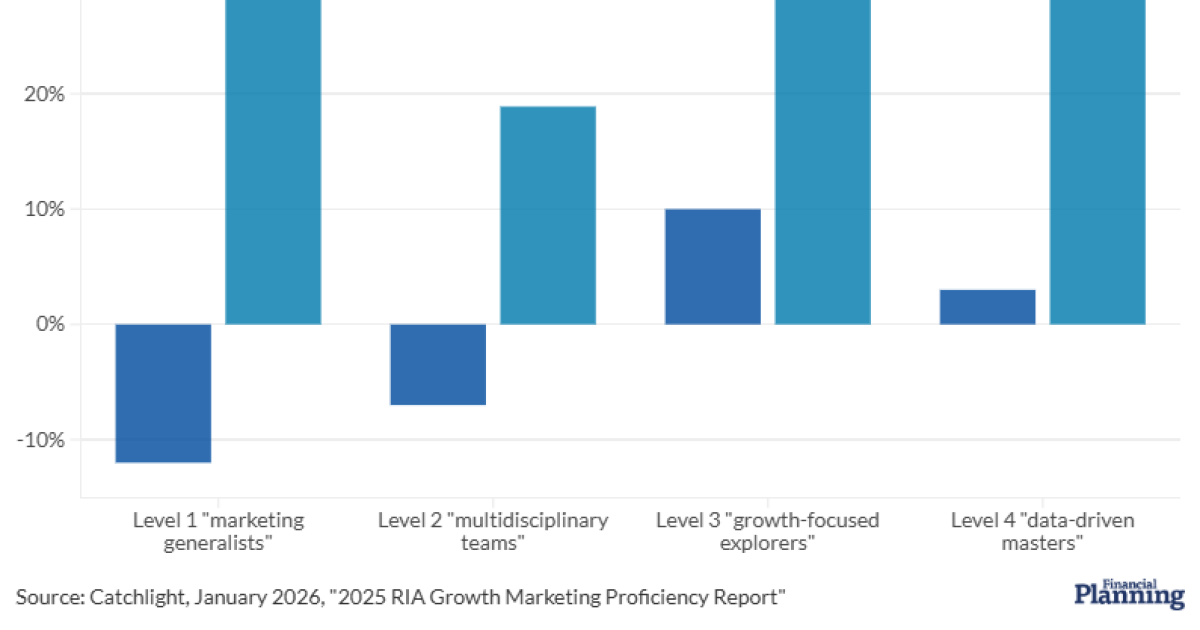
The study arrived at a clear dividing line for marketing efforts at the big RIAs. It sorted the firms into one of four levels of marketing investment that returned, on average, negative organic growth at the first two tiers and positive expansion at levels 3 and 4. Defining “organic growth” using the industry’s traditional definition of new assets under management minus the impact of M&A deals and investment appreciation, the study classified the RIAs as either “marketing generalists,” “multidisciplinary teams,” “growth-focused explorers” or “data-driven masters.”
“Some marketing departments were teams of one or two with no real budget to speak of,” the report’s author, marketing consultant Mary Kate Gulick, wrote. “Some teams had 30 people or more with multimillion-dollar budgets, including internal headcount, third-party agencies and partners and media spend. In between, we saw teams that were organized around disciplines and focused on executional excellence while still focused on brand building rather than AUM growth, and teams that were transitioning into accountability to driving revenue and getting their metrics frameworks in place. In the end, every team fit into one of four profiles which acts as a stage on an evolutionary continuum of organizational maturity.”
After subtracting M&A deals and the healthy stock returns for 2024 in the S&P 500, the RIAs with generalists or small teams composed of people filling several roles at once saw negative numbers for organic growth. Those in the latter two categories raked in positive organic expansion that year. Both qualitative and quantitative factors explained the differences.
“As RIAs cross from level 2 to level 3, a major shift takes place,” according to the study. “The view of what marketing is and what it can do for the firm transforms and leadership has come to see marketing as a growth function. Whatever caused that perspective change, there are some night-and-day differences between level 3 RIA marketing teams and those at levels 1 and 2. There’s real, intentional leadership, strategy and investment where there hasn’t been before. And with that comes a dramatic shift in marketing team priorities. At level 3, marketing teams have partial accountability for AUM growth.”
In some cases, investments by private equity firms or other external partners may act as the driving force behind that switch.
“Typically, a PE investor, even with a minority stake, has a strategic say in steering the company, and it makes sense that AUM, revenue and EBITDA growth would be the first focus,” the report said. “As professional growth consultants from the private equity world look under the hood at the RIA they just invested in, they’re often discovering (as this study has) that marketing is under leveraged for growth and being used only for aesthetic consistency and general brand awareness. In order to drive AUM growth, PE investors may be the driving force behind the sea change in Level 3 marketing teams — the significant investment, the push for growth accountability, the influx of more experienced team leadership and more expert marketers and outcomes-based strategy.”
Even after a private equity firm has provided ample financing for such growth, leaders must still teach their RIAs how to execute on the goal. To use an example cited in the report, a firm described as “Level 2 Wealth Management” set a goal of 8% organic growth for a given year on top of its existing base of $30 billion in client assets, which broke down into an additional 1,813 new customers. The firm allocated 2.4% of its $285 million in annual revenue — $6.84 million — toward that target. At an average account size of $1.125 million, fees of 0.95% and $10,688 in revenue per year, the marketing budget assigns a client acquisition cost of $3,773 per household. But that falls far below the actual cost of nearly $10,000 that the firm’s chief marketing officer has estimated in the past. So the firm will miss its goal of incoming customers by 62%. However, if the firm spends $18.13 million — in line with the actual cost and 2.65 times its allocated marketing budget — it will generate $1.2 million more revenue in one year than the cost and an additional $189.2 million in revenue over the clients’ lives.
The distinction between firms that are tapping into marketing for organic growth and those that haven’t done so yet often begins with the fact that the expanding firms are “really interested in CAC,” Gilmartin said, using the acronym for “client or customer acquisition cost.” Then they’re “going even further” by calculating the ratio between that cost and the clients’ lifetime value and assessing the performance of leads that come through the firm’s website, search traffic, seminars or other sources, he said.
“They’re dialed in on all those metrics throughout the lead and customer acquisition funnel,” Gilmartin said. “More proficient firms are looking at that channel by channel and really understanding those metrics.”
READ MORE: The RIA race to $1B — and whether it’s worth running
It takes a village (and capital)
Growing RIAs also spend 5% or more of their projected revenue on marketing, the report noted, recommending that firms staff up their teams, invest in technology tools, consider working with outside investors or experts and plan for their long-term enterprise value.
“What we call ‘marketing’ today has evolved dramatically from what it was 20, 10 or even five years ago,” the report said. “And the expectations attached to marketing leaders in wealth management — especially with the introduction of private equity investment and guidance into the space — have shifted even faster. Where a marketing leader’s job was once to generate brand awareness (a nebulous and largely unmeasurable goal that one could never really fail at), now many marketing teams are expected to generate brand awareness, leads, revenue and measure how it’s all being done.”
RIA owners and their teams should start by ensuring that they’re providing space and capital for the flexibility to test out the many tech tools and methods available to them, Gilmartin said.
“You don’t need to build a massive team in order to drive organic growth meaningfully to a firm,” he said. “That’s more the attribute that sets folks apart from those that aren’t doing it.”