No Result
View All Result
  • Login
Wednesday, August 5, 2026
theadvisertimes.com
  • Home
  • Business
  • Financial Planning
  • Personal Finance
  • Investing
  • Money
  • Economy
  • Markets
  • Stocks
  • Trading
  • Home
  • Business
  • Financial Planning
  • Personal Finance
  • Investing
  • Money
  • Economy
  • Markets
  • Stocks
  • Trading
No Result
View All Result
theadvisertimes.com
No Result
View All Result
Home Investing

Rethinking Exit Multiples in High-Growth Company Valuations

by theadvisertimes.com
5 months ago
in Investing
Reading Time: 5 mins read
A A
0
Rethinking Exit Multiples in High-Growth Company Valuations
Share on FacebookShare on TwitterShare on LInkedIn


What This Analysis Delivers

A framework for deriving exit multiples from long-run growth, return, and discount rate assumptions embedded in discounted cash flow (DCF) models.

Empirical evidence that expected growth explains much of the variation in observed multiples for high-growth firms.

Recognition that interest rate regimes materially influence valuation levels and should be reflected in exit assumptions.

In high-growth company valuations, terminal (exit) assumptions often account for a large share of enterprise value. When exit multiples are selected without explicit reference to growth, return, and rate expectations, the analysis can become internally inconsistent. The framework that follows draws on valuation theory and empirical evidence to show how exit multiples can be derived from and reconciled with underlying economic assumptions.

The Limits of the Five-Year Forecast

A standard income approach using a five-year explicit forecast plus a Gordon growth terminal value assumes the company reaches “stable growth” by year five. For many smaller, early-stage growth firms, that is unrealistic. The high-growth period may extend well beyond five years. One solution is to use two-stage or three-stage (or H-model) structures. However, in practice, many companies’ business plans stop at year five, and forecasting an additional five years is often too difficult.

Consequently, many valuers use a terminal (exit) multiple based on EBITDA or revenue. This approach is market-consistent but blends relative valuation with an income-based framework.

Yes, we know this is not ideal. Mixing approaches is theoretically flawed, but it remains common practice, especially in the private equity world.

The Value-Driver Identity as a Bridge

A useful bridge is the value-driver identity, which links terminal value to ROIC, growth, and the discount rate. In enterprise terms:

Divide by EBIT (or revenue) to get an implied EV/EBIT (or EV/Revenue) multiple that is consistent with the company’s long-run economics.

These are approximations, but they tie the exit multiple to the assumptions about long-run growth (g), WACC, ROIC, margins and taxes.

Valuers should then cross-check their exit multiple assumption against current medians, long-run sector bands, and transaction evidence. If comps diverge, valuers can explain why; differences in growth durability, capital intensity, or risk.

In reality, the selection of the multiple is based on the median or average of current valuations at the time of the analysis, or the average of the median over the last five to 10 years. But is this correct?

Well, as always—it depends. It could be. Data teaches us something important that we should incorporate into our thinking when selecting the exit multiple.

For exit EBITDA multiples, Michael Mauboussin found that expected EBITDA growth and the spread between ROIC and WACC have a significant impact on valuation for unprofitable companies. However, determining ROIC or exit EBITDA margin is difficult when companies are not yet profitable or in a stable phase.

For this reason, revenue growth and gross margin are often used instead.

What the Data Show

To further investigate this relationship, we examined listed operating firms across all industries in the US, Canada, and Europe, selecting only those with a 10-year CAGR above 30%, which we use as a proxy for growth-stage companies. The analysis covers the period between 2015 and 2024. For each year, we ran a regression with the LTM EV/Revenue multiple as the dependent variable and the 1-year expected revenue growth rate as the independent variable (adding ROIC or gross profit margin as a second independent variable in the regressions did not prove to be statistically significant, as expected, given that those companies are not yet in the stable stage).

We observed two key insights:

Expected one-year growth explains around 55% of the variation in valuation multiples.

The intercept of each year’s regression is negatively correlated with the corresponding risk-free rate. This is intuitive, as high-growth companies’ cash flows (i.e. value) are concentrated in the future, making their valuations more sensitive to the risk-free rate.

Authors’ analysis

The second point highlights another important consideration when selecting an exit multiple: it is maybe necessary to form a view on the level of the risk-free rate at the time of exit. The prevailing interest rate environment will influence whether the assumed multiple is realistic and can be supported.

Conclusion

Based on both data and experience, investors, analysts, and valuation specialists should avoid simply applying a median multiple in the exit terminal year. Instead, they should consider expected growth beyond the terminal year and form a view on the likely level of the risk-free rate. Everyone would love to return to the low rates of 2020–2021 with sky-high valuations, but that’s unlikely. Using the average of the last five or 10 years may incorporate valuations that are too high for today’s environment.

Three Practitioner Takeaways

Exit multiples are not plug numbers. They reflect assumptions about long-run growth, returns on capital, and the cost of capital embedded in the DCF.

Growth expectations largely determine valuation differences. In high-growth companies, higher expected revenue growth supports higher observed multiples.

Interest rates matter. The level of the risk-free rate materially influences valuation levels and should be considered when selecting an exit multiple.




Source link

Tags: CompanyexitHighGrowthmultiplesRethinkingvaluations
ShareTweetShare
Previous Post

The Comprehensive Guide to Ecosystem Growth in 2026

Next Post

10 Trips for Disney Adults That Aren’t Disney

Related Posts

Central Bank Gold Buying Accelerated Again in June

Central Bank Gold Buying Accelerated Again in June

by theadvisertimes.com
August 5, 2026
0

by Mike MaharreyGold buying accelerated again in June as central banks took advantage of the softer price environment to add...

Idiots get too close to Bison, child could have been killed — Here’s the video.

Idiots get too close to Bison, child could have been killed — Here’s the video.

by theadvisertimes.com
August 4, 2026
0

Skip to contentInvestment Watch Blog Menu Menu HomeAboutSubscribeMonthly Subscription6-Month SubscriptionYearly SubscriptionMember’s AreaMember HubLoginAccountPrivacy PolicyDisclaimerAugust 4, 2026, 10:08 pm by Alex...

Conversations with Frank Fabozzi, Featuring Kari Vatanen

Conversations with Frank Fabozzi, Featuring Kari Vatanen

by theadvisertimes.com
August 4, 2026
0

Key discussion pointsBeyond the traditional 60/40 portfolio: Why investors are rethinking the role of bonds, diversification, and portfolio objectives.Total portfolio...

Iran Gets Another “Last Chance” – How Many Are We Up To Now?

Iran Gets Another “Last Chance” – How Many Are We Up To Now?

by theadvisertimes.com
August 3, 2026
0

by MichaelWhen will the charade finally end? Over the past several months, Iran has been given opportunity after opportunity to...

Biggerpockets Pro Members Can Now Turn Home Equity Into a Flexible Line of Credit With Aven

Biggerpockets Pro Members Can Now Turn Home Equity Into a Flexible Line of Credit With Aven

by theadvisertimes.com
August 3, 2026
0

In This Article Home equity is one of the biggest, most underused assets most investors have. It’s sitting there, tied...

Deal Diary: How a Math Teacher Bought 19 Doors

Deal Diary: How a Math Teacher Bought 19 Doors

by theadvisertimes.com
August 3, 2026
0

In This Article Name Christle Stezskal Location Northwest suburbs of Chicago, Illinois (investing in Kansas City, MO, and Rock County,...

Next Post
10 Trips for Disney Adults That Aren’t Disney

10 Trips for Disney Adults That Aren’t Disney

How to claim the Canada Caregiver Amount due to infirmity

How to claim the Canada Caregiver Amount due to infirmity

  • Trending
  • Comments
  • Latest
SEC pushes private market access, but retail is already in

SEC pushes private market access, but retail is already in

July 16, 2026
How I Maximize My Sapphire Reserve Dining Credit

How I Maximize My Sapphire Reserve Dining Credit

July 10, 2026
The Weekly Notable Startup Funding Report: 6/22/26 – AlleyWatch

The Weekly Notable Startup Funding Report: 6/22/26 – AlleyWatch

June 21, 2026
The 10 Largest NYC Tech Startup Funding Rounds of June 2026 – AlleyWatch

The 10 Largest NYC Tech Startup Funding Rounds of June 2026 – AlleyWatch

July 6, 2026
The Weekly Notable Startup Funding Report: 7/20/26 – AlleyWatch

The Weekly Notable Startup Funding Report: 7/20/26 – AlleyWatch

July 20, 2026
*HOT* Ninja Nutri-Blender Pro with 2 Single-Serve Cups only .99 shipped (Reg. 0!)

*HOT* Ninja Nutri-Blender Pro with 2 Single-Serve Cups only $49.99 shipped (Reg. $110!)

July 4, 2026
Court halts Knesset Finance C’ttee transfers

Court halts Knesset Finance C’ttee transfers

0
Why Isn’t AI Replacing More Workers?

Why Isn’t AI Replacing More Workers?

0
The Property Rights Duality and the Defense of Freedom

The Property Rights Duality and the Defense of Freedom

0
AI Agents Can’t Read Your Pricing. That’s Becoming A Revenue Problem.

AI Agents Can’t Read Your Pricing. That’s Becoming A Revenue Problem.

0
Oracle vs Amazon: Wall Street Strategist Picks the AI Trade’s Winner and Loser

Oracle vs Amazon: Wall Street Strategist Picks the AI Trade’s Winner and Loser

0
Solana Holds Near  As ETF Flows And Ecosystem Pilots Stay In Focus

Solana Holds Near $73 As ETF Flows And Ecosystem Pilots Stay In Focus

0
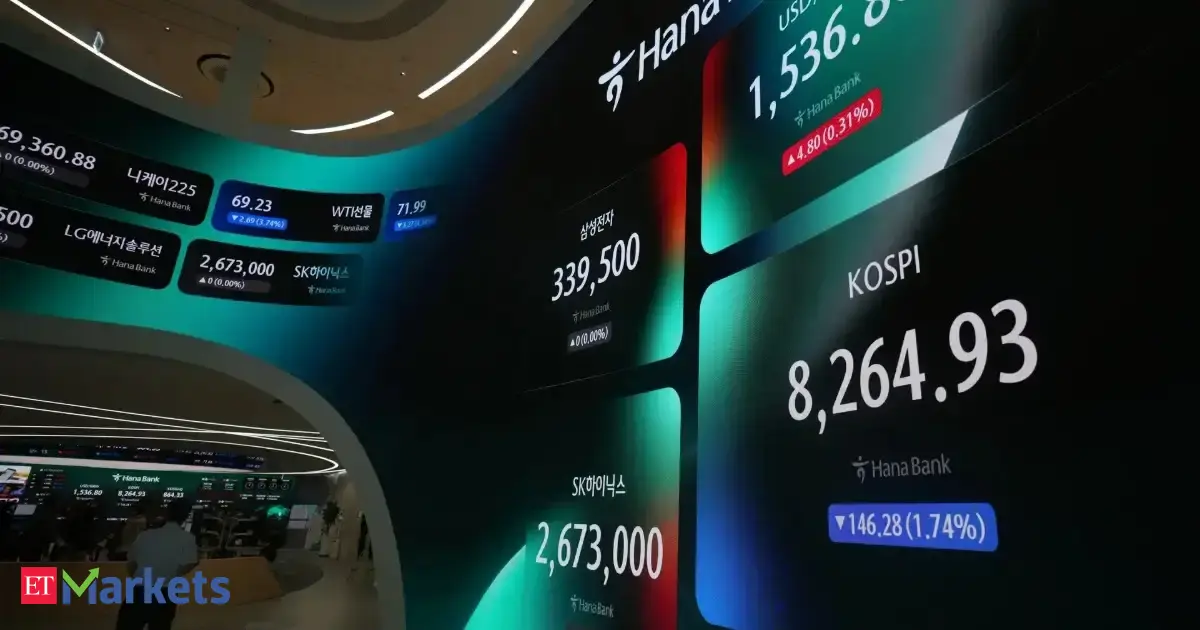
Global Market Today: Asian stocks drop as AI rally pauses, oil dips

Global Market Today: Asian stocks drop as AI rally pauses, oil dips

August 5, 2026
Global Food Prices Will Soar And Acute Hunger Will Spike Thanks To A Shocking Confluence Of Disastrous Events

Global Food Prices Will Soar And Acute Hunger Will Spike Thanks To A Shocking Confluence Of Disastrous Events

August 5, 2026
AI Agents Can’t Read Your Pricing. That’s Becoming A Revenue Problem.

AI Agents Can’t Read Your Pricing. That’s Becoming A Revenue Problem.

August 5, 2026
SpaceX created a new class of ultrawealthy. Here’s what comes next

SpaceX created a new class of ultrawealthy. Here’s what comes next

August 5, 2026
WTW, SEI partner on private market offerings

WTW, SEI partner on private market offerings

August 5, 2026
Highlights of McKesson’s (MCK) Q1 2027 earnings report

Highlights of McKesson’s (MCK) Q1 2027 earnings report

August 5, 2026
theadvisertimes.com

Get the latest news and follow the coverage of Business & Financial News, Stock Market Updates, Analysis, and more from the trusted sources.

CATEGORIES

  • Business
  • Cryptocurrency
  • Economy
  • Financial Planning
  • Investing
  • Market Analysis
  • Markets
  • Money
  • Personal Finance
  • Startups
  • Stock Market
  • Trading

LATEST UPDATES

  • Global Market Today: Asian stocks drop as AI rally pauses, oil dips
  • Global Food Prices Will Soar And Acute Hunger Will Spike Thanks To A Shocking Confluence Of Disastrous Events
  • AI Agents Can’t Read Your Pricing. That’s Becoming A Revenue Problem.
  • Our Great Privacy Policy
  • Terms of Use, Legal Notices & Disclosures
  • About Us
  • Contact Us

© Copyright 2024 All Rights Reserved
See articles for original source and related links to external sites.

Welcome Back!

Login to your account below

Forgotten Password?

Retrieve your password

Please enter your username or email address to reset your password.

Log In
No Result
View All Result
  • Home
  • Business
  • Financial Planning
  • Personal Finance
  • Investing
  • Money
  • Economy
  • Markets
  • Stocks
  • Trading

© Copyright 2024 All Rights Reserved
See articles for original source and related links to external sites.