No Result
View All Result
  • Login
Wednesday, June 3, 2026
theadvisertimes.com
  • Home
  • Business
  • Financial Planning
  • Personal Finance
  • Investing
  • Money
  • Economy
  • Markets
  • Stocks
  • Trading
  • Home
  • Business
  • Financial Planning
  • Personal Finance
  • Investing
  • Money
  • Economy
  • Markets
  • Stocks
  • Trading
No Result
View All Result
theadvisertimes.com
No Result
View All Result
Home Financial Planning

Long-term care costs outpacing retirement income: AARP

by theadvisertimes.com
3 months ago
in Financial Planning
Reading Time: 4 mins read
A A
0
Long-term care costs outpacing retirement income: AARP
Share on FacebookShare on TwitterShare on LInkedIn


The gap between retirement income and long-term care costs is widening rapidly. New research shows that what was once a difficult but manageable challenge through the 2010s has shifted in recent years, leaving financial advisors grappling with a growing affordability problem that is changing how they approach planning.

Processing Content

For advisors, the shift isn’t theoretical. It’s showing up in client portfolios, family decisions and increasingly difficult trade-offs around care, location and legacy goals.

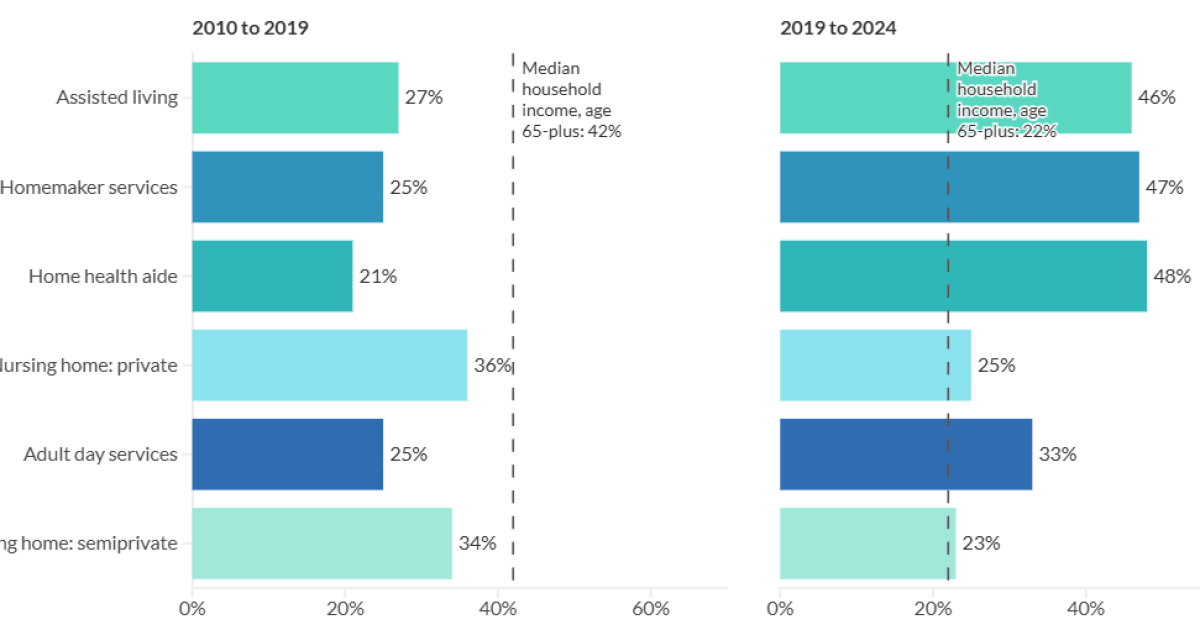
For much of the 2010s, income growth among older households often outpaced increases in long-term services and supports (LTSS) costs such as private nursing homes and adult day services. That trend has now reversed, according to new research from the AARP Public Policy Institute.

Between 2019 and 2024, the cost of the most commonly used services, particularly home care and assisted living, surged by nearly 50%, far exceeding the roughly 22% increase in median income for households age 65 and older.

The result is a clear and growing gap. In 2024, the median older household income of about $60,000 could barely cover a year of part-time home care and fell well short of assisted living or nursing home costs, which can exceed $70,000 and $100,000 annually, respectively.

For advisors, that means older assumptions about “manageable” care costs may no longer hold.

READ MORE: Private markets in 401(k)s face major liquidity challenges: Morningstar

Modeling for long-term care inflation

Part of the challenge is structural. As advisors model retirement outcomes, long-term care sits in a category of expenses that consistently outpaces general inflation and income growth.

Zachary Bachner, a financial advisor at Summit Financial Consulting in Sterling Heights, Michigan, builds that reality directly into planning assumptions.

“Along with college costs and other medical costs, we use a higher-than-average inflation rate for our long-term care forecasts,” said Bachner. “We typically use 2.5% for general inflation and use 5% for college and medical inflation.”

At the same time, Bachner said he tends to assume a more modest 3% income growth rate.

“This means that income should outpace standard inflation, but it would lag the college and medical inflation inputs,” he said. “This 2% lag is how LTC costs could outpace the average household income over time, especially when forecasting out until a client is age 90-plus. And with these assumptions, the gap will only widen over time.”

READ MORE: Policy changes scare clients — but they won’t tell advisors

Middle-income clients feel it most

While affluent clients may have more tools to absorb rising costs, the pressure is most acute among middle- and lower-income retirees.

Joon Um, a tax advisor and CFP at Secure Tax & Accounting in Beverly Hills, California, said the trend is becoming increasingly visible in client conversations.

“For clients with fewer assets, it really comes down to planning early and being realistic,” he said. “We talk about what care might cost locally, building some savings for it and having honest conversations with family.”

That emphasis on early planning is becoming more common across advisory firms, even for younger clients who are decades away from retirement.

“Rising long-term care inflation requires a comprehensive, early and family-centered approach that blends proactive planning with creative, multigenerational solutions,” said Mark Cannon, president of Dallas-based private wealth advisory firm Luminate. “We begin planning conversations earlier than most expect: often when clients are in their mid-30s.”

Starting early, Cannon said, gives advisors time to walk clients through both the statistical likelihood of needing care and the financial consequences of being unprepared.

READ MORE: The Medicare tax trap costing clients thousands

Working with an imperfect set of options

As the income-cost gap widens, advisors are increasingly forced to pull from a limited and often imperfect set of strategies to try to plan around long-term care needs.

Savings and self-insurance remain the first line of defense, but the data underscores how fragile that approach can be. Median financial assets for households age 75 and older sit around $50,000, enough to cover roughly a year of home care, or far less in institutional settings.

Insurance solutions are another lever, though not always an easy sell.

Bachner said that he rarely recommends traditional long-term care insurance due to client resistance to “use it or lose it” structures. Instead, he looks to hybrid approaches.

“We typically look at either a life insurance policy or an annuity with an LTC rider,” he said. “The life insurance would pay out a death benefit, and the annuity would provide an account value death benefit, so these funds are not lost if the LTC benefit is not utilized.”

In some circumstances, advisors like Cannon also extend LTC planning to the client’s children as a way to tackle costly premiums that can extend beyond the client alone.

“We frequently involve adult children and encourage them to contribute to premiums when appropriate, especially since many hybrid LTC solutions offer substantial return of premium features,” he said. “We also explore alternative strategies, such as life insurance on parents to reimburse children for future caregiving costs or to create a guaranteed estate value if LTC needs never arise.”

Relocation is another consideration for clients struggling to cover LTC-related costs, which can vary dramatically by state. In the highest-cost areas, LTC expenses are at least double those in the lowest-cost regions, according to AARP’s research.

“We discuss relocation as a legitimate cost management strategy when appropriate, particularly when moving brings clients closer to family or to lower cost care markets,” Cannon said.

But in cases where a client would be moving away from family, Bachner said relocation may not make sense.

AARP research shows that unpaid family caregivers remain the backbone of the long-term care system, contributing hundreds of billions of dollars in economic value annually. Advisors say that has a major impact on planning.

“We typically do not recommend relocation as this could cause the client to move away from loved ones who could provide in-home care for them,” he said. “Having family around is one great way to delay the more expensive LTC costs.”



Source link

Tags: AARPCareCostsIncomeLongTermOutpacingretirement
ShareTweetShare
Previous Post

Weekend Reading For Financial Planners (March 21–22)

Next Post

NVIDIA (NVDA) eyes China AI chip re-entry as export licensing shifts to case-by-case review

Related Posts

CFPs, asset managers spar over DOL’s 401(k) rule

CFPs, asset managers spar over DOL’s 401(k) rule

by theadvisertimes.com
June 3, 2026
0

CFPs have come out swinging against a rule that would allow alternative assets in 401(k)s, according to comments submitted to...

Why Every Indian Business Needs a UPI Payment Gateway in 2026

Why Every Indian Business Needs a UPI Payment Gateway in 2026

by theadvisertimes.com
June 3, 2026
0

Based on info given by the National Payments Corp of India (NPCI), the Unified Payments Interface (UPI) saw big growth...

SPLC controversy underscores key limitation of donor-advised funds

SPLC controversy underscores key limitation of donor-advised funds

by theadvisertimes.com
June 2, 2026
0

Financial advisors now have an important example to point to when explaining a key limitation of donor-advised funds: Sponsors retain...

RIAs, IBDs gobbling up advisors face a new challenge

RIAs, IBDs gobbling up advisors face a new challenge

by theadvisertimes.com
June 2, 2026
0

Independent brokerages and registered investment advisory firms are winning the financial advisor recruiting race, but they can't afford to get...

The 4 AI tools I use in my practice — and 3 questions to avoid ‘AI ick’

The 4 AI tools I use in my practice — and 3 questions to avoid ‘AI ick’

by theadvisertimes.com
June 2, 2026
0

A few weeks ago, I walked into a client meeting with an entrepreneur who was in the process of selling...

Just 5% of U.S. family offices say next generation is prepared: UBS

Just 5% of U.S. family offices say next generation is prepared: UBS

by theadvisertimes.com
June 1, 2026
0

Many family offices, like their broader wealth management counterparts, aren't prioritizing the preparation of the next generation of decision-makers for...

Next Post
NVIDIA (NVDA) eyes China AI chip re-entry as export licensing shifts to case-by-case review

NVIDIA (NVDA) eyes China AI chip re-entry as export licensing shifts to case-by-case review

Kalshi Defies U.S. Legal Tussle and Nevada Temporary Ban as Valuation Doubles to B

Kalshi Defies U.S. Legal Tussle and Nevada Temporary Ban as Valuation Doubles to $22B

  • Trending
  • Comments
  • Latest
FIS, InvestCloud aim to help advisors connect with younger clients

FIS, InvestCloud aim to help advisors connect with younger clients

May 20, 2026
15 “Weird” Ways to Save Money

15 “Weird” Ways to Save Money

May 2, 2026
Teacher Appreciation Week 2026 Deals Include Freebies, Discounts

Teacher Appreciation Week 2026 Deals Include Freebies, Discounts

May 4, 2026
6 Hotels Where Chase’s Points Boost Yields 2.5x

6 Hotels Where Chase’s Points Boost Yields 2.5x

May 22, 2026
Buy a 0K/Year Income Stream? This Is How to Do It

Buy a $500K/Year Income Stream? This Is How to Do It

May 22, 2026
Anthropic’s confidential S-1 signals summer AI IPO race could heat up fast

Anthropic’s confidential S-1 signals summer AI IPO race could heat up fast

June 2, 2026
8 Free (or Cheap) Doughnut Deals for June 5

8 Free (or Cheap) Doughnut Deals for June 5

0
Warsh’s Concerning Interest in Redefining “Inflation”

Warsh’s Concerning Interest in Redefining “Inflation”

0
69-year-old furniture store chain files for Chapter 11 bankruptcy

69-year-old furniture store chain files for Chapter 11 bankruptcy

0
3 Altcoins to Watch as June Begins With Weak Risk Appetite

3 Altcoins to Watch as June Begins With Weak Risk Appetite

0
CFPs, asset managers spar over DOL’s 401(k) rule

CFPs, asset managers spar over DOL’s 401(k) rule

0
10 Top Entry-Level, Remote Careers for New Grads (and Companies Hiring)

10 Top Entry-Level, Remote Careers for New Grads (and Companies Hiring)

0
8 Free (or Cheap) Doughnut Deals for June 5

8 Free (or Cheap) Doughnut Deals for June 5

June 3, 2026
CFPs, asset managers spar over DOL’s 401(k) rule

CFPs, asset managers spar over DOL’s 401(k) rule

June 3, 2026
New SNAP Work Rules Are in Effect. What You Should Know

New SNAP Work Rules Are in Effect. What You Should Know

June 3, 2026
OMV: Ösi-Ölmulti mit Breakout-Setup am Allzeithoch!

OMV: Ösi-Ölmulti mit Breakout-Setup am Allzeithoch!

June 3, 2026
Crypto PAC-Supported Candidates Sweep US State Primaries after Media Buys

Crypto PAC-Supported Candidates Sweep US State Primaries after Media Buys

June 3, 2026
Norms issued to estimate District Domestic Product

Norms issued to estimate District Domestic Product

June 3, 2026
theadvisertimes.com

Get the latest news and follow the coverage of Business & Financial News, Stock Market Updates, Analysis, and more from the trusted sources.

CATEGORIES

  • Business
  • Cryptocurrency
  • Economy
  • Financial Planning
  • Investing
  • Market Analysis
  • Markets
  • Money
  • Personal Finance
  • Startups
  • Stock Market
  • Trading

LATEST UPDATES

  • 8 Free (or Cheap) Doughnut Deals for June 5
  • CFPs, asset managers spar over DOL’s 401(k) rule
  • New SNAP Work Rules Are in Effect. What You Should Know
  • Our Great Privacy Policy
  • Terms of Use, Legal Notices & Disclosures
  • About Us
  • Contact Us

© Copyright 2024 All Rights Reserved
See articles for original source and related links to external sites.

Welcome Back!

Login to your account below

Forgotten Password?

Retrieve your password

Please enter your username or email address to reset your password.

Log In
No Result
View All Result
  • Home
  • Business
  • Financial Planning
  • Personal Finance
  • Investing
  • Money
  • Economy
  • Markets
  • Stocks
  • Trading

© Copyright 2024 All Rights Reserved
See articles for original source and related links to external sites.