No Result
View All Result
  • Login
Tuesday, June 23, 2026
theadvisertimes.com
  • Home
  • Business
  • Financial Planning
  • Personal Finance
  • Investing
  • Money
  • Economy
  • Markets
  • Stocks
  • Trading
  • Home
  • Business
  • Financial Planning
  • Personal Finance
  • Investing
  • Money
  • Economy
  • Markets
  • Stocks
  • Trading
No Result
View All Result
theadvisertimes.com
No Result
View All Result
Home Startups

Why Your AI Works One Day and Fails the Next

by theadvisertimes.com
2 months ago
in Startups
Reading Time: 4 mins read
A A
0
Why Your AI Works One Day and Fails the Next
Share on FacebookShare on TwitterShare on LInkedIn


If you’ve spent any time building with AI, you’ve likely experienced this.

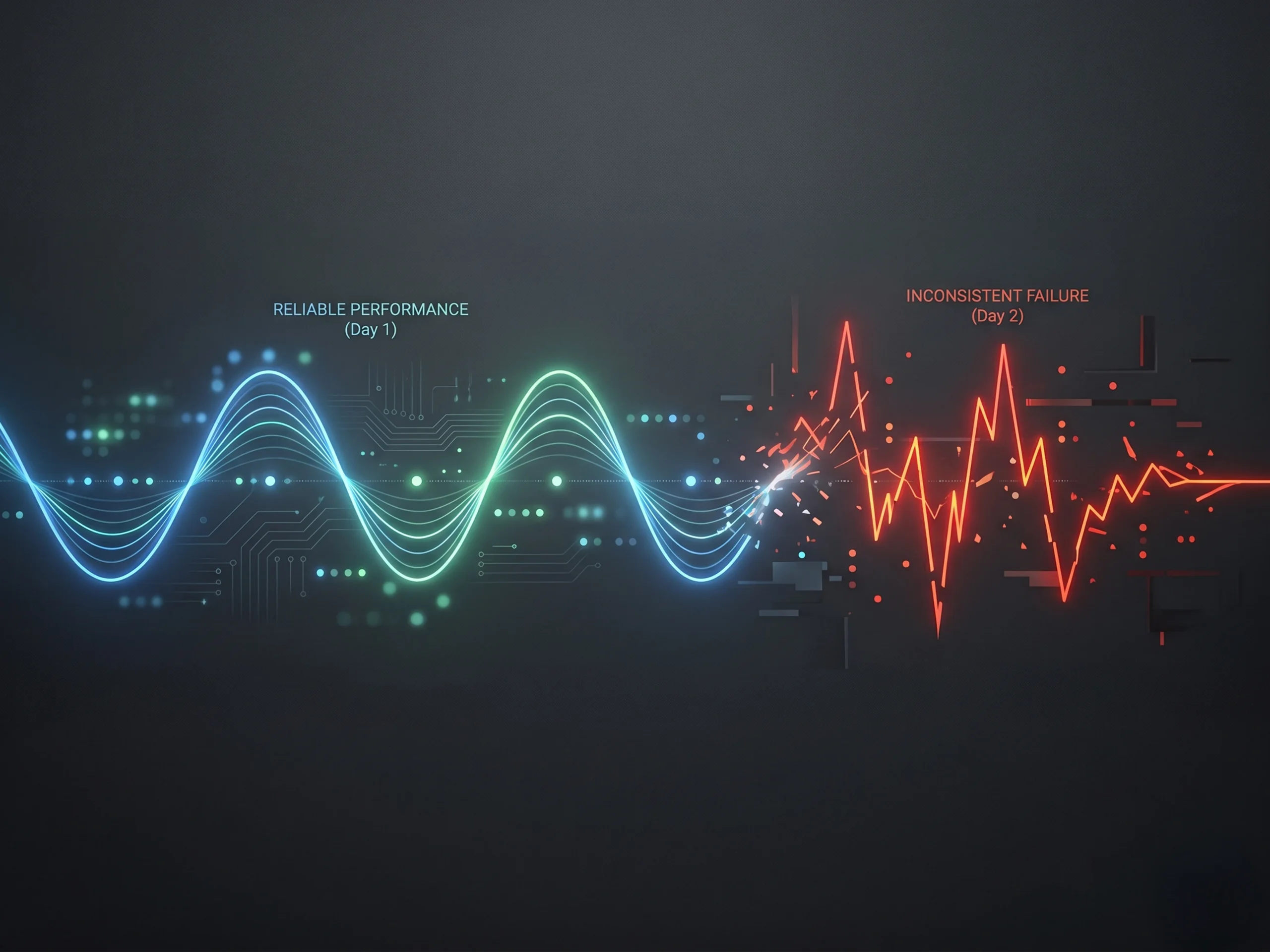
One day, the system feels incredible. It answers questions well, generates useful outputs, and starts to feel like something you could actually rely on. The next day, with a slightly different input, it misses the point entirely. It hallucinates. Or it gives you something so generic that it is unusable.

Same model. Same tools. Completely different outcome.

That inconsistency is what frustrates teams the most. It is also what prevents many growth-stage companies from moving AI from experimentation into real production workflows.

At a recent AIConf in Ahmedabad, Ravi Bhatia, Senior Software Engineering Manager at Loopio, framed the issue clearly. The problem is not the model. It is how you are feeding it context.

The Hidden Variable Most Teams Ignore

When teams think about improving AI performance, they usually focus on the obvious levers like better models, better prompts, or more features. But as Ravi Bhatia emphasized in his talk, the real driver of performance is much simpler and much more overlooked.

It is what information is actually being passed into the system, and how it is structured.

As he put it, output quality is directly tied to context. Garbage in, garbage out.

That has deep implications. Every response is shaped not just by the question being asked, but by everything surrounding it. Conversation history, retrieved data, tool outputs, memory, and system instructions all compete for attention inside a limited window. When that system is not designed well, performance becomes unpredictable.

Why Performance Degrades as You Scale

Ravi Bhatia spent time outlining why systems that work early often break as they scale.

Most AI systems perform well at the beginning because they are simple. Limited inputs, narrow use cases, and clean prompts create clarity. But as companies grow their usage, complexity increases. More tools are connected, more data is pulled in, and more interactions are layered into the system.

At that point, teams typically fall into one of two traps.

Some overload the system. Every message, every tool response, and every piece of data gets appended into the context. Costs increase, latency slows, and accuracy drops as the model struggles to focus.

Others provide too little context. The system lacks the information it needs, which leads to hallucinations, irrelevant answers, and wasted time. Bhatia called out both of these failure modes explicitly, noting that they cost teams not just money, but trust.

For growth-stage companies, this is often the moment where confidence in AI starts to erode.

More Data Is Not the Answer

One of the most important insights from Bhatia’s session is that more information does not lead to better results.

In fact, as context grows, models become less effective at reasoning over it. Important details get buried, earlier information is forgotten, and outputs degrade. He described this as context rot, where the system technically has the right information but cannot reliably surface it.

The principle that follows is simple but powerful. Fewer tokens, higher signal.

This is where discipline shows up for growth-stage teams. It means selecting relevant tools instead of exposing every possible capability. It means referencing documents instead of loading entire files. It means deciding what belongs in short-term context versus long-term memory.

Bhatia used a helpful analogy that resonates with technical teams. Context is your RAM. You would not load your entire hard drive into memory, and the same principle applies here.

AI Is Now an Infrastructure Problem

Another key point Bhatia made is that context is not just a quality issue. It is an infrastructure issue.

Every token has a cost, and as context windows grow, systems become more expensive and slower. He highlighted that as context increases, computational complexity scales in ways that directly impact latency and cost.

This is where techniques like prompt caching become critical. If your system structure is consistent, you can reuse large portions of context at a fraction of the cost. If it is not, you lose that efficiency entirely.

For growth-stage startups, this matters more than it might seem. It impacts margins, pricing models, and the ability to scale AI features sustainably.

Where the Best Teams Focus

Ravi Bhatia also made it clear where teams should focus if they want to improve performance quickly.

Retrieval.

Getting the right information at the right time has an outsized impact on system performance. Most teams underestimate how nuanced this is. Keyword search alone is not enough. Semantic understanding is required to match intent, and the best systems combine both approaches.

He also highlighted structural challenges like the “lost in the middle” problem, where models pay more attention to information at the beginning and end of the context window than the middle.

For growth-stage companies, improving retrieval is often the highest ROI investment they can make in AI performance.

Why This Becomes a Leadership Issue

As systems scale, Bhatia emphasized that this stops being just a technical problem and becomes a leadership one.

How disciplined is the team in how they build? Are they measuring performance or relying on intuition? Do they have a clear definition of what “good” looks like?

He cautioned against rushing from demo to production without proper evaluation. Instead, he recommended building “golden sets” of test cases that reflect real-world scenarios and using them to continuously measure performance.

This is what separates teams that experiment from teams that scale.

The Bottom Line

The reason AI feels inconsistent is not because it is unpredictable.

It is because most systems feeding it are.

Ravi Bhatia’s core message was clear. If you want AI to work consistently, you have to be intentional about context. What goes in, what stays out, and how information flows through the system all matter.

For growth-stage companies, this is one of the most important shifts to internalize. The teams that treat context as a first-class problem will build systems that are faster, more accurate, and more cost-effective.

Because in the end, AI is not just about what the model can do.

It is about what you enable it to do.

To stay up-to-date on all upcoming York IE events, follow us on LinkedIn.



Source link

Tags: dayfailsWorks
ShareTweetShare
Previous Post

Was it a secret Chinese spy headquarters or a ping-pong parlor? New York Chinatown case goes to trial

Next Post

Oil Price Today (May 7): Crude oil reclaims $100, snaps two-day losing streak. Here’s why

Related Posts

We give people a few days and expect them back as themselves, when the science of loss says grief takes no days off at all, and the shame around admitting that is its own quiet cruelty

We give people a few days and expect them back as themselves, when the science of loss says grief takes no days off at all, and the shame around admitting that is its own quiet cruelty

by theadvisertimes.com
June 22, 2026
0

The average bereavement policy in Europe gives employees somewhere between three and five days for the death of an immediate...

Psychology suggests that people who fear AI are often not only afraid of the technology itself — they’re afraid of what it threatens to erase: the status, competence, identity, and sense of usefulness they spent years building.

Psychology suggests that people who fear AI are often not only afraid of the technology itself — they’re afraid of what it threatens to erase: the status, competence, identity, and sense of usefulness they spent years building.

by theadvisertimes.com
June 22, 2026
0

In late 2024, the Pew Research Center surveyed more than 5,000 employed Americans and found that 52 per cent were...

The Weekly Notable Startup Funding Report: 6/22/26 – AlleyWatch

The Weekly Notable Startup Funding Report: 6/22/26 – AlleyWatch

by theadvisertimes.com
June 21, 2026
0

The Weekly Notable Startup Funding Report takes us on a trip across various ecosystems in the US, highlighting some of...

McKinsey’s 2025 global AI survey: 88% of organizations now use AI in at least one function, up from 78% — but most are still stuck in pilot mode, and only a minority can point to any real impact on profit

McKinsey’s 2025 global AI survey: 88% of organizations now use AI in at least one function, up from 78% — but most are still stuck in pilot mode, and only a minority can point to any real impact on profit

by theadvisertimes.com
June 21, 2026
0

Two numbers from McKinsey’s 2025 survey sit awkwardly next to each other. The first is 88 percent, the share of...

The oldest known written customer complaint is a 3,750-year-old clay tablet from ancient Ur, where a furious customer named Nanni accused the merchant Ea-nasir of delivering sub-standard copper — proof that bad reviews are almost as old as writing itself

The oldest known written customer complaint is a 3,750-year-old clay tablet from ancient Ur, where a furious customer named Nanni accused the merchant Ea-nasir of delivering sub-standard copper — proof that bad reviews are almost as old as writing itself

by theadvisertimes.com
June 20, 2026
0

In the British Museum’s Mesopotamian collection sits a palm-sized rectangle of baked clay, catalogued as UET V 81. It is...

I asked ChatGPT why reaching every goal still leaves me flat. The answer wasn’t the one I was expecting.

I asked ChatGPT why reaching every goal still leaves me flat. The answer wasn’t the one I was expecting.

by theadvisertimes.com
June 20, 2026
0

I typed it out plainly: “Based on everything you know about me, why does reaching my goals still leave me...

Next Post
Oil Price Today (May 7): Crude oil reclaims 0, snaps two-day losing streak. Here’s why

Oil Price Today (May 7): Crude oil reclaims $100, snaps two-day losing streak. Here’s why

Horizon Organic Chocolate Milk Boxes Recalled Due to Packaging Issue

Horizon Organic Chocolate Milk Boxes Recalled Due to Packaging Issue

  • Trending
  • Comments
  • Latest
Should You Offer a Concession to Get Your Apartment Leased Faster?

Should You Offer a Concession to Get Your Apartment Leased Faster?

June 15, 2026
6 Hotels Where Chase’s Points Boost Yields 2.5x

6 Hotels Where Chase’s Points Boost Yields 2.5x

May 22, 2026
Understanding risk remains a major investor blind spot: TIAA Institute

Understanding risk remains a major investor blind spot: TIAA Institute

June 5, 2026
Anthropic’s confidential S-1 signals summer AI IPO race could heat up fast

Anthropic’s confidential S-1 signals summer AI IPO race could heat up fast

June 2, 2026
Memorial Day 2026: Take Advantage of Food Freebies, Deals

Memorial Day 2026: Take Advantage of Food Freebies, Deals

May 23, 2026
9 Best Cheap Cell Phone Plans That Will Save You Money

9 Best Cheap Cell Phone Plans That Will Save You Money

June 3, 2026
8 Places to Sell Printables Online for Cash

8 Places to Sell Printables Online for Cash

0
Vedanta Power, Oil & Gas, and Iron shares rally up to 5%; Aluminium sheds 3%. Should you buy, sell or hold?

Vedanta Power, Oil & Gas, and Iron shares rally up to 5%; Aluminium sheds 3%. Should you buy, sell or hold?

0
The Board-Lot Reckoning: Access, Liquidity, and Governance

The Board-Lot Reckoning: Access, Liquidity, and Governance

0
EU Committee Advances Digital Euro CBDC Bill After Vote

EU Committee Advances Digital Euro CBDC Bill After Vote

0
Cisco Systems (CSCO): Neues Fundament nach Kurssprung!

Cisco Systems (CSCO): Neues Fundament nach Kurssprung!

0
Roku (ROKU) Has a CTV Operating-System and Ad Platform Bigger Than a Hardware Narrative

Roku (ROKU) Has a CTV Operating-System and Ad Platform Bigger Than a Hardware Narrative

0
EU Committee Advances Digital Euro CBDC Bill After Vote

EU Committee Advances Digital Euro CBDC Bill After Vote

June 23, 2026
Roku (ROKU) Has a CTV Operating-System and Ad Platform Bigger Than a Hardware Narrative

Roku (ROKU) Has a CTV Operating-System and Ad Platform Bigger Than a Hardware Narrative

June 23, 2026
Cisco Systems (CSCO): Neues Fundament nach Kurssprung!

Cisco Systems (CSCO): Neues Fundament nach Kurssprung!

June 23, 2026
Gen Z: if you want to succeed at work, you need to start friction-maxxing

Gen Z: if you want to succeed at work, you need to start friction-maxxing

June 23, 2026
266. “I carry the household, the bills, and the stress”

266. “I carry the household, the bills, and the stress”

June 23, 2026
Lies, Damn Lies, and the History of Capitalism

Lies, Damn Lies, and the History of Capitalism

June 23, 2026
theadvisertimes.com

Get the latest news and follow the coverage of Business & Financial News, Stock Market Updates, Analysis, and more from the trusted sources.

CATEGORIES

  • Business
  • Cryptocurrency
  • Economy
  • Financial Planning
  • Investing
  • Market Analysis
  • Markets
  • Money
  • Personal Finance
  • Startups
  • Stock Market
  • Trading

LATEST UPDATES

  • EU Committee Advances Digital Euro CBDC Bill After Vote
  • Roku (ROKU) Has a CTV Operating-System and Ad Platform Bigger Than a Hardware Narrative
  • Cisco Systems (CSCO): Neues Fundament nach Kurssprung!
  • Our Great Privacy Policy
  • Terms of Use, Legal Notices & Disclosures
  • About Us
  • Contact Us

© Copyright 2024 All Rights Reserved
See articles for original source and related links to external sites.

Welcome Back!

Login to your account below

Forgotten Password?

Retrieve your password

Please enter your username or email address to reset your password.

Log In
No Result
View All Result
  • Home
  • Business
  • Financial Planning
  • Personal Finance
  • Investing
  • Money
  • Economy
  • Markets
  • Stocks
  • Trading

© Copyright 2024 All Rights Reserved
See articles for original source and related links to external sites.