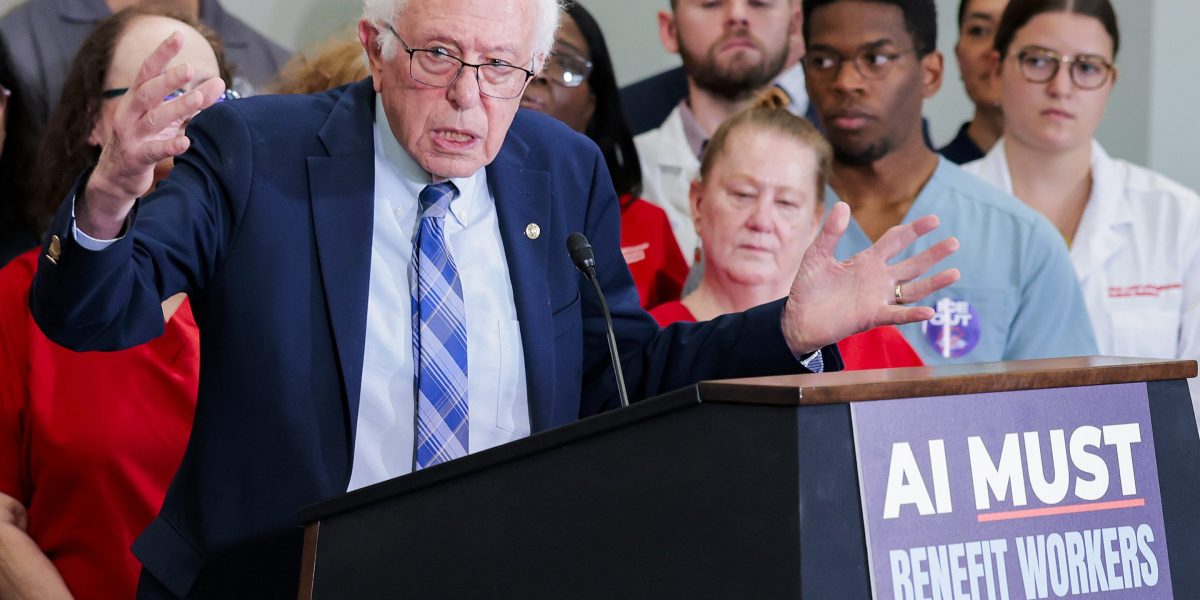
Senator Bernie Sanders wants every American to own a piece of OpenAI, Anthropic, and xAI. Late on Monday, he posted a video describing his vision: the American AI Sovereign Wealth Fund Act, which would impose a one-time 50% tax on each company’s stock, paid in shares, depositing the equity into a public fund that gives ordinary Americans voting rights, board representation, and eventually, a check in the mail.
The federal government would also have the power, through those voting shares and equal board seats, to block decisions deemed harmful and push for policies that benefit the public—something one of Anthropic’s cofounders even argued for during Pope Leo XIV’s presentation of his first papal encyclical.
While it may seem typical coming from the senator who has long pushed spoke of AI taking jobs from American and pushed for redistribution through a tax on billionaires, he’s not alone in calling for supervision on the AI industry.
Typical bedfellows from the left include Sen. Elizabeth Warren and climate activist Erin Brockovich, whose work led to the restitution of millions of dollars to victims of environmental hazards and was famously portrayed by Julia Roberts. Most surprisingly, however, is that even the Trump administration seems to agree.
Taking ownership of a private company was once unthinkable for a right-wing government, but the Trump administration has been aggressive in doing so. While this is a contested figure, the Cato Institute estimates that the White House already has ownership stakes in 20 private companies, in the form of equity stakes, warrants, and golden shares. These range from mineral companies like MP Materials, Trilogy Metals and Lithium Americas, to semiconductor firms like Intel and xLight, to quantum powers IBM and GlobalFoundries. So while the independent senator from Vermont is advocating for redistribution of government ownership in private companies, the Trump administration has already completed the first part—save for giving the wealth back to the people.
But this isn’t socialism or fascism. A look back at the history of capitalism — and one of the first AI experts to make this comparison — shows that we have very probably been here before with the invention of electricity.
The warning from history
When Coursera cofounder and Google Brain lead Andrew Ng told a Stanford audience in 2017 that AI would transform the world the way electricity did a century ago—touching every industry, reshaping every economy, becoming as fundamental as the grid itself—Silicon Valley embraced the comparison as prophecy. Less welcome for the current hyperscalers, of course, is the idea of being turned into a utility, rather than a purely for-profit company.
In the 1930s, as Ng argued nearly a decade ago, only about 10% of rural Americans had electricity, while cities enjoyed near-universal access, largely because private utility companies refused to serve communities that weren’t profitable enough. When the federal government stepped in through the Tennessee Valley Authority, the power companies called it unconstitutional, filed lawsuit after lawsuit, and installed “spite lines,” or power lines run purely to block cooperatives from forming because they didn’t want anyone else to have them.
When the Norris Dam was built in East Tennessee, more than 15,000 people were displaced from 125,000 acres condemned by eminent domain. Those who owned property received some compensation while sharecroppers and tenant farmers received nothing.
Like the electrification of the grid, fears of how the public’s consent is exercised when infrastructure or technology is put into place are just as prominent in the age of AI, and has a historical backing to leave people feeling weary. Think of the telegraph, which arrived in the 1840s and policymakers debated public ownership from its earliest days (in fact, the Labor Reform Party’s 1872 platform demanded the government prevent telegraph corporations from exacting rates that bore unduly on producers and consumers). Soon after came the telephone, which was eventually nationalized during World War I, when President Wilson put telephone and telegraph lines under the U.S. Post Office from June 1918 to July 1919, all before it was returned to private hands and rebuilt as a monopoly. It was regulated for fifty years, and finally broken apart in 1984.
Every transformative communications technology in American history has cycled through the same arc: private consolidation at a public cost, and a political reckoning at a delayed intervention.
A cohesive force
Sanders, who himself has a long history of calling for the redistribution of wealth from the haves to the have nots, is far from alone in making this argument. There are several distinct and ideologically unrelated forces that have converged on the same underlying concern, all of ensuring there is some supervision of how this industry continues scaling.
Sanders, in an op-ed in the New York Times, said it only makes sense to redistribute the proceeds of AI to the people, simply because it was created using the content of the people. “A.I. is built on our collective intelligence: our books, songs, artwork, journalism, computer code, scientific research, videos, conversations, images and ideas spanning generations,” he wrote. “For the most part, tech oligarchs have fed this knowledge into their A.I. models without permission, without acknowledgment, without compensation. In other words, the creative work of millions of people—writers, artists, musicians, journalists, teachers, scientists and ordinary citizens—has essentially been stolen by some of the wealthiest people in the world. It’s time for us to reclaim it.”
Senator Elizabeth Warren also published her own AI tax proposal in Time just days before Sanders’ piece appeared, similarly calling for a tax on AI to help those who were and potentially may be displaced by it. “Taxing AI is one way we make sure the winnings from AI benefit all Americans, rather than channeling them only to the wealthy few,” she wrote.
Erin Brockovich, the climate activist who won over $333 million for victims of PG&E’s groundwater contamination, and whose effort was later turned into a movie staring Julia Roberts. This time around, the activist secured nearly 4,000 complaints from residents across nearly all 50 states about data center developments in their communities. The grievances span noise, water consumption, and utility bills, which a Carnegie Mellon study estimates data centers could raise average U.S. electricity bills by 8% by 2030.
And again, similar to how the grid was electrified, the concerns come with the consent of the public. One of the complaints reported to Brockovich include a neighbor in Holly Ridge, LA who said she and her neighbors were uninformed of Meta’s planned $27 billion Hyperion data center set to consume 4,000 acres nearby. “Nobody told us anything,” she said.
Critics like the Cato Institute make legitimate objections. Norway and Alaska built their funds from resources the government already owned, not from a forced equity transfer from private companies. When the government becomes a major shareholder, regulatory neutrality collapses: referees with a financial stake in the outcome are no longer only calling the game.
This is nothing new for the rest of the world. The EU has been building public AI investment frameworks for years. The UK’s National Wealth Fund has explicitly targeted AI infrastructure as a strategic asset. Singapore’s sovereign wealth funds have been quietly accumulating positions in AI-adjacent companies since 2023.
Dozens of sovereign wealth funds already exist around the world to ensure ordinary people benefit from national wealth. Norway’s fund, seeded from oil revenues, is now worth more than $2 trillion. Alaska has paid annual dividends directly to residents from its oil-backed fund for fifty years. Researchers have proposed sovereign wealth funds as a foundational policy instrument for navigating the economic and strategic challenges posed by transformative AI, drawing on analogies from resource governance and historical state-led development.
Tech layoffs in 2026 have already surpassed 142,000, with companies like Meta, Atlassian, and Cloudflare explicitly citing AI investment as the reason for workforce reductions. Software developer employment for workers aged 22 to 25 has fallen roughly 20% from its 2024 peak. Though Sanders said he recognizes the complications of government holding a major stake in companies for which AI is only part of their business, he argues that when a public resource generates wealth, the public should share in that wealth. AI is built on a public resource far more valuable than oil.
So will the Trump White House follow through on the logic of its move into the private sector, and agree with Bernie Sanders?