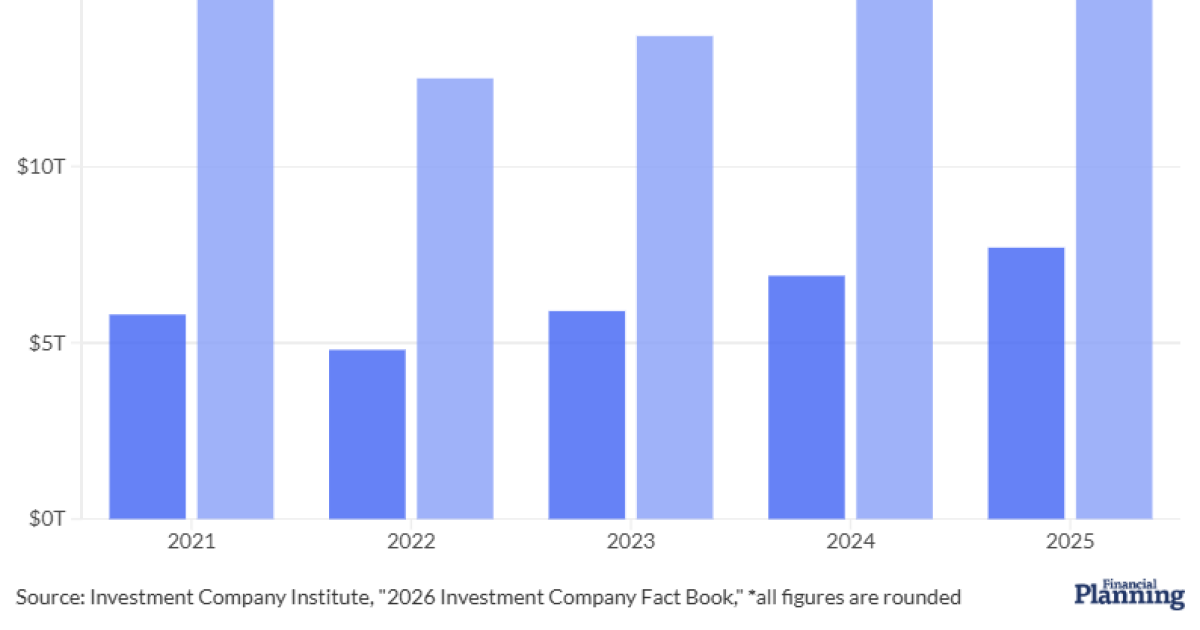
Financial advisors and other investors have, by and large, been choosing passive funds over active management for decades, thanks to their lower cost and the difficulty of beating an index.
Processing Content
But a new working academic paper suggests one frequently cited comparison may overstate how often active managers fail to beat their passive peers.
The Active Managers Council of the Investment Adviser Association, an advocacy group for fund companies that manage vehicles of both types, commissioned and released the study examining the S&P Dow Jones Indices’ S&P Indices Versus Active (SPIVA) scorecard last month. (The authors plan to pursue publication in a peer-reviewed journal.) The results are a signal to advisors and their clients to “look at the scorecards critically” when deciding between active and passive funds, Karen Barr, the CEO of the association, said in an interview.
“Active and passive both have an important place in investors’ portfolios, and it’s important to look at the actual investors’ experiences when analyzing what is best for your clients,” she said, stating that the IAA supported the research without pushing for specific findings.
READ MORE: The 4 AI tools I use in my practice — and 3 questions to avoid ‘AI ick’
Weighing one calculation against another
That SPIVA scorecard is a metric stemming from a formula that “makes several choices that systematically understate the performance of active funds,” the study said.
The numbers suggesting that active returns do not surpass their benchmarks fall drastically “after adjusting those choices to better reflect the actual investor experience,” wrote Timothy Riley of the University of Arkansas, K.J. Martijn Cremers of the University of Notre Dame and Jon Fulkerson of the University of Dayton.
The authors concluded that SPIVA’s estimates had overstated the underperformance of actively managed funds. Using data from 2024, they weighted the calculations by fund assets, comparing active vehicles to their passive equivalents (rather than “hypothetical benchmarks”) and pulling in the performance of liquidated funds prior to their exit (instead of counting them as failing to outperform). Under that rubric, 55% of active U.S. equity funds underperformed passive stock vehicles in the past 20 years, compared to the finding of 92% by the SPIVA scorecard. And they found a more pronounced disparity in bond funds, with 37% coming in below a passive peer during the last decade. The SPIVA scorecard had put the share at 71%.
“Broadly speaking, the SPIVA U.S. scorecard is too negative on the value of active management,” Riley said in a statement. “Staying with the scorecard’s framework, we identify substantially more value after modifying key empirical choices to better align with the actual mutual fund investor experience.”
Representatives for S&P pushed back on the study’s findings. In a statement, a spokesperson said that the metric is “underpinned by a rigorous methodology” that is available on the company’s website.
“For decades, SPIVA has served as a trusted voice in the active versus passive investment debate, delivering transparent and objective data on the performance of actively managed funds relative to their respective benchmarks, along with a range of deeper statistics and analysis,” the statement said. “It is important to note that SPIVA measures the proportion of funds that underperform, rather than the proportion of assets. This approach provides a clear view of fund manager performance independent of fund size. The fundamental claim of active management is the ability to ‘beat the market’ — not to outperform a basket of index funds. SPIVA aligns with a long-standing tradition of evaluating this specific claim by comparing active funds to broad, capitalization-weighted, investable market benchmarks.”
READ MORE: Getting serious with clients about long-term care insurance
Not the only scorecard on the street
To be sure, investors have largely picked passive funds, which research firm Morningstar said first topped active vehicles in assets two years ago. Morningstar’s “Active/Passive Barometer” reported that only 38% of active mutual funds and ETFs beat their passive peers in 2025 returns, with a smaller portion (21%) surpassing passive vehicles over the last decade.
“Recent data show that passive strategies continue to dominate investor demand, capturing the majority of new inflows across key asset classes, particularly in U.S. equity funds,” Morningstar reported in April. “Active investing strategies often come with higher expenses for manager skills, involvement, and specialized analyst teams. Over the past decade, inflows in the United States have tilted toward passive funds with consistent outflows from actively managed strategies and strong inflows into passive vehicles reflecting demand for cost-efficient, broad market exposure.”
Even though such findings have become accepted conventional wisdom throughout the industry, active managers continue to win awards from Morningstar and work closely with many large wealth management firms in collaborations that span decades. At the individual advisory practice level, many planners continue to use some form of active management.
For example, Michael Hollis, the founder of Aurora, Illinois-based registered investment advisory firm TapestryFP, defined his philosophy as “more of a rules-based type of investing, but I see the value in passive investing.” After talking with clients about their goals and time horizons, he walks them through metrics examining criteria such as the profitability, value and quality of the securities, rather than recommending strictly passive funds. While awaiting regulatory approval for the formal launch of his firm, he had some time to look deeply into the topic.
“I’m really spending my time reevaluating my position on this,” Hollis said. “It’s almost like a middle ground between active and passive.”
READ MORE: How to use equity compensation to boost RIA valuation and more
Reframing the question
The authors of the new study admit that investors have been voting in droves with their wallets for passive vehicles, to the tune of $4.7 trillion in outflows from active mutual funds in the last two decades. Yet they argue that the narrative around passive vehicles’ apparent overwhelming victory may be missing some nuances.
“Our reframed question — what percentage of active fund assets underperform equivalent passive funds? — is more relevant for investors seeking to understand the historical performance record,” they write. “Addressing survivorship, focusing on assets and comparing against passive funds show that the scorecard understates the value of active management.”
Members of the Investment Adviser Association created the council of active managers within the organization about seven years ago as a way “to do research and make sure people have accurate information about active and passive management,” Barr said. “What you’re looking for is value for money, and you can get value for money out of both passive and active.”