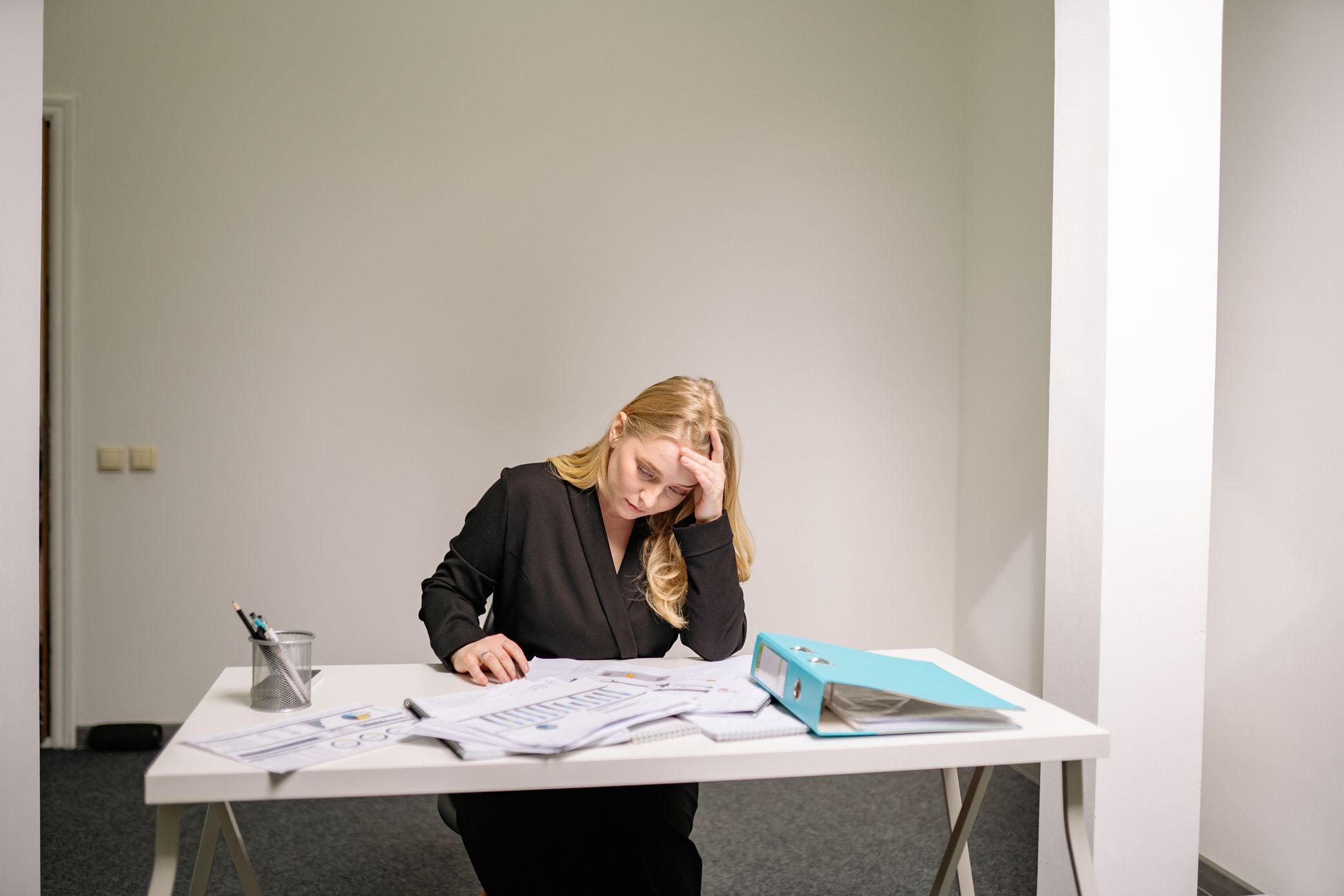
Open someone’s laptop on a Tuesday evening and you can sometimes catch the ritual. A tab for Notion, a tab for Todoist, the calendar app pinned. They are not doing work, exactly. They are tidying. A task gets dragged from one project database to another. A tag gets renamed. A recurring event gets nudged from 9:15 to 9:30 because the previous block ran long and the system, somehow, needs to reflect that. There is a small exhalation when everything lines up. Then they close the laptop and look slightly more tired than they did before they opened it.
Watch this often enough and a question starts to form. The person at the laptop is competent. They are good at their job. The system they are tending is genuinely impressive, the kind of setup that gets screenshotted and posted to productivity forums. So why does maintaining it look less like sharpening a tool and more like soothing something?
The elaborate productivity stack is usually mistaken for competence. A Notion second brain with nested databases and bidirectional links, a Todoist setup that follows Getting Things Done to the letter with contexts and weekly reviews, a calendar blocked to the quarter hour with travel buffers and focus blocks colour-coded by energy level: most people look at that and see someone who has figured out modern work. The honest version is harder. Many of the people running these systems are not only optimising for output. They are also trying to protect themselves from an older, quieter fear: that forgetting anything, ever, would mean something was wrong with them.
The conventional story about productivity tools is that they exist because work has become impossibly complex, and we need scaffolding to keep up. That story is partly true. Knowledge work really has multiplied, more channels, more stakeholders, more half-finished threads. But it does not explain why two people with the same job can have wildly different relationships to their tools. One uses a paper list, forgets things, and shrugs. The other has built a personal information architecture that would not embarrass a mid-sized consultancy, and still wakes up at 3am worried about whether a tag got applied to the right project.
The bill that arrives as a database
The second brain, in its purest form, is a beautiful idea. Tiago Forte’s framing, capture, organise, distill, express, gave language to something a lot of people were already doing in scattered notebooks. The premise is that human memory is unreliable and external systems can free the mind for higher-order thinking. In theory, this is liberation. In practice, for a particular kind of person, it becomes the opposite.
Watch what happens when their system goes down. Notion has an outage. Todoist fails to sync. The calendar app loses a week of events. The reaction is not simple annoyance. It is a sharper kind of distress, out of proportion to the practical inconvenience. That intensity is the tell. The tool has stopped being just a tool. It has become the place where the person stores proof that nothing has been missed.
Cognitive offloading is a real and useful phenomenon. Writing things down genuinely does free working memory. The trouble is that there is a difference between offloading to think more clearly and offloading because the alternative, trusting your own mind to hold what matters, feels unsafe. A republished Conversation article on cognitive offloading makes a useful distinction between relying on external supports and handing over so much thinking that the underlying capacity gets less practice. The relief of capturing everything is real. So is the risk that the mind learns to stop holding anything on its own.
What forgetting used to cost
The interesting question is why some people experience that offloading as freeing and others experience it as frightening. The answer often lives in earlier environments where forgetting was not treated as a neutral event. In some families, forgetting your homework meant a parent’s disappointment that lasted three days. In others, forgetting a younger sibling’s medication or a bill that needed paying produced consequences a child had to absorb. In immigrant households running on thin margins, forgetting which form needed to be at school by Friday could mean a real problem nobody had the bandwidth to fix gracefully. A child in that environment learns something specific. They learn that their mind is the load-bearing wall of a household that cannot afford slippage. Forgetting is not a small human lapse. It becomes a sign of carelessness, evidence that you cannot be trusted with the things that matter. The lesson lodges below the surface, and decades later the person may not remember being told this. They just feel a particular kind of dread when something slips, and a particular kind of calm when every input is captured.
The second brain is, in this light, a coping mechanism wearing professional clothes.
The GTD inbox, the quarter-hour calendar, these become external proofs that nothing has been dropped. They function the way a clean kitchen functions for someone who grew up in chaos: not merely as preference, but as evidence that things are under control. The tools are not the problem. The relationship to the tools is.
Productivity as perfectionism in costume
This is where the conversation about productivity systems intersects with older writing on perfectionism. Work on perfectionism has long distinguished between high standards that help a person do good work and the more punishing version, where any mistake feels like evidence against the self. The second variety does not reliably lead to better outcomes. It leads to exhaustion, avoidance, and a strange kind of paralysis where you cannot start a task until the system around it is perfect.
Listen to how power users of productivity tools talk about their setups. There is often a recurring note of dissatisfaction, a sense that the system is almost right but not yet. They migrate from Notion to Obsidian to Roam to Logseq. They redesign their tagging taxonomy. They rebuild the weekly review template for the fourth time. The work is real, but it is not productive work. It is the work of trying to build a container watertight enough that nothing could ever leak out. The container does not exist. The leak is not in the system.
Something similar shows up in the way these systems get described to other people. There is pride in the architecture, yes, but also a defensiveness, as though the person is anticipating being judged for needing it. They will tell you it saves them hours. They will rarely tell you it costs them hours to maintain. The honest accounting almost never gets done because the honest accounting is not the point. The point is the feeling of being held.

The mind that stops practicing
There is a second cost, harder to see. When you externalise everything, the mind that used to do that work quietly gets less practice. The capacity to hold a thought across three days without writing it down. The trust that important ideas will resurface when they need to. The looseness of attention that lets something incubate. These are not productivity features. They are how thinking actually happens, much of the time. Capture every fleeting thought and you train yourself to believe no thought can be trusted to return on its own.
People who study cognitive offloading have noted that the more we hand to external systems, the less practiced we become at the underlying skill. This is unremarkable as a general principle: muscles weaken when they are not used, languages fade when they are not spoken. But it has a specific consequence for memory. The mind that has learned to trust an external second brain may stop doing the small consolidation work that makes a thought into an idea. Everything stays at the level of captured fragment. Nothing has to mature.
There is also a cost to attention. A calendar blocked to the quarter hour is not, mechanically, more accurate than a calendar blocked in two-hour windows. The granularity is mostly theatre. What it does is keep the mind in a state of constant checking: what is next, what is now, what got bumped. That has its own price. People who run these calendars often describe feeling perpetually behind even when they are technically on schedule. The schedule is so tight that any drift feels like failure. The system manufactures the feeling it was supposed to prevent.
What the person is actually asking for
None of this is an argument against tools. Notion is a beautiful piece of software. GTD is a coherent framework. Time blocking, in moderation, helps a lot of people. The argument is that for a meaningful subset of users, the tools are not answering the question they think they are answering. They are answering a question about steadiness, not productivity, and they answer it imperfectly because no external system can permanently quiet the fear that one missed thing will make everything fall apart.
The signs that this is what is happening are recognisable. Spending more time maintaining the system than using it. Feeling disproportionate distress when a task slips through the cracks. Being unable to relax on a Sunday until inbox zero has been achieved across three platforms. Treating the absence of a structured plan for an evening as something that needs solving. Silicon Canals has explored a related version of this elsewhere, the way an empty afternoon can feel like an accusation rather than a gift. The mechanism is similar. Structure becomes protection from a feeling the person does not yet have words for.
The deeper work, if someone wants to do it, is not to throw out the tools. People who burn down their second brain in a fit of minimalism often rebuild it within six months because the underlying relationship to forgetting has not changed. The work is slower and less dramatic. It might involve leaving a few low-stakes things uncaptured on purpose and noticing what happens. It might involve allowing an evening to remain unplanned. It might involve discovering that a forgotten article idea, a postponed email, or a messy Sunday does not have to become evidence of failure.
The cultural rhetoric around productivity has, on balance, made this harder rather than easier. A generation ago, a person who could not relax until every input was logged would have been quietly noted as high-strung, and somebody might have suggested they ease up. Today they get a podcast recommendation and a Notion template. The behaviour gets reframed as discipline, as a system, as an enviable kind of rigour. That reframe is not a neutral piece of language. It is a way of dressing up anxious cognition so that it looks like a virtue, which means the older question underneath, who taught you that your mind, on its own, was not enough, never has to be asked.
So the honest verdict is less generous than the usual one. For most people who have built one of these elaborate stacks, the system is not paying for itself. The hours spent maintaining it, the low hum of vigilance it requires, the slow erosion of the mind’s own consolidation work, these are real costs, and they do not get logged in any database. The output that justifies them is mostly imagined. What the system produces, reliably, is the feeling of having a system. That feeling is worth something, but it is not worth what people are paying for it.
The bill arrives later, usually as exhaustion, sometimes as the strange grief of realising you have spent fifteen years making sure nothing slipped, and you still cannot remember what any of it was for.