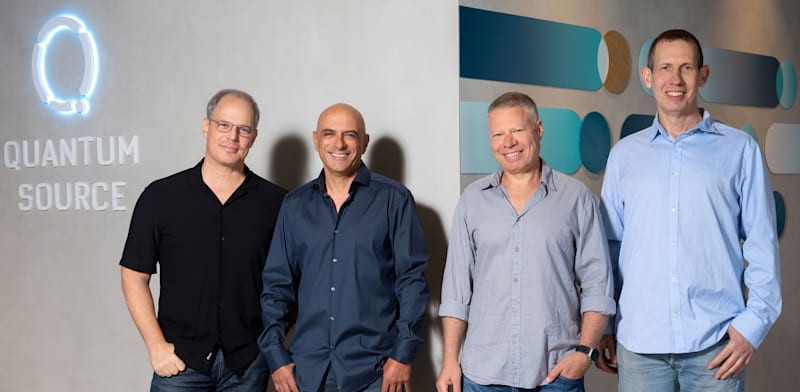
Quantum Source, which is developing a quantum computer based on the combination of photons and cold atoms, and which was founded by a team of Weizmann Institute alumni and serial chip entrepreneurs, has been voted by “Globes” readers as their favorite startup, as part of the Globes Most Promising Startup Rankings for 2026.
In second place was Hoopo, which has developed a system for managing the logistics supply chain at sea by identifying industrial equipment without the use of GPS. In third place: was fintech company April, which has developed AI-based systems for filing annual tax returns in the US.
Some 3,500 “Globes” website readers voted over the past week in the poll, which included 30 growth startups. Other startups in the poll included: AirEV, the electric flying vehicle (eVTOL) manufacturer from Pardes Hanna; Kela, the cybercrime threat intelligence company; Wonderful, the AI agent company; Jerusalem-based Factify, which seeks to replace PDF documents.; and Quantum Art, which has developed an end-to-end quantum computer based on trapped ions, and which also uses atoms.
The readers’ choice is made alongside the ranking of “Globes” 10 most promising startups for 2026, which will be published for the 20th time next Wednesday, June 17, at the Globes TECH IL conference. The conference, which will host senior figures such as Ami Luttwak, one of the founders of Wiz, Shlomo Kramer, Liad Agmon, Michal Braverman-Blumenstyk, Hamutal Meridor, Eyal Freund and Hila Zigman, will focus on the red-hot trends in the tech industry, foreign exchange challenges, the major exits in cybersecurity, and the boom in defense tech.
Breakthrough solution
Based in Ness Ziona, Quantum Source was founded by Prof. Barak Dayan, a renowned physicist from the Weizmann Institute. He operated one of the two quantum photonics laboratories at the Weizmann Institute after returning from postgraduate studies at Caltech, where he worked with one of the most outstanding scientists in the field. Dayan sought to develop a quantum computer – a computer that harnesses special physical properties of light particles for quantum computing, and which could be faster than the most powerful supercomputers currently available, based on quantum mechanics. But he felt thwarted by one of the worst properties of photons: the rays do not communicate with each other, so it is very difficult to build a computer from them.
The solution he found was the ability to harness atoms to link photons in order to create the “logic gates”, the way in which light rays are arranged to create various computational operations. He founded Quantum Source after serving as an expert on a task for the Pitango Foundation: examining its investment in another quantum photon company: Australia’s PsiQuantum, a company that was famous for giant quantum photon computers the size of a football field. “I told our friends at PsiQuantum about the idea of harnessing light rays to each other using an atom – their scientists admitted to me that no one had this technology before us,” Dayan tells “Globes.”
RELATED ARTICLES
Photonic quantum computer co Quantum Source raises $50m
Globes readers choose Atlas Invest as favorite 2025 startup
The company was founded by Dayan together with three prominent computing entrepreneurs in Israel: CEO Oded Melamed, who founded and sold Altair Semiconductor to Sony about a decade ago for $212 million (Sony recently decided to sell Altair’s operations); VP of R&D Gil Semo, a former member of the management of Anobit, Apple’s first acquisition in Israel and former VP hardware; and Chairman Dan Charash, former CEO of chip company Provident, which was sold to Broadcom last decade. The group was joined in May 2023 by former Prime Minister Naftali Bennett, who sits on the board. Bennett was formerly CEO of fintech company Cyota, which was sold to RSA, and was an investor in software company Soluto, which was acquired by Asurion.
Particles that can be in two places at once
Quantum computers already exist today, but they cannot be used significantly on a large scale, certainly not to replace Nvidia’s efficient supercomputers. The difficulty lies in the challenge that these computers are designed to solve: exploiting the non-trivial property of microscopic particles such as ions, atomic particles, or photons that create light waves for particularly powerful computing. According to quantum theory, which was formulated a century ago, very small particles such as light waves or ions can be in two places at the same time.
Intuitively this is a property that is difficult to understand since it is not a characteristic of large objects, but at levels below the molecule. It is scientifically proven and already today companies that develop quantum computers testify to its existence. Imagine a coin that is spinning rapidly – if you stop it, it will only show one side – a tree or a leaf – but while it is spinning, it shows both sides at the same time.
Particles that can be in several places at once could revolutionize the way computers have worked since the 20th. Century. Instead of processing information based on a variable electrical voltage that distinguishes between zero and one, the entire range of possibilities between zero and one could be obtained by exploiting the ability of an ion or photon to simultaneously behave as a zero and a one, or at the same time any number on the continuum between zero and one. One such particle that represents several numbers at once is called a “qubit”, the smallest processing unit in a quantum computer, equivalent to a “bit” in a traditional computer.
Because a qubit represents several numbers at once, it is capable of performing a much larger number of calculations than a regular bit, and instead of doing this serially – one after the other – as a regular computer does, a quantum computer would be able to process all this data in parallel, simultaneously. This is why the development of a new drug molecule will be shortened from a process of years to minutes – through a virtual experiment conducted inside the computer, all the possibilities for the feasibility of the molecule and the reactions it will create simultaneously with other molecules will be calculated.
Unlike the traditional computer built on electronic circuits integrated with semiconductors, quantum computing is in its infancy, with several technologies competing from different directions in the race to reach the “quantum advantage” – the moment when a quantum computer will be more powerful than Nvidia’s most powerful supercomputer. While the most mature technologies on the market today come from superconductors – this is how IBM and Google’s quantum chips are built – or from trapped ions (the Quantum and IonQ computers), photonic quantum computing remains in the shadows, with one dominant company: PsiQuantum. Only at the end of last year, PsiQuantum raised $1 billion, at a valuation of $7 billion, to build two photonic supercomputers the size of a manufacturing plant each – one in Australia and the other near Chicago.
A “hybrid” quantum computer the size of a server
Prof. Dayan, together with his friend of Melamed, following the Australian company’s feedback, decided to embark on a long journey of feasibility testing. “We set out on a three-year journey of calculations – we didn’t run straight to investors,” recalls Dayan.
Quantum Source believes it will be able to create a functioning quantum computer with millions of “qubits” and a scale no larger than an average Nvidia or AMD server rack, and that it will be possible to place it in data centers in the future. This is in contrast to the maximalist approach of PsiQuantum, which claims that the only way to do this is using computers the size of a stadium. The big challenge that quantum photonics companies encounter concerns how they harness the light rays to each other to produce a logic gate, that is, the basic data that the light rays will represent in the quantum calculation later on – whether the rays represent 0 or 1, or 0.5 for that matter.
While PsiQuantum passes the photons through meters-long tubes to increase the chance of creating an interaction between them, in the Israeli company the coupling of the two photons is accelerated by confining frozen atoms in special vacuum tubes, which in turn bind two photons on a standard photonic chip commonly used in industry. Prof. Dayan calls his quantum computer a “hybrid” one, which combines the advantages of photons and atoms.
“The efficiency of creating a photon is low and its binding together with other photons is extremely low, because of this, PsiQuantum reaches an efficiency of one in a million. To accelerate and optimize this process we use atoms but you don’t need more than a few hundred of them to bind an infinite number of photons to create millions of qubits, and from there the way to creating a powerful computer is open.”
The optical fiber, says Dayan, is a cheap and common means, and can be used to translate many elements from the traditional computing world to quantum computing. Winding a fiber and “trapping” photons in it to delay them from reaching the processing chip and can actually create a memory element, similar to a traditional computer, and by creating loops and windings to build a powerful computer architecture that can more easily accommodate millions of qubits using the same coupling and memory elements.
Unlike other quantum companies, Quantum Source has not yet launched a quantum processor. Dayan believes that even those that have launched quantum processors have not been able to demonstrate sufficient computing capacity on a large number of qubits.
When will quantum computing reach a level that allows it to overtake today’s standard supercomputers in computing power? According to experts, this point in time, known as the “quantum advantage,” will arrive by the end of the decade, but Dayan takes a more pessimistic view. “Nobody is five or six years away from achieving this advantage. The question is when will the first player reach computing based on millions of qubits. I think in the next eight years we will be there. And while other companies will get there before us with factory-sized computers, we will be able to do it shortly after with server-sized computers.”
Quantum Source, founded in 2021, has raised only $77 million to date from investors such as Chemi Peres’ Pitango First, Dov Moran’s Grove Ventures, Lior Susan’s Eclipse, and Michael Dell’s DTC. Other investors include 10D Funds, Standard Investments, Canon Equity and Level VC. The company employs nearly 70 people in Ness Ziona, 30 of whom have PhDs as well as five professors.
Published by Globes, Israel business news – en.globes.co.il – on June 10, 2026.
© Copyright of Globes Publisher Itonut (1983) Ltd., 2026.