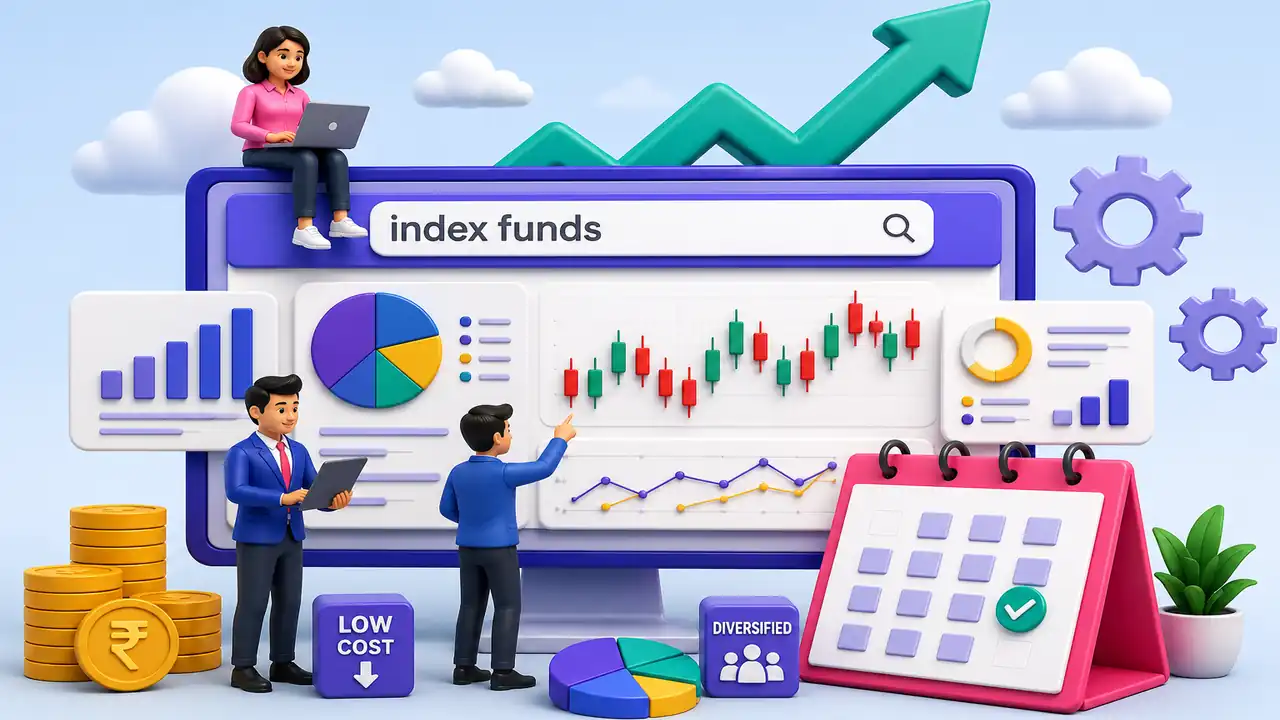
Index funds have changed how investors invest by making market participation simple and structured. You do not need to pick individual stocks. With a single investment, you get access to numerous companies at a lower cost. These funds encourage disciplined investing because they reduce the pressure of constant decision-making. Their low charges, built-in diversification, and easy management make them a practical choice for those seeking stable, long-term growth.
Learn in detail below how index funds work and how investors identify what qualifies as the “best” mutual fund category.
What are Index Funds?
Index funds are a type of passively managed mutual fund that replicates the performance of a specific market index, such as the Nifty 50 in India. They collect money from several investors and use it to invest in the stocks, bonds, or securities that comprise the index.
Types of index funds:
Broad market index funds
Sector-based index funds
Market capitalisation-based index funds
Equal weight index funds
Strategy index funds
International index funds
Debt index funds
When the index rises or falls, the value of the index fund generally moves in the same direction. A measure called ‘tracking error’ is used to gauge how closely the fund follows the index it targets to replicate.
How Investors Determine the “Best” Mutual Fund or Index Fund Category
Every investor views the best mutual fund or index fund differently. Each decision depends on personal financial objectives, the ability to deal with risk, and the expectation of growth. The following points explain how you can identify an ideal mutual fund or index fund category.
Choice of Index
The index you choose largely shapes the risk and return profile of your investment. A broad index like Nifty 50 or Sensex offers exposure to India’s largest and most financially stable companies. This gives you stability and balanced sector coverage. A wider index, such as Nifty 100 or Nifty 500, increases market coverage and enhances diversification. You define the ideal category by judging how well the selected index fits your comfort with risk and your vision for long-term returns.
Expense Ratio
The expense ratio of mutual fund investments influences how much return you retain each year. A higher ratio reduces gains, while a lower ratio supports more efficient compounding.
Index funds usually have lower fees because they follow a rule-based approach. However, even a small difference, such as 1%, can create a large gap in long-term results. So, examine the cost carefully because a fund that maintains cost discipline often supports better wealth creation over time.
Tracking Error
Tracking error shows how accurately an index fund mirrors its benchmark. A low tracking error signifies that the fund replicates the index effectively and minimises deviations. A high error signals greater deviation and indicates inefficiencies or challenges in the fund’s management. Since an index fund promises benchmark-like performance, this metric gives you a clearer picture of its efficiency.
Fund Size and Liquidity
Analyse the fund’s asset size and liquidity. Larger funds often show smoother operations, stable trading activity, and lower chances of sudden strategy shifts. Adequate liquidity also means you can enter and exit easily without causing a major impact on the price.
Fund Management Quality
Although index funds use a passive investment strategy, they still call for disciplined management. The Asset Management Company (AMC) must maintain timely rebalancing, transparent reporting, and accurate tracking of the benchmark. A strong fund house shows consistency in process, technology, and governance.
Conclusion
Index funds offer broad diversification, lower fees, and market-linked growth. These advantages make them a useful addition to any portfolio. You can invest in index funds hassle-free through online platforms of AMCs and investment apps. For steady, ongoing contributions, a Systematic Investment Plan (SIP) works well. The lumpsum option suits investors who can take on more risk and wish to invest a sizeable amount at once.
Before you begin, you should conduct proper research and select funds that match your goals, risk comfort, index choice, cost structure, and tracking quality. It allows you to invest with clarity and maintain a steady long-term outlook.