It is not uncommon for people to conflate victory and liberty with centralization and inflation. Even in the case of the American Revolution—which was relatively decentralized—many at the time, and others since, argued that monetary inflation, standing armies and a state-centric approach to war, consolidation under a centralized national government, direct taxation, and central banking were all necessary to achieve victory and independence. The not-too-subtle implication is that liberty depends on big government.
When the American Revolution began, and as it was waged, key policy decisions were made—approaches and interventions that begot further interventions. As mentioned above, these interventions were justified as war necessities. In reality, it can be argued that such interventions were counterproductive, actually threatened the cause of independence and victory, and all but guaranteed more consolidation at the expense of the states.
During the war, many either pushed for or were pressured into accepting greater consolidation under the Articles of Confederation and central banking under the Bank of North America (BONA). Of course, these measures were also justified as war necessities. Pressured by the conservative nationalists, many Americans begrudgingly accepted these measures to achieve victory. However, while we can appreciate the difficulty of their position, we can demonstrate that neither the Articles of Confederation nor the Bank of North America (BONA) were necessary to win the Revolution.
Given the nature of human action and uncertainty, we have to be cautious with counterfactual history. Contradistinguished from certain sciences in which repeatable experiments can be run, where key variables can be known, and where controls allow for holding certain variables constant, history does not allow us to repeat unique events, change key variables, and then determine with certainty what would have happened. Even if we could change key variables in the past, humans are acting, choosing agents, so we cannot say definitively what they would have chosen in a different mix of circumstances. Furthermore, any conclusions from counterfactual history are necessarily speculative.
With those cautionary barriers in place, how can it possibly be argued with such certainty that neither the Articles of Confederation nor BONA were necessary to win the Revolution? The answer is simple historical sequence demonstrates this: the war was virtually over before either could take effect.
The Articles of Confederation
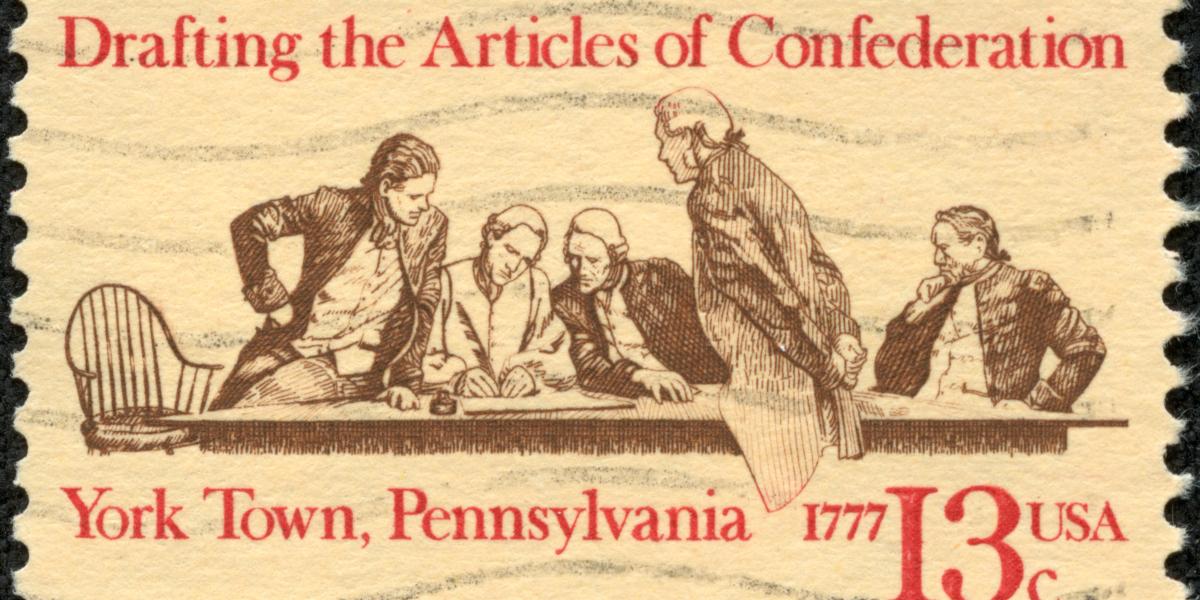
Politically, during this period there were persistent calls by the conservative nationalists for creation of a powerful central state to win the war and provide order and stability. Winning the war was a key argument for the Articles of Confederation and more consolidated national government. However, the Articles were drafted in 1777 and only fully ratified in 1781, yet the Revolution had virtually ended by October 19, 1781 with the surrender of Cornwallis.
In Conceived in Liberty, Rothbard writes,
The myth abounded that formal confederation was necessary to win the war, although the war would be virtually won by the time the confederation was finally achieved. The war was fought and won by the states informally but effectively united in a Continental Congress. . . There was no particular need for the formal trappings and permanent investing of a centralized government, even for victory in war.
Even though the Revolution was won without the Articles of Confederation, the government created by the Articles would remain after the war and be effective only in peacetime. The Articles of Confederation marked a significant step away from the loose wartime coordination of the Continental Congress and toward a more centralized national government.
In The Articles of Confederation: An Interpretation of the Social-Constitutional History of the American Revolution, 1774-1781 (p. 163), Merrill Jensen explains,
The conservatives who had opposed the Revolution and who went along with it only when they saw no alternatives, as well as many who were not opposed to independence, wanted supreme political authority placed in a central government which could exercise a coercive power over the states and their citizens. . . . They valued the British connection for the very definite advantages it gave the ruling classes of the colonies. When faced with the fact of independence, they demanded the creation of a government which would in some way function as a bulwark of conservative interests: in other words, as a substitute for the British government.
On the other hand, Rothbard described the position of the radicals,
The most important political fact of the years after independence was the movement toward a formal confederation by the revolutionary states of America. The radicals. . .were engaged in fighting a war against centralized government, its taxation, restrictions and privileges, and were not about to favor establishing an equivalent at home to what they were fighting to eject from American shores.
While the Articles preserved many limits on federal power, they represented an important victory for those seeking greater political consolidation. In this sense, the Articles continued a process that mirrored the very centralization the colonies had resisted under British rule, subordinating aspects of state sovereignty to a national authority. As such, the Articles served as a crucial stepping stone to the even stronger central government established by the Constitution in 1787.
The Bank of North America (BONA)
A critical driver of centralization was the financial chaos left in the wake of the Revolutionary War. During the war, both the individual states and the Continental Congress had inflated fiduciary notes—essentially fiat paper money—to finance military operations. These notes had depreciated dramatically, creating widespread economic dislocation.
Writing in Cronyism, Patrick Newman explains the post-war depression,
After the Revolutionary War, the country faced an economic crisis. . . Difficulties in the early 1780s came from the war’s aftermath, and postwar interventions delayed recovery. . . . First, industries had to recover from wartime destruction and rebuild damaged infrastructure. Second, manufacturers needed to experience a harsh but necessary correction: when peace arrived, Great Britain’s better quality and lower-priced manufacturing exports returned to American shores. Consequently, Americans had to reallocate labor and other resources away from eastern manufacturing and back to agriculture and westward settlement. Third, Great Britain now restricted its purchases of American exports, forcing a redirection of exports to continental Europe and Asia. All three of these factors—recovering from wartime destruction, reallocating resources used in wartime production, and suffering from coercive foreign trade legislation—produced a postwar depression in 1784. . . . Postwar tax and monetary policies aggravated this depression and hampered a quick recovery.
Rothbard likewise writes about the inflationary credit expansion of the Bank of North America (BONA), as well as the Bank of Massachusetts and Bank of New York. The BONA was a federally-chartered bank established in 1781 and linked government finance, public debt, and privileged banking. It was an important precursor to Hamilton’s financial system and was the first national bank in US history.
Writes Rothbard,
Robert Morris’s nationalist vision was not confined to a strong central government, the power of the federal government to tax, and a massive public debt fastened permanently upon the taxpayers. Shortly after he assumed total economic power in Congress in the spring of 1781, Morris introduced a bill to create the first commercial bank, as well as the first central bank, in the history of the new Republic. This bank, headed by Morris himself, the Bank of North America, was not only the first fractional reserve commercial bank in the U.S.; it was to be a privately owned central bank, modeled after the Bank of England. The money system was to be grounded upon specie, but with a controlled monetary inflation pyramiding an expansion of money and credit upon a reserve of specie.
The Bank of North America, which quickly received a federal charter and opened its doors at the beginning of 1782, received the privilege from the government of its notes being receivable in all duties and taxes to all governments, at par with specie. In addition, no other banks were to be permitted to operate in the country. In return for its monopoly license to issue paper money, the bank would graciously lend most of its newly created money to the federal government to purchase public debt and be reimbursed by the hapless taxpayer. The Bank of North America was made the depository for all congressional funds. The first central bank in America rapidly loaned $1.2 million to the Congress, headed also by Robert Morris.
Although less inflationary than the Continental paper-money regime, the BONA still expanded the money supply through fractional-reserve banking and established a precedent for government-supported monetary inflation.
It is a common claim that the BONA was essential for stable financial support to win the Revolution, however, William Gouge, in his A Short History of Paper Money & Banking (1833), deals with this claim with a simple presentation of historical sequence,
It is a common opinion that the Bank of North America rendered essential service during our revolutionary struggle—that, without it, the achievement of independence would have been difficult, if not impossible. Assertions to this effect have been made with so much confidence that we once believed them to be well-founded; but on examination we find—
First. That the capture of Cornwallis, which is described by historians as the closing scene of the Revolutionary War, took place on the 9th [sic] of October, 1781, and that the Bank did not go into operation till January 7th, 1782.
. . . .
The reader, on duly considering these facts, will probably be convinced that the services rendered by the Bank of North America, during our revolutionary struggle, have been grossly exaggerated.
Gouge likely means October 19 when Cornwallis formally surrendered, but it does not affect the overall thrust of his argument. If the war was basically over—though unofficially until the Treaty of Paris (1783)—then there is hardly any basis to claim that the opening of the BONA on January 7, 1782 was critical to American victory against the British. In fact, from the perspective of Austrian economics, it likely exacerbated postwar economic dislocations and the depression of 1784.
Conclusion
As we have seen, simple awareness of historical sequence demonstrates that neither the Articles of Confederation nor the Bank of North America were necessary to win the Revolution, even though that was the primary argument espoused for both. Yet, while both the Articles and the BONA were temporary, they were key stepping stones, not toward liberty, independence, and victory, but toward consolidation and centralization at the expense of the liberty and independence of the American states.