The dream of upward mobility has long anchored the economic fabric of society, but expanding webs of government regulation increasingly choke off the entryways to entrepreneurship. While massive corporations easily absorb the compliance burdens of dense legal mandates, small business creation faces a steep uphill battle against regulatory excess. Burdensome occupational licensing laws, complex tax compliance codes, and expensive local permitting processes serve as artificial barriers to entry that stifle competition. Intelligent minds viewing this phenomenon will point out that these top-down constraints inadvertently shield established corporate incumbents from the disruptive forces of market competition, transforming the regulatory state into a mechanism that prevents fresh, localized ideas from taking root.
This regulatory thicket inflicts its most severe damage on the living standards of immigrant entrepreneurs. For individuals possessing limited capital but immense drive, a small business—whether a corner grocery, a landscaping firm, or a food truck—is often the singular vehicle available to escape poverty. However, because immigrants are disproportionately likely to start micro-businesses, the flat-rate costs of compliance hit them with regressive severity.
When a simple startup requires thousands of dollars in legal fees, specialized language proficiencies to navigate bureaucratic paperwork, and months of waiting for government approvals, the ladder of self-sufficiency is effectively kicked away. Forced to remain in low-wage, under-the-table positions or to abandon their ventures entirely, these marginalized communities face depressed living standards and diminished generational wealth, demonstrating how government market interference frequently ends up locking out the poorest citizens.
This aggressive restriction of free enterprise acts as a structural chokehold, matching the disruptive severity of direct government enforcement. When a working-class immigrant is barred from opening a small bakery, running an independent transport service, or operating a street vending business due to prohibitively-expensive permits and bureaucratic compliance, the economic outcome is devastating.
This devastation has a wide-ranging effect because, according to the US Small Business Administration (SBA), over the last 30 years small businesses have consistently accounted for roughly two-third of all net new private-sector jobs created in the United States. In recent years, an unprecedented wave of new business applications has driven that percentage significantly higher: According to the SBA’s 2025 data covering March 2023 to March 2024, small businesses accounted for an astonishing 9 out of 10 net new jobs created in America, fueled by a historic surge in new business starts.
Restricting the activities of small businesses is in effect shutting down the economy’s blue collar and service job-creation engine. The economic case for slashing regulatory requirements for small businesses rests on unleashing the latent productivity of localized, decentralized knowledge. When a municipality or state lowers the barriers to entry—by streamlining permits, abolishing protectionist occupational licensing, and simplifying tax compliance—it triggers an immediate expansion in micro-enterprise creation.
According to data on regulatory burdens and entrepreneurship tracked by the National Bureau of Economic Research, reducing the friction of starting a business directly correlates with increased market competition, lower consumer prices, and robust job growth at the community level. When individuals are legally permitted to deploy their labor and capital without bureaucratic permission slips, wealth is generated organically from the bottom up rather than redistributed from the top down.
Furthermore, deregulation would serve as a powerful mechanism to reduce the net fiscal costs associated with illegal or unauthorized immigration. The primary financial strain on local infrastructure occurs when a segment of the population is legally barred from formal work, forcing them into an underground economy where they consume public services but cannot contribute to the tax base. By deregulating simple trades and lowering startup costs, a wider circle of entrepreneurs can register their businesses, and generate transparent revenue. Research from the Cato Institute highlights that the fiscal contribution of immigrants turns decisively positive when they are integrated into formal, lawful employment. Eliminating the progressive regulatory wall allows these micro-enterprises to scale, hire workers, and contribute directly to local and state tax revenues, turning a perceived socioeconomic burden into a net-positive engine for domestic economic growth.
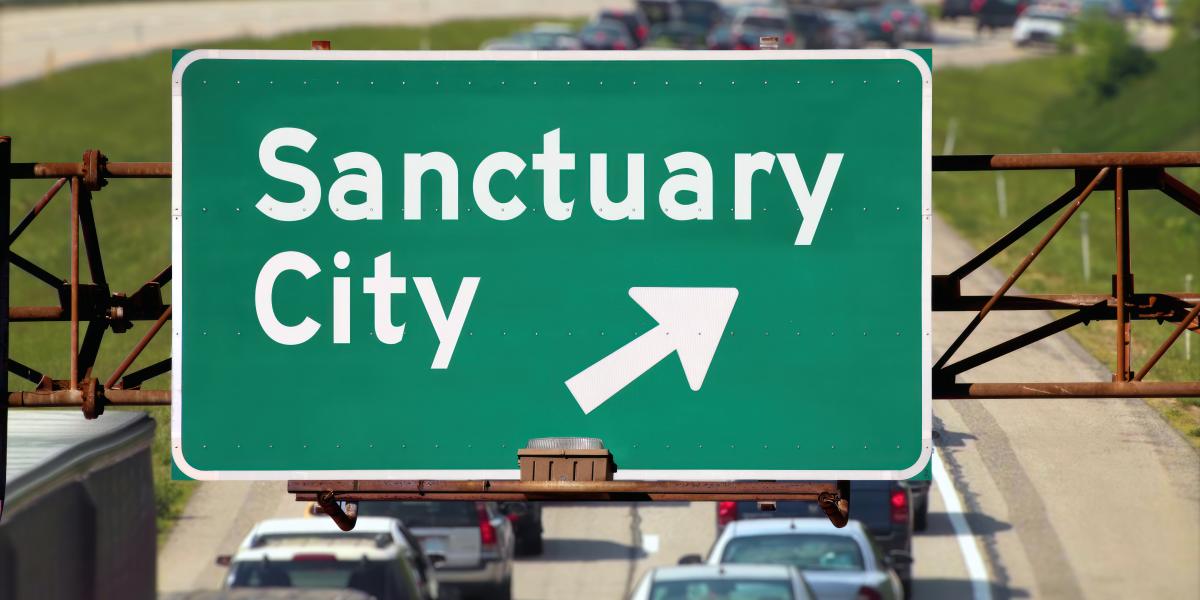
Sanctuary policies are overwhelmingly concentrated in major, left-leaning urban centers—such as New York, Los Angeles, Chicago, and San Francisco. The same local political coalitions that champion sanctuary protections for immigrants also heavily favor an interventionist approach to the economy. As a result, these cities consistently rank at the bottom of measures like the US Metropolitan Area Economic Freedom Index, which tracks local government spending, tax burdens, and labor market regulations.
While progressive politicians advocate for immigrant rights on a social level, their fierce commitment to expanding the regulatory state creates a stark economic hypocrisy. Progressive platforms routinely champion high minimum wage hikes, strict workplace mandates, complex occupational licensing, and intensive local zoning codes, framing them as essential protections for workers. However, these policies build an invisible wall that blocks the economic advancement of the very communities they claim to defend. By systematically driving up the fixed costs of legal market entry, progressive regulatory frameworks strip marginalized individuals of their primary path to self-sufficiency.
When an entrepreneur—immigrant or otherwise—tries to start a small business in these jurisdictions, they face a dense thicket of market interference. For the immigrant entrepreneur, this creates a bizarre socioeconomic paradox. They may choose to live in a sanctuary city to seek a community safe from federal deportation forces, yet once there, they find the local government heavily policing their right to earn a living. The state protects their presence on a geographic level, but micro-manages, taxes, and licenses their productivity to the point of exclusion. This simply makes no sense.
Focusing solely on liberalizing immigration policy while leaving the regulatory welfare state intact is an incomplete solution that ultimately sets newcomers up for economic stagnation. While opening borders or streamlining visa processes can eliminate the state’s restriction on the freedom of movement, it only solves half of the equation. If an immigrant successfully navigates the border only to be met by a wall of domestic market interventions, their right to self-ownership and labor is still effectively compromised by government coercion.
Without a radical reduction in market interference, improved immigration policies simply transfer individuals from a state of geopolitical exclusion to a state of domestic economic subjugation. Austrian capital theory dictates that wealth creation requires the free interaction of labor, capital, and entrepreneurship.