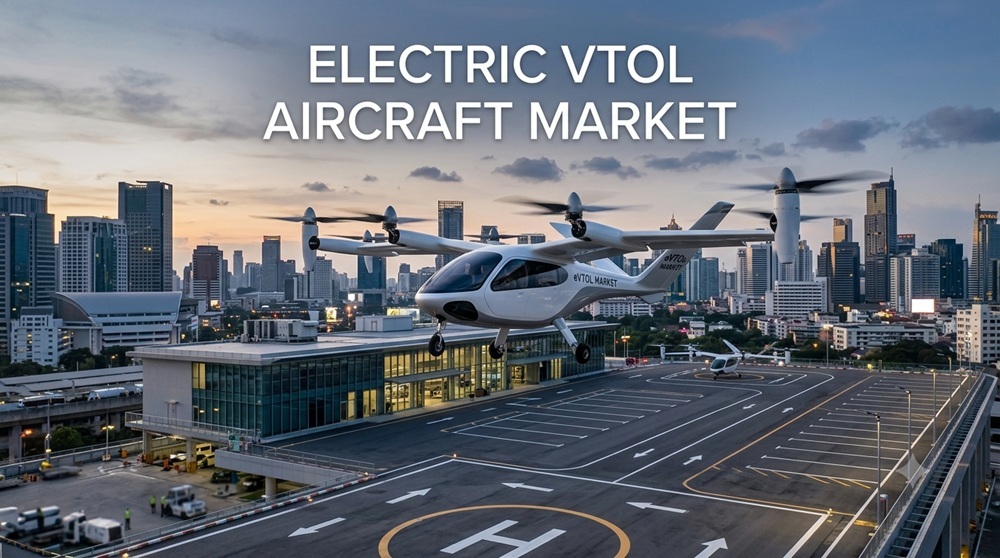
The Electric VTOL Aircraft Market is advancing rapidly as the aviation industry embraces sustainable and efficient air mobility solutions. Electric vertical takeoff and landing (eVTOL) aircraft are designed to reduce urban congestion, lower emissions, and enable faster transportation. Supported by technological innovation, regulatory progress, and growing investments, the market is expected to play a significant role in the future of urban and regional air mobility.
The global electric VTOL (eVTOL) aircraft market is estimated to reach $700.5 million in 2032 from $27.5 million in 2023, at a growth rate of 38.2% during the forecast period 2023-2032.
What are the Key Drivers of the Electric VTOL Aircraft Market?
Rising demand for sustainable transportation is accelerating the development of electric air mobility solutions.
Increasing investments from aerospace companies, venture capital firms, and governments are supporting eVTOL research and commercialization.
Advances in battery technology, electric propulsion systems, and autonomous flight capabilities are improving aircraft performance and operational efficiency.
Growing urbanization and traffic congestion are driving interest in advanced air mobility for passenger and cargo transportation.
What are the Key Trends Shaping the Electric VTOL Aircraft Market?
Manufacturers are conducting flight testing and certification programs to accelerate commercial deployment.
Partnerships between aircraft developers, infrastructure providers, and aviation authorities are expanding the advanced air mobility ecosystem.
Autonomous and semi-autonomous flight technologies are being integrated to improve operational safety and efficiency.
Development of vertiports and charging infrastructure is gaining momentum to support future commercial operations.
Get An Updated Sample for Electric VTOL Aircraft Market – Focus on Design, Range, Use Case, Mode of Operation, Energy Source, Component, and Country – Analysis and Forecast, 2023-2032
What Does the Regional Analysis Reveal?
North America leads the Electric VTOL Aircraft Market, supported by strong investments, a well-established aerospace industry, and active regulatory initiatives. Europe is witnessing significant growth through sustainable aviation programs and urban mobility projects. Meanwhile, the Asia-Pacific region is expanding rapidly due to increasing government support, technological innovation, and rising investments in next-generation transportation infrastructure.
What Challenges and Opportunities Exist in the Electric VTOL Aircraft Market?
The market faces challenges related to regulatory approvals, battery limitations, infrastructure development, high manufacturing costs, and public acceptance. Certification processes and the establishment of air traffic management systems for urban operations also remain critical hurdles.
However, opportunities continue to grow as advancements in electric propulsion, battery performance, autonomous technologies, and digital aviation systems improve commercial viability. Expanding investments in urban air mobility, cargo transportation, emergency medical services, and regional connectivity are expected to create substantial long-term growth potential for the industry.
Who are the Key Players in the Electric VTOL Aircraft Market?
Several aerospace companies and technology innovators are actively shaping the market through aircraft development, strategic partnerships, and commercialization efforts, including:
Airbus SE
Archer Aviation Inc.
Aura Aerospace LLC
Aurora Flight Sciences
Bell Textron Inc.
Beta Technologies
Eve Holding, Inc.
Elroy Air
EHang
Jaunt Air Mobility LLC
Joby Aviation
Lilium GmbH
Piasecki Aircraft Corporation
Urban Aeronautics
Terrafugia
Vertical Aerospace Group Ltd.
Wisk Aero LLC
XTI Aircraft Company
These companies are focused on advancing electric propulsion technologies, aircraft certification, autonomous flight capabilities, and advanced air mobility infrastructure.
Get More Insight on Aerospace Market
Conclusion
The Electric VTOL Aircraft Market is positioned to transform the future of aviation by offering sustainable, efficient, and flexible transportation solutions. While regulatory, infrastructure, and technological challenges remain, continuous innovation, strategic investments, and supportive government initiatives are expected to accelerate commercialization. As urban air mobility gains traction worldwide, the market is likely to witness sustained growth across passenger, cargo, and specialized aviation applications.