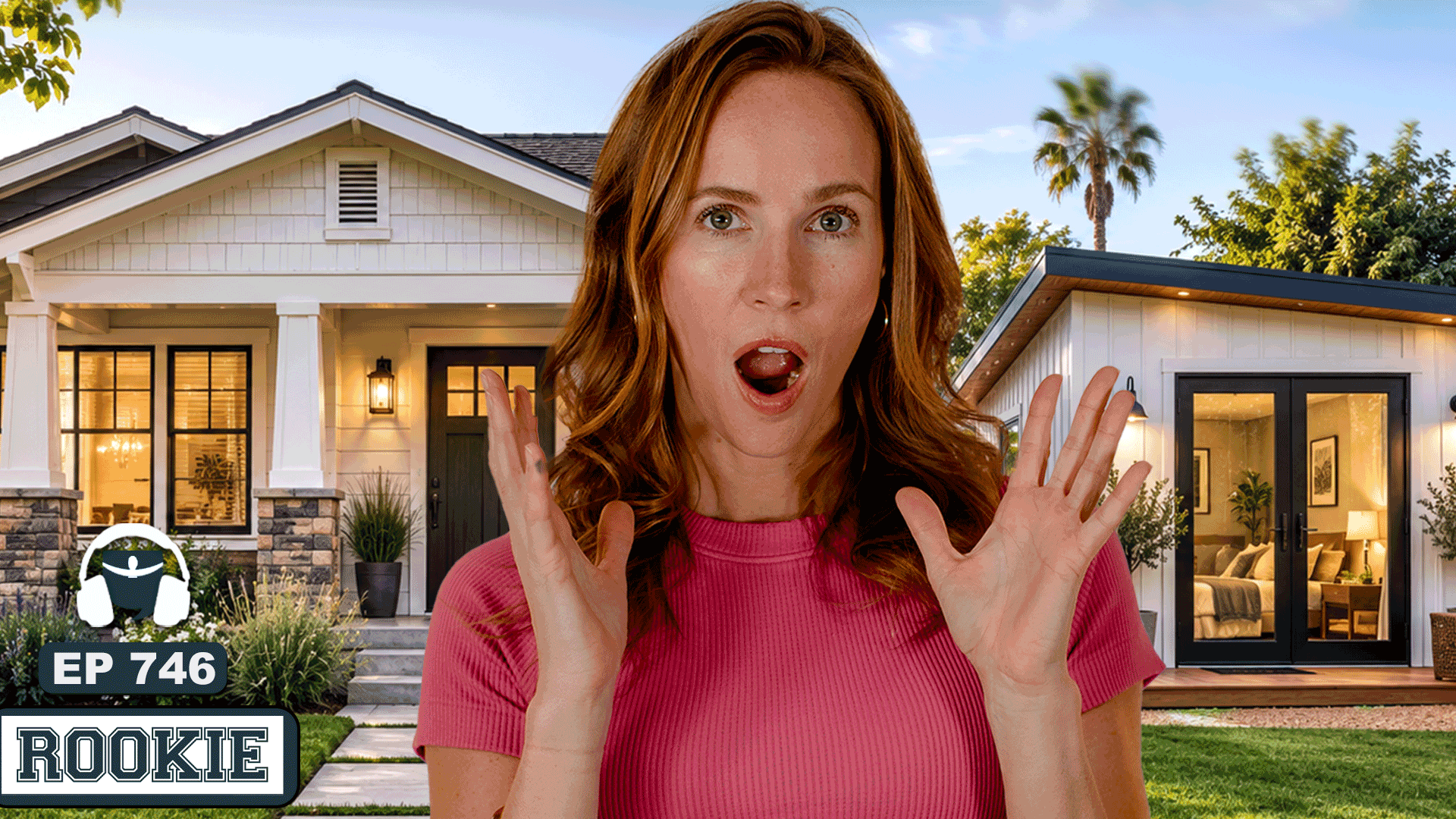
People think you need a dozen rental properties to achieve financial freedom. You don’t. Buy the right property in the right location, and it may only take one. Just ask Hana and Easton Jones, whose tiny back unit pays their entire mortgage and then some—allowing Hana to quit her W-2 job and live out her dream of being a stay-at-home mom!
Welcome back to the Real Estate Rookie podcast! Hana and Easton were a couple of 25-year-olds with regular jobs. How could they possibly afford real estate around Los Angeles? Driven by the dream of homeownership, they sacrificed, they saved, and when the time came, they bought the house no one wanted. It wasn’t perfect. It needed work. But it also had its own hidden income stream—a small ADU (accessory dwelling unit) that now covers their $3,300 mortgage each month!
In this episode, they break down their exact savings strategy, what it looks like to house hack an Airbnb, and how Hana was able to buy back time with her kids. Whether you live in an expensive city or want a way out from your nine-to-five, this story delivers the inspiration you need to take the next step in your real estate journey!
Ashley:Most people will tell you that buying a home in Los Angeles takes family money, a six-figure windfall, or a 20% down payment that you will never save in time. Today’s guest bought a $675,000 house at 25 with having none of that.
Tony:Hannah and Eason Jones, a husband and wife duo, saved their way on a regular paycheck and used loans most rookies overlook and found a house with a built-in way to help them cover the mortgage every single month. So they’re both about to walk you through exactly how they pulled this out.
Ashley:This is the Real Estate Rookie Podcast. I’m Ashley Kehr.
Tony:And I’m Tony J. Robinson and let’s give a big warm welcome to Hana and Easton. Guys, thank you for joining us on the Rookie Podcast today.
Easton:Hello, thanks for having us. Stoked to be here.
Ashley:Well, we’re happy to have you guys and we can’t wait to get into your story. Take us back to before you even though about real estate investing. You guys were both regular W-2 earners and you were living in one of the most expensive places in the country. So what made buying a home at 25 feel like a must instead of something that you’d get to do one day?
Easton:I’ve always really wanted a house. I was a big dreamer, always wanted the wife, the kids, the dogs, the house. I’m born and raised here in the South Bay and it was just always something that I knew I was going to do. And so I had been a saver from a young age, probably when I was 12 or so. My favorite candy was Junior Mints growing up, but for me to purchase them at 7-Eleven, it was a big purchase. I was always just saving my money. So yeah, from a young age, started early and then yeah, we just had some big dreams together.
Ashley:And Hannah, was that your dream from the beginning too?
Hana:I definitely wanted a house, but when we started dating, that was a very big topic and subject on his mind was like, “Okay, hey, this is what we’re going to do. This is my dream.” He actually took the Dave Ramsey course when he was 15 or something. And so it was like, “Okay, this is what we’re going to do. This is how we’re going to set up our life.” And I was all for it. In college, my number one social media was Pinterest and all the home stuff. So I had this far out dream. I thought it was far out of owning a home and getting to do little things to it. But when you’re growing up, it seems like such a far off dream. And just because so many people aren’t necessarily doing it at the age that we did. So when we started dating and that was his goal, I was like, “Okay, let’s do it.Let’s buckle down. Let’s do it together.”
Tony:So you guys are living in the greater Los Angeles area. What were you guys doing after college? What careers did you guys go into?
Hana:So I didn’t go to school for software engineering. I actually started off being a personal assistant to somebody in LA, but then was like, “I need to figure out what type of career I want to do. ” So I actually went back to school and did a software engineering bootcamp. That’s not something that a lot of people really know about, but becoming a software engineer is a great profession and has a good pay. So I went back to school, did a three-month bootcamp, and then got a job with a healthcare app right after that program. So yeah, that was my first job. And then –
Easton:Yeah. And then first jobs for me, so I started a company when I was 19, a clothing brand. And then I started working at another clothing brand, was helping out with them. So during college, I was working at Islands Restaurant. I was doing my company and then I was working at a clothing company and also doing some interning as PA work for commercials, et cetera. And then I got a job at Nitro Circus. That was my first full-time paying job. I was getting paid, I think, $48,000 a year. And then I was also commuting 120 miles each day there. It was 60 miles there, 60 miles back. So that was a long drive. And then in 2018, I went on my own to continue doing my graphic design business that I was doing on the side. So in 2018, took that on full-time. And 2018 I think is the year you moved here from Oregon?
Hana:2017.
Easton:2017. And then in 2019, we got married. And 2018, I actually quit that job at Nitro Circus and went full-time on my own.
Tony:Well, first, both of you guys sound like hustlers, right? So I love that part. And I think a lot of our rookies would do well to take a note from a page in that book. But I mean, you guys obviously have done well for yourselves, but you guys weren’t attorneys living in, physicians living in Southern California that had these massive, massive incomes coming in. So I think maybe walk us through how the two of you actually saved, because most people hear Los Angeles and they hear 25 years old and assume that buying any type of real estate is imposible. So what did your day-to-day money habits really look like during those years where you were building up your savings?
Hana:Yeah. So I think when you have a huge goal together, it doesn’t feel like such a sacrifice when you’re not going out to eat and doing these things because our day-to-day was eat at home, buy groceries for a minimum. We weren’t buying organic, weren’t buying expensive things because we had this huge goal in mind. Our church has a food bank and so we would go to the church food bank. You would be so surprised at how much food actually goes to waste in the Los Angeles area because every single grocery store has to get rid of all the expired food. So there’s so many resources. And then yeah, we made sure to eat before going out to eat with friends. We were really diligent. I mean, his spreadsheets were crazy. I mean we were writing down every single purchase and would put it in brackets and be like, “Okay, this month we were $50 over.How can we cut back just a little bit?” So we were really thoughtful about every purchase we made and making sure it was within budget.
Ashley:What was the monthly dollar amount that you were actually trying to save every month during this time?
Hana:As much as possible.
Easton:Yeah, as much as possible. I mean, we were always doing investing. We were always trying to max out our Roth IRAs at the same time. Like I said, when I was working at the company Nitro Circus, I was making about $48,000, which is nothing. I was probably spending more in gas on the commute. So yeah, dollar amount, I’m not really sure what we were trying to save, but we were just trying to put everything that we could towards our house saving and of course get by in life. We were renting in a small apartment in Manhattan Beach. We actually had a really decent rent, $2,300 at the time. And yeah, we were just going for it, just trying to shovel away little by little.
Tony:And Eason, just so you know, for all of our audience who is not in Southern California, when you said decent rent at 2,300, a lot of people, their minds are blown right now.
Easton:Yeah, my mind is blown too because we’ll never see a price like that again. But yeah, I mean, Manhattan Beach is a really nice city. Of course, it’s touching the beach. But yeah, 2,300 for a two-bedroom apartment with a little patio, outdoor area, garage is an extremely good price. And honestly, I don’t know anything differently because I was born and raised here. We never lived in Manhattan Beach specifically, but the surrounding cities. And yeah.
Tony:So guys, Ash and I talk a lot about Dave Ramsey, not a lot about Dave Ramsey, but we’ve talked about Dave Ramsey many times in this podcast and we love a lot of his advice in certain areas. We disagree with a lot of it in other areas. But I think one of the reasons that Dave Ramsey gets knocked a little bit is because it can feel like deprivation when you’re kind of following the baby steps. Did you guys feel that level of deprivation as you were working through that savings journey? And if not, how did you still maybe find joy in that process when you were saying no to so many things that people typically want to say yes to?
Easton:Yeah. Well, following the course was definitely tough. And I had taken the course before I was homeschooled and I took that growing up when I was 15. And then when Hannah and I were engaged, we actually took the course together as well. And yeah, it’s tough. I mean, we didn’t do everything that he says. For instance, I got a credit card because I like the idea of points. And so I only used a credit card though as a debit card. And so basically we’re living within our means, whatever we are normally spending, we’re putting it on. And then I’d be paying that credit card off every twice a month. And yeah, the great thing about that is it gives you points. And I think to Dave Ramsey’s point, he’s huge on no credit cards, which I understand it’s because he’s so black and white and he’s doing this certain program.So if he’s kind of being lenient in some areas and not in others, then it really just doesn’t make sense. So I think the great thing about following steps of someone like Dave Ramsey is you could take what you like and what you don’t like, and then also just through our community, different people in our lives and just taking the advice of
Ashley:Them. Now you really went the extreme of spending less, but a lot of times people go the other way and to afford their first property, they actually try to earn more. So during this time, did you try and pull that lever too as far as doing any side hustles or trying to increase your income? And if not, why did you not do that and decided just to focus on the frugality?
Easton:Yeah, so side hustles is definitely the thing that we’ve both really done. Hannah can talk about that, but I did a lot of modeling growing up, fit modeling, which is putting on clothing for the companies. And then also had my clothing company that I was running. Also had a graphic design business. Like I said, I was working at Islands Restaurant and I was working at a couple different jobs as well. So hustling at different levels of jobs was always our thing and we were getting money from different areas. Granted, it wasn’t anything crazy, but at the same time, it was a solid start to our young careers.
Ashley:After the break, Hannah and Eason are going to take us inside the actual purchase. The loan most rookies never hear of, the house everyone else passed on, and the little back unit that quietly helps pay the mortgage. We’ll be right back after this break. Okay, so now that we learned how they saved the money, let’s get into how they actually got the keys. Because in a market like LA, a down payment alone does not hand you a house. So Eason, let’s start with the part that surprises most people. You did not put 20% down. Walk us through the loan you actually used and what you brought to the closing table for this deal.
Easton:So we found this house together and we looked at one house from before this. We really liked it and it just wasn’t in the best single family residence area. My dad kind of talked us out of it. Then we found this one and Hannah kind of had to talk me into this one because it was a little smaller. It had a lot of work to do. And then as far as the loan, we put down 9% and we got an FHA loan. Again, the house was 675 at the time. It was mid – COVID. We closed in July. And so it was a scary time. And on top of that, with COVID, my job was in events and graphic design and I was producing merch for companies. And so literally my job just fully tanked come March. And so I was really just going off of savings.I had barely any income. And then Hannah thankfully had the W-2 job at the time. So we had a great savings and then she had her W-2 at the same time. So we were just really taking it step by step. We knew it was a great time to get a house because the interest levels were below 3%, which was unheard of. And it would be nice if we ever see that again. But yeah, so on the FHA loan, we put down 9%, which was close to, I think it was $70,000 plus closing costs. And I think the total we put down on the house was around $80,000.
Tony:Eason, let me ask, because when we talk FHA, one of the benefits that folks cite as the reason for going FHA is that the down payment can get to 3.5%. And typically when someone wants an FHA loan, they’re putting down 3.5%. Now 9% is obviously way less than 20%, but maybe walk me through why did you guys put down 9% versus what most folks put down on an FHA, which is three and a half?
Easton:Well, of course, the more you put down on the down payment, the less your mortgage is going to be. And that was something that we of course had to afford. And honestly, I didn’t want to put down something like three and a half percent because the mortgage would’ve just spiked up. And then we had the savings, what else are we going to do with it? We want to have a comfortable mortgage. And so that’s why we chose to do the 9%. I think we were trying to do 10%. Of course, we would’ve loved to do 20%. And anything below the 20%, you have that PMI insurance, which is also a couple hundred bucks a month at that rate. So that was something that we were just trying to hold on temporarily.
Tony:Yeah, I love that. So it was really just a personal choice. Hey, we have the cash. We want to reduce our ongoing monthly expenses. Let’s just put the cash to work that way. Man, I love that. It’s a great answer.
Ashley:Now with this deal, when you went and walked it and you put in your offer, was there any competition? And take us through that offer process on the deal.You had said during COVID, was this a time when there’s 20 offers on the table or were you the only one?
Easton:Yeah. So for other houses, there may have been 20 offers, but this house, to tell you the truth, it was pretty ugly, pretty outdated. There were bars on the windows. It wasn’t an appealing house. And that’s another reason why I said Hannah had to convince me to get this house because I was not expecting all the work that it was going to take, but she has a good eye and –
Ashley:She has the Pinterest vision all of those years on Pinterest paid up.
Easton:Yeah. So she was able to see the potential that it had and that’s where we went.
Tony:What was some of that potential that you guys saw on this property?
Easton:We loved that it had a huge backyard and then it was close to the freeway, close to where we loved to hang out. And then it was also as close to the beach as possible that we could afford. I also grew up very close by, so that was a nice touch to it too. But I’d say the most appealing part about it was that it had a little guest house in the back. And one of the biggest reasons on our list when buying the house was that we wanted some sort of way to also make income, whether it would be a detached garage, a two-car garage, a little back house or something like that that we could rent out.
Ashley:Now, when you looked at this property, did you estimate the rehab at all or is this something you just wanted to get into and you’re going to DIY it? What was the actual plan to do the renovations and to make it work for you? And how did you budget for it?
Easton:We honestly didn’t have an idea of what we could spend on the rehab. And honestly, we spent pretty much every penny that we had on the house. And when we did buy the house, we did a month of renovation. So we basically knew that we had enough money for the house and then a certain amount of money for the remodel, which I think was like $30,000.
Hana:Yeah. Yeah. We had to get really crafty with our remodel because it was mid – COVID and also because we were trying to do it as cheap as possible. And so we used a lot of Facebook marketplace fines, like tile from Facebook Marketplace or used secondhand appliances, the stove. You can find actually really amazing deals. There’s so much here in LA. There’s so many different resources that you can find secondhand that are barely used or just has a debt or it’s an open box. So it’s cool. Yeah, we had to make sure it was as cheap as possible because we didn’t have very much money. Had no
Easton:More money. Exactly.
Tony:As you guys went through this process, did you guys have experience doing renovations yourself? Did you DIY a lot of this or did you hire out what you could? For our rookies that are listening that maybe want to follow in your footsteps, but don’t necessarily have the experience of renovating a home. It can feel somewhat intimidating. So did you guys DIY? And if so, how did you educate yourself on the correct way to do that?
Easton:Yeah, we really had no idea what we were going to do or how we were going to do it. Thankfully, we had an amazing friend named Joe and he was a little slow during that time. He owns a construction business and he literally allowed us to pay his guys by the hour, no upcharges. He was just a blessing from God. We love Joe. And basically we would go to Home Depot, swipe the card, which we would of course pay off. We didn’t get into any debt during this besides the home loan itself. And yeah, we were just paying for all of the materials ourselves. And then we were paying for the hourly of the guys, which was incredible.
Hana:Yeah, there’s definitely resources again to get crafty. You don’t necessarily have to go straight through a construction company. There’s a lot of side workers or people on apps and little things that you can get workers, construction workers that have that experience. Because yeah, for us, we didn’t do very much DIY. We had the vision and we had the idea and then we went and purchased the materials, but we didn’t actually… Well, yeah, we didn’t do it ourselves. However, my dad is a finished carpenter. So my dad came and also helped out too.
Easton:This is his first contribution. He helped with the ceiling here. That was awesome.
Ashley:Now what about the numbers on the guest house and how that would actually rent? So did you factor in what you’d be able to make in rental income and what strategy were you actually planning? Short-term, long-term, mid-term?
Easton:So we really didn’t have a strategy. We just knew that we wanted something that would also bring in some income. And we were talking to my cousin before we purchased the house and we were like, “Hey, if we had a little back house, would you rent from us?” And we were really just trying to offset the mortgage. And the mortgage at the time I believe was $3,300 a month. And then we were charging my cousin just below $1,000. So that turned our mortgage into 2000, which was awesome.
Tony:Which is less than what you guys were paying in Manhattan Beach, right?
Easton:Literally. It was just a shift, except we had no more money in our bank account.
Hana:Yeah. And then after long-term renting to his cousin for a year, we went and traveled through Europe and every place that we were staying was tiny and didn’t have full kitchens. And I always had this though that the back house couldn’t be… It’s just so small. So it’s like to have even our cousin back there was like, “Okay, it’s really tiny.” But once we were traveling Europe, we were like, “Well, maybe we could actually turn it into a short-term rental, put it on Airbnb because you don’t necessarily need a full kitchen.” It’s kind of like a hotel room. So we were like, “Let’s just try to make it, fix it up a little bit, put some makeup on it, make it look pretty and put it on Airbnb and see how it does.” And I talk about this on my Instagram, but it started bringing in three to sometimes even upwards to five grand a month.So it started paying for our full mortgage. We had no expectation of that. We were kind of just like, “Let’s just see how it goes.” But everyone who came through loved it. We would give them sparkling water and just really trying to make their experience as a host personal. And I think that’s what made it really special for people who come and stay here. We always try to introduce ourselves and yeah, we really weren’t expecting much and it turned out to be the best decision for our family.
Tony:How big is that back unit square footage wise? Just ballpark.
Hana:Less than 200 square feet.
Tony:That is incredible. So we’re talking less than 200 square feet producing enough money to cover your entire mortgage.
Easton:Correct.
Hana:Sometimes more, which is cool.
Easton:Yeah. And to be honest, of course, sometimes less too. But generally our bookings are pretty much back to back. We’ll have someone come in, they’ll leave that day, we’ll have a cleaner, and then someone comes either that day or the next day. So we’ve really been blessed. We live in a great location. We’re close to the airport, the beach, SoFi Stadium, all of that. So yeah, people love to come.
Tony:What city specifically are you guys in?
Easton:We’re in Hawthorne, but I kind of don’t want to say that if possible.
Tony:Oh, gotcha. Okay. No worries. Editors just cut that out. Don’t say Hawthorne.
Ashley:I was going to say I’m getting shiny object syndrome where I want to head down to the Amish, get myself a shed built and throw it in my backyard. But now that you’re naming all the things airport, So if I see beach, all these things you’re close to, mine probably would not bring in the same amount. I got a creek in my backyard.
Tony:Ashley’s in the boonies of Western New York. Boonies of
Ashley:Buffalo. Yeah,
Tony:The boonies of Buffalo. Well, guys, I think a lot of rookies here like, “Hey, my Airbnb covers my mortgage,” and picture maybe passive income. But maybe what’s one part of running your short-term rental that they maybe wouldn’t expect? Hat does it actually look like for you guys on a day-to-day basis in terms of time involvement to get that money to cover your mortgage?
Easton:I think the hardest part is really just getting into it. So we finally had the place that we could actually rent out. And then there’s the setup work, which is putting the listing online. It’s the makeup, as Hannah said, the painting, getting it ready, getting the furniture and all of that of course. But then once it’s running, it’s pretty simple and there’s a little bit of communication. I do the communication with the guests through the messaging and then in person. And we have a great family cleaner who comes and we pay them about a hundred bucks to clean the space. Like I said, it’s small. They usually clean it about an hour and a half. So it’s great money for them, great money for us. And yeah, after the setup work, it’s really not that hard.
Ashley:Up next, Hannah and Easton are going to go over what owning this house actually bought them because the Airbnb covering the mortgage is not even the part that has changed their lives. We’ll be right back. So the savings got them in the door and the back unit helps carry the mortgage. But now let’s talk about what that freedom actually looks like and what it costs to get there. Okay, so Hannah, you eventually ended up leaving your software job to be home with your kids. How did owning this house and the income from the unit actually make this decision even possible for you?
Hana:What’s amazing about it is that even though I had a really great paying job because of the mortgage being covered, we were able to live off of just Easton’s pay, which was great. And also he had mentioned back in 2020 that pretty much he lost all of his clients and his income, but then he was able to rebuild that enough to where we were able to cut back and let go of my software engineering job. At the time when we first bought the house, it was 75,000 and then it actually went up to 140, but because the mortgage… So it was a great paying job. But yeah, the mortgage being covered and just us being smart about our finances, we were able to just live off of Easton’s income.
Ashley:I think it’s incredible and a great example of how this one property could do this for you. There’s often this misconception that you need a huge portfolio, you need to buy 10 rentals before you could even consider that. But here is a great example of turning a primary residence into a house hack that completely changed your life of no longer having to go to work anymore and getting to experience life with your kids just from one property. And I think too many people get caught up in that accumulation phase when really you make a life decision to house hack, which a lot of people will not do. But look at what has been able to do for you in your life. Congratulations. That’s amazing.
Hana:Thank you so much. Yeah, I think the biggest thing is having goals and being really conscientious about your spending habits from the beginning and sticking to your goal. Our goal from the get – go was to have me be a stay-at-home mom at some point. And yeah, we’re just so fortunate that we were able to purchase the home, make decisions that ended up putting me in this place now. So making small decisions that then have a really big effect, which is cool.
Tony:It’s an incredible story and truly incredible. And I think so many people in our rookie audience want to get to the point where they have that option to walk away from, you said, $140,000 salary and do so with the confidence they can still be able to provide for their family and put food on the table and shelter and closing all those things. So absolutely incredible to your point, Ash, what one property can do and execute it the right way. I think the final question, so many people look at a young couple owning a home in LA or name the other expensive market. And again, assume that you must be rich or lucky maybe. When a Ricky feels like ownership is out of reach, what do you want that person who’s listening right now, Hannah, to take most from yours and Eason’s story?
Hana:It’s definitely doable. Dave Ramsey says live like no one else now so you can live like no one else later. And that is a huge motto in our household. You don’t have to go out and spend $70 at dinner. You don’t have to buy the brand new car. You don’t have to do these things. If you want to invest in real estate and end up eventually hopefully not paying a mortgage it’s the small day-to-day decisions that really make the biggest impact.
Ashley:Well, Hannah and Easton, thank you and Kan. Thank you so much for joining us today on Real Estate Rookie. Where can people find out more information about your journey and how you’re investing?
Hana:You can go to my Instagram. It’s Hanna, H-A-N-A-A Jones. And other than that, even you’ll post sometimes about our life on Orange Goods. Easton’s business is called Orange Goods. So Orange Goods, Instagram as well. Yeah. Keep up with the Joneses, right? Well,
Ashley:Thank you guys so much. We really apreciate you taking the time to share your story and your lessons learned and all of your success. So thank you so much for taking the time today. I’m Ashley, he’s Tony, and this has been another episode of Real Estate Rookie.
Help us reach new listeners on iTunes by leaving us a rating and review! It takes just 30 seconds and instructions can be found here. Thanks! We really appreciate it!
Interested in learning more about today’s sponsors or becoming a BiggerPockets partner yourself? Email [email protected].