By Peter Reagan
We tend to use the word “safe” as though it has only one meaning.
But a life jacket won’t put out a kitchen fire. A smoke detector won’t help much during a flood. They are all safety equipment – they simply address different dangers.
The concept of “financial safety” works the same way. In one sense, there’s no such thing as “financial safety” at all. Just varying types and levels of risk.
An asset can be stable in price, but vulnerable to inflation. Easy to sell, but dependent on another institution’s promise to pay. It can carry almost zero default risk and still become a liability during a political dispute.
That last category of risk is receiving a great deal more attention from the world’s central banks, just as it has been since 2022.
According to the World Gold Council, central banks and other official institutions purchased 289 metric tons of gold during the second quarter of 2026. That was 62% more than the same period last year, and the biggest amount ever recorded for a second quarter.
Now, central-bank purchases have not simply marched upward in a straight line. The first quarter of the year’s net gold buying was unusually quiet.
But as interesting as they are, these quarter-to-quarter numbers aren’t the most important part of this story.
The more consequential development is why central banks are buying gold.
I have come to believe they are reconsidering what financial risk actually means.
The old definition of “safe” is breaking down
For decades, reserve managers generally treated highly liquid U.S. federal debt and foreign currency deposits as the foundation of financial safety.
Granted, there were good reasons for that.
These assets were highly liquid; they could generally be converted into cash quickly. They could be used to settle international transactions, stabilize their currency or provide emergency liquidity during a crisis.
But every financial asset built on debt carries a basic condition: Someone else must fulfill a promise.
That promise may be exceptionally credible! The borrower may have a long history of perfect repayment. Their debt may trade in one of the world’s deepest and most active markets.
Nevertheless, it remains a promise.
Gold is different.
Physical gold does not depend on a borrower, corporation, bank or government making a future payment. It does not require an issuer to remain solvent. When held under a nation’s direct control, it is also far less exposed to the risk that access could be restricted through sanctions or political pressure.
That difference has become much more valuable in a world of trade conflicts, frozen reserves, interrupted payment systems and increasingly hostile international relationships.
A new survey from the Official Monetary and Financial Institutions Forum, better known as OMFIF, helps explain the change in thinking.
OMFIF surveyed more than 70 central banks and found:
82% of respondents held physical gold, compared with 71% a year earlier.A net 30% intended to increase their gold holdings over the next one to two years.68% cited diversification as a reason for holding gold.51% cited shelter from geopolitical risk, an increase of 11 percentage points from 2024.
For those of you who prefer charts:
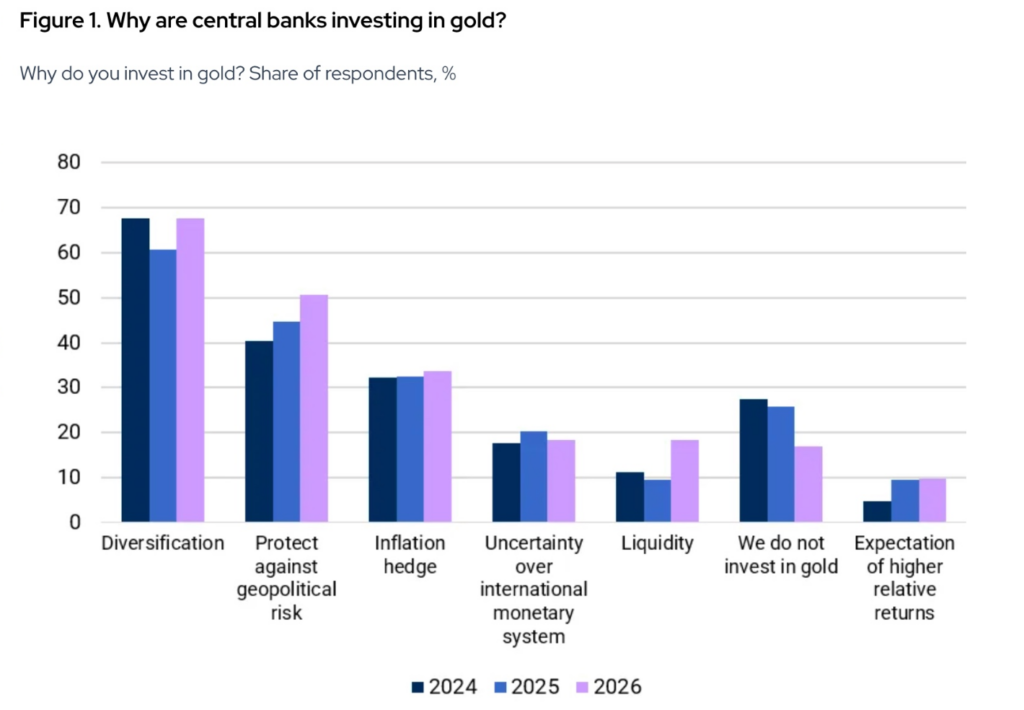
Surprisingly, for the first time in OMFIF’s survey series, central banks also expressed an intention to reduce their dollar holdings over the coming decade.
Let’s not overstate this.
The dollar still represents about 58% of global foreign currency reserves. The dollar is still central to international trade, global banking and emergency liquidity.
Central banks are not suddenly replacing the dollar with gold.
I think what they’re doing is more subtle – and more significant.
They are adding an asset that sits partly outside the very financial system their other reserves depend on…
Risk does not disappear – it moves
This brings us to an apparent contradiction.
If gold is becoming more important to central banks, why did the International Monetary Fund recently describe it as a “high-risk reserve asset”?
Because the IMF and the central banks buying gold are measuring different kinds of risk.
Gold prices can fluctuate considerably, even in dollars (as we’ve seen since January 1 this year). Gold does not generate interest payments. Selling large amounts of gold quickly may be more complicated and expensive than selling the most liquid forms of government debt, as well.
For a central bank that needs immediately available funds to stabilize its currency or meet an external obligation, those limitations matter.
The IMF therefore argues that gold is poorly suited to the most liquid portion of a nation’s reserves. It may have a role among longer-term holdings, but it should not be mistaken for emergency cash.
That is a reasonable argument. It’s like saying, “If you have to pay a doctor’s bill, you should use your checking account rather than selling a gold coin.”
I don’t think the IMF perspective undermines the strategic case for gold. Instead, it clarifies the case.
Central banks are not buying physical gold because it is perfect. No asset is.
They are buying it because its weaknesses are different from the weaknesses of the rest of their reserves.
Consider the tradeoff: Government debt may offer greater short-term liquidity, but it depends on an issuer not to inflate away its value. Debt operates inside a financial network controlled by governments, banks and clearing institutions.
While gold fluctuates more in price, it has no issuer. It cannot default. And when physically held under the owner’s control, access does not depend on another country’s banking system.
One asset faces more market-price risk.
The other faces more issuer, inflation, counterparty and access risk.
The goal of diversification is not to eliminate all risk. That is impossible.
The goal is to avoid having every part of your financial life exposed to the same risk.
Central banks are accepting the tradeoff
The IMF also raises another important point.
Much of the recent increase in gold’s share of global reserves came from rising gold prices, rather than central banks purchasing enormous quantities of additional metal.
Between 2018 and 2025, the market value of central-bank gold holdings increased approximately 268%, from around $1.2 trillion to $4.5 trillion. Over the same period, the actual quantity of gold held increased only about 8.5%.
That is worth understanding.
When gold rises in price, the value of gold already sitting in central-bank vaults rises along with it. A nation does not need to buy another ounce for gold to become a larger share of its reserves.
But that does not mean the physical buying is imaginary or insignificant.
According to the same IMF analysis, central banks that actively added gold increased their physical holdings by roughly 36%.
In other words, price appreciation magnified a genuine – if selective – shift toward physical gold.
And those purchases have continued despite substantial price volatility.
Reuters recently reported that analysts still viewed central banks as one of the most dependable sources of gold demand, even after gold experienced a sharp retreat from its January high. The underlying concerns they cited included geopolitical tensions, government debt, fiscal stability and confidence in currencies.
That tells us something important.
Central banks do not appear to be buying gold merely because its price has been rising.
In the second quarter, they purchased record Q2 amounts even as the average gold price fell from its first-quarter level.
They were not avoiding volatility.
They were accepting volatility in exchange for a different kind of financial independence.
The dollar still runs the system – and that is the point
I think of the dollar as the operating system of international finance.
Central banks hold dollars because the world’s financial machinery largely runs on them. International contracts are priced in dollars. Commodities are traded in dollars. Banks borrow, lend and settle payments in dollars.
That makes the dollar extraordinarily useful.
But reliance on any operating system also creates dependence.
Your files may be perfectly secure. Your computer may function flawlessly. But if someone else controls your password, your access is not entirely your own.
That is the risk central banks increasingly seem determined to address.
Gold does not replace the dollar’s everyday functions. It does not move through the banking system with the same ease. It is not a practical substitute for all the liquid reserves a country may need.
It does something the dollar cannot do:
It provides value without requiring continued access to the dollar system.
OMFIF put this plainly: Gold is the one major reserve asset that carries no national flag.
That neutrality matters more when the world is politically divided.
It matters when governments use access to financial networks as a tool of foreign policy.
And it matters when nations are no longer certain that yesterday’s financial relationships will survive tomorrow’s political dispute.
What central banks understand about diversification
There is a lesson here for ordinary Americans, although we should not pretend that a family’s savings operate exactly like a central bank’s reserves.
A central bank must prepare for several different emergencies. It needs liquidity for immediate obligations. It needs assets that can withstand long-term inflation. It needs reserves that are not entirely dependent on one currency, one government or one financial network.
Families face their own assortment of risks.
Cash is useful and liquid, but inflation can steadily reduce what it buys.
A home is tangible, but it may be expensive to maintain and difficult to sell during a financial emergency.
Bank accounts are convenient, but they are still claims within the banking system.
Physical gold can fluctuate in price, but it does not depend on an issuer’s promise. It represents tangible value held outside the usual chain of debts, banks and counterparties.
None of these assets is sufficient by itself.
That is precisely the point.
Diversification does not require believing that physical gold will rise every month or solve every possible financial problem. Central banks plainly do not believe that. They know gold can be volatile. They know it is not the best tool for every job.
They are buying it anyway.
Not because gold has no risk – but because it offers shelter from risks their other reserves cannot address.
“Safe” was never supposed to mean one thing
For many years, financial safety was treated almost as a synonym for owning the obligations of large, powerful governments.
That definition made more sense in a stable world where major nations trusted one another, payment networks were treated as neutral infrastructure and governments rarely questioned whether they could access their own reserves.
That is no longer the world reserve managers are preparing for.
Today, financial safety may mean liquidity.
It may mean price stability.
It may mean freedom from default.
Or it may mean owning something that does not depend on another government’s permission.
Physical gold does not satisfy every one of those definitions. Neither does any other asset.
But gold addresses a kind of risk that has become harder for central banks to ignore: the risk of depending entirely on promises, institutions and systems outside their control.
That does not signal the sudden end of the dollar. (It’s certainly not good news for the dollar; but the dollar and gold have been coexisting for over 200 years.) Central banks still need dollars to settle transactions inside the global financial system.
It signals the beginning of a new understanding of what financial safety means to central bankers.
Increasingly, they seem to buy gold bullion in case the financial system itself becomes the biggest source of risk.
Now, I’m not saying we need to do what central banks are doing, ounce for ounce. (Even if we could afford to.) But we can learn from the question they are asking:
Are all of our savings exposed to the same promises, the same currency and the same financial system?
Diversifying with physical precious metals is one way to begin answering that question.
Learn more about the role physical gold can play in diversified savings – and request your free Precious Metals Information Kit today.