
No Result
View All Result
  • Login
Wednesday, June 3, 2026
theadvisertimes.com
  • Home
  • Business
  • Financial Planning
  • Personal Finance
  • Investing
  • Money
  • Economy
  • Markets
  • Stocks
  • Trading
  • Home
  • Business
  • Financial Planning
  • Personal Finance
  • Investing
  • Money
  • Economy
  • Markets
  • Stocks
  • Trading
No Result
View All Result
theadvisertimes.com
No Result
View All Result
Home Money

How often should you rebalance?

by theadvisertimes.com
3 months ago
in Money
Reading Time: 3 mins read
A A
0
How often should you rebalance?
Share on FacebookShare on TwitterShare on LInkedIn


But markets do not stand still. Over time, some asset classes outperform while others lag. Stocks may surge ahead during a bull market. Bonds may stabilize the portfolio during downturns. As those returns compound at different rates, the asset mix begins to drift from your original allocations. 

An 80% equity portfolio can quietly become 85% or 90% equities after a strong rally. A rough year for stocks can tilt you further into fixed income than you intended. Performance swings, good or bad, can push your portfolio away from the risk profile you originally chose. 

At some point, the mix no longer reflects your original plan. So, should you step in and rebalance?

You might look to large ETF providers for guidance. The answers are not always clear. The Vanguard Growth ETF Portfolio (VGRO), for example, states that its 80% stock and 20% bond portfolio may be rebalanced at the discretion of the sub-advisor. That leaves plenty of room for interpretation.

Others are more prescriptive. The Hamilton Enhanced Mixed Asset ETF (MIX) uses 1.25x leverage on a 60% S&P 500, 20% Treasury, and 20% gold allocation. Hamilton specifies that it rebalances automatically if weights drift 2% from their targets. That is a tight band and implies frequent turnover.

But you are not running a fund with institutional constraints or leverage targets. You are managing your own portfolio. For most DIY investors, a simpler approach works better. Rather than reacting to every small market move, sticking to a consistent, time-based rebalancing schedule can reduce complexity and prevent decision fatigue. 

In today’s column, we will look at why you should rebalance, how different time-based approaches have historically behaved, and why consistency often matters more than perfect timing.

Why rebalance your portfolio at all?

Rebalancing is the process of selling assets that have grown beyond their target weight and buying those that have fallen below it, such that you restore your portfolio to its intended allocation.

Article Continues Below Advertisement

Outstream Volume Icon

Skip Ad

X

When you combine assets that are not perfectly correlated and periodically rebalance them back to target weights, you create what is referred to as a rebalancing premium. The underlying explanation has to do with how returns compound. 

The arithmetic return is the simple average of yearly or periodic returns. It treats each period independently. The geometric return is the compounded growth rate of your money over time. It shows what you actually earn after gains and losses build on each other.

The arithmetic average of returns does not reflect the true investor experience. Investors live with the geometric return, which accounts for the effects of compounding and the impact of volatility. 

Large swings in portfolio value widen the gap between arithmetic and geometric returns. By blending assets with different correlations and rebalancing them, overall volatility can be reduced. That narrows that gap and improves the compounding outcome. A simple back test illustrates this effect. 
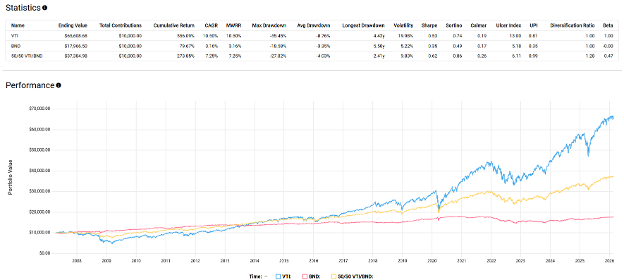
Source: testfolio.io

From April 2007 through February 2026, U.S. stocks returned 10.5% annualized. U.S. bonds returned 3.16% annualized. If you simply averaged those two numbers, you get 6.83%.

Now consider a portfolio that held 50% U.S. stocks and 50% U.S. bonds and rebalanced once per year. That portfolio returned 7.25% annualized over the same period. The difference between 7.25% and 6.83% of 0.42% per year reflects the benefit of combining and rebalancing the two asset classes rather than simply averaging their stand-alone returns.

The improvement also shows up in risk-adjusted terms. The all-stock portfolio delivered a Sharpe ratio of 0.53. Bonds delivered 0.35. The 50-50 portfolio, rebalanced annually, achieved a Sharpe ratio of 0.62. Even though its raw return was lower than 100% stocks, it generated more return per unit of risk taken.


Source link

Tags: Rebalance
ShareTweetShare
Previous Post

What happens when you inherit an IRA or 401(k)?

Next Post

Parsec Shuts Down Business Amid Crypto Market Volatility

Related Posts

10 Top Entry-Level, Remote Careers for New Grads (and Companies Hiring)

10 Top Entry-Level, Remote Careers for New Grads (and Companies Hiring)

by theadvisertimes.com
June 3, 2026
0

Editor's Note: This story originally appeared on FlexJobs.com. Graduating in 2026? According to a recent survey by the National Association of...

Finding financial support as a disabled student in Canada

Finding financial support as a disabled student in Canada

by theadvisertimes.com
June 2, 2026
0

Nowhere can that be felt more acutely, in many cases, than in the lives of disabled students.  To even get...

5 Georgia Counties Where Seniors Pay alt=

5 Georgia Counties Where Seniors Pay $0 in School Tax

by theadvisertimes.com
June 2, 2026
0

The average U.S. household pays $3,119 annually in property taxes. For seniors living on a fixed income, property tax bills...

6 Survivor-Benefit Rules That Can Boost a Widow’s Check

6 Survivor-Benefit Rules That Can Boost a Widow’s Check

by theadvisertimes.com
June 2, 2026
0

Losing a spouse is absolutely devastating. On top of dealing with grief, many widows are also faced with financial uncertainty...

The ICE Contact Every Senior Should Add to Their Phone Today

The ICE Contact Every Senior Should Add to Their Phone Today

by theadvisertimes.com
June 2, 2026
0

When people hear “ICE” right now, they are likely envisioning mass arrests and deportation, but that’s not what we are...

Why Keeping Your Keys by the Bed Could Stop a Break-In

Why Keeping Your Keys by the Bed Could Stop a Break-In

by theadvisertimes.com
June 2, 2026
0

Most people toss their keys onto a kitchen counter, hallway table, or hook by the front door (or if you’re...

Next Post
Parsec Shuts Down Business Amid Crypto Market Volatility

Parsec Shuts Down Business Amid Crypto Market Volatility

EQ Bank aims to become a household name

EQ Bank aims to become a household name

  • Trending
  • Comments
  • Latest
FIS, InvestCloud aim to help advisors connect with younger clients

FIS, InvestCloud aim to help advisors connect with younger clients

May 20, 2026
15 “Weird” Ways to Save Money

15 “Weird” Ways to Save Money

May 2, 2026
Teacher Appreciation Week 2026 Deals Include Freebies, Discounts

Teacher Appreciation Week 2026 Deals Include Freebies, Discounts

May 4, 2026
6 Hotels Where Chase’s Points Boost Yields 2.5x

6 Hotels Where Chase’s Points Boost Yields 2.5x

May 22, 2026
Buy a 0K/Year Income Stream? This Is How to Do It

Buy a $500K/Year Income Stream? This Is How to Do It

May 22, 2026
Anthropic’s confidential S-1 signals summer AI IPO race could heat up fast

Anthropic’s confidential S-1 signals summer AI IPO race could heat up fast

June 2, 2026
69-year-old furniture store chain files for Chapter 11 bankruptcy

69-year-old furniture store chain files for Chapter 11 bankruptcy

0
3 Altcoins to Watch as June Begins With Weak Risk Appetite

3 Altcoins to Watch as June Begins With Weak Risk Appetite

0
CFPs, asset managers spar over DOL’s 401(k) rule

CFPs, asset managers spar over DOL’s 401(k) rule

0
10 Top Entry-Level, Remote Careers for New Grads (and Companies Hiring)

10 Top Entry-Level, Remote Careers for New Grads (and Companies Hiring)

0
Crypto PAC-Supported Candidates Sweep US State Primaries after Media Buys

Crypto PAC-Supported Candidates Sweep US State Primaries after Media Buys

0
OMV: Ösi-Ölmulti mit Breakout-Setup am Allzeithoch!

OMV: Ösi-Ölmulti mit Breakout-Setup am Allzeithoch!

0
CFPs, asset managers spar over DOL’s 401(k) rule

CFPs, asset managers spar over DOL’s 401(k) rule

June 3, 2026
New SNAP Work Rules Are in Effect. What You Should Know

New SNAP Work Rules Are in Effect. What You Should Know

June 3, 2026
OMV: Ösi-Ölmulti mit Breakout-Setup am Allzeithoch!

OMV: Ösi-Ölmulti mit Breakout-Setup am Allzeithoch!

June 3, 2026
Crypto PAC-Supported Candidates Sweep US State Primaries after Media Buys

Crypto PAC-Supported Candidates Sweep US State Primaries after Media Buys

June 3, 2026
Norms issued to estimate District Domestic Product

Norms issued to estimate District Domestic Product

June 3, 2026
Bernie Sanders wants Americans to own a piece of AI. The Trump White House seems to agree

Bernie Sanders wants Americans to own a piece of AI. The Trump White House seems to agree

June 3, 2026
theadvisertimes.com

Get the latest news and follow the coverage of Business & Financial News, Stock Market Updates, Analysis, and more from the trusted sources.

CATEGORIES

  • Business
  • Cryptocurrency
  • Economy
  • Financial Planning
  • Investing
  • Market Analysis
  • Markets
  • Money
  • Personal Finance
  • Startups
  • Stock Market
  • Trading

LATEST UPDATES

  • CFPs, asset managers spar over DOL’s 401(k) rule
  • New SNAP Work Rules Are in Effect. What You Should Know
  • OMV: Ösi-Ölmulti mit Breakout-Setup am Allzeithoch!
  • Our Great Privacy Policy
  • Terms of Use, Legal Notices & Disclosures
  • About Us
  • Contact Us

© Copyright 2024 All Rights Reserved
See articles for original source and related links to external sites.

Welcome Back!

Login to your account below

Forgotten Password?

Retrieve your password

Please enter your username or email address to reset your password.

Log In
No Result
View All Result
  • Home
  • Business
  • Financial Planning
  • Personal Finance
  • Investing
  • Money
  • Economy
  • Markets
  • Stocks
  • Trading

© Copyright 2024 All Rights Reserved
See articles for original source and related links to external sites.