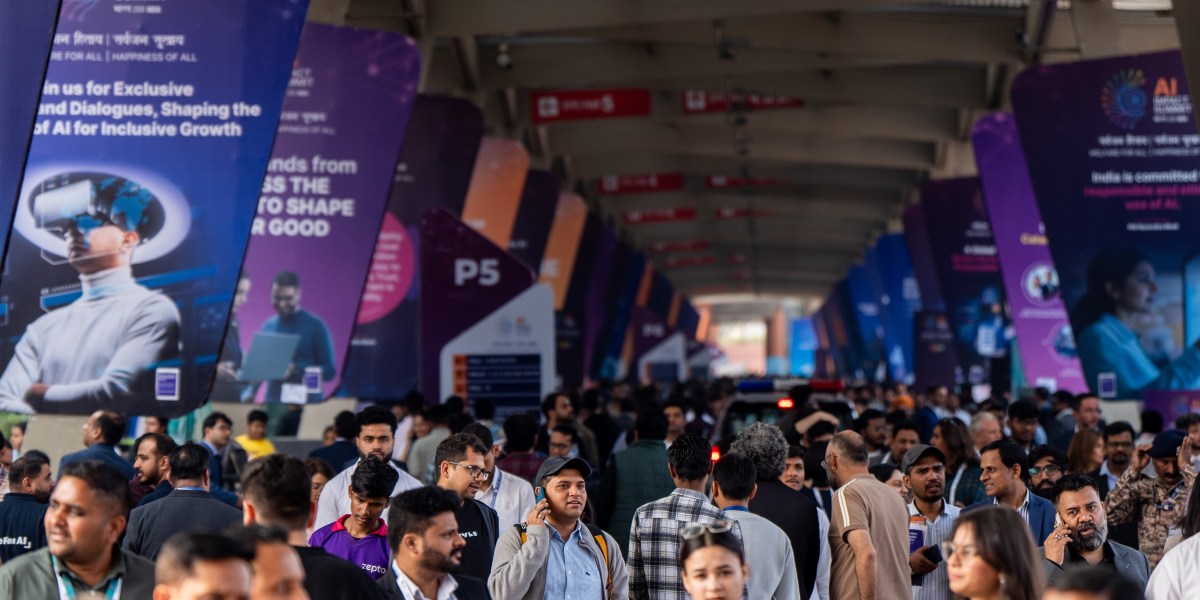
For five days, New Delhi became the capital of the global AI debate, hosting heads of state, Big Tech CEOs, and policymakers who, between them, hold much of the power to determine how this technology develops.
When delegates finally made it through New Delhi’s gridlocked streets, the question was whether the world’s most ambitious AI gathering could produce tangible progress on the industry’s hardest problems: who controls the technology, who bears its risks, and who gets to share in its rewards.
India’s AI Impact Summit was the fourth in a series of global AI summits, following those held at Bletchley Park in the U.K., Seoul, and Paris, and the first to be held in the Global South. Many were hoping the Summit could help to forge a credible path for middle powers to shape the AI era and ensure that the technology’s benefits aren’t concentrated among a handful of American and Chinese companies.
The week was big on investment, thinner on binding commitments, and left some of those hoping for a genuine shift in global AI governance walking away with mixed feelings.
The New Delhi Declaration
The Summit’s main achievement was 88 countries and international organizations adopting the New Delhi Declaration on AI Impact—a non-binding agreement built around principles of inclusive, human-centric AI development. When the declaration, which was widely expected on Friday, eventually emerged late on Saturday both the U.S. and China had endorsed the declaration.
The declaration’s ambitions are broad: democratizing access, expanding AI’s role in healthcare and education, and ensuring ethical safeguards and transparency. But there are also significant gaps. While the declaration calls for equitable AI, it sidestepped the reality that the computing power, data, and the know-how to build frontier AI models remains concentrated in just a handful of economies and corporations. As is perhaps inevitable from a multilateral declaration, the operational details are also thin.
At the Summit, many attendees were nervous about AI’s tendency to further consolidate power in the hands of the already powerful. Much of the global AI industry is dominated by a few American corporations, whose proprietary frontier models and computing infrastructure underpin a significant share of global AI development. China is the other major player and together the two nations control roughly 90% of global AI computing infrastructure. While some countries and companies are building their own foundation models, and open-source alternatives are growing, few can yet compete at the frontier.
“If you only saw the photo ops, you’d think the Summit was exclusively about Silicon Valley’s Impact in India,” Mark Surman, the president of Mozilla, told Fortune. “But beyond the cameras we saw real hunger from countries, companies and communities to come together and build AI that is open source, sovereign and culturally tailored.”
In Europe, where questions about the reliability of American partnership have become more explicit following U.S. President Donald Trump’s efforts to acquire Greenland, this duopoly of power is causing acute concern.
“Many of my U.S. colleagues (and, from my impression, the U.S. administration) genuinely don’t seem to get how much Greenland changed things for the EU and other relevant countries,” Seán Ó hÉigeartaigh, director of AI FAR at the University of Cambridge, said. “Feels like they’re still reading from last year’s notes. Trying to push positions and strategies that will no longer work.”
Arthur Mensch, CEO of French AI company Mistral, tackled the issue more head on in his keynote, arguing that as AI comes to represent an ever-larger share of global GDP, every organisation running AI workloads—every government, every hospital, every public institution—needs genuine access to what he called “the turn on and turn off button.” Dependency on external providers who could withdraw access at any moment is not an acceptable risk in our AI-powered future, he argued.
“If you have the impression that you have a trustworthy partner…then it’s fine to rely on them,” Bengio said of the concerns in a Tuesday interview. “But if you see the opposite, then you want to be preparing Plan B. It’s a question of democracy and a kind of equitable world order in which no one country can use technology to dominate the others. We don’t want to end up in a world where we have two hegemons who each control part of the world.”
The concerns were not lost on Washington, with Michael Kratsios, director of the White House Office of Science and Technology Policy, making it clear with his Summit address that the U.S. had little appetite for global governance. Kratsios rejected the prospect of centralized oversight and pushed the idea of “sovereign AI capability”: where countries adopt U.S. technology as the backbone of their AI infrastructure and build out independent AI capabilities on top.
“Real AI sovereignty means owning and using best-in-class technology for the benefit of your people,” he said. “It does not mean waiting to participate in an AI-enabled global market until you have tried and failed to build full self-sufficiency.”
“Complete technological self-containment is unrealistic for any country, because the AI stack is incredibly complex. But strategic autonomy alongside rapid AI adoption is achievable, and it is a necessity for independent nations. America wants to help,” he added.
In a boon for the U.S., on the sidelines of the Summit, India joined Pax Silica, a U.S.-led technology alliance aimed at building secure semiconductor supply chains, advanced manufacturing networks among strategic allies, and counter Chinese AI efforts. The group already includes Japan, South Korea, the U.K. and Israel. The move signals a significant warming in the U.S.-India relations after a period of friction over India’s previous purchases of discounted Russian oil.
A pair of safety commitments
The other tangible output was the New Delhi Frontier AI Impact Commitments, a set of voluntary agreements announced by the Indian government and endorsed by leading frontier AI companies. Participating firms, which included Indian companies alongside global frontier AI firms, signed on to two core commitments.
The first focuses on transparency around real‑world AI usage. Companies agreed to analyze and publish anonymized, aggregated insights into how their AI systems are used, to help policymakers and researchers understand AI’s impact on jobs, skills, productivity, and broader economic transformation. The second focuses on inclusion with companies committing to strengthening testing and evaluation of AI systems across underrepresented languages and cultural contexts, especially in the Global South, so that frontier AI models become more reliable and accessible beyond English‑speaking markets.
“That there were any commitments at all is a good sign,” Stuart Russell, a leading computer scientist said of the commitments. “I hope that it’s the beginning of a process leading to binding international agreements whereby governments ensure the safety of their peoples.”
Some, however, felt the commitments didn’t go far enough and ignored many safety issues discussed at the summit. “So many risks from child safety to national security risks to loss of control were discussed in the corridors with greater urgency than ever but didn’t make it to the official outcome,” Mark Brakel, director of policy at the Future of Life Institute, said.
Those hoping that the Delhi Summit would use this moment to establish a more structural, genuine coalition of middle powers to contest the current duopoly, while enthusiastic about the conversations taking place, were somewhat left unimpressed with the lack of concrete progress achieved. Some policymakers described the event as a natural progression from the Paris Summit, which kicked off the shift in priorities from governance to commerce, and left the summit often feeling more like a trade fair than a diplomatic summit.
A flood of investments
On the business side, the summit was considerably more successful, at least from the Indian perspective. The five-day event generated a wave of major investment commitments in the country, with Electronics Minister Ashwini Vaishnaw saying over $200 billion in AI and deep tech investment is expected in the country over the next two years.
India’s own conglomerates likely make up a large part of this. Reliance Industries and its telecom arm Jio pledged $110 billion over seven years to build AI and data infrastructure, with chairman and managing director Mukesh Ambani citing compute cost as the central bottleneck to AI adoption. Adani Group matched that ambition with a $100 billion commitment to renewable-powered AI data centres by 2035. Infrastructure giant Larsen & Toubro, meanwhile, announced a venture with Nvidia to build what it is billing as India’s largest AI factory.
American tech companies also announced significant investments. Microsoft said it is on pace to invest $50 billion across the Global South by 2030, building on $17.5 billion already committed to India last year. At a Wednesday press briefing, Google also announced a $30 million AI for Government challenge and a separate $30 million AI for Science fund, alongside a new climate technology centre in partnership with the Indian government. Blackstone also led a $600 million equity investment in Indian AI cloud startup Neysa, while AMD expanded its partnership with TCS to deploy up to 200 megawatts of AI infrastructure capacity in the country.
OpenAI also agreed to be the first customer for TCS’s data centre unit under its Stargate initiative, while Anthropic revealed that India had become its second-largest market and opened a new office in Bengaluru.
If India was hoping its flashy AI Summit would show the world it was a major player in the AI investment boom, it largely succeeded. But some felt the investments masked the harder question of whether India, or anyone outside the U.S.-China bloc, has yet found a credible path to shaping the future of the AI era rather than simply jumping on for the ride.




-1024x683.jpg "The Key Battles for Senate Control Are Set")