Prediction markets, like Polymarket and Kalshi, have captured billions in venture capital fundraises and total market value. This subsector of trade finance is commanding attention from financial analysts and regulators alike, though questions abound surrounding the legality of prediction market platforms.
Processing Content
Prediction markets are, officially, exchange-traded platforms where participants buy and sell contracts, known as futures or events contracts, based on the outcome of future events such as elections, economic data or sporting event outcomes. Prices reflect the aggregated probability of an event occurring, and the contract matures when the future event either does or does not occur.
For instance, on Monday, Kalshi users were betting on who President Trump will nominate to be the next Fed chair. Most – 94% – were predicting Former Fed Governor Kevin Warsh, while 4% forecast Judy Shelton, a former economic advisor to Trump.
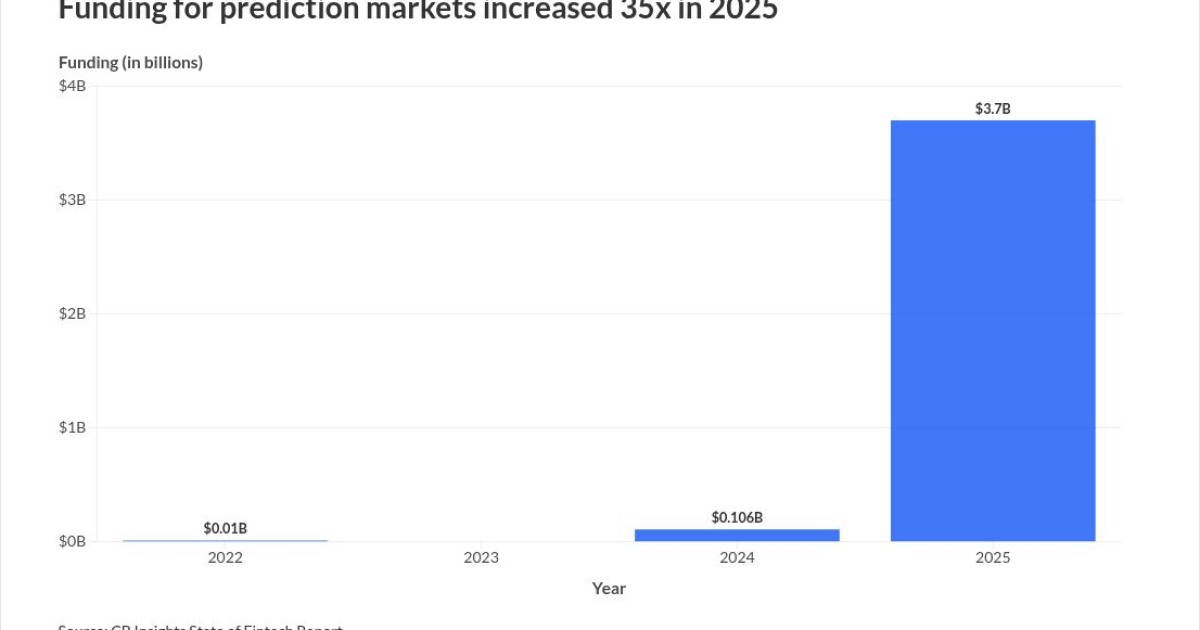
CB Insights’ figures on fintech venture capital funding for 2025 found that the prediction markets space collectively received $3.7 billion in funding in 2025, an approximately 35x increase from the prior year’s $106 million. (A CB Insights report initially attributed the total amount of 2025 prediction market funding as $1.7 billion, but a CB Insights analyst told American Banker that the firm has since updated its total to $3.7 billion to include a promised $2 billion investment into Polymarket from the Intercontinental Exchange in November 2025.)
CB Insights noted that most of the equity funding coming into the predictions market industry is focused on the two largest competing firms: Kalshi and Polymarket. Kalshi raised $1.485 billion across three fundraises in 2025, and Polymarket raised $2.15 billion with two fundraises.
The two companies, which are competing for venture capital investment (and partook in multiple high-profile marketing stunts with free groceries for New York City shoppers), commanded 98% of VC funding for 2025 and hold a combined 64% of total market share for prediction markets, according to Pitchbook.
“Polymarket and Kalshi, which both became unicorns in 2025, are dueling for funding, talent and partnerships,” the CB Insights report said. “In Q4 alone, Kalshi more than doubled its valuation to $11 billion following a $1 billion Series E, while Polymarket’s recent raise caused its valuation to [increase by] 9x to $9 billion.”
Pitchbook senior analyst Rudy Yang has been tracking the rise of prediction markets, and he argues that they will become a “new information layer” for the finance industry.
“Weekly notional volumes surpassed $5 billion in December 2025, evolving from niche betting platforms into legitimate financial information inputs used by institutions and media,” Yang wrote in Pitchbook’s 2026 state of the fintech industry report.
Notional volume is a term used by traders to refer to the total value of the underlying assets in a contract, and does not reflect the exact cash paid. It is usually calculated by multiplying the contract price (typically $1.00) by the contract size or number of transactions. Prediction market analysts use notional value to analyze and compare risk.
Yang argues that prediction markets should be taken seriously by financial institutions due to the information they can provide to analysts and investors, and that increased scale in prediction markets could improve their market estimates.
“Prediction markets work by turning many individual views into a single probability,” he wrote. “Prices reflect the aggregated beliefs across many participants and allow more information to be surfaced. Markets with strong volumes and liquidity tend to produce probabilities that align closely with real outcomes. Further participants and higher activity improve liquidity and reduce noise, making prices more stable and informative over time.”
Yang noted that prediction markets intersect with decentralized finance and artificial intelligence, both of which are hot topics of conversation in the banking and finance industry.
“Blockchain and decentralized finance strengthen prediction markets by enabling tokenized contracts, deeper liquidity and automatic settlement through smart contracts, which naturally suit event-based outcomes,” he said. “Separately, prediction markets will be a key tool for AI agents, as they concentrate massive amounts of real-time information into prices that can surface new signals and inform investment positioning.”
Investing platforms and finance news media outlets are already using the information that prediction markets provide, according to Yang. For example, Kalshi now has partnerships with companies such as Robinhood, Coinbase, CNN and CNBC.
“Asset managers, hedge funds and research teams have increasingly begun to monitor these signals alongside polls and forecasts,” he said.
Goldman Sachs CEO David Solomon said on the investment firm’s annual earnings call in January that the firm is actively exploring its options for prediction markets as well.
“I’ve personally met with the two big prediction companies and their leadership in the last two weeks and spent a couple of hours with each to learn more about that,” he said in response to an analyst question on the call. “We have a team of people here that are spending time with them and are looking at it.”
Coinbase has also expanded into its own prediction market products as part of its diversification strategy that it calls the “Everything Exchange,” including announcing an acquisition of prediction markets firm The Clearing Company in December of last year.
Similarly, Robinhood launched a futures trading product in October 2024 and closed on a deal in January of this year to acquire a 90% stake in a CFTC-licensed digital currency futures exchange and clearinghouse called MIAXdx.
“Robinhood is expanding into both prediction markets and banking products,” CB Insights intelligence analyst Aisha Chandraker told American Banker. “As the largest public fintech incumbent in retail trading, I would say it’s uniquely positioned to span these sectors.”
Robinhood CEO Vladimir Tenev told investors in the firm’s annual earnings call on Feb. 10 that “prediction market volumes more than doubled yet again, with over 12 billion contracts traded in 2025, which is the first full year of prediction markets. Customers have already traded over 4 billion [contracts] so far in 2026.
“I think we’re just at the beginning of a prediction markets supercycle that could drive trillions in annual volume over time,” Tenev said later in the call.
The potential growth of prediction markets, however, could be throttled by regulatory disputes. Lawsuits have been filed nationwide calling into question whether prediction market firms should be treated as federally regulated financial exchanges or as gambling operations that should be regulated like state-licensed sports books.
After a 2018 Supreme Court ruling that overturned a federal ban on sports betting, the practice is currently legal in 38 states as well as Washington, D.C., and Puerto Rico. The Commodity Futures Trading Commission, or CFTC, currently regulates prediction markets, and that federal oversight allows Kalshi, Polymarket and other prediction markets to operate in all 50 states, even those where gambling is illegal.
Michael Selig, chairman of the CFTC, indicated that he is open to overseeing the growth of events contracts as a regulated form of exchange trading.
“It is time for clear rules and a clear understanding that the CFTC supports lawful innovation in these markets,” Selig said in his first public remarks as chairman at a joint CFTC-SEC event on Jan. 29. “Consistent with my commitment to fostering responsible innovation in crypto asset markets, I will continue to support the responsible development of event contract markets and the important role they play in the broader financial system.”
Selig was appointed to the position by President Trump in October and was confirmed in December. President Trump’s son, Donald Trump Jr., invested an undisclosed amount in Polymarket in August 2025 through his venture capital firm 1789 Capital and is on the advisory board for the prediction market. He is also a strategic advisor for Kalshi as of January of this year.
Securities and Exchange Commission Chair Paul Atkins said in testimony before the Senate Banking Committee on Feb. 12 that the Wall Street regulator could soon involve itself in the regulation of prediction markets. In response to a question from Pennsylvania senator Dave McCormick, Atkins said that “prediction markets are exactly one thing where there’s overlapping jurisdiction potentially,” adding that “it’s mostly, at least currently, on the CFTC side, but we need to be harmonized in the way we’re addressing these markets.”