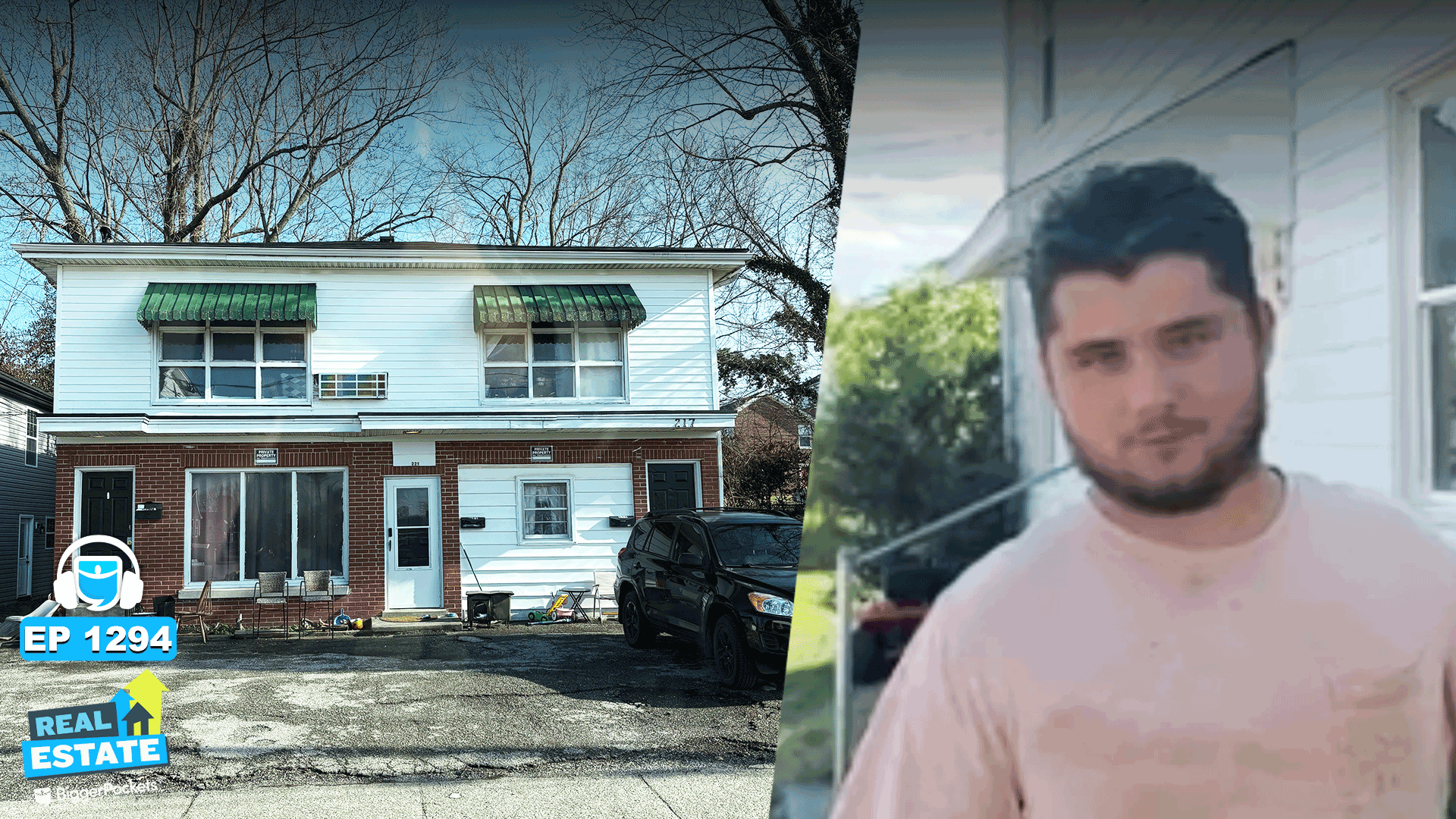
Britton Eads was making $15 per hour putting up fences all day. He had no college degree; he dropped out of the electrician trade and didn’t have many other options. One day, he read Rich Dad Poor Dad, and realized his life didn’t need to stay on the same track it was going.
Now, just four years later, he’s got over 15 rental units, his rental income replaced his fence job, he’s sitting on $200,000 in equity across his portfolio, and he couldn’t be happier. It only happened because he took action instead of second-guessing himself.
Britton’s story is one of the wildest we’ve heard. Everything from burst pipes to ceiling holes, very low appraisals, and funding mishaps. But it didn’t stop Britton from pushing forward and creating the wealth he knew was possible. He just had to learn from his mistakes.
If you feel like you’re stuck, wanting to get into real estate investing, but thinking you don’t have the cash, the income, or the experience, there is no better guest than Britton to prove you can start—you just need to start.
Henry:This has to be one of the wildest, funniest episodes I’ve ever recorded on this podcast. Britton Eads tried college and then he dropped out. He tried joining the electricians union, then he dropped out. Now he was working for a fencing company getting paid just $15 an hour. And you know what he did with his paychecks? He spent every dollar he had on rental properties. He bought a duplex, then a fourplex, then seven more units while making just $3,000 a month. He made the classic beginner mistakes. He bought a house without ever going to look at it. He didn’t get an inspection, had pipes burst just two weeks into owning his first rental. Oh, by the way, don’t ever do half the stuff he mentions early on. But what he didn’t do was give up. Now he’s got over 15 rental units that have replaced his paycheck and built him over $200,000 in equity.He used that equity to buy more properties when he didn’t have the money, got seller credits to fund his renovations and did it even with 8% interest rates. Britain had every excuse not to be successful in real estate and he made it work. This is how you can do it too.What’s going on everybody? I’m Henry Washington, host of the BiggerPockets Podcast and we have an investor story for you today. We have investor Britton Eads out of Kentucky. Let’s jump in. Brittany Eades, welcome to the BiggerPockets Podcast. Oh,
Britton:It’s good to be here.
Henry:Man, so good to have you. For our audience, why don’t you give us a little bit of a peek into your background and how you first got into real estate.
Britton:So I graduated high school in 2021. I was 18 years old and when I graduated, I didn’t really know what I wanted to do. So I went to college for about six months and then I dropped out. So then I joined the electrician union. My dad wanted me to do that. So I went to electrician union for probably another six months and then the school started and I thought, well, I don’t think I really want to go and do the school because they was wanting us to go and work all day and then go to school for like two or three hours at night after work. And I was like an hour away from my house where I was having to work at. So while I worked there, my wife, well, it was my girlfriend, but now my wife, her grandma gave me the book, Rich Dad, Poor Dad.And I read it and as soon as I read it, I was like, wow, is it really this easy to go and buy real estate or start a business and not have to work and become financially free through real estate investing?
Henry:All right.
Britton:So then I was like, “Well, I don’t really want to go to school anymore.” So then I quit doing that. Yeah,
Henry:We picked up on that. I noticed the theme of you not wanting to go to school amongst your story, which was fair enough. School isn’t for everybody.
Britton:I
Henry:Get it. I get it.
Britton:I got lucky probably to pass high school. Not really. Not really. I had A’s and B’s, but I hated every single second of it. So after that, I went back to work for my dad and I started looking for properties and listening to podcasts. That was 2022. And by the end of 2022, December, I bought my first property. It was a duplex for $70,000.
Henry:Wow.
Britton:But when I bought this duplex, I had never seen it. I didn’t do an inspection. I didn’t even know how old it was. I didn’t know anything about it.
Henry:You just knew how much it cost?
Britton:I just knew how much it costed. Honestly, the guy asked me, he said, “I want 80,000.” I said, “I’ll give you 70.” And he said, “Okay.” He just wanted rid of it.
Henry:All right. Okay. All right. Hold on. First and foremost, what I like about what you told me about your story is it was action-based. You took massive action, you started looking for properties, you found something to buy. I do not love the fact that you didn’t see it, nor did you get an inspection.
Britton:I didn’t even know how old it was.
Henry:That’s
Britton:Wild. It ended up being over a hundred years old and I had no idea.
Henry:No, no, no. It didn’t end up being over a hundred years old. That thing was over a hundred years old well before you made an offer on it. You just didn’t research enough to know that it was a hundred years
Britton:Old. No.
Henry:But you took some action, you didn’t go see it. So how far away from you was the property? Was it a drive to go see it or was it close to you?
Britton:So it was about 30 minutes from where I lived at.
Henry:Okay.
Britton:So you should
Henry:Have went to see it. Got it.
Britton:Yeah, I should have went to see it. I was working every day and honestly, I just knew I wanted to buy real estate. That was all I was really worried about. So it was rented for about $1,000 a month. So when I bought it, at first I was making about $200 a month off of it.
Henry:Some information that was great was you knew that it was rented prior to you buying it, which means it should at least be in somewhat of a livable condition.
Britton:Somewhat, yes.
Henry:Somewhat. But let’s talk about the actual property. You paid $70,000 for it. You didn’t have to do any renovation at that point.
Britton:So the people that had lived there had lived there for four or five years. So technically I didn’t have to do any renovations, but I had listened to Robert Kiyosaki and Ken McElroy in bigger pockets and I thought, well, let’s see if I go and put some money into this property if it’ll appraise for more and if I could get more rent on it. So it’s about six months before I decided to go through with this. So I went back to the bank and I said, “I want to go and fix this property up and see what it’ll be worth. I think I can get. ” I ended up getting $1,800 a month in rents.
Henry:Oh, wow.
Britton:So what I ended up doing, I put a $30,000 into this property. I put a roof on it. I put many splits in it. I put LVP flooring in it. One of the apartments had an old claw foot bathtub and we actually took it out and put a new shower in, a bathtub, shower combo. And we actually got the property fixed up pretty nice and we ended up rerenting it for $1,800 a month. But the craziest thing about it is I paid 70 for it. When I bought it, it appraised for I think 85,000. I put $30,000 into it with the construction loan from the bank and it still only appraised for $100,000. Oh,
Henry:Wow. So $70,000, that was a conventional loan that you
Britton:Used? So here where we live at, these local banks, they call them commercial loans and they’re on a five-year term and they’ll do 15, 20 or 25 years. That one was a five-year term, 20 years. I think the interest rate was eight and a half when I first got it.
Henry:Okay. So you did a commercial construction loan, 15% dam. It’s on a five-year adjustable rate. Typically, that means you’re on interest only payments while you’re fixing it up as well. They gave you 30 grand to fix it. So you paid 70, you put 30 in it, you’re all in for a hundred. Good news, it’s renting for 1,800, which is definitely positive cashflow. So that’s excellent cash flow, but you didn’t appraise for enough to pull your cash out. So were you able to refinance at all? Did you do like a rate and term?
Britton:Yeah. So whenever I got that loan, when I first got it, it was five years fixed, 20 years amortization and then five year balloon. So when I refinanced it, I refinanced it and it was I think 8.5% for just one year on the construction loan of it. So I had a year to fix it and then I had to come back and refinance it again after that. And I refinanced a five-year term on a 20-year amortization again and I couldn’t pull anything out because I didn’t have really any equity, but I think my payment was $697 a month. My insurance was $100 a month, taxes was about $100 a month and then I was putting back about $300 a month for fixing things. So I was cash flowing five or $600 about every single month.
Henry:So my first question is, did you learn some lessons with that first one that you applied now
Britton:To
Henry:Your second deal so that you didn’t repeat the mistakes? Because I’m just going to be honest with you, Brittany, some of the mistakes that you made on that first deal, if you were to repeat that now in the 2025, 2026 market, you would be in a world to hurt, right?
Britton:Yeah.
Henry:But A, you bought something that had a ton of cash flow in it, which was great. Did it appraise for what you wanted? No, but you’re cash flowing. So you’ve got positive income coming in, which is great, but hopefully you learned some lessons that you applied to the second deal.
Britton:So after I bought that one, it took me about a year and a half to buy my next one, which was April 2024. And when I bought it, I bought a fourplex and I actually bought that one on FHA. So I only had to put three and a half percent down on it and you have to live in it for a year, but I was able to get a $245,000 fourplex with about $7,000 out of pocket. So I met my mentor, Hank, and I asked him like, “What do you think something like this would rent for? ” It was three two bedrooms and one one bedroom unit. And when I bought it, the old landlord had put in a roof on it, it had new HVACs and it was only rented for $1,200 a month. The one bedroom was rented for 600 and the two bedroom was rented for 600 and two of them were empty and they was in really bad shape.I don’t know how it really passed the FHA inspection because they’re really strict on it. So we went and fixed that unit up. We put LVP flooring in it, tore that wall out and we rented that unit for $950 a month to a tenant on section eight and I paid the water bill, which was, it’s about $50 every month. So we had that one rented for $900 a month. And after that happened, I thought, well, if this one just rented for 900, I can easily rent the other one for that.
Henry:I like that you waited. You didn’t jump and rush right into the second one. And I also liked that you did an FHA loan. So give us just a recap of the numbers on this one. Your purchase price for this property was how much?
Britton:It was 245,000.
Henry:Okay. About how much money would you say you spent renovating the property as a whole?
Britton:Probably less than $10,000.
Henry:So you paid 245, you got 10K in it, you’re all in for 255 and what are your total rents on that property now?
Britton:I’ve got three of those units on Section eight. So I’ve got three of the two bedrooms rented for $900 a piece and then the one bedroom’s rented for 850. So right now we’re getting about 3450 in wrench on that.
Henry:3450 on a property you’re all in at 250 and some change I would say is a good solid cash flowing deal, especially since you used an FHA and
Britton:You only
Henry:Had to put seven and a half thousand dollars. How did you find it? Was this an on market deal or was this a pocket listing? How did you come across this deal?
Britton:So every single property I have bought besides the first duplex I bought has been off Zillow. So I was looking at where we live at in Richmond and most of the time fourplexes here where we live at, most of them sell for a little over the 1% rule. So they’re between 350,000. Some of them is 400,000, which 400,000 is on the high end. But I knew that this was a really, really cheap fourplex because you couldn’t find another fourplex for this price where we live at. Now, it was in really bad shape. The owner had taken care of the outside. It had a new roof. Some of the siding was new. The HVACs were new, but he didn’t touch the inside of these two units. They had old wood floors that he had just painted black.
Henry:Landlord special.
Britton:When people went and looked at it, he went and had a huge hole cut in the ceiling of one of the units because one of the toilets had licked upstairs and he was too lazy to come over and fix it. So people were going and looking at it and they’re looking at that and they’re looking at these other two units and they’re like, “Well, this guy hasn’t done any work to this thing since he bought it. ” So I think a lot of people, they see properties like that that are ugly and that need work and they don’t want to go and buy a property like that because it had been on Zillow for I think six months.
Henry:Okay, cool. Thank you for sharing. And look, I know I’m laughing and joking with you, but I 100% appreciate the honesty and transparency because there are lessons to be learned in wins, there are lessons to be learned in mistakes. And from what I know about your story, you’re doing pretty darn well as a newer and especially a younger real estate investor. One last question I had about this particular deal is, so you’re all in it for 250 and some change. Have you had it appraised? What would you say the value of that property is now?
Britton:I had an appraiser, he’s a really good friend of mine actually, but he’s probably 70 or 80 years old. I’m not too sure how old he is and he’s like, “Well, this property ain’t worth but 260 or 270 and there’s no fourplexes that sell for that where we live at.” And I got a friend of mine that lives in a little bit of a bigger city and sees some higher prices sometimes and he came back and reappraised it for closer to what I thought it would be worth, which was 322,000. Well,
Henry:That’s awesome. If you got a $322,000 appraisal, you absolutely have some equity. So this sounds like a decent deal to me, positive cashflow, great rents, and you’ve got some equity in the deal. One thing I want to discuss with you is you had mentioned that you found a mentor and that mentor helped you learn how to scale and I want to dive into kind of how you met that mentor and how you’ve implemented some of his teachings, but we’re going to do that right after the break. All right, back on the BiggerPockets podcast with investor Briton Eads, who has told us all about his first two deals. First deal was a duplex that he paid only $70,000 for. He bought it side unseen and turned out to be a decent deal, positive cash flow, maybe didn’t get the appraisal you wanted, but you were making money.You waited about a year and a half, you bought your second deal, a quadplex, which the numbers sound really amazing on. But as you were telling us that story, you had mentioned that you met a mentor with about 800 doors. I know a lot of new investors are looking for people who would mentor them. So can we just talk for a second about how you met this guy and how your relationship is and what kind of advice he was giving you on your real estate journey?
Britton:So after I bought my first duplex, I got stuck. It took me a year and a half, but I would have rather have bought something the next day if I would have had the money or if I even could have found it. And my mom is actually the, I don’t know, she’s like a vice president I think at one of these banks over here where I live at. And I just asked her, I was like, “Mom’s like, do you know anybody that owns a bunch of apartments? I mean, you have to see these people all the time and stuff.” She’s like, “Yeah.” And she gave me this guy’s name. His name was Hank Ballinger and he owned then 800 and something apartments in the city where we live at. And whenever I met him, he was doing a class. So it was a one-on-one class.I think it was $500 and I went there and met him every single day for about six weeks and he really just taught me about how to know if a property is a good deal, the 1% rule and to make sure that every property that you buy cash flows and to not just buy cheap properties like I did at first with the duplex, but to buy in areas that will appreciate but also cashflow at the same time so you can hold those for long periods of time and ride that appreciation up over longer periods of time. He taught me things like that and he taught me a lot just about to get inspections on properties when you go to make sure you walk properties when you do buy them.
Henry:He taught you a few little things like go see a house before you buy it, maybe have somebody check it out before you close on it. Look, again, I tease, but I like this because you did what I think where I think everyone should start. You utilized the resources that you had first in order to try to help you make connections. So not everybody listening is going to have a mother that has a position at a bank where they can introduce you to somebody, but you probably have someone in your network somewhere who knows people in real estate. Everybody’s got a friend or a cousin or somebody who’s an agent, right? Start with who’s in your network and tell them what you’re doing and ask them to make connections. Those connections can lead you to other connections. And so if you’re listening to this and you want to mentor, start with the people in your network, see who they know, go to lunch, go to coffee and then ask them if there’s somebody else in their network now that they know a litle bit more about you and what you’re looking for, is there someone else in their network that they can connect you to so you can have your next meeting and you could be well on your way to meeting your next mentor.So Mr. Britton, you now have done two deals and they are positive cashflowing deals. One of them has a good amount of equity in it, but if I’ve learned anything about you in this conversation, the last thing you want to do is sit on your hands with this gunpowder and this mentor who’s teaching you how to scale. So what the heck did you do with all this information? What was your next deal?
Britton:So after I bought the fourplex in April of 2025, I found a triplex and a house that was on Zillow. Again, they’re asking $185,000 for a triplex and a house.
Henry:So you found a triplex and a house listed online for $185,000. Something’s not right with that. That doesn’t math to me based on the numbers you were telling me. So why 185? What was wrong with that?
Britton:So the house was just a litle cottage behind it. When I say it was a house, it’s only like a 500 square foot house. It wasn’t reallyTechnically wasn’t really a house and they were just on one lot and the triplex was in pretty bad shape when I bought it. But the greatest thing about it was when I went to look at it and I noticed that there was another triplex next door that looked identical to the other one and I noticed that there were seven mailboxes on that one porch. So we called the other realtor and luckily they actually owned the other triplex too and I said, “Well, would he want to sell them all together?” And he said, “Yes.” So we went and looked at it and two of these units were tore all the way down to the studs and the one was rented I think for $600 a month and they were all rented total for $3,200 a month. And when I looked at them, two of the units were tore all the way down to the studs on the other one and he only wanted $80,000 for that one.
Henry:So 180 plus 80 would get you everything.
Britton:185 plus 80 got me everything and we went and I was like, “Oh my God, this should be worth between 400, 450,000 if it’s all fixed up and I could get these re-rented for about $6,000 a month.” So I went ahead and I had about $1,500 in the bank and I wrote $1,000 check to put those under escrow and I had about 45 days to close on these. So I’d done what anybody would do and I went to the bank that done my other loan. I said, “Hey, I found these properties. They’re this much. I’ll have them rented for this much. They’re rented for 3,200 right now.” And the first thing he asked me, he said, “Well, do you have the down payment?” And I said, “Yes.”
Henry:People are going to hear this story and going to think you got lucky, right?And is there some element of luck in finding something like this? Sure, there’s a small element of luck. What isn’t luck is if you are consistently looking for deals, if you make it your job to look for properties to buy, when deals like this come across, you’re able to find them because you’re consistently looking. Two, Dave Meyer and I talk about this all the time. There are tons of properties listed online. I like to call them misclassified listings where sellers or agents for some reason have no idea how to market properties and things are not marketed correctly. It takes a little bit more of a keen eye. So you saw what looked like a deal, you went to the property and you didn’t just look at what was in front of you, but you looked at what was next door and you noticed some things.You noticed that the property next door looked exactly like the property you were at. You noticed that the owner of the property, once you did a little research, owned that property too. And then you did what I think every real estate investor should do, which is ask, “Hey, do you have anything else you’d be willing to sell or would you be willing to sell everything?” So now you find yourself under contract for a property for $265,000 for seven units, two triplexes and a single family home for 265,000. But the key, the thing that I think is important about this deal is the current rents. Current rents were above $3,000, which means as the property sat the day you paid for it, it was cash flowing.That means you’re buying yourself a good deal because everything else that you force in terms of cashflow down the road is additional icing on the cake.And this wasn’t that long ago. This was 2025, correct?
Britton:Yeah. So I seen it in April 2025. We closed May 2025.
Henry:Absolutely. So people say there are no good deals out there. There are deals out there. You got to have a different pair of eyeballs than everybody else to be able to see things that other people don’t see. But I like the fundamentals of this one because as the property sat, even though it was in bad shape, even though there were two units down to the stud, the property was making money and that opens up options for you in terms of how you’re able to finance the deal. So you’ve got this thing on the line for 265. The banker asked you, did you have the down payment? And you said, yes, I did the exact same thing on my first deal. I absolutely did not have the down payment, but the banker asked me, did I have it? And I said yes, because all that means to me is I got time to go find it, even if I don’t have it in that moment.So talk to me about the financing of this one. How did you take this deal down?
Britton:So I was part of this other community and they had other people in there that were millionaires and I just got on there and posted. I said, “Hey, I got this property under contract. It should be worth about $450,000 whenever y’all finished. The rent will be 6,000. I’ll do 10% interest only a month for one year and a 10% balloon payment when I refinance the property.” So within two weeks, I had somebody message me. They said, “Hey, we’re interested in doing it. ” I talked to them on the phone twice and a couple days after that they sent me a wire for $46,025. The $25 was the wire fee. So a couple weeks after that, I took that money and took it to the bank and we closed on that property, but that’s where the money come from for that. And so I bought it, put the money down and then they gave me a permanent loan on that, which was a earlier five year term, 20 year amortization.And then they just added the construction loan on top of that, which was another, I think, $40,000.
Henry:So 265 purchase price, $40,000 renovation. You’re telling me this entire property only needed $40,000 worth of work?
Britton:I’d done it all again.
Henry:Okay. So some sweat equity. So you got a $40,000 line of credit. So again, what you’re using and what you’re explaining is the essence of community banking. They typically are going to finance you a commercial loan. So you had to put 15% down. You borrowed that 15% down from another real estate investor in the community you were at. So essentially 265, 15% down that you borrowed, you were paying 10% interest only on the down payment money and then you had a commercial loan for the rest. $40,000 of the renovation. How long did it take you to do that work and did it truly end up being 40 grand or did you have to spend more?
Britton:It was close to 40,000. The same guy that I got to appraise the Fordplex, I got him to appraise those and those actually came back. Like I said, I had 305 in them. Those came back at $545,000.
Henry:So with that appraisal, what were you able to do?
Britton:So what I’d done after I got that property all fixed up, I got it rented for $6,000 a month. It reappraised for 545. I found another duplex and this was actually before I got the appraisal on that one and I put it under contract. It was 250,000. It was rented for $1,400 a month. It was a three bedroom, two bathroom, 2,900 square foot duplex. They’re selling for 320 to 340 every single day here where we live at. And again, just like the seven units, I was the very first person to see this property. There’s two people behind me. We all three looked at it the same day. Those two people made offers. I made an offer for what they was asking because I knew that’s what it would be worth fixed up and I bought that property again and the way I bought it was I still only had probably $3,000 in the bank because I hadn’t refinanced those other ones yet.I actually took the equity from one of those triplexes. I pulled it off of the loan with the other triplex in the house and I combined it on the loan with this duplex and they just added debt to that loan of $50,000 for the down payment of that duplex.
Henry:All right. For those listening, what you are explaining, Britt, is what banks like to call cross collateralization. So because you had a property with that bank that had equity and you had another deal under contract, which the bank saw as a good deal with potential equity, what they allowed you to do was to combine those loans or tap into the equity of one property, tie all those together and so now you have a larger loan, but what the bank is concerned about in these situations is what’s the loan to value. In other words, how much money are we allowing you to borrow in relation to what are the property values worth? And so what the bank was saying is that there is enough value here for us to be able to allow you to cross collateralize this portfolio and what they call this is a portfolio loan.So now you’ve got a portfolio loan on multiple properties that allows you to be able to do multiple deals. So you bought that second deal and to recap, it’s a duplex $250,000 purchase.
Britton:Yep. And when I bought it, it was only rented for 1,400.
Henry:Total, not per side.
Britton:Yeah, total. Yeah, total. Right now it’s rented for $3,000 a month.
Henry:So you more than doubled the rents. Did you have to put a heavy rehab in that one?
Britton:So what I done on this one basically was just on both sides, they had carpet. I ripped out all the carpet, put LVP flooring in, stainless steel appliances, painted the cabinets, redone the countertops, painted the walls and that was really about it. This property had two brand new HVACs again, just like the fourplex did and it took me about two months. I got the first one rented for 1,500 a month. Then about a month after that, I got the next one done, got it rented for $1,500 a month and that one I rented both of those sides for $1,500 a month, $3,000 a month total. But the worst part about this one was, again, like I said a minute ago, I had about $3,000 in the bank when I bought it. Well, the bank I use this time was a bank is another local bank, but they wanted to do a DSCR loan.Well, on these DSCR loans like that, they’ve got six months of seasoning. So I could not get them to do a construction loan on it, but I got the owner to do $5,000 in closing costs. For whatever reason, I got lucky enough that the bank gave me the $5,000 back at closing and I used that money to rehab the property. So again, I rehabbed it. I think it cost me about $8,000 total and this property, that duplex just reappraised for 320,000.
Henry:Britain mentioned using a DSCR loan on this property. So if you’re considering a DSCR loan, BiggerPockets.com Pro members can actually get up to $2,000 a year off of your origination through a partnership with LendingOne. So if you go to biggerpockets.com/pro and check that out, you may be able to save yourself a lot of cash when you’re doing a DSCR loan. All right, Britain, where I want to wrap up is you talking to the aspiring real estate investors who are listening to this show because what I found is new investors fall into two camps. There are people who are analyzing, analyzing, analyzing, and they don’t take action and there are heavy action takers who maybe don’t analyze enough. And I’m going to say that you fall into that latter category, but you’ve got several deals and doors under your belt now and you’ve learned a lot of lessons.So I want you to talk to those aspiring investors. We’re going to do that right after the break.All right. We are back on the BiggerPockets podcast with investor Britain Eads. Britain, first and foremost, congratulations on all the success you’ve had as a real estate investor. You took a lot of massive action. You took a lot of risks and it sounds like a lot of those risks have paid off, but I will say that there are probably people listening who’ve taken similar risks that either didn’t pay off as well or people listening who want to do what you’ve done. So you’ve done a ton of deals. You’ve had some success. Can you share with us maybe some of the most important lessons that you’ve learned as a real estate investor? And what I’d really like to hear is do you feel like there are lessons or things that you do differently now that you’ve had some success and you’ve got some deals under your belt?Because I know that there are people listening who are ready to go and do what you’ve done.
Britton:The most important thing is cashflow is making sure these properties cash flow. When I bought these properties, I kind of knew what they would be worth, but that wasn’t really the main thing. The main thing was buying properties with as little money as possible that could cash flow me the most amount of money so eventually I could become financially free because I was working with my dad and them and I hated working everyday fencing. The biggest thing’s keeping reserves too, because when I first started investing, I didn’t keep any reserves and that changed when I took all of those problems Properties I talked about just a minute ago and I combined them on all into one jumbo loan and this is the first cash out refinance I’d done. I pulled out $212,000 in one day on a cash out refinance and I was still making about $2,000 a month off of all those properties, which $2,000 a month isn’t a ton, but $200,000 to go out and buy more properties and to keep those reserves.And that’s the biggest thing I’ve learned now is that as soon as I got that money, I had $15,000 in repairs that came up that just happened in one month emergency repairs. I had $5,000 in plumbing. I had two HVACs that one of the compressors went out. Luckily, those repairs never happened before because I would’ve lost everything.
Henry:Cashflow is your safety net. Cashflow is a measure that you’ve bought a deal that you can keep, right? Because if the property is paying for itself, especially if you can get that property to pay for itself on day one, then you are protecting yourself in the event where things go wrong because you don’t have to worry about coming out of your bank account to pay for that property. That property is paying for itself. And so cashflow is great. Yes, if you want to live off of it, you can do that. But what it really does is it protects you and allows you to keep your properties because if the market changes and you’ve got cashflow and cashflow on day one, then you’re going to be able to hold onto that property. So I like that you were shopping for cashflow. I like that you’re still shopping for cashflow on day one and you’re looking for ways to add value to add to that appreciation because the true wealth is built through the appreciation.I appreciate the transparency in you sharing your story and congratulations to you on building a portfolio that has allowed you to build up some income every month. And so before we get out of here, can you just briefly talk about what is it that you were making every month when you were digging holes and laying fences to where now you’ve got a rental portfolio?
Britton:I was making $15 an hour. So I was making like two or $3,000 a month. I don’t think I ever made any more than 3,000 a month. Now I’m making about $3,000 a month with the new fourplex that I just bought. And I’ve got about, like I said, a minute ago, about a hundred thousand in cash from doing all the cash out refinances and I’m building two new duplexes that should be finished in about three months and I’ll be cash flowing about $1,200 off of those two.
Henry:That’s awesome. Congratulations on that. And what you said about learning the lesson about cash reserves is huge. Cash reserves are going to save your buck. I personally know and I know people, you can 100% buy real estate with very little of your own money, but it is almost impossible to own real estate and not have money
Britton:Because
Henry:Things break and you got to fix them. You can’t have a tenant living in a house in the middle of winter with no heat. If the heat goes out, you got to fix it. If you don’t have the money, that means you got to go find the money. You probably got to borrow it on a credit card or do something. So buying real estate with little to no money is possible, but you have to have cash reserves. Cash reserves are what allow you to keep your portfolio when things go wrong, because if things go wrong, you don’t have cash, you’re right. You could lose it all because you’re forced to sell it or you’re forced to give it back to the bank because you can’t maintain your property appropriately. So it sounds like you’ve learned from the mistakes that you have made and luckily you’ve been able to sustain any mistakes you’ve made because you bought good deals that cash flowed on day one.So please listen to the lessons here. Listen to what Britain has done, learn from the things that he maybe didn’t do appropriately at first, but what he always did was he looked for good deals to purchase so that the properties can maintain themselves. Look, man, you laugh, but this is real life, man. There are tons of people who maybe made similar mistakes but did not buy good enough deals to protect themselves. And I love that you’ve been transparent with us and I love that you’ve had some fundamentals of buying good deals. So if you’re listening to this story, make sure you are shopping for good deals. You are A, it sounds like you’re always shopping whether you’re ready to buy or not. B, you’re looking for opportunity to make cash flow on day one and opportunity to add value. Those are real estate 101 fundamentals.So I appreciate you sharing that. Thank you so much, Britain. All right, everybody. Thank you so much for listening to the BiggerPockets Podcast. I hope this was a valuable episode for you. Congratulations, Britain, on all your success. And again, thank you so much for sharing your story with our BiggerPockets audience. And as always, we’ll see everybody on the next episode of the BiggerPockets Podcast.
Help us reach new listeners on iTunes by leaving us a rating and review! It takes just 30 seconds and instructions can be found here. Thanks! We really appreciate it!
Interested in learning more about today’s sponsors or becoming a BiggerPockets partner yourself? Email [email protected].