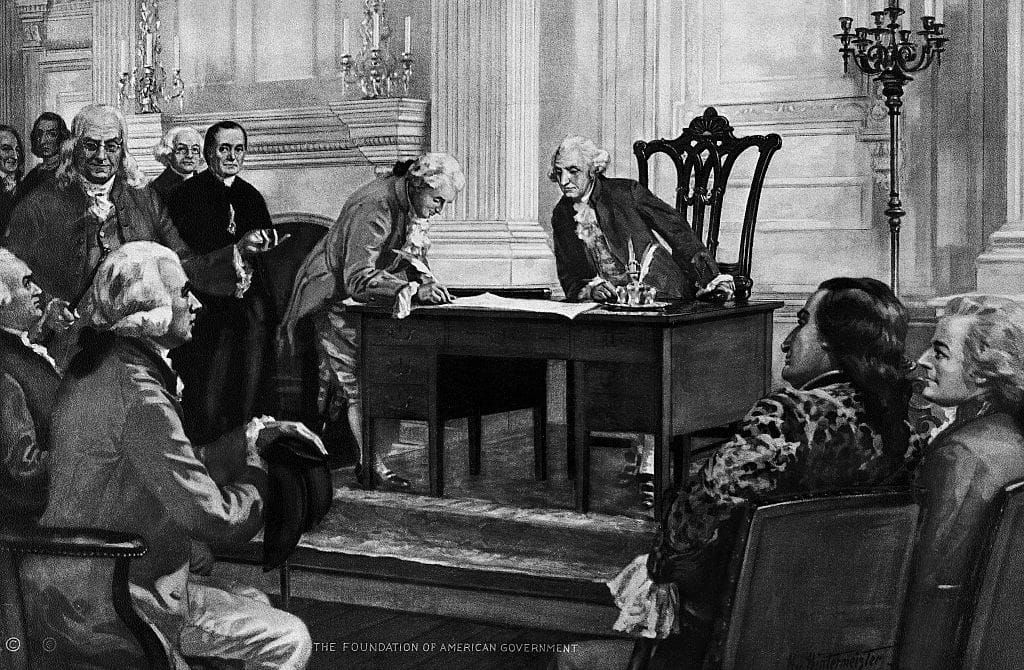
As we celebrate 250 years of the great American experiment in ordered liberty, it is instructive to remember that, in the late 18th century, it was hardly a foregone conclusion that the original 13 colonies-turned-states could forge a workable alliance. It was difficult enough to convince the many loyalists to England – maybe half the colonial population at the time – that a revolution was necessary, but getting the colonies to agree to a single document without surrendering their autonomy became a herculean task.
Lengthy and arduous debate resulted in a document that even anti-government types will admit was too weak to effectively govern such a newly established, immense, and diverse country accustomed to comfortable British paternalism. But the Founders, driven to revolt by the increasingly tyrannical rule of King George III, were in no mood to grant any more power than what was absolutely necessary to another central authority. And so, the Articles of Confederation were established in 1781, creating a relatively feeble central government with most power granted to the states.
Each state had one vote in Congress, but the inability to effectively tax, regulate trade, and enforce laws, plus the lack of an executive branch or national courts, led to all manner of financial and governing problems that prompted the Constitutional Convention in 1787. The 55 delegates actually met to revise and strengthen the Articles. Instead, they tossed it aside and framed the US Constitution, since amended 27 times, which still stands today as the law of the land.
The Advent of States’ Rights
But with this new Constitution strengthening the power of the national government, what was to become of the newfound independence of the states for which so much blood, sweat, and tears had been shed? Before the Constitution was amended with the Bill of Rights, there was precious little clarity about which powers would be specifically granted to the states or how clashes between state and federal law would be adjudicated. So, two years after the Constitution was ratified, the Bill of Rights was first proposed, directly addressing the fundamental individual rights and limits on government authority that we enjoy today. Following furious debate, it was ratified two years later, in 1791.
It was the last of the ten provisions in the Bill of Rights that answered the burning question of states’ rights beyond the one specifically included in Article I, their charter to conduct elections. The Tenth Amendment reads: “The powers not delegated to the United States by the Constitution, nor prohibited by it to the States, are reserved to the States respectively, or to the people.” So there it was, plain, elegant, concise language that is actually more about restraining federal power than expanding state authority. No new or specific states’ rights or powers of “the people” to whom it refers are listed, effectively setting up decades of debate about the powers that actually are enumerated and belong to the federal government.
Threats to Federalism Over 250 Years
The Constitution itself may not be 250 years old, but it did establish the national framework to protect the liberty the Founders fought for in the war. Yet there were still threats to federalism. Two particular clauses in the Constitution have been distorted over the years by those hoping to justify any new federal power grab. The Commerce Clause in Article I, Section 8 empowers Congress to “regulate Commerce with foreign Nations, and among the several States, and with the Indian Tribes.” The General Welfare Clause, found in another section of Article I, Section 8, grants Congress the power to tax and spend to “provide for the common Defence and general Welfare of the United States.” The increasingly broad interpretation of these two clauses has long served as foundational authority for the federal government’s broad spending power. Big government proponents have effectively exploited the lack of specificity in the Commerce and General Welfare clauses in applying them to all manner of federal expansion, and consequent contraction of state power.
At the same time, the concept of “states’ rights” has not been without controversy. That term was employed by segregationists in the South to justify their brutality during the days of Jim Crow and the rise of the Civil Rights movement. It led to the Voting Rights Act of 1965, mandating federal authority over states in the old Confederacy, including the power to control congressional maps. And most infamously, of course, the ultimate escape hatch for states, the right to secede from the voluntary union, was suppressed by President Abraham Lincoln, leading to the Civil War.
50 States, A Single Union
No matter one’s view on the subject of war, secession, or states’ rights, the essential purpose of the Tenth Amendment was to prevent the rise of the same kind of autocratic, distant, and unaccountable rulers against whom they had just fought a revolution. It has been said, and rightfully so, that the further a government official is from the people he governs or regulates, the less accountable he is bound to be. It is easy to confront a postman who damaged your mail or a councilman from down the block who wants to build low-income housing in your backyard. But it is all but impossible to even identify, not to mention hold accountable, the faceless bureaucrats in Washington making decisions that ultimately affect your life as much as, if not more than, the postman and local councilman.
The 50 states have rightfully been dubbed the laboratories of democracy. Trial and error being the standard scientific methodology, any state is free to experiment with everything from eliminating the state income tax to expanding school choice to creating a healthcare entitlement, and beyond. Programs that fail can serve as a warning to other states considering similar projects, while those that succeed or become popular can be adopted at the federal level. The most famous example might be Romneycare in Massachusetts, which served as the model for Obamacare.
Ultimately, the federalism simply and elegantly outlined in the Tenth Amendment protects us from tyranny. It ensures that if California seeks to tack far left and Alabama far right, they are free to try and act accordingly. And, as is happening more in recent years, those who don’t like the politics of a blue state can move to a red state, or vice versa. But perhaps more than anything in the context of today’s political environment, where socialism is suddenly becoming a force in the Democratic Party, federalism protects us from the arbitrary exercise of power by those who would like nothing more than to gut states’ rights in favor of federal hegemony. Fortunately for the rest of us, discarding the Tenth Amendment is not going to happen anytime soon. So when you say God Bless America on the most seminal Independence Day of our lives, remember to bless not just the nation but the 50 great states being celebrated on the National Mall in the Great American State Fair. Together, in spite of their many differences, they formed a union the likes of which the world has never seen.
Dig Deeper: Enter the Liberty Vault!
Liberty Vault: The Constitution of the United States