In the first week of May, two data center developments, one in Arizona and another in Georgia, were caught taking public water without authorization.
In both cases, data center developers consumed water they were expressly prohibited from taking, in communities already experiencing water stress, and in both cases it was the residents who discovered it.
When residents complained of low water pressure in Georgia or dust control efforts in Arizona, they unknowingly tipped off regulators in areas fraught with depleting water supplies, and added to an escalating conflict over data center water use across the country.
In 2023, U.S. data centers directly consumed 17.4 billion gallons of water, a figure projected to rise to between 38 and 73 billion gallons by 2028, according to the EPA. In Texas alone, a study by the Houston Advanced Research Center estimated data centers would use 49 billion gallons in 2025 and as much as 399 billion gallons by 2030—or the equivalent of drawing down Lake Mead, the largest reservoir in the country, by more than 16 feet in a single year. Texas is already in crisis: Reservoirs and groundwater are drying up statewide, Corpus Christi is preparing to declare a water emergency with 25% usage cuts, and communities are fighting over what remains.
And so, the residential complaints in Tucson and Fayette County are part of a larger pattern. Google’s data centers in The Dalles, Ore., a city of 16,000, consumed 355 million gallons in 2021, roughly a quarter of the city’s total water supply. Google even funded the city’s lawsuit against a local newspaper that tried to obtain those figures through a public records request, arguing the data was a trade secret. A Meta data center in Newton County, Ga., disrupted nearby private wells, leaving families hauling water and replacing sediment-clogged appliances. In South Carolina, conservation groups fought Google’s permit to draw 1.5 million gallons a day. Meanwhile, in Utah, a data center proposal tied to Shark Tank star Kevin O’Leary (a.k.a. Mr. Wonderful) drew nearly 3,900 public protests over a water rights application that would have shifted irrigation water to industrial use.
Now, more than 50 cities across the country enacted bans or moratoria on new data center construction—including Fayetteville, Ga.
Meta and Google didn’t immediately respond to Fortune‘s request for comment.
Fayette County, GA: 29 million gallons and no water pressure
Throughout the entirety of last year, residents of the affluent subdivision Annelise Park, located about 20 miles south of Atlanta in Fayette County, Ga., noticed their water pressure was tanking. The county utility investigated and traced the problem to two industrial-scale water hookups feeding a 615-acre data center campus codenamed Project Excalibur, developed by Quality Technology Services (QTS), a company owned by Blackstone.
One connection had been installed without the utility’s knowledge. The other existed but was not linked to QTS’s billing account, meaning the water flowed unmetered and uncharged. By the time officials identified the problem, QTS had consumed more than 29 million gallons, the equivalence of 44 Olympic-sized swimming pools, a volume that far exceeded the peak usage limit agreed to during the project’s planning process. Those 29 million gallons is equal to roughly the daily water consumption of a small American city of several thousand people, or about 8% of the 355 million gallons Google’s data centers used in The Dalles over the course of an entire year, though still is a small fraction of the 6.1 billion gallons Google reported using across all its data centers globally in 2024.
The Fayette County water system sent QTS a letter in May 2025 documenting retroactive charges of $147,474, which QTS paid, and no additional fines were imposed on the developer.
Asked why the county didn’t fine QTS, county water director Vanessa Tigert said the company is the county’s largest customer and that the relationship requires partnership, according to Politico. The QTS campus, which currently comprises 13 buildings spanning approximately 6.2 million square feet, is projected to generate $150 to $200 million annually in property tax revenue for the city. QTS says it will use a closed-loop cooling system that will not consume water for cooling once operational, and that the high water usage was tied to the temporary construction activities of concrete, dust suppression, site preparation.
Construction, however, is expected to continue for another three to five years.
This all came forward with a resident running for a seat on the Fayette County Board of Commissioners. Local attorney James Clifton obtained the utility’s 2025 letter to QTS through a public records request and posted it on Facebook, and told Politico the county had been pressuring individual residents to cut water use while QTS—the single largest consumer in the county—was draining the supply without paying.
Drought conditions in Georgia have worsened since the project was announced, and today, the whole state is experiencing severe to exceptional drought, with destructive wildfires burning in the southern part of Georgia. Gov. Brian Kemp declared a state of emergency last month as a result.
QTS has a record of water-related regulatory issues at other sites. In Iowa, state officials discovered 40 unpermitted wells at the company’s data center site in Cedar Rapids in 2025, prompting Linn County to seek a $20,000 fine.
Tucson, Arizona: 650,000 gallons used for dust control
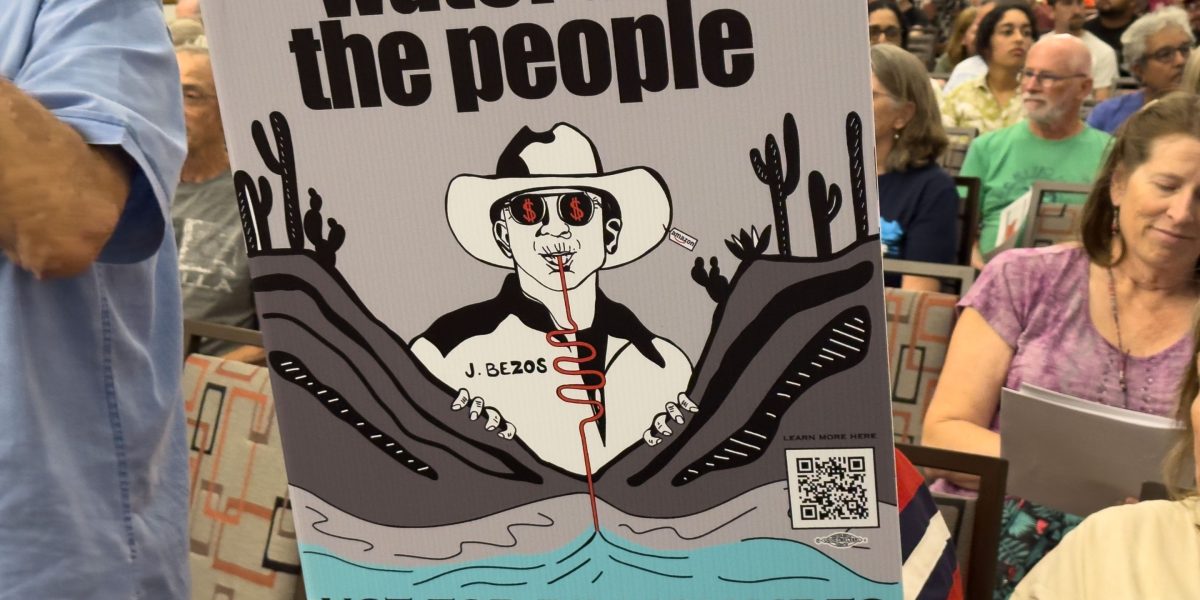
In August 2025, the Tucson City Council unanimously rejected any involvement with the Project Blue data center complex, originally linked to Amazon, which was to be sited just outside city limits. Given the region averages seven to 10 inches of rain per year, the council directly expressed concern over the region’s water and electricity usage in rejecting the project.
In less than a year, Amazon withdrew from the project, but the developer, Beale Infrastructure, purchased the land from Pima County and continued construction while seeking new partners.
Amazon didn’t immediately respond to Fortune‘s request for comment.
Recently, a resident asked a city staffer whether the dust control water at the Project Blue site was coming from the city, and as a result, triggered an investigation into the site’s water usage.
Last week, City Manager Timothy Thomure sent a letter to Beale stating the city had discovered a contractor, Ames Construction, had obtained a construction water meter within Tucson’s service area and transported the water outside city limits to the Project Blue site, where it was being used for dust control–all without authorization. The city shut off the meter immediately.
Thomure demanded that Beale replace the two acre-feet of water used, which approximately 650,000 gallons, or roughly equal to the annual water usagee of six to seven American households. Compared to operational data centers, it’s a fraction of the water consumed, but still, it’s a developer taking water from a city that had explicitly refused to provide it.
Beale said the city had issued a permit for temporary water through normal channels. City spokesman Andy Squire said the document was not a permit but an application for a construction meter intended for use within Tucson Water’s service area, and the contractor didn’t disclose that the water would be transported outside city limits.
The city limits are an important context here: Developers increasingly site large projects just beyond municipal boundaries to avoid the state’s Assured and Adequate Water Supply law, which requires a demonstration that a development can meet its water needs for 100 years. Building outside city limits allows developers to sidestep that requirement while still relying on nearby water infrastructure.
Earlier this month, the lower Colorado River basin states of Arizona, Nevada, and California signed a new conservation agreement aimed at saving a million acre-feet of water from a river system that was first divided among the states in 1922, when the Phoenix metropolitan area had a population of roughly 30,000. Today it has about 5 million.
On average, a medium-sized data center consumes roughly 110 million gallons of water per year for cooling, which is enough to power the annual water use of about 1,000 households. Larger facilities can consume up to 5 million gallons a day.