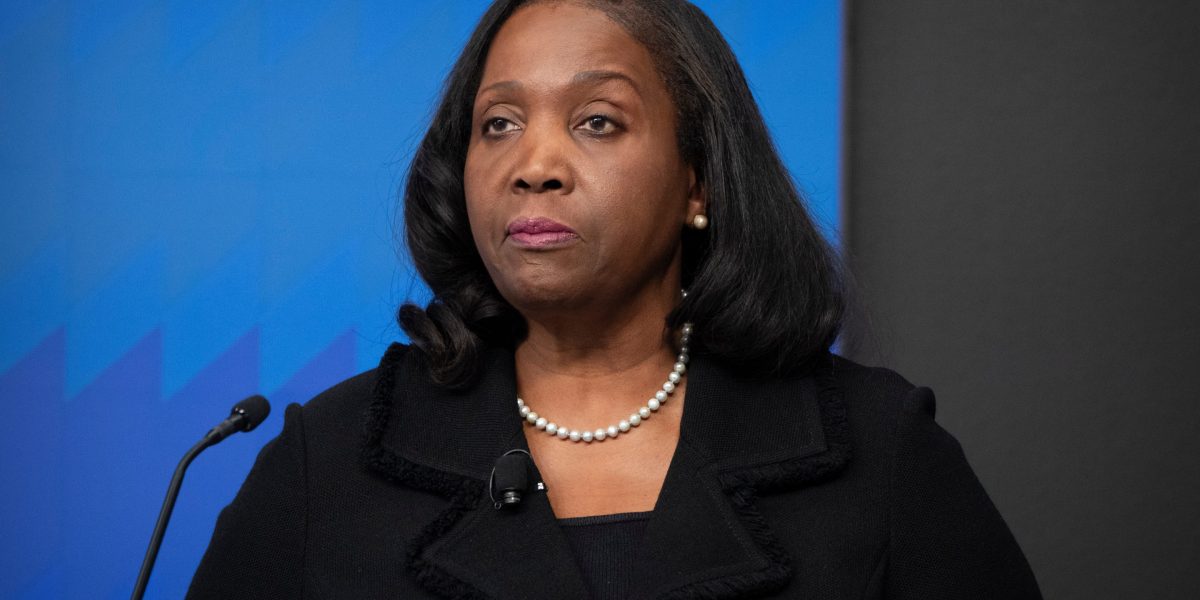
Good morning. Mark Patterson has spent 26 years at Cisco Systems, which is long enough to watch the company navigate multiple technology cycles. But he says nothing compares to what’s happening now.
“AI is the most significant technology transition that we’ve seen in probably our lifetime, and I think Cisco was right at the heart of it,” Patterson, CFO since July 2025, told me. That includes not just building the infrastructure powering the AI economy but embedding AI into how the business runs.
Starting in its new fiscal year at the end of July, Cisco (No. 83 on the Fortune 500) is rolling out AI agents to its approximately 90,000 employees. Each employee will have access to a personalized assistant capable of handling tasks, answering questions, and routing requests to the most efficient AI model. The company said it does not separately disclose those costs outside of its earnings reporting.
The architecture reflects a focus on performance optimization. “It’s not going to burn a whole bunch of tokens with frontier models,” Patterson said. Cisco’s system dynamically selects the right model for each task. “It knows which tool is most effective and most efficient,” he said. Much of the infrastructure is built on-premises, giving Cisco greater control over cost and data.
“We feel like that’s the most efficient way is to build our own AI stacks, which will go out and query the different models based on the particular use case,” he said.
In general, AI agents use far more tokens than standard chats because they continuously plan, call tools, and process intermediate steps. While a typical chat may use a few thousand tokens, complex agent tasks can consume hundreds of thousands to millions in a single run.
Patterson has his own agent as well. He uses it primarily for benchmarking—quickly comparing Cisco’s performance against peers across metrics like revenue growth, EPS, R&D spend, and capital allocation, often through dashboard-style analysis.
I asked him about training. Cisco is pairing its rollout with company-wide upskilling efforts and internal knowledge sharing to encourage experimentation. Patterson expects internal competition as teams discover new AI applications.
Reimagining the finance function
Regarding AI already in use on the finance side, Patterson said MD&A preparation, which is the mandatory narrative section in public company filings, has been streamlined. “I’d say 80%-90% of the first draft, at least, is now done by AI,” he said. Cisco has built and is refining an AI tool for investor relations that analyzes its financial history alongside competitors’ earnings calls and can anticipate likely questions from specific analysts.
Patterson and his team are also refining a “CFO cockpit,” an AI-powered dashboard that would synthesize performance data across products, geographies, and customer segments, predicting where the business is headed and recommending actions.
The opportunity ahead
Founded more than 40 years ago, Cisco built its business on networking technologies that power enterprise networks and much of the internet. But it has repositioned itself for the AI era by embedding AI across its portfolio and expanding into high-speed data center networking, custom silicon, optical networking, and AI security. Cisco’s stock has climbed about 53% year to date in 2026, trading around $117 in late June.
Patterson said the AI era has unlocked multi-year, multi-billion-dollar opportunities by expanding existing markets and opening new ones. A key growth driver is Cisco’s work with hyperscalers, where its custom silicon, optics, and systems offerings are fueling rapid expansion, he explained. Cisco reported $2 billion in orders in fiscal year 2025 and has raised its fiscal year 2026 guidance to $9 billion, reflecting growth that is becoming an increasingly material part of the business, he said.
In his career at Cisco, Patterson has held leadership roles across finance, strategy, operations, and the sales organization. Before becoming CFO, he was chief strategy officer. Now a year into the role, he has a central position in steering AI strategy to create value.
“In my 26 years at Cisco, I’ve never seen as much opportunity as we have today,” he said.
Sheryl [email protected]
Leaderboard
Jonathan Collins was appointed SVP of finance and CFO of Genesco Inc. (NYSE: GCO), a footwear company, effective Aug. 3. Genesco president and CEO Mimi E. Vaughn has served as interim CFO since March. Collins brings more than 30 years of senior financial experience. Most recently, he served as CFO of America’s Car-Mart, Inc. He previously spent more than a decade with Walmart (from 2012 to 2025) in a series of successive executive leadership roles, including CFO of Walmart Africa, chief accounting officer of Flipkart Group, and chief accounting officer of Walmart.
Ravi Thanawala, CFO of Papa John’s International, Inc. (Nasdaq: PZZA), is leaving for a CFO position at another public company. Chris Collins, SVP of corporate finance and principal accounting officer, has been appointed to the additional position of interim CFO, effective immediately. Thanawala will be available in an advisory capacity until July 31. The company has begun a search for a permanent CFO.
Big Deal
A Pew Research Center report finds that AI adoption among U.S. adults is growing—about half now report using AI chatbots, with roughly one in four using them daily, and 44% saying they use ChatGPT specifically.
The most common applications are information searches (42%) and work-related tasks (38%). Yet despite rising usage, public sentiment remains largely skeptical: 40% believe AI will have a negative impact on society over the next 20 years, about two-thirds say it is advancing too quickly, and 71% worry it will make personal information less secure. Only 16% expect a positive societal impact.
Going deeper
“Nike’s earning numbers exceeded Wall Street’s expectations. But CEO Elliott Hill’s next test is the World Cup” is a Fortune article by Mia Osmonbekov.
Osmonbekov writes: “When Nike brought Elliott Hill out of retirement almost two years ago to helm the sports conglomerate, it was with the intention of turning the brand’s strained relationships with athletes and retailers around in what Hill would later call a ‘sport offense.’ That offensive strategy seemed to pay off—in North America at least—when Nike’s quarterly earnings exceeded Wall Street’s expectations.” Read more here.
Overheard
“Change can be made in response to a dramatic disaster, or change can be made proactively.”
—R. Jisung Park, a labor economist at the University of Pennsylvania’s Wharton School, told Fortune in an interview about the effects of a heat wave on productivity and the economy. Park is the author of Slow Burn: The Hidden Costs of a Warming World.