Almost every quarter in the past couple of years, our banks have boasted about their rate of growth in credit to businesses. The five largest banks have grown by double-digit percentages over the past year in credit awarded. On the face of it, that’s a positive sign, but in-depth analysis of the figures indicates that this exceptional rate of growth is not necessarily a sign of a growing economy, and that it is mainly a result of artificial respiration for real estate and construction companies.
Meitav Investment House chief economist Alex Zabezhinsky analyzed figures from the Bank of Israel and found that the annual rate of growth in the balance of credit to business was over 15%. That rate of growth, Zabezhinsky says, is the highest at least since 2010 (when measurement began). He says that the growth in credit “is one of the growth engines of the economy at this time” and that it will support economic growth, while possibly contributing to inflationary pressures.
Another interesting finding by Zabezhinsky is that the banks are the source of the entire growth in business credit, which in the past year reached a peak of 25%. “In the decade before the Covid pandemic, the annual rate of growth never crossed the 10% mark, while growth in business credit from other sources, such as the financial institutions and foreign residents, was negative,” Zabezhinsky says.
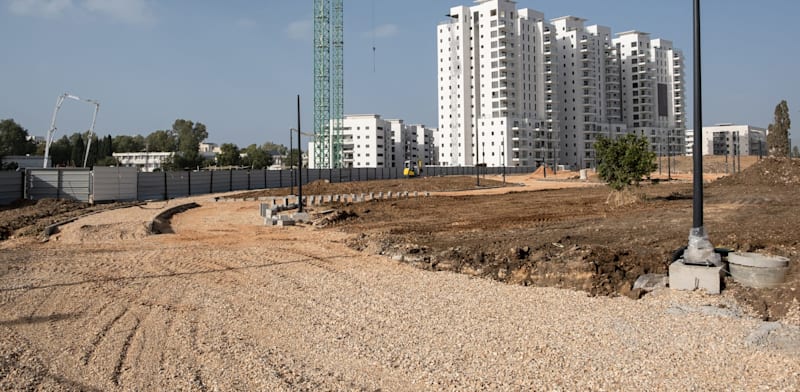
As mentioned, however, behind the record numbers lies a complicated reality. “It’s important to point out that in the recent period the growth in business credit has mainly gone to companies in the real estate and construction sector. This growth does not stem from high demand for real estate assets, but actually from the opposite,” Zabezhinsky explains. “Companies in the sector have been compelled to finance construction activity at a time when the housing market has been at a standstill and demand for offices is low. Contrary to past trends, the rate of growth in bank credit to business is rising precisely when the rate of growth in land where there is active construction is moderating. In this environment, the growth in credit raises the level of risk for both borrowers and lenders.”
These figures are consistent with findings of a study of the banking system by the Bank of Israel released two months ago. At that time “Globes” reported that the sharp fall in developers’ sales and the growth in the supply of homes was directly impacting the banks: according to the study, in the past year the banks had to raise the credit given to finance residential projects by no less than 40%, because of the decline in sales, the rise in construction costs, and the financial performance of the real estate developers.
RELATED ARTICLES
Desperate developers devise gimmicks to sell new homes
Some Tel Aviv home prices falling sharply, study finds
Sharp jump in mortgage taking by foreign residents
Tel Aviv, Jerusalem lead home price falls
That Bank of Israel survey found that total credit for financing residential real estate projects jumped from NIS 49 billion at the end of 2024 to NIS 69 billion at the end of last year, representing a rise of 40% in just one year, after substantial rises in the previous two years. In addition, the Bank of Israel estimated in that report that “because of special financing offers in the residential sector, the banks will increase the mortgages they give home buyers as the handover date for the homes purchased approaches.”
The growth in credit is in inverse proportion to the state of residential real estate development, where sales have fallen steeply, the supply of unsold homes is at a peak, and building costs have risen during the war. These factors led to the 20%/80% financing offers, whereby homebuyers paid only 20% of the price at the time of purchase and the remaining 80% on handover. These offers were designed to bring buyers back to the housing market in exchange for tempting loans that embodied substantial discounts on the prices of homes.
The continuing weakness of the contractors is also evident from a special report by rating agency Midroog last October, compiled by Midroog vice president and head of real estate Sigal Issachar, senior real estate analyst Lidor Uzan, and real estate team leader Gil Raz. “In general, over time, the rise in the stock of homes is liable to have a substantial impact on the developers. The time taken to make a sale is lengthening, and during this period the developers have to finance the construction costs with bank credit at high interest rates. This is at a time when the projects are also bearing the cost of the financing offers for the homes that have already been sold. If these conditions persist, there is fear of continued diminution of the profitability of the projects and of the development companies,” Midroog warned.
This is also Zabezhinsky’s conclusion. He estimates that part of the business credit granted in recent months is for propping up construction and real estate companies. Contractors that do not manage to sell homes at the right rate need credit to survive, not to expand. “The bottom line is that the growth in business credit supports economic activity in the short term, but since a substantial portion of it went to financing companies in the construction and real estate sectors, its contribution to long-term growth could be limited,” Zabezhinsky explains.
“In general, growth in credit is an engine for the economy,” he continues, “but when the growth is so high it can generate inflationary pressures.”
In the past, he says, when credit to contractors rose, this was in parallel with an expansion of construction. Today we are seeing a reduction in the amount of land on which construction is taking place, while the amount of credit continues to rise. The conclusion is that the credit is not going to construction as such. It makes sense that when home prices are falling and there are few transactions, construction should shrink. The credit is financing a shortfall in cash flow for these companies. That is to say, the banks are keeping the contractors on artificial respiration. Of course, if interest rates fall and people start buying more apartments, it will work out. The real estate market is marking time at the moment. I would give that situation another year at most. If it continues, we’ll start to see problems.”
The banks are well aware of the difficulties in the real estate sector. Earlier this month, Clara Zwergel, head of the real estate sector in the Corporate Division at Bank Hapoalim, said, “Despite the current slowdown, the developers are reinventing themselves all the time, in the type of project, the financing method, and so on.”
Zwergel also commented on the office market, which has also been experiencing a slowdown. In the past few years, the income producing real estate companies have built shiny office towers in central Tel Aviv, and are now believed to be having difficulty in filling them with enough tenants.
“The office market was written off during the pandemic because people were switching to working from home, and many companies thought that they wouldn’t need physical offices anymore. But in the past few years, in Israel and globally, we have seen a reverse trend of a return to the office, as companies realize that there is no substitute for work in an office and the interaction between employees.”
A different picture in consumer credit
What about credit to households? Here, the picture is completely different. Credit to households (excluding mortgages) has grown by a fairly sharp 7%, says Zabezhinsky, but he points out that this is not a historical peak. “It’s a relatively high level, but not an unprecedented one. The numbers do not include the non-bank credit companies, apart from the credit card companies.”
The trend in consumer credit is even the opposite of the trend in corporate credit. The banks are somewhat out of the running in the pursuit of loans to private consumers, while the non-bank players, such as the insurance companies, investment houses, and credit card companies, are leading the growth.
Zabezhinsky does not see an especially problematic situation in consumer credit. “The picture is not exceptional. It’s a fairly normal rate of growth in credit.”
Published by Globes, Israel business news – en.globes.co.il – on July 29, 2026.
© Copyright of Globes Publisher Itonut (1983) Ltd., 2026.