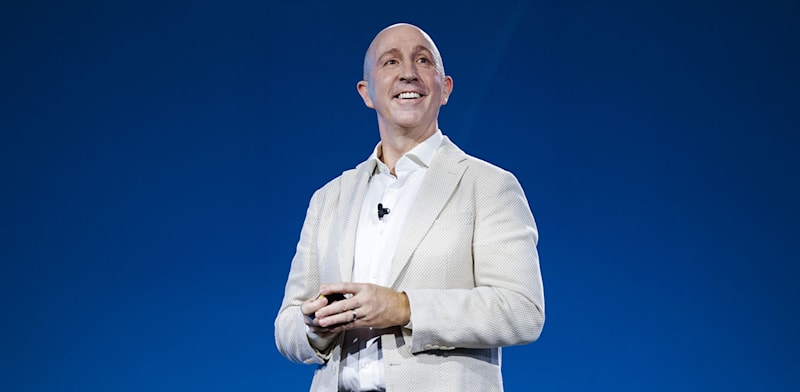
The past month has been particularly busy for Nice (Nasdaq: NICE; TASE:NICE) CEO Scott Russell. He found himself twice standing in front of thousands of people, in the UK and the US, at the annual conferences of the Israeli tech company he has headed for the past 18 months. From his perspective, Nice is not in crisis at all but has actually just completed a transformation into the field of AI, to provide its solutions for managing customer relationships (customer experience, CX) in the new world of AI.
“The future of customer experience belongs to those who will be the conductors of the AI orchestra,” he repeats several times. “We all already live in an ‘AI-First’ world. GPT chat plans your vacations, Cloud turns tasks that take hours or days at work into minutes or seconds, and Gemini provides instant answers and offers solutions that you would never have thought of. The bar for standards has been completely redefined.”
Anyone who doesn’t follow the company’s share price and only heard Russell’s enthusiasm might have missed the fact that Nice’s stock, previously the most valuable Israeli company on Wall Street with a market cap of $20 billion, has lost 70% of its value since March 2024 and is at a multi-year low (with a market cap on Nasdaq of $5.7 billion). This is due to the fear that AI will replace the services offered by software companies of its kind.
“Proud of Israeli identity, we have no plans to lay off people there”
Russell, 52, grew up in Australia and left it at the age of 28 for Singapore with his wife and three young children at the time, to work at IBM. “We planned to move for one year, and it’s been 25 years and we still haven’t been back,” he says. Since then, he has lived in several countries in Asia and Europe. Before his position at Nice, he served as a senior executive and global revenue manager at software giant SAP. He has lived in the US for the past six years.
Yet, he remains connected to Australia. “My children live in Australia, my youngest daughter and I are training together virtually for a half marathon in October, and we talk about the runs we’ve done every week.”
Next month, he will ‘pop over’ to Australia for 4 days to visit his mother, who will be celebrating her 80th birthday. Russell loves to play golf and he and his wife are “avid travelers. We’ve traveled to Europe, Alaska, and more.”
What makes Nice Israeli today? You barely get to Israel; only 900 of the company’s 10,000 employees are in Israel.
RELATED ARTICLES
What has sent Nice tumbling?
“We are incredibly proud of the fact that Nice is an Israeli company, of its heritage and history. We are expanding our presence in Israel and our R&D capacity, and we are keeping our employees. Israel is a small market, The Israeli market and talent are used to serving the world.”
Will you lay off employees in Israel?
“We have zero such plans. On the contrary, we have plans to grow in Israel.”
But despite these words, it was hard to escape the impression that the company was still somewhat blurring its Israeli identity. On stage, Russell said of AI that “I’ve met many of you, here in England, in Germany, in Amsterdam, Mumbai, Tokyo, in the US and in Latin America,” only Israel’s name was absent.
To implement basketball in business
Russell assumed his position as Nice CEO in January 2025, needing to fill the big shoes left by his predecessor Barak Ilam who led the company for a decade. He has had to deal with a world that is rapidly racing towards the AI revolution. “I have a very strong drive to win. I am an uncompromising person and I do not give up and I will not lose,” he declares in his first interview since taking office.
This is not how he planned his life to be. “When I was young, I wanted to be a professional basketball player,” Russell says with a smile when we meet for an interview the day before he takes the big stage at the company’s customer conference in London. “Michael Jordan was my hero. I trained and was very good, but I was just not tall enough or talented enough.
“The dream died at 16 or 17, and then I was selected for a number of leadership programs for young people. I guess I always had a natural talent for leading teams. I did not aspire to be a CEO, but to lead a team, which led me to become a basketball coach for 20 years, as a hobby, at the same time as moving into the business world.”
He also brings insights from basketball to business. “On a basketball court, you can’t have five shooters; you need five players who complement each other, with different skills and chemistry and team support. One player, no matter how good, is not enough for a team to win. In the business world, I also use the importance of chemistry and different abilities and hire people who are not like me. I don’t need a team that duplicates me, but one that complements what I lack.”
“We deliver results”
Russell’s management skills and fighting spirit are especially needed now. The global market is trying to crack the billion-dollar question: who will really benefit from the AI revolution and who will disappear into the pages of history. In the meantime, Nice suffers from concerns that AI will replace its software solutions for human customer service centers.
Thus, the stock plunged at the beginning of 2025 when the company provided a relatively weak forecast, and fell again later this year, when it cut forecasts in the third quarter and again at the beginning of 2026, along with other software stocks. In the first quarter of 2026, Nice extended its forecast range downward, sparking market concerns, and the stock fell again.
Russell sees things differently. “All we did last quarter was extend the forecast range. We had previously stated 14.5% as a mid-range, and we have returned to a range of 13% to 15% (growth forecast) to give a little more flexibility. At the same time, we have committed to continuing to accelerate growth in the AI field. I feel very strong and confident about the annual forecast and the acceleration of growth. We are on the right track for long-term growth, though we will have to deal with short term ups and downs.”
Nice worked hard to show conference attendees that it has already jumped over the AI crisis and the damage to software companies. Among other things, it brought in the company’s presenter last year, Hollywood actress Kristen Bell, known, among other things, as the voice of Anna, the young princess from the blockbuster hit Frozen. She related how she “accidentally” ordered 10 cowboy hats, how she despaired of human customer service, and how in an instant Nice’s AI agent solved the problem to her satisfaction.
And yet, the market seems skeptical about you
Russell: “My advantage is that I have data, and data creates confidence. Revenue is the ‘here and now.’ The figure that guides the future is the backlog of orders, the binding deals that will be translated into future revenue that have not yet been recognized.”
A large part of Nice’s revenue comes from managing customer service centers (call centers) in the cloud. Russell says, “The backlog in the cloud is growing much faster than the current revenue it produces. There is a 27% jump in the last year, after record deals in recent quarters. The markets have not yet rewarded us for this, but it will come. I am confident in this because we deliver results.” The company’s future backlog already stands at $3.67 billion, of which $3.2 billion is in the cloud.
Nice’s revenues continued to grow last year and reached $2.95 billion (76% of which is from the cloud), up 7.7%. So did non-GAAP net profit, which rose to $779 million. The company’s forecast for the coming year is for revenue of $3.18 billion (mid-range).
“Plans are being moved forward”
Russell knows that all this is not enough, and it was evident at the conference held in London. Although the AI field currently accounts for only 14% of Nice’s cloud revenue, it was almost the only topic discussed at the event. Nice wants at least 30% of its revenue to come from AI by 2028. It sought to prove that it was completing the transition to the AI field through a huge deal, the first in a decade, in which it acquired German AI company Cognigy for $955 million. “Without the acquisition of Cognigy, Nice would have been in big trouble,” several of the company’s clients who attended the conference told “Globes.”
The market speculated: was the acquisition just intended as a gesture or does it create a new growth engine for Nice. According to the company, the second answer is correct: the company presented us with an AI agent that can talk to a person in an almost human way and verify the customer’s details. However, when we tried to challenge the agent In “out of the box” questions, it turned out to be just a simulation.
“We weren’t prepared for this,” the company employee apologized. Another AI agent performed more advanced actions and checked whether our active insurance policy covered certain events, and even “purchased” additional appropriate coverage.
In addition, after a senior manager told us “I will show you some of the capabilities but please don’t think that’s all, take this just as an example,” he demonstrated how the AI tool knows how to identify and recommend to companies what key customer service needs they are lacking, and suggests that they quickly develop AI agents that will improve results. All this while recommending to focus on the most urgent factors and quantifying the annual cost savings for the company. For example, for fashion companies that deal with returned products, or airlines that deal with flight cancellations and changes. Another employee at the company showed us how AI helps the customer service center manager solve the customer’s problem and even identify angry customers in real time.
These services are provided by Nice thanks to the acquisition of Cognigy, whose AI agents are available in more than 100 languages, according to the company. Nice currently has over 25,000 customers, some of which, such as airline giant Lufthansa and food chain Nestle, joined with the acquisition of Cognigy.
Russell reveals, “We are bringing forward the Cognigy implementation plan by six months. Today, Nice and Cognigy are one unified platform. We planned to complete the integration by the end of the year and we finished in June. 2026 is a transition year, the growth in orders this year will fuel 2027 revenue, and in 2028 we want to grow cloud revenue by 17% to 19%,” This is compared with 13% today. Nice estimates that in 2028, cloud revenue will reach $3.5 billion, up 56% compared with 2025.
“There are existing customers with whom we have expanded our activities. At the same time, we are taking market share from competitors; for example, we won a new customer in the UK, Revenue and Customs, with a contract worth over $100 million.” According to Russell, AI agents are already reducing costs for companies. “We are the only company that provides an end-to-end solution.”
What will stop rivals from canceling out your advantage in two years?
“Today, you can build software very quickly. Our ‘moat’ is data. Every year, 25 billion interactions pass through our platform. Our models are constantly learning from them, so our AI agents are trained to solve the most complex consumer problems at the enterprise level – in banking, insurance, healthcare, travel and retail, and most importantly: in large numbers. Can any tool handle the load of 10,000 customers calling at once? It will be very difficult to duplicate our knowledge, data and expertise.”
As an example, Russell cites Lufthansa: “Rebooking a canceled flight is not a simple process that requires a booking platform, seat availability in the right class, and price checking. With a human representative, it’s a matter of 10 minutes. With ‘Nice- Cognigy’, the passenger wakes up in the morning, discovers that the flight has been canceled, and the AI agent contacts him within seconds, informs him that the registration for the replacement flight and hotel has been completed, and arranges distribution of the vouchers automatically, and all of this happened only last April.” At that time there was a strike at the airline, and AI agents helped customers enormously.
“A journey of many years”
When asked what the next few years will look like for Nice? Russell estimates, “The volumes of activity in AI will increase, and so will those of Nice. Our main limitation as consumers when we approach brands is time,” he explains. “The time it takes to call the bank or browse the airline’s website. Now a person will say to the personal AI agent: ‘Call the bank, change the seats on the flight.’ The personal agents will create a huge volume of interactions with brands. Companies will not be able to support this with a human model that is limited in capacity.”
It was recently announced that the sale of Nice’s Actimize, a financial crime prevention division, is on the table and you have received offers in excess of $2 billion?
“We are at the valuation stage. This is a great business that has grown exceptionally as a leader in its market over the past 15 years. We are looking at whether it creates value for shareholders. No decision has been made at this time.”
What Key Performance Indicators (KPIs) do you think investors should look at to measure your success?
“Order backlog, because it is an indicator of future revenue and growth, and the other is annual recurring revenue in the AI field, which will show how healthy our growth engine is. We are ahead of schedule in both and I am confident that investors will see this. If we continue to deliver results, we will have happy investors and a status that reflects leadership in customer experience in the AI world.”
How long will you stay in the position?
“I have worked at a small number of companies, usually about 10-15 years. I am committed to the long term at Nice. The commitment is to bring Nice from a leader in its market to a leader in the AI world. It is a journey of many years.”
Full disclosure: The writer attended the Nice Customer Experience Conference as a guest of the company.
Published by Globes, Israel business news – en.globes.co.il – on July 9, 2026.
© Copyright of Globes Publisher Itonut (1983) Ltd., 2026.