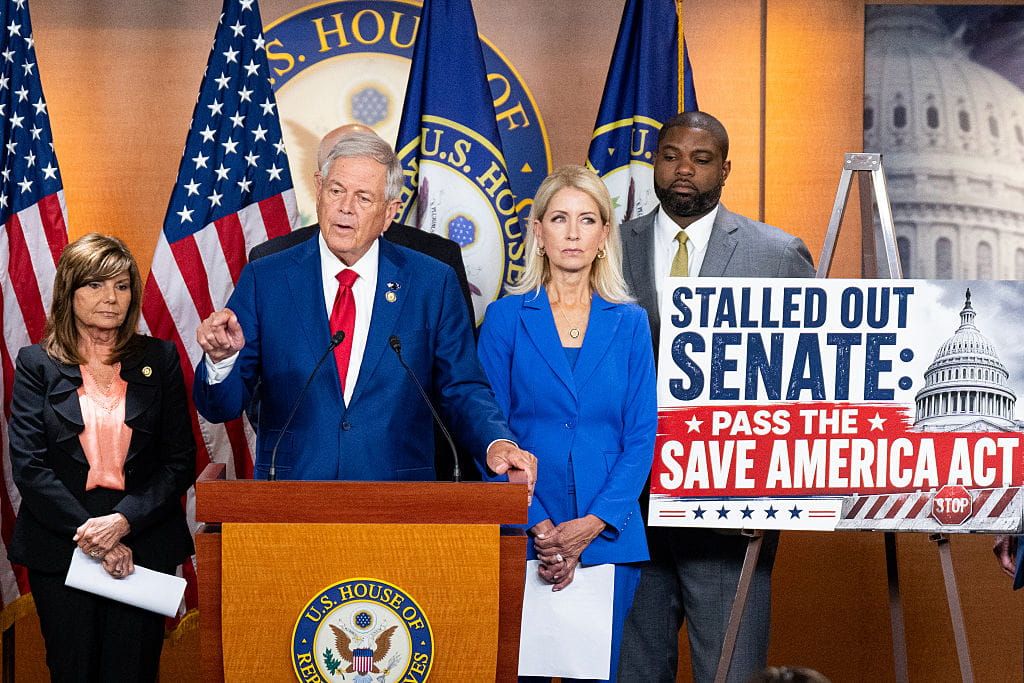
One of the few genuine 80-20 issues in political life is on the ropes and showing no signs of recovery. Despite massive public support, the SAVE America Act, which would make voter ID the law of the land, is in its death throes. Why would such a seemingly popular piece of legislation become a sticking point for Congress? And would the SAVE Act fare any better under another administration?
Elections Matter
President Donald Trump has relentlessly pushed the SAVE Act – even going so far as to refuse to sign other legislation until it passed Congress. And there’s a significant number of Republicans who also want to see it enacted. So, with the trifecta in Washington, DC, one might assume clear sailing.
First, the basics: The bill aims to require valid identification to cast a ballot and for citizens to register to vote. Simple so far. A version of it passed in the House back in February with a 218-to-213 vote – notably, Rep. Henry Cuellar of Texas was the only Democrat to join the majority. Since then, it has been stuck in the upper chamber with Majority Leader John Thune (R-SD) insisting it just does not have the votes to pass.
With only 53 GOP votes, getting to the 60-vote threshold is a steep hill to climb. But it seems that even if the filibuster were done away with (as Trump has suggested), it may not even get the 50 votes for a straight majority. So almost half of the House and half of the Senate don’t want to deliver what 80% of the public wants. What’s wrong with this picture?
Confidence Missing
A recent Wall Street Journal/NORC poll puts Congress dead last when it comes to the percentage of Americans who hold a great deal of trust in the people who run American institutions. Just 6% seem to think Congress is well run. That’s quite a figure and yet not all that surprising.
After all, voters tend to be partisan. If a non-favored party controls either chamber or both, then that cuts confidence by 50%, if only for the purpose of supporting one’s own team. And then, of course, individuals want Congress to do things that are not politically, logistically, or legally possible. But to reiterate, voter ID is an 80-20 issue. It is not a partisan boondoggle that one side of the political divide hates and the other loves; it is a uniting factor across all racial, economic, and sex demographics. And yet still it rots away like an unnoticed whale carcass on the floor of the upper chamber.
SAVE Act Imponderables
There are a few likely reasons why the legislation is stalled and going nowhere.
Pork Stuffing: It would be nearly unthinkable for a clean bill to get through Congress. All lawmakers have a vested interest in adding something to legislation they feel will pass. While initial intentions may be honorable, the knock-on effects and unintended consequences soon mount. While it is difficult to defend not voting for an 80-20 issue, pinning the blame on some senator looking to enrich a constituent is a surefire way to avoid scrutiny.
A Bad Midterm Look: For Democrats specifically, signing on to a voter ID act right before the November midterms has a number of problems. First, it may seem a tacit acknowledgment that voter fraud occurs – something the party has generally pooh-poohed. Second, the “20” element of that 80-20 equation is almost certainly on the more progressive “no human is illegal” side. When fractions of percents matter in close races, Democrats can’t afford to alienate.
The Trump Factor: It’s no secret that, despite Donald Trump becoming the driving force in right-wing politics, there are a certain number of folks on Capitol Hill who will breathe a sigh of relief when Jan. 20, 2029, rolls around – and they aren’t all on the Democrat side. The president makes enemies at a staggering rate (and, bizarrely, seems to make political friends just as easily). There will be some who just don’t want to hand Trump a win that would secure his legacy as one of the most effective executives in history. Voter ID would do just that.
With just a few short months until the November midterms, it seems that the SAVE Act is, in fact, beyond saving. Unless Thune has a change of heart regarding the filibuster and, add to this, a couple of senators decide to switch their stated positions, it’s not happening.




-1024x683.jpg "Soft Words, Big Sticks, and an Endgame in Iran")