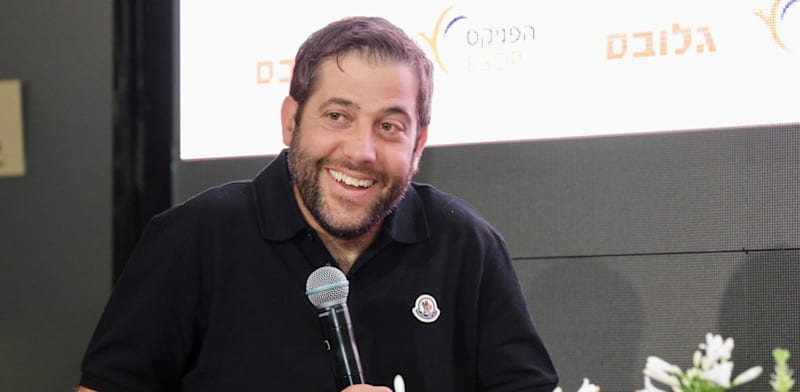
After the huge exit of Wiz, which was acquired by Google for $32 billion, cofounder and CTO Ami Luttwak spoke at the Globes TECH IL Conference to “Globes” High-Tech Editor Assaf Gilead.
“I have to admit that when we founded Wiz in 2020, which wasn’t our first startup, we wanted to revolutionize the world of security but I never dreamed it would be this revolutionary. We’re very proud that we managed to establish something like this that affects the whole world. Every country in the world uses the product we built,” said Luttwak.
What does life look like after the exit?
“It looks the same. This isn’t the first company we built, we sold Adallom in 2015. After the exit, nothing changes for me, the aim is still to change the world of security. I still get up in the morning, take a train and the goal is the same goal – in the end, the goal hasn’t changed. We realized that the way they approached security was wrong and have been trying to change the path ever since. Everything they did before is irrelevant.”
In an interview two months ago, you talked about “dangerous” models and their impact on the known data security mechanisms. That was two months ago. Has the prophecy come true?
“I admit that I didn’t understand myself how quickly AI will affect the cybersecurity world. Everyone talks about it, about how quickly and how attacks are undertaken. But there is usually a distance between hype and reality. Most revolutions in history take time to have an impact. In the industry, you feel that everything is changing at a crazy pace, because there is a situation where AI models are better than the best humans in the area of vulnerabilities. This creates a situation where everything we have done to date in cybersecurity needs to change.”
The deal with Google and US government bans
You told us in an interview that one of the reasons for saying yes to the deal with Google was Gemini
“You have to remember that the talks were two years ago. When you think about it today, everything is clear. There is not a single software company in the world today, certainly in cybersecurity, that is not asking how it is changing its strategy and building the product around AI. Part of that was that if you took Wiz to the next level, you had to team up with Google and get access to the most amazing AI minds in the world, and that’s proving itself. The threats to customers have changed dramatically from what they were two years ago. It’s a whole new world, and together with Google we are building the company we dreamed of.”
RELATED ARTICLES
Biggest-ever exit: Google completes Wiz acquisition
Gemini can also be a tool for offense
“It’s like an arms race, every capability will be for both defense and offense. In the end, I think the systems will be more secure, but those who don’t respond quickly enough are in trouble. What customers need to do, and we as suppliers need to help, is use the new capabilities really quickly. New models are coming out all the time. We need to organize ourselves so that we are always running with the newest capabilities to find vulnerabilities before the attackers.”
What should legacy companies in the cybersecurity world that were established before GPT chat actually do?
“This is an interesting test for any market that AI will really reach and not at the hype level, that is, at a level that changes the actions you take every day. I look at what this means for anyone who existed before AI. Any company that doesn’t respond really, really quickly now will be irrelevant, and it will have to respond all the time. By the way, any company, not just cybersecurity.”
Fable (which the US government shutdown) may be just the first victim, what do you say about the government’s ban?
“AI capabilities give us capabilities that weren’t there before. We need to change the perception in many markets and also in cybersecurity, and not have a static wall like a firewall, that won’t continue to work. We need to simulate what attackers can do. In our world, systems have to be updated. Until today, it was about a month – the entire software world is built on the fact that there is a month to fix a system if they find a critical vulnerability in it. You run tests, you see that it works. Today, we see that statistics say that attackers take a vulnerability and find how to use it within hours. Organizations must change the way they work, and respond within hours. You need to change the entire way you work, it’s not just ‘let’s use AI,’ it’s being very reactive.”
“Not enough has been done in Israel in the field of AI”
An equally important angle is that the models were banned only for Americans, what are we supposed to think in Israel?
“Ultimately, just as the cloud is infrastructure, models are also critical infrastructure. The more we rely on AI services, the more critical they are for all of us. Right now, the number of products that strategically depend on AI is still small. You need to build infrastructure that will be immune. In the cloud, there is no doubt an Israeli cloud. You need to plan for resiliency. What happens if the data center is damaged, where is it located?”
The question is whether you think the national AI program should include developing a large language model, a supercomputer?
“The questions about where Israel should be are open questions. I don’t think we’ve done enough, I haven’t seen any real action taken, and there’s really a challenge here for every company and country. I don’t have a clear answer, this world is moving so fast that it’s hard to predict. It’s easy to say we’ll invest in infrastructure, but it’s very challenging. You just have to respond to everything quickly, that’s the truth. There are no absolute answers. You have to prepare yourself to respond, no matter what comes.”
Israeli tech is in a challenging situation, layoffs, on the other hand, the number of jobs in the tech industry has grown by 12% and wages are at an all-time high. How do you explain the contradiction?
“Good question. In my opinion, Israeli tech is an incredible miracle and it’s a privilege to be a part of it. AI brings with it opportunities but also threats. The entrepreneurial capability in the country is amazing. On the other hand, anyone can build something, you have to reach sales. Historically, there have been many attempts to build and then sell it, that won’t work anymore, technical ability alone is no longer enough because anyone can build something for investors in a minute. That’s the next challenge.”
If Wiz was founded today, would it be just as successful?
“I have no idea. Today it’s easier to start and harder to succeed. In a certain sense, it’s harder to differentiate yourself, and an important thing for a startup is to rise above the noise. For beginning entrepreneurs, this is a difficult situation. On the other hand, the number of entrepreneurs can be much larger. In practice, building something amazing is easier, but raising significant money is more difficult.”
Do you have any advice for beginning entrepreneurs, who are now sitting in a garage and want to build the next Wiz?
“I’ll give you some advice and tomorrow it will change. The technological barrier today is smaller and you need to build something technological with a long-term advantage. You need to go straight to your market, start selling, reach sales of millions, and then you have something in hand.”
Full disclosure: Globes is grateful to the partners that helped in holding the TECH IL Conference: Phoenix Group, Phoenix ESOP, Ondas Israel, Microsoft Israel R&D, Fischer (FBC), Voicenter, Cyberstarts, and the Israel Innovation Authority.
Published by Globes, Israel business news – en.globes.co.il – on June 18, 2026.
© Copyright of Globes Publisher Itonut (1983) Ltd., 2026.