No Result
View All Result
  • Login
Wednesday, July 22, 2026
theadvisertimes.com
  • Home
  • Business
  • Financial Planning
  • Personal Finance
  • Investing
  • Money
  • Economy
  • Markets
  • Stocks
  • Trading
  • Home
  • Business
  • Financial Planning
  • Personal Finance
  • Investing
  • Money
  • Economy
  • Markets
  • Stocks
  • Trading
No Result
View All Result
theadvisertimes.com
No Result
View All Result
Home Cryptocurrency

DeFi’s old hack vectors are fading

by theadvisertimes.com
1 month ago
in Cryptocurrency
Reading Time: 5 mins read
A A
0
DeFi’s old hack vectors are fading
Share on FacebookShare on TwitterShare on LInkedIn


Decentralized finance has gotten a lot safer over the past six years, and a new review of protocol losses from 2020 through 2025 puts a pretty large number behind that claim.

Industry-wide DeFi losses peaked at $2.62 billion in 2022 and fell roughly 80% to $534 million by 2024. Bridge hacks that once produced billion-dollar headlines now account for a tiny slice of annual totals, and the typical exploit today does about a quarter as much damage as it did at the peak.

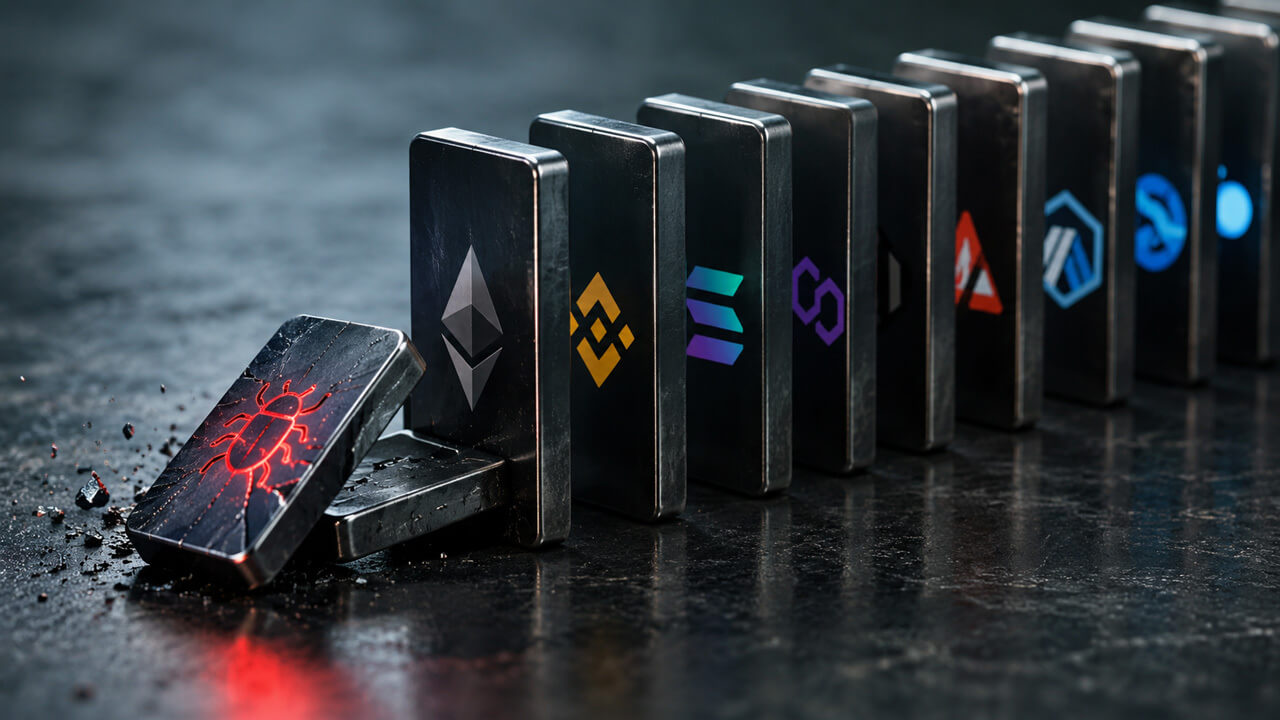
While this is certainly great news for the crypto industry, there’s still quite a bit of risk left; it just shows up in a different place. Major protocols now often deploy the same code across Ethereum, Base, Arbitrum, Polygon, OP Mainnet, and Sonic, so a single flaw can now drain funds on every network running it at the same time, and that’s the form crypto’s next systemic problem is likely to take.

We’ve seen this in November last year, when Balancer’s V2 Composable Stable Pools were drained of roughly $128 million in under half an hour across six blockchains simultaneously.

According to Check Point Research, the attacker exploited an arithmetic precision flaw in the pools’ invariant math, nudging token balances onto a rounding boundary and then chaining batched swaps until those tiny errors compounded into a full drain.

The contracts with the same vulnerability had been deployed on Ethereum, Arbitrum, Base, Polygon, Sonic, and OP Mainnet, so the exploit reached all of them at once because the flaw was embedded in the code itself, and that code had been copied everywhere.

As CryptoSlate reported at the time, eleven separate audits had failed to catch it, which tells you just how subtle this class of bug has become and why it’s so much harder to anticipate than the attacks that came before.

The hacks got smaller as the chains multiplied

The encouraging part of the data is that the cheap, repeatable attacks that defined crypto’s early years have mostly been engineered out of existence, and total losses dropped 80% in two years, even as DeFi’s TVL kept climbing. A huge drop was also seen in the median loss per incident, which fell from $6 million in 2022 to $1.5 million in 2025, a 75% decline.

The count of unique incidents actually rose to 83 in 2025, so more hacks are happening while each one does far less damage, which is roughly what a maturing security field is supposed to look like.

Bridges were the defining vulnerability in 2021 and 2022, and in that second year alone, nine bridge exploits resulted in $1.9 billion in losses. These hacks were truly some of crypto’s worst moments, with the Ronin Bridge accounting for a $624 million loss on its own.

CryptoSlate tracked it on-chain as the funds moved through Tornado Cash, followed by Binance Bridge at $570 million, Wormhole at $326 million, Nomad at $190 million, Harmony at $100 million, and Qubit at $80 million.

It accounted for 73% of all DeFi losses that year, and by 2025, the bridge’s share had collapsed to 3%, thanks to improved verification mechanisms, decentralized validator sets, and a broader shift toward native cross-chain messaging.

Flash-loan attacks followed the same path down. They represented 54% of all losses in 2020 when they were the signature DeFi technique, and by 2025, they accounted for under 1%, because protocols adopted defenses tailored specifically to that attack: time-weighted average prices, Chainlink oracle integrations, reentrancy guards, and designs that assume an attacker can manipulate prices within a single atomic transaction.

Private-key compromises saw a similar decline, falling from 28.7% of losses in 2022 to 8.1% in 2025. Each of these categories shrank for the same underlying reason, which is that the industry recognized a repeatable pattern and built a standardized answer to it, and as CryptoSlate’s year-end review of 2025 found, those answers have largely held.

What’s left is harder to defend against

Closing off the generic attacks left behind a far more difficult category: in 2025, 89.1% of DeFi losses came from protocol logic exploits, meaning code-level flaws specific to how one application was designed. A bridge hack involves recognizable trust assumptions, and a flash-loan attack is part of a known family of techniques, so both can be defended with reusable patterns.

CryptoSlate Daily Brief

Daily signals, zero noise.

Market-moving headlines and context delivered every morning in one tight read.

5-minute digest 100k+ readers

Free. No spam. Unsubscribe any time.

Whoops, looks like there was a problem. Please try again.

You’re subscribed. Welcome aboard.

However, a protocol logic bug is bespoke by nature. It emerges from the particular math, access controls, or composability choices of a single codebase, making it hard to defend against systematically, because each instance is its own puzzle and shares little with the last.

Multi-chain deployment is what turns one of these bespoke bugs into a full-blown crisis. ImmuneFi’s report draws a direct line from the defining multi-chain incident of 2021, the roughly $611 million Poly Network exploit, to Balancer in 2025.

Poly Network was a failure at the connection point between systems, the kind of choke point that bridges create, whereas Balancer was the same logic failing identically across networks that share code, signer paths, and verification assumptions. Once a chain becomes part of the default deployment map for major protocols, it absorbs the risk surface of everything it hosts, however sound its own infrastructure happens to be.

That changes how you measure an ecosystem’s safety, and the report’s method shows this by attributing the full loss from a multi-chain exploit to each affected chain, on the logic that participants across all six networks were exposed to the full impact.

The trade-off is that the 2025 hack figures for Polygon, OP Mainnet, Base, and Sonic are heavily influenced by the Balancer cascade. The report also strips out centralized exchange failures entirely, which is why the year’s largest single theft, the $1.5 billion Bybit hack that the FBI attributed to North Korea, is considered a custody failure rather than a protocol one.

On a loss-to-TVL basis, the safest tier among major ecosystems was Ethereum at around 0.42%, Solana at 0.42%, and BNB Chain at 0.33%, the three largest DeFi ecosystems by value locked, which suggests scale and security have been improving together rather than at each other’s expense.

While these changes fare much better for the average protocol, they’re not so good for the average user. A loss can now occur in an app that carries a flaw imported from elsewhere, and the convenience that makes multi-chain apps appealing is what makes this mistake escalate from a local to a shared one.

Crypto spun up all these separate chains partly to avoid depending on any single system, and the irony is that running the same handful of popular protocols across all of them has rebuilt the concentration those chains were meant to escape.

The next big incident may look small on the day it lands (a single logic bug in a widely deployed protocol), but reveal its true size only once people realize the same vulnerable code was sitting on half a dozen networks the entire time.



Source link

Tags: DeFisfadingHackVectors
ShareTweetShare
Previous Post

9 Ways to Stay Safe Walking Alone

Next Post

6 Password Habits That Lock Scammers Out for Good

Related Posts

Solana Tokenized Assets Hit Record .8 Billion in Q2, up 114% as Stock Trading Volume Quadruples

Solana Tokenized Assets Hit Record $5.8 Billion in Q2, up 114% as Stock Trading Volume Quadruples

by theadvisertimes.com
July 21, 2026
0

Key TakeawaysSolana’s tokenized asset volume hit $5.77 billion in Q2 2026, up 114% quarter over quarter.Tokenized equities on Solana quadrupled...

Senator Lummis says with CLARITY “your crypto stays yours”

Senator Lummis says with CLARITY “your crypto stays yours”

by theadvisertimes.com
July 21, 2026
0

When Celsius collapsed, its Earn customers learned that the crypto in their accounts belonged to the bankruptcy estate, not to...

Crypto Gains Momentum as AI Boom Shows Signs of Cooling

Crypto Gains Momentum as AI Boom Shows Signs of Cooling

by theadvisertimes.com
July 21, 2026
0

Bitcoin and the broader cryptocurrency market looked poised for a recovery on Tuesday as progress on landmark US crypto legislation...

Russia Gives Crypto Firms Until July 2027 to Obtain Licences Under New Market Rules

Russia Gives Crypto Firms Until July 2027 to Obtain Licences Under New Market Rules

by theadvisertimes.com
July 21, 2026
0

Fintech Education Explained: How Finance Magnates Academy Helps You Build a Career Fintech Education Explained: How Finance Magnates Academy Helps...

Russia Moves Crypto Regulation Toward Final Readings

Russia Moves Crypto Regulation Toward Final Readings

by theadvisertimes.com
July 21, 2026
0

Russia’s State Duma has moved crypto regulation toward its final legislative stage, advancing a bill that would establish formal rules...

.1B Farmers & Merchants Investments Discloses XRP, Bitcoin ETF, Robinhood Holdings

$4.1B Farmers & Merchants Investments Discloses XRP, Bitcoin ETF, Robinhood Holdings

by theadvisertimes.com
July 21, 2026
0

Farmers & Merchants Investments, a bank holding company with $4.1 billion in assets under management (AUM), has disclosed significant holdings...

Next Post
6 Password Habits That Lock Scammers Out for Good

6 Password Habits That Lock Scammers Out for Good

Is McDonald’s Corp (MCD) One of the Best Stocks to Buy According to Billionaire Bill Gates?

Is McDonald’s Corp (MCD) One of the Best Stocks to Buy According to Billionaire Bill Gates?

  • Trending
  • Comments
  • Latest
SEC pushes private market access, but retail is already in

SEC pushes private market access, but retail is already in

July 16, 2026
How I Maximize My Sapphire Reserve Dining Credit

How I Maximize My Sapphire Reserve Dining Credit

July 10, 2026
Fourth of July 2026 Freebies and Deals

Fourth of July 2026 Freebies and Deals

July 3, 2026
5 things financial therapists want every advisor to know

5 things financial therapists want every advisor to know

June 26, 2026
The 10 Largest NYC Tech Startup Funding Rounds of June 2026 – AlleyWatch

The 10 Largest NYC Tech Startup Funding Rounds of June 2026 – AlleyWatch

July 6, 2026
Prime Day, June 2026: How Retailers Competed With Amazon

Prime Day, June 2026: How Retailers Competed With Amazon

June 29, 2026
Microsoft celebrates 50 years with Copilot

Microsoft celebrates 50 years with Copilot

0
Technology Leadership Networking In Austin: Forrester’s Tech Forum

Technology Leadership Networking In Austin: Forrester’s Tech Forum

0
Why SEI’s 0.10% custody fee stands out from giant custody rivals

Why SEI’s 0.10% custody fee stands out from giant custody rivals

0
Kalshi launches election hub for prediction markets ahead of midterms

Kalshi launches election hub for prediction markets ahead of midterms

0
Israel Railways disarray deepens after new CEO nixed

Israel Railways disarray deepens after new CEO nixed

0
Corn Starts the Week with Strength

Corn Starts the Week with Strength

0
Technology Leadership Networking In Austin: Forrester’s Tech Forum

Technology Leadership Networking In Austin: Forrester’s Tech Forum

July 22, 2026
Kalshi launches election hub for prediction markets ahead of midterms

Kalshi launches election hub for prediction markets ahead of midterms

July 22, 2026
Trump plans high generic-drug tariffs in 2028 to spur U.S. production

Trump plans high generic-drug tariffs in 2028 to spur U.S. production

July 22, 2026
AI-focused E2E Networks shares hit 5% upper circuit as firm swings to black in Q1, revenue soars 334%

AI-focused E2E Networks shares hit 5% upper circuit as firm swings to black in Q1, revenue soars 334%

July 22, 2026
CDC Reports Over 4,000 Cyclosporiasis Cases in 41 States Amid Outbreak

CDC Reports Over 4,000 Cyclosporiasis Cases in 41 States Amid Outbreak

July 21, 2026
Oil Price Today (July 22): Crude oil crosses , hits 2-month high as US strikes enter 11th day. 0 possible, say experts

Oil Price Today (July 22): Crude oil crosses $90, hits 2-month high as US strikes enter 11th day. $120 possible, say experts

July 21, 2026
theadvisertimes.com

Get the latest news and follow the coverage of Business & Financial News, Stock Market Updates, Analysis, and more from the trusted sources.

CATEGORIES

  • Business
  • Cryptocurrency
  • Economy
  • Financial Planning
  • Investing
  • Market Analysis
  • Markets
  • Money
  • Personal Finance
  • Startups
  • Stock Market
  • Trading

LATEST UPDATES

  • Technology Leadership Networking In Austin: Forrester’s Tech Forum
  • Kalshi launches election hub for prediction markets ahead of midterms
  • Trump plans high generic-drug tariffs in 2028 to spur U.S. production
  • Our Great Privacy Policy
  • Terms of Use, Legal Notices & Disclosures
  • About Us
  • Contact Us

© Copyright 2024 All Rights Reserved
See articles for original source and related links to external sites.

Welcome Back!

Login to your account below

Forgotten Password?

Retrieve your password

Please enter your username or email address to reset your password.

Log In
No Result
View All Result
  • Home
  • Business
  • Financial Planning
  • Personal Finance
  • Investing
  • Money
  • Economy
  • Markets
  • Stocks
  • Trading

© Copyright 2024 All Rights Reserved
See articles for original source and related links to external sites.