
No Result
View All Result
  • Login
Monday, July 13, 2026
theadvisertimes.com
  • Home
  • Business
  • Financial Planning
  • Personal Finance
  • Investing
  • Money
  • Economy
  • Markets
  • Stocks
  • Trading
  • Home
  • Business
  • Financial Planning
  • Personal Finance
  • Investing
  • Money
  • Economy
  • Markets
  • Stocks
  • Trading
No Result
View All Result
theadvisertimes.com
No Result
View All Result
Home Cryptocurrency

Visa is quietly building stablecoins into mainstream payment plumbing without you knowing

by theadvisertimes.com
2 months ago
in Cryptocurrency
Reading Time: 8 mins read
A A
0
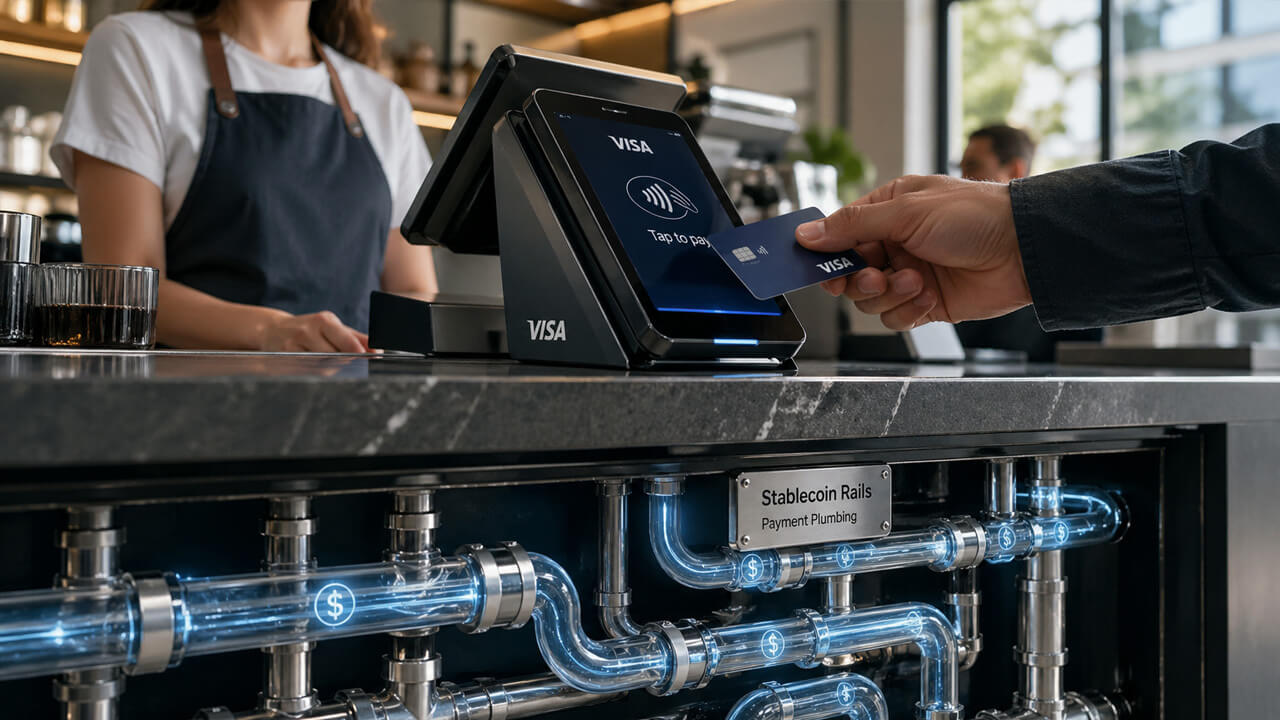
Visa is quietly building stablecoins into mainstream payment plumbing without you knowing
Share on FacebookShare on TwitterShare on LInkedIn


Make CryptoSlate preferred on

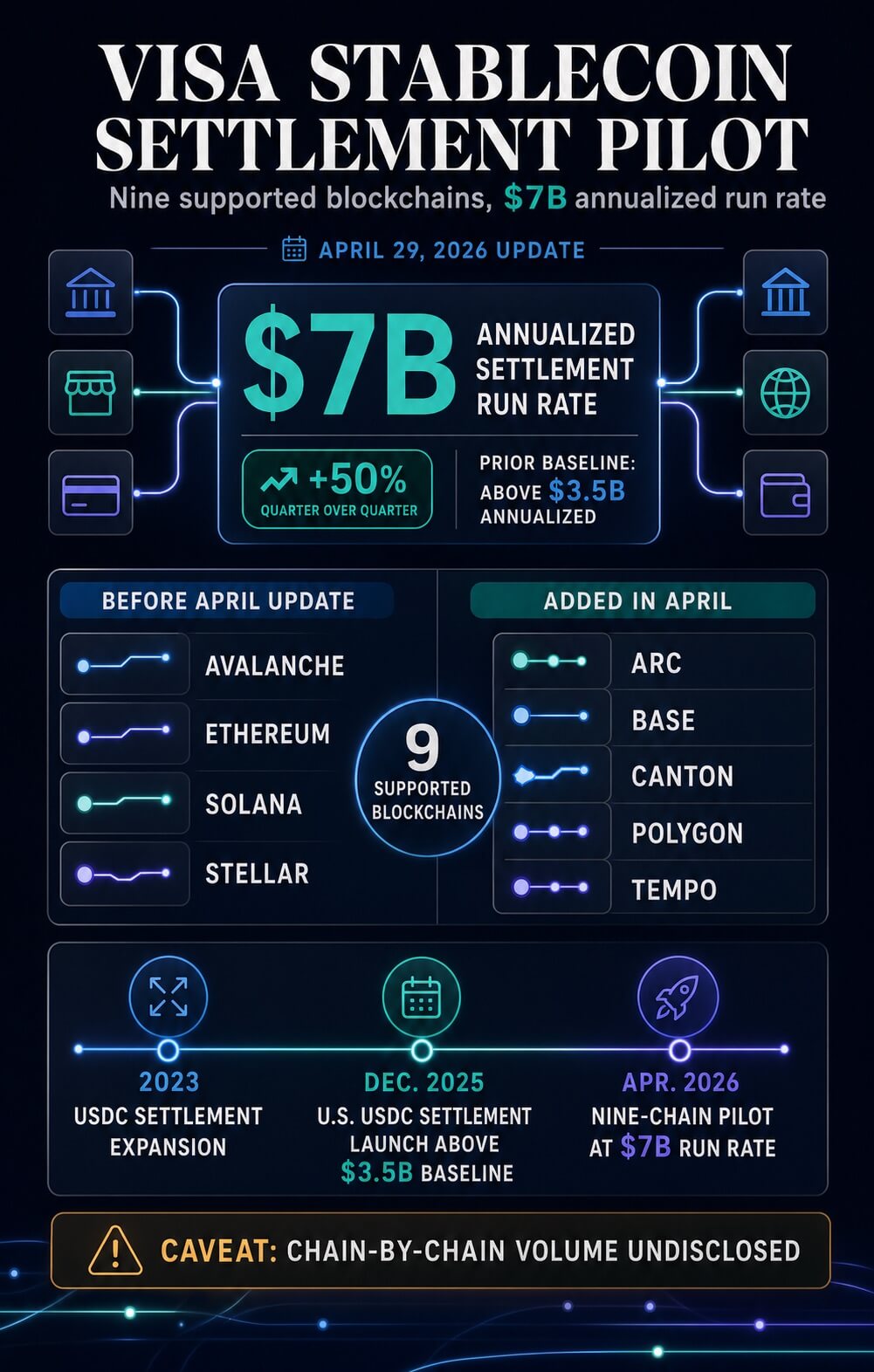
Visa said its settlement pilot for stablecoins now supports nine blockchains and has reached a run rate of $7 billion a year.

The company announced on April 29 that it added Arc, Base, Canton, Polygon and Tempo to a pilot that already used Avalanche, Ethereum, Solana and Stellar.

Visa said the annualized settlement run rate is up 50% from the prior quarter.

The pilot remains bounded by Visa’s own language, but the signal is in where the volume sits. Stablecoins are entering the part of payments consumers rarely see, the settlement layer that moves value between issuers, acquirers, banks, program managers and treasury systems after a transaction has already been authorized.

That makes the update a settlement-infrastructure signal as much as a blockchain support list. Visa is testing whether stablecoins can become a parallel settlement option inside payment infrastructure that already touches banks, card programs and merchants across markets.

The operational point is direct: crypto adoption is moving into the back office before it becomes visible at the checkout screen.

The conclusion has limits. The company described a pilot and support, gave a run rate for stablecoin settlement, and left the split by chain, stablecoin, partner, and geography undisclosed.

That keeps things bounded: the network is adding optional settlement rails, while traditional settlement remains part of the stack.

Crypto now projected to move $719 trillion through global paymentsCrypto now projected to move $719 trillion through global payments
Related Reading

Crypto now projected to move $719 trillion through global payments

Consumers may not see the shift yet, but the fight over how money moves is already underway.

Apr 9, 2026 · Gino Matos

Infographic showing Visa's stablecoin settlement pilot at a $7 billion annualized run rate across nine supported blockchains, with chain-by-chain volume undisclosed.Infographic showing Visa's stablecoin settlement pilot at a $7 billion annualized run rate across nine supported blockchains, with chain-by-chain volume undisclosed.

How Visa got to nine chains

Visa has been building toward this point for several years. In 2023, the company said it had moved millions of USDC between partners over Solana and Ethereum to settle fiat-denominated VisaNet payments.

That announcement followed an earlier Crypto.com issuer pilot and expanded the settlement work to merchant acquirers Worldpay and Nuvei.

The operational issue is familiar in card payments. A consumer gets near-instant authorization at the point of sale, but funds still have to move between the issuing bank and the merchant’s bank.

Visa’s treasury and settlement systems sit inside that process, moving value across currencies and institutions.

In December 2025, U.S. issuer and acquirer partners gained the ability to settle with Visa in USDC, with Cross River Bank and Lead Bank initially settling over Solana.

The company cited faster funds movement, seven-day availability, and resilience across weekends and holidays.

Solana is becoming settlement rail for Visa and JPMorgan but one metric still scares insidersSolana is becoming settlement rail for Visa and JPMorgan but one metric still scares insiders
Related Reading

Solana is becoming settlement rail for Visa and JPMorgan but one metric still scares insiders

Wyoming’s Frontier launch plus a Wall Street wrapper filing happened fast, and the real institutional bet is on settlement rails.

Jan 8, 2026 · Gino Matos

The April release also connected the chain expansion to Visa’s stablecoin-linked card programs, which it said numbered more than 130 programs across more than 50 countries.

That makes the nine-chain footprint part of a broader payment operating model, beyond a ledger experiment.

The new run rate gives that timeline a sharper shape. The December 2025 U.S. launch put the prior annualized stablecoin settlement baseline above $3.5 billion.

The April update puts the run rate at $7 billion, with five more blockchains added to the pilot.

Before the April updateAdded in AprilOperational signalAvalanche, Ethereum, Solana, StellarArc, Base, Canton, Polygon, TempoVisa is widening the settlement pilot across public chains, payment-focused networks and institution-oriented infrastructure.

The table serves as a footprint rather than a volume map. The run rate applies to the pilot as a whole; the available disclosure leaves that volume undivided across the nine supported networks.

The sequence also shows a shift in who the product is for. The early work proved that USDC could move between card ecosystem participants.

The current phase asks whether the same settlement logic can be offered across a wider menu of rails while reducing the need for each partner to build separate crypto operations from scratch.

What the chain mix shows

The five additions suggest the types of environments Visa wants available to partners.

Arc is a stablecoin-native Layer 1 created by Circle. It brings USDC-denominated fees, optional privacy, sub-second deterministic finality and direct integration with Circle’s stack.

That makes Arc relevant to payment flows where predictable costs, stablecoin liquidity and transfer guarantees count more than token speculation.

Arc’s public materials also describe public testnet status, which keeps production claims bounded.

Base brings a different route into the same problem. Visa described Base as powered by Coinbase, while Base offers USDC payments that settle in seconds, use low gas costs and can be funded from a Base Account or Coinbase Account.

Base connects wallets, payment tooling, and exchange-linked liquidity into a consumer and developer surface.

Canton adds the institutional privacy layer. Visa had already said in March that it would become a Canton Super Validator, helping banks and financial institutions explore privacy-preserving payments, settlement and treasury use cases.

Canton centers stablecoin payments on need-to-know privacy, so counterparties, amounts and strategies can remain visible only to the parties that need them, unlike many open blockchains.

As an analytical reading of the chain mix, Polygon and Tempo fit the payment-infrastructure side of the roster. Polygon emphasizes global payments, stablecoin liquidity and lower-cost transactions.

Tempo emphasizes dedicated payment lanes, stablecoin-native gas, payment metadata for reconciliation and deterministic settlement.

Together, the additions create a wider operating menu across chain types. One partner may need low-cost stablecoin movement.

Another may need privacy controls for regulated finance. Another may value Coinbase-connected payment tooling.

CryptoSlate Daily Brief

Daily signals, zero noise.

Market-moving headlines and context delivered every morning in one tight read.

5-minute digest 100k+ readers

Free. No spam. Unsubscribe any time.

Whoops, looks like there was a problem. Please try again.

You’re subscribed. Welcome aboard.

Visa’s role is to make those differences usable through a common settlement layer.

The result is a portfolio of settlement options across chain types. That portfolio lets Visa present stablecoins as infrastructure that can adapt to partner constraints, from regulated privacy to low-cost throughput, while keeping the payment-network relationship in the center.

The adoption signal is operational

The broader market context supports the shift while keeping price moves out of the frame. As of April 30, the crypto market stood at around $2.55 trillion, while DefiLlama put total stablecoin market capitalization at around $319.802 billion.

USDC sits in that context as a core settlement asset used for payments, treasury management, collateral, and cross-chain liquidity.

Ethereum, Solana, and Polygon Ecosystem Token are large or payment-relevant networks and tokens that can carry settlement infrastructure while keeping price data in the background.

Stablecoins already have enough liquidity and operating history for large payment networks to treat them as infrastructure options.

The adoption test shifts from whether a consumer chooses a wallet over a card to whether payment firms can use stablecoins to move value after the customer-facing transaction is done.
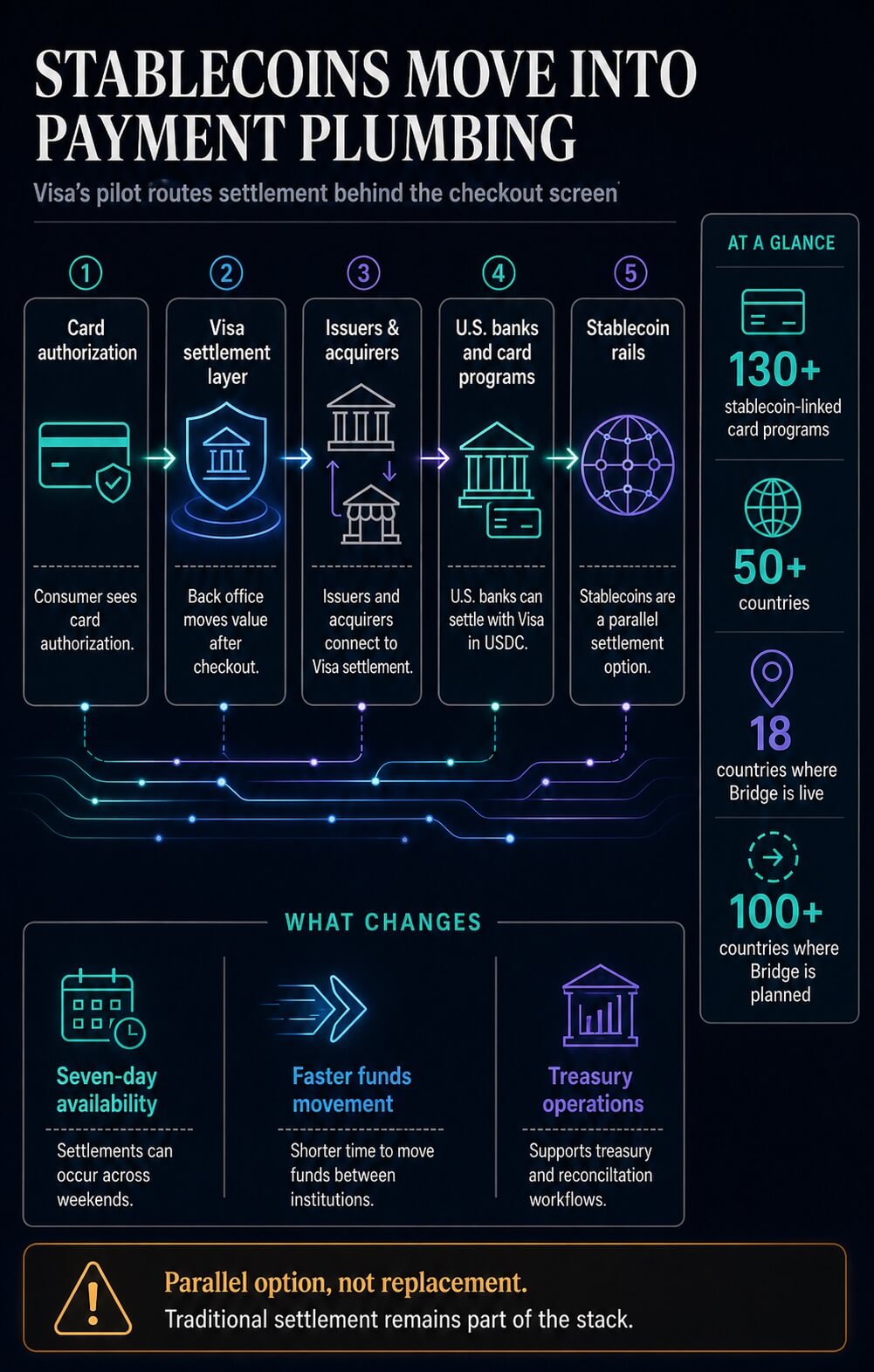
Infographic explaining stablecoins as a parallel payment settlement option behind checkout, with card programs, countries, Bridge markets, and treasury operations highlighted.Infographic explaining stablecoins as a parallel payment settlement option behind checkout, with card programs, countries, Bridge markets, and treasury operations highlighted.

The market-side thesis has been building. A January analysis of BlackRock’s stablecoin thesis argued that dollar tokens were shifting from trading utility to settlement infrastructure within and alongside traditional finance.

An April analysis of Visa, Stripe, and Mastercard described stablecoins as a settlement and liquidity layer beneath existing payment brands.

Visa’s update provides a current operating example for that thesis. The company is connecting stablecoin settlement to issuers, acquirers, U.S. banks, and stablecoin-linked card programs.

Its March expansion with Bridge said stablecoin-linked Visa cards were live in 18 countries, with planned expansion to more than 100 countries.

That release also said issuers and acquirers involved in those programs could settle with Visa using stablecoins over supported networks.

Regulation sits in the background. Treasury framed the U.S. GENIUS Act as providing regulatory clarity for a market it expects could become much larger.

A CryptoSlate analysis of stablecoin economics under the CLARITY and GENIUS framework showed why the policy fight has moved toward who captures digital-dollar economics.

CLARITY Act stablecoin fight shifts from yield to who captures digital-dollar economicsCLARITY Act stablecoin fight shifts from yield to who captures digital-dollar economics
Related Reading

CLARITY Act stablecoin fight shifts from yield to who captures digital-dollar economics

Washington’s stablecoin rules are turning a yield fight into a broader contest over payments, reserves, wallets, and bank rails.

Apr 28, 2026 · Liam ‘Akiba’ Wright

Visa tied the expansion to pilots, banks, partners, and supported networks, while the policy debate helps explain why payment stablecoins are drawing more mainstream attention.

The $7 billion run rate shows real activity, while the lack of a chain-by-chain breakdown leaves the depth of each rail unclear.

The nine-chain footprint shows optionality, while the pilot label keeps the conclusion bounded.

The adoption signal is therefore specific. Stablecoins are taking on a role beyond trading-market distribution.

Within Visa’s settlement pilot, they are becoming a treasury and settlement option for institutions already within mainstream payments.

The next test is whether that option remains a specialist rail for selected partners or becomes a routine part of how global payment firms move value after the consumer never sees the transaction again.



Source link

Tags: BuildingknowingMainstreamPaymentPlumbingQuietlyStablecoinsVisa
ShareTweetShare
Previous Post

9 High Cash Flow Stocks Likely to Outperform If Rates Stay Higher for Longer

Next Post

Jim Cramer on Ventas: “I Think This Is Just a Fantastic Business”

Related Posts

Bolivia Considers Recognizing USDT for Payments Amid Dollar Shortage

Bolivia Considers Recognizing USDT for Payments Amid Dollar Shortage

by theadvisertimes.com
July 13, 2026
0

Bolivia is evaluating integrating Tether's USDt into its national payments system, a move that could mark one of Latin America's...

Zcash & Monero Retreat As Privacy Coins Face Setbacks in China

Zcash & Monero Retreat As Privacy Coins Face Setbacks in China

by theadvisertimes.com
July 13, 2026
0

The privacy coins are once again making headlines amid renewed pressures from Chinese legal researchers. The impact is also visible...

Bitcoin falls below ,000 as markets give Hormuz traffic just 3% chance to normalize by August

Bitcoin falls below $63,000 as markets give Hormuz traffic just 3% chance to normalize by August

by theadvisertimes.com
July 13, 2026
0

Bitcoin slipped below $63,000 as renewed fighting between the United States and Iran pushed oil prices higher, drove bond yields...

Webull EU Secures MiCA Authorisation as EU Targets Post-Regulation Gaps

Webull EU Secures MiCA Authorisation as EU Targets Post-Regulation Gaps

by theadvisertimes.com
July 13, 2026
0

Webull EU has secured approval under the Markets in Crypto-Assets (MiCA) regulation, granted by the Dutch regulator. This authorisation represents...

Ripple Almost Shut Down and Distributed XRP After SEC Lawsuit, CEO Reveals

Ripple Almost Shut Down and Distributed XRP After SEC Lawsuit, CEO Reveals

by theadvisertimes.com
July 12, 2026
0

Key TakeawaysRipple came close to shutting down after the SEC filed a lawsuit over XRP.The company considered distributing its XRP...

Saylor’s Strategy Messaging Not Helping Push Bitcoin Story Says StanChart

Saylor’s Strategy Messaging Not Helping Push Bitcoin Story Says StanChart

by theadvisertimes.com
July 12, 2026
0

Strategy founder and chairman Michael Saylor again took to social media on Sunday to offer his latest signal to investors...

Next Post
Jim Cramer on Ventas: “I Think This Is Just a Fantastic Business”

Jim Cramer on Ventas: “I Think This Is Just a Fantastic Business”

Inside the Fed: Powell and Warsh set to clash

Inside the Fed: Powell and Warsh set to clash

  • Trending
  • Comments
  • Latest
Should You Offer a Concession to Get Your Apartment Leased Faster?

Should You Offer a Concession to Get Your Apartment Leased Faster?

June 15, 2026
How I Maximize My Sapphire Reserve Dining Credit

How I Maximize My Sapphire Reserve Dining Credit

July 10, 2026
Fourth of July 2026 Freebies and Deals

Fourth of July 2026 Freebies and Deals

July 3, 2026
5 things financial therapists want every advisor to know

5 things financial therapists want every advisor to know

June 26, 2026
The 10 Largest NYC Tech Startup Funding Rounds of June 2026 – AlleyWatch

The 10 Largest NYC Tech Startup Funding Rounds of June 2026 – AlleyWatch

July 6, 2026
Prime Day, June 2026: How Retailers Competed With Amazon

Prime Day, June 2026: How Retailers Competed With Amazon

June 29, 2026
The Fallacy of the Keynesian Theory of Insufficient Demand

The Fallacy of the Keynesian Theory of Insufficient Demand

0
Germany opposes EU trade embargo on settlements

Germany opposes EU trade embargo on settlements

0
Ford Recalls Nearly 1M Vehicles in 2 Weeks. Is Your Car on the List?

Ford Recalls Nearly 1M Vehicles in 2 Weeks. Is Your Car on the List?

0
Goldman Sachs quietly snags a corner of America’s retirement money

Goldman Sachs quietly snags a corner of America’s retirement money

0
US stocks today: US stocks end lower as Iran tensions dampen risk appetite; chipmakers drop

US stocks today: US stocks end lower as Iran tensions dampen risk appetite; chipmakers drop

0
Bolivia Considers Recognizing USDT for Payments Amid Dollar Shortage

Bolivia Considers Recognizing USDT for Payments Amid Dollar Shortage

0
Ford Recalls Nearly 1M Vehicles in 2 Weeks. Is Your Car on the List?

Ford Recalls Nearly 1M Vehicles in 2 Weeks. Is Your Car on the List?

July 13, 2026
How Outdated EBT Cards Are Fueling a Surge in SNAP Benefit Theft

How Outdated EBT Cards Are Fueling a Surge in SNAP Benefit Theft

July 13, 2026
US stocks today: US stocks end lower as Iran tensions dampen risk appetite; chipmakers drop

US stocks today: US stocks end lower as Iran tensions dampen risk appetite; chipmakers drop

July 13, 2026
Waller says Fed shouldn’t ‘fight the last war’ on inflation but warns hikes still possible

Waller says Fed shouldn’t ‘fight the last war’ on inflation but warns hikes still possible

July 13, 2026
Exclusive: Delaware Secretary of State partners with Norm Ai to propose the AIC, a legal entity for agents

Exclusive: Delaware Secretary of State partners with Norm Ai to propose the AIC, a legal entity for agents

July 13, 2026
Will the Trump Admin Buy Into OpenAI & Save Softbank?

Will the Trump Admin Buy Into OpenAI & Save Softbank?

July 13, 2026
theadvisertimes.com

Get the latest news and follow the coverage of Business & Financial News, Stock Market Updates, Analysis, and more from the trusted sources.

CATEGORIES

  • Business
  • Cryptocurrency
  • Economy
  • Financial Planning
  • Investing
  • Market Analysis
  • Markets
  • Money
  • Personal Finance
  • Startups
  • Stock Market
  • Trading

LATEST UPDATES

  • Ford Recalls Nearly 1M Vehicles in 2 Weeks. Is Your Car on the List?
  • How Outdated EBT Cards Are Fueling a Surge in SNAP Benefit Theft
  • US stocks today: US stocks end lower as Iran tensions dampen risk appetite; chipmakers drop
  • Our Great Privacy Policy
  • Terms of Use, Legal Notices & Disclosures
  • About Us
  • Contact Us

© Copyright 2024 All Rights Reserved
See articles for original source and related links to external sites.

Welcome Back!

Login to your account below

Forgotten Password?

Retrieve your password

Please enter your username or email address to reset your password.

Log In
No Result
View All Result
  • Home
  • Business
  • Financial Planning
  • Personal Finance
  • Investing
  • Money
  • Economy
  • Markets
  • Stocks
  • Trading

© Copyright 2024 All Rights Reserved
See articles for original source and related links to external sites.