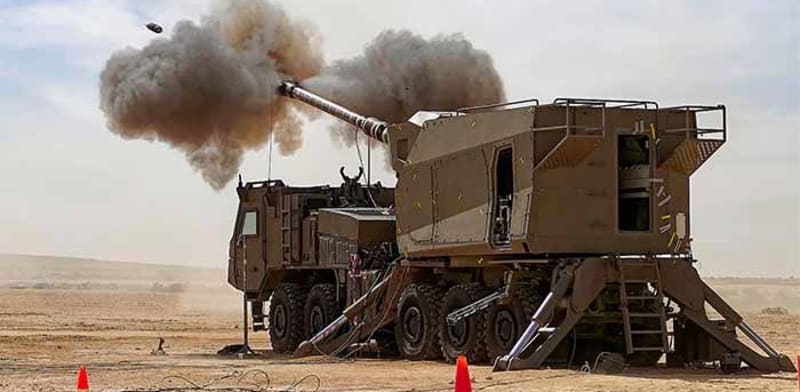
For more than four decades, the Patriot defensive missile system has occupied a central place in the architecture of American military power. Exported widely across NATO, the Middle East, and Asia, Patriot has become more than a defensive missile battery. It is simultaneously a battlefield system, a geopolitical signal, a reassurance mechanism for allies, and a symbol of American technological sophistication.
The system retains enormous prestige. New Patriot batteries continue to be ordered despite high acquisition and sustainment costs. Political leaders routinely present Patriot deployments as evidence of American commitment and advanced defensive capability. During periods of regional crisis, requests for Patriot deployments often carry almost ritual significance. A Patriot battery does not merely defend airspace; it visibly anchors a state inside the American security order.
Patriot PAC-3 launch
Yet beneath this continued prominence lies a more complicated reality. Patriot has spent four decades adapting to a threat environment evolving faster than the system itself. The missile-defense problem confronting the United States today differs fundamentally from the one Patriot was originally designed to solve. Modern missile warfare favors abundance, saturation, distributed attack, and rapid adaptation. Patriot, by contrast, remains rooted in an architecture built around expensive interceptors, centralized radar systems, finite inventories, and stable threat assumptions.
Patriot remains capable, lethal, and in many circumstances tactically effective. The deeper problem is strategic. U.S. assumptions surrounding tactical missile defense are ageing faster than the missile batteries themselves. This article examines the evolution of the Patriot missile system and related tactical and strategic problems.
Cold War Origins
Patriot emerged during the Cold War as a replacement for older American anti-aircraft missile systems. Its original purpose was relatively conventional: defending fixed assets and troop formations against hostile aircraft. Although later modifications added ballistic missile interception capability, the system was fundamentally designed in an era shaped by assumptions very different from those governing modern warfare.
The original threat environment emphasized targeting manned aircraft, relatively limited missile inventories, and predictable strike packages launched by centralized state adversaries. The United States expected to confront Soviet airpower and tactical missile forces in a highly organized Cold War battlespace. The problem was difficult, but it remained conceptually bounded.
The Patriot system evolved gradually through the PAC-1, PAC-2, and PAC-3 upgrade cycles. (PAC = Patriot Advanced Capability.) Radars improved. Interceptor accuracy increased. Anti-ballistic missile capability expanded substantially. Networking and tracking functions became progressively more sophisticated. These upgrades were technologically real and often impressive. Yet they largely represented iterative modernization of a legacy architecture rather than a fundamental redesign of the defensive paradigm itself. Patriot evolved slowly in stages. In recent decades, however, the operational environment has evolved through disruption rather than incremental change.

The Patriot Evolutionary Split: PAC-2 and PAC-3
One of the most important developments in the Patriot system was the divergence between the PAC-2 and PAC-3 interceptor families. These are not simply older and newer versions of the same missile. They represent different interception philosophies evolving inside the same defensive ecosystem. PAC-2 reflected the culmination of traditional Cold War surface-to-air missile doctrine. It is a large interceptor carrying a substantial fragmentation warhead. The missile destroys targets through proximity detonation, spraying high-velocity fragments across a lethal radius. This approach is well suited to engaging aircraft, helicopters, and some cruise missiles across relatively broad engagement geometries. The philosophy is straightforward: the missile does not need to collide precisely with the target. It only needs to detonate close enough to destroy or cripple it.
Ballistic missile interception introduced a radically different problem. Ballistic targets travel at extreme speed, often descending steeply with compressed engagement windows. Near misses are unreliable against hardened or maneuvering reentry vehicles. Interception therefore demands far greater precision. PAC-3 emerged as the response to this challenge. Unlike PAC-2, PAC-3 is a much smaller missile built for hit-to-kill interception. Rather than destroying the target with explosive fragmentation, PAC-3 attempts direct collision. This required advanced seekers, extreme maneuverability, rapid terminal correction, and highly precise guidance systems. PAC-3 therefore became less a conventional anti-aircraft missile than a specialized ballistic missile interceptor integrated into the broader Patriot architecture.
PAC-3’s hit-to-kill design required a fundamentally different control philosophy from earlier Patriot interceptors. In addition to aerodynamic maneuvering, PAC-3 incorporated lateral thrusters capable of making extreme terminal-course corrections during high-speed ballistic missile interception. In PAC-3, Patriot had evolved from a traditional anti-aircraft missile system into a design optimized for defeating ballistic missile targets.
The introduction of the Patriot Advanced Capability-3 Missile Segment Enhancement (PAC-3/MSE) represented a further evolution of the Patriot system toward specialized ballistic and maneuvering-threat interception. PAC-3 MSE retained the hit-to-kill philosophy of the earlier PAC-3 design while incorporating a larger rocket motor, expanded control surfaces, and improved maneuverability. These changes substantially increased the interceptor’s engagement envelope and terminal agility, particularly against high-speed ballistic and maneuvering targets. In effect, MSE expanded the PAC-3 engagement envelope while further enhancing terminal interception performance
This evolutionary split resulted in operational tradeoffs. PAC-3 dramatically improved Patriot’s ability to engage ballistic missiles, maneuvering threats, and high-speed terminal targets. But PAC-2 retained advantages in engagement range against aircraft, and slower targets. This distinction matters because modern air warfare emphasizes stand-off attack. Aircraft may launch cruise missiles or glide weapons from outside dense defended airspace. Under such conditions, longer-range engagement against the launch platform itself retains substantial value.
The coexistence of PAC-2 and PAC-3 therefore reflects a deeper reality: the missile-defense problem itself fragmented faster than any single interceptor design could fully solve. Patriot evolved into a layered defensive ecosystem balancing different engagement geometries, target classes, and inventory priorities against a continuously expanding threat environment.

The U.S. Air Superiority Assumption
Following the collapse of the Soviet Union, the United States entered a prolonged period of military dominance characterized by near-total air superiority. American doctrine emphasized stealth aviation, expeditionary warfare, precision strike, carrier aviation, and offensive air dominance. The underlying assumption was that the United States would generally control the skies before large-scale missile saturation became decisive. Potential adversaries evolved differently.
Russia and China emphasized integrated air defense systems, anti-access and area-denial strategies, long-range surface-to-air missiles, layered radar architectures, and survivable mobile launch systems. The contrast was doctrinal as much as technological. The United States treated tactical air defense as a supporting component of offensive air dominance. Its competitors treated air denial as a central condition of survival.

Russian S400 air defense system
Systems such as the Russian S-400 and Chinese HQ-9 reflected this different strategic emphasis. Whether these systems ultimately outperform Patriot in combat is less important than the fact that competing powers pursued aggressive doctrinal evolution in layered ground-based air defense while the United States prioritized offensive reach and air supremacy. This divergence matters.

The Arithmetic of Saturation
Modern offensive missile warfare is evolving toward saturation attacks by mixed missile and drone forces. Cheap drones, low-cost cruise missiles, maneuvering ballistic and hypersonic missiles, and numerous launch systems allow adversaries to generate attack densities that strain defensive systems designed around expensive interceptors and limited magazine depth. This creates an unfavorable cost and quantity asymmetry for Patriot systems facing persistent mixed-threat saturation attacks. The defender must succeed repeatedly. The attacker often requires only partial leakage. This arithmetic favors the offense.

The problem is not simply missile cost. It is industrial and temporal. High-end multi-million dollar interceptors such as PAC-3 MSE are complex, production-constrained, and difficult to replenish rapidly during sustained conflict. Modern missile defense therefore becomes an inventory-management problem as much as an interception problem. Saturation attacks target not only defended assets, but the defensive ecosystem itself. The goal is to degrade defenses by inducing interceptor depletion, overwhelming tracking systems, exhausting reload capacity, compressing command decisions, and disrupting coordination. This is fundamentally an attack on the defender’s battle management capacity.

Ukraine, Iran, and the Stress Test of Modern Missile Defense
The wars in Ukraine and the Middle East have provided the first modern stress tests of advanced integrated missile defense under sustained combat conditions. These conflicts did not demonstrate the obsolescence of systems such as Patriot, but they revealed the growing structural pressures imposed by saturation warfare. In Ukraine, Patriot batteries demonstrated significant capability against Russian missile attacks, despite reports of ballistic missile interception failures and damage to Patriot installations. Ukrainian officials repeatedly described Patriot as capable of engaging Russian missile threats.
The Ukraine war also revealed the speed at which modern offensive systems adapt. Russian forces altered attack profiles, mixed drones with cruise and ballistic missiles, varied launch timing, employed decoys, and experimented with maneuvering trajectories designed to complicate interception geometry and overwhelm defensive allocation decisions. This enabled them to inflict substantial damage where Patriot systems were overwhelmed or absent. The conflict also highlighted the industrial dimension of missile defense. Ukraine’s dependence on continuing external interceptor supply revealed how rapidly high-intensity warfare can stress even advanced defensive inventories. Production capacity, replenishment velocity, logistics, and reload sustainability became strategic variables rather than secondary procurement concerns.
The Iran-Israel missile exchanges revealed similar pressures under a different operational model. Iran demonstrated the ability to generate large-scale ballistic and drone salvos against heavily defended targets. Israeli and allied defensive systems achieved high interception rates overall, yet even sophisticated multilayer defenses experienced leakage under sustained attack conditions. Because of uneven defensive coverage, Iran was able to destroy key early warning radars, reducing strike warning times and complicating missile defense. The issue was not absolute failure. The issue was that the defensive architecture was not impermeable against sustained large-scale saturation attacks.

Iranian Shahed drone – cheap and numerous
These conflicts collectively revealed that modern missile defense operates in an attrition-sensitive environment. Defensive success depends not merely on interceptor sophistication, but on inventory depth, adaptation speed, production elasticity, reload sustainability, and the ability to manage complex engagement environments under severe temporal compression. Perhaps most importantly, these wars demonstrated that offensive adaptation may now occur faster than defensive system development. Missile tactics, decoy deployment, drone integration, and mixed-salvo attack concepts evolved continuously in combat, while defensive systems remained tied to standard doctrines and longer modernization and production cycles. This widening evolutionary gap lies at the center of an emerging strategic problem.
The OODA Differential
John Boyd’s OODA concept (Observe, Orient, Decide, Act) is often interpreted narrowly as a matter of tactical reaction speed inside combat engagements. In modern missile warfare, however, the more important contest occurs between engagements rather than within them. The central strategic issue is not simply whether a Patriot battery can process information rapidly during an incoming attack. Modern defensive systems are often remarkably capable at the target engagement level. The deeper issue is the relative speed at which offensive and defensive systems evolve over time.
Recent conflicts suggest that offensive adaptation cycles are accelerating faster than defensive adaptation cycles. Attackers can rapidly modify: attack composition, decoy usage, launch sequencing, and flight profiles using comparatively inexpensive and abundant weapons. These changes can emerge over weeks, days, or even battle-to-battle as attackers continuously experiment with new combinations intended to exploit defensive weaknesses.
Defensive systems evolve more slowly. A system such as Patriot depends upon: specialized interceptors, fixed radar architectures, complex industrial production chains, logistical support, and limited inventories. Adapting such systems often requires lengthy procurement and modernization cycles measured in years rather than weeks. This creates a widening temporal asymmetry. The attacker operates inside a rapid experimental cycle driven by low-cost iteration and operational improvisation. The defender operates inside a slower institutional cycle shaped by production constraints, procurement bureaucracy, sustainment requirements, and technological specialization.
The wars in Ukraine and the Middle East illustrated this divergence repeatedly. Offensive forces continuously adjusted attack vectors, drone mixes, decoy deployment, and saturation timing in response to observed defensive behavior. Defensive systems adapted as well, but generally through slower software updates, revised engagement doctrine, inventory redistribution, and incremental modernization rather than rapid structural transformation.
Missile defense now resembles a competition between adaptation velocities rather than a static contest between fixed weapons systems. The side capable of modifying tactics, decoys, and attack architectures faster than the defender can adjust interception doctrine and defensive inventories progressively gains strategic initiative. This is where the ageing of Patriot becomes strategically important. Its evolution may not match the increasing tempo of operational challenges.
Institutional Intertia vs. Operational Reality
Despite these issues, Patriot remains globally sought after and commercially successful. A single Patriot missile battery (radar, control station, and 4-8 launchers) costs roughly $1 billion. Patriot’s strategic and political value is reflected in continued procurement demand. RTX, Patriot’s manufacturer, reportedly earned more than $8 billion in Patriot-related sales during 2025. Patriot buyers seek more than operational missile defense; they secure alliance integration, political reassurance, interoperability, prestige, symbolic American commitment, and participation in the U.S. defense ecosystem. In many cases, purchasing Patriot is as much a geopolitical decision as a military one. Great powers frequently continue refining dominant systems after the strategic conditions supporting those systems begin eroding.
Patriot’s continued commercial success reinforces sustainment contracts, upgrade programs, procurement continuity, industrial dependency, and political support structures. The American defense-industrial system optimizes for continuity, sustainment, incremental modernization, shareholder returns, exportability, and high-value procurement cycles, while the operational environment rewards scalability, affordability, rapid iteration, distributed systems, attritable platforms, and mass production. The resulting divergence may become a significant long-term constraint on U.S. military effectiveness.
Conclusion
The issue is not whether the Patriot still works. The deeper question is whether the strategic assumptions underlying American tactical missile defense remain sustainable under conditions of rapidly accelerating technological and operational change. The ageing of Patriots is therefore not merely a technical problem. It is an institutional and temporal problem. The United States fields defensive missile architectures based on expensive interceptors, complex production chains, and incremental modernization cycles. Its adversaries pursue volume production, scalable saturation, distributed attack systems, low-cost experimentation, and rapid tactical adaptation. The critical danger is therefore not that missiles may penetrate American defenses. It is that the evolutionary tempo of adversary weapon systems may outpace the development cycles of U.S. weapons designed to resist them. In modern missile warfare, the side that adapts fastest may prevail against the side that spends the most. The ageing Patriots do not lack speed of flight. They risk lacking speed of evolution.