Until very recently, nuclear proliferation was treated primarily as a problem of rogue states, revisionist regimes, or localized regional instability. The prevailing assumption was that restraint would be rewarded with security guarantees, legal protection, and predictable international behavior. That assumption is no longer tenable. The systematic breaching of legal and institutional limits on the use of force by the United States has begun to reshape global security incentives. As U.S. aggression becomes normalized, legally unmoored, and increasingly detached from diplomatic norms, nuclear weapons reassert themselves as the only credible deterrent against coercion by superior military powers.
The Signal Being Sent
Recent U.S. international conduct communicates a stark and globally legible message: international law is optional, treaties are contingent, and security guarantees are political rather than institutional. Covert action, paramilitary force, and the threat of unilateral military intervention have become routine tools of policy rather than exceptional measures. When senior U.S. officials openly assert unchallenged authority to attack other nations and seize their resources, the lesson absorbed abroad is unmistakable. State sovereignty cannot be protected by rules or norms that powerful actors openly disregard. For nations with sufficient resources and technical capacity, this logic points directly toward recourse to nuclear deterrence.
Why Nuclear Weapons Reassert Their Logic
Nuclear weapons have always functioned primarily as tools of regime survival rather than instruments of battlefield utility. As treaty compliance fails to deliver protection and diplomatic alignment fails to guarantee restraint, deterrence regains primacy. A nuclear weapons capability offers a uniquely efficient means of deterring both superpowers and regional adversaries. Even a small number of deliverable, rudimentary nuclear weapons sharply increases the risks faced by any potential attacker, altering strategic calculations in ways that no attainable conventional force can replicate. Proliferation pressure today reflects defensive rationality under weakened international norms, not ideological ambition or militaristic fervor.
What Latent Nuclear Capability Means
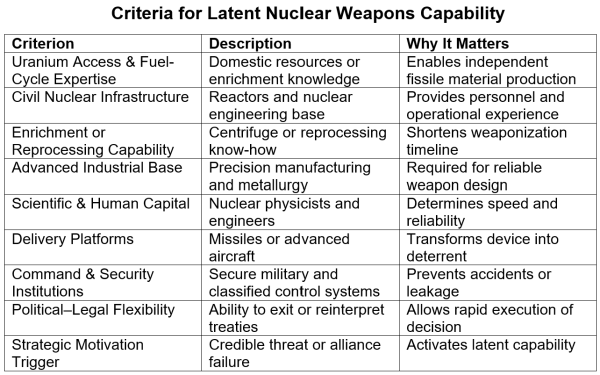
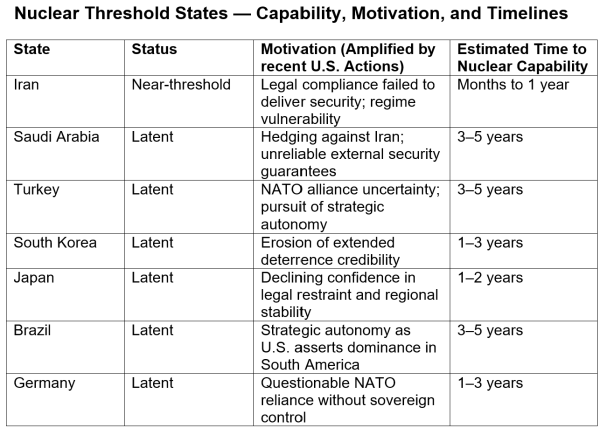
Many states already possess latent nuclear capability: the ability to cross the nuclear threshold rapidly once political authorization is given. Latency reflects possession of the human capital, financial resources, industrial base, and technical expertise required to develop and produce nuclear weapons. In such cases, the principal constraint is not practical feasibility but political restraint. As confidence in international norms erodes, that restraint weakens, compressing timelines from decades to years, and in some cases to months under crisis conditions.
Threshold State Assessments
Iran
Iran demonstrates with particular clarity how legal compliance can fail to deliver security. After years of restraint, intrusive inspections, and formal adherence to international agreements, compliance neither prevented sanctions escalation nor shielded Iran from covert sabotage, cyber operations, or persistent military threats. From Tehran’s perspective, compliance arguably increased vulnerability by exposing constraints without delivering reciprocal restraint. With Iran already near the technical threshold, the remaining barrier to weaponization is political rather than technical. As confidence in reciprocity collapses, nuclear capability increasingly appears not as leverage for negotiation, but as a necessary guarantor of regime survival.
Saudi Arabia
Saudi Arabia’s nuclear calculus reflects strategic hedging rather than ideological aspiration. The Kingdom has explicitly linked its nuclear posture to Iran’s trajectory while confronting the limits of externally provided security guarantees that are visibly transactional and reversible. Recent experience has underscored that alignment does not ensure automatic protection or enduring commitment. In a system where alliance assurances appear contingent and legal constraints on force weaken, sovereign nuclear deterrence emerges as an insurance policy against abandonment rather than a bid for regional dominance. Saudi Arabia has long been suspected of pursuing a form of nuclear threshold capability through its relationship with Pakistan: financing nuclear development in the past and maintaining a contingent deterrence understanding that could be activated in extremis. While there is no public evidence that Riyadh possesses nuclear weapons or completed designs, the existence of such arrangements underscores how states adapt to weakened nonproliferation norms without crossing formal thresholds.
Turkey
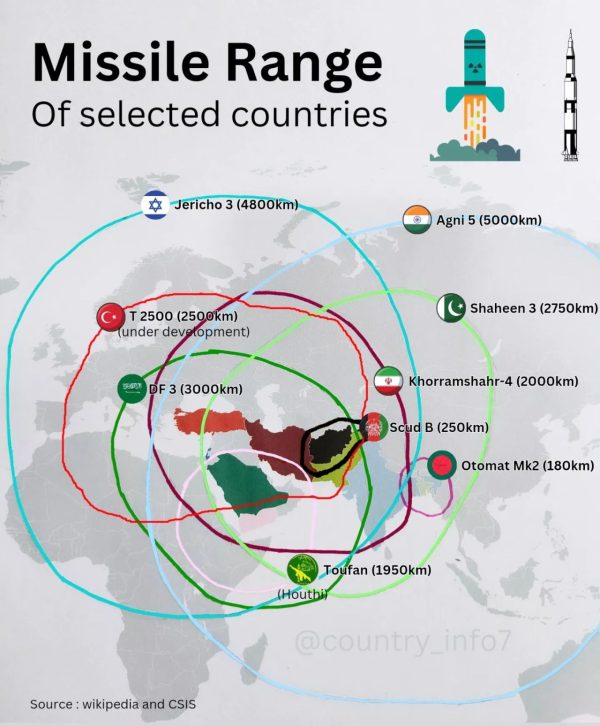
Turkey occupies an increasingly unstable position as a NATO member that hosts nuclear weapons without sovereign control while pursuing greater strategic autonomy. Ankara has openly questioned the equity of the existing nuclear order and has invested heavily in advanced industrial, aerospace, and missile capabilities. As alliance cohesion weakens and the selective application of international law becomes more apparent, Turkey’s incentive to secure independent deterrent leverage grows. This pressure arises not from expansionist ambition, but from uncertainty about whether alliance-based protection will remain reliable during acute crises. Turkey also faces the dual potential threat of nuclear-armed powers, Russia and Israel, to its north and south.
South Korea
South Korea represents one of the most compressed proliferation timelines in the international system. Facing a nuclear-armed adversary and possessing advanced industrial and scientific capacity, Seoul has long relied on extended deterrence to justify restraint. However, extended deterrence depends on predictable political commitment by the U.S. As those commitments appear increasingly volatile and subject to domestic political fluctuation, nuclear latency functions as a rational insurance mechanism against strategic abandonment. South Korea faces a far weaker northern adversary that has nevertheless succeeded in defying the U.S. by means of its nuclear arsenal. The lesson for South Korea is plain: the U.S. respects only military power.
Japan
Japan is among the most consequential restraint cases in global politics. With extensive civilian nuclear infrastructure, advanced fuel-cycle capabilities, and exceptional technological sophistication, Japan’s non-nuclear status rests almost entirely on trust—trust in legal norms, alliance predictability, and escalation control. As those assumptions weaken under regional militarization and declining confidence in rule-based restraint, the logic of permanent abstention becomes increasingly strained. Any Japanese reconsideration of nuclear posture would signal a profound failure of the postwar Asian security architecture. Japan’s neighbors have long memories of the damage inflicted by imperial Japan, and a nuclear-armed Japan would put regional relations into a dangerous state of turmoil.
Brazil
Brazil highlights the fragility of norm-based restraint under conditions of asymmetric enforcement. Long committed to multilateralism and non-proliferation, Brazil nevertheless maintains nuclear fuel-cycle expertise and a sophisticated industrial base enabling nuclear energy and naval nuclear propulsion programs. When international law appears selectively binding and force increasingly overrides restraint, unilateral compliance begins to resemble strategic exposure rather than principled leadership. Brazil’s case underscores that proliferation pressure now extends even to historically norm-oriented states once reciprocity is perceived to have collapsed. Bellicose U.S. actions in Latin America will further intensify this pressure.
Germany
Germany is the most revealing threshold case. Its postwar security identity is grounded in legalism, alliance integration, and deliberate restraint, yet it possesses the industrial, scientific, and institutional capacity to proliferate rapidly if political constraints shift. Dependence on nuclear sharing without sovereign control, combined with fears of strategic abandonment and the normalization of force outside legal frameworks, all undermine nuclear restraint. Any German movement toward nuclear capability would mark not a return to militarism, but a collapse of confidence in the system designed to prevent it. This would be a particularly alarming development for Germany’s neighbors.
From Proliferation to Entanglement: The World War I Parallel
The most dangerous consequence of renewed proliferation is not simply an increase in the number of nuclear weapons, but the alliance entanglements they generate. Each new nuclear state may extend deterrence umbrellas over allies, proxies, and aligned regimes, multiplying escalation pathways and delegating nuclear risk downward. The structural parallel to the pre-World War I alliance system is striking. Before 1914, dense and overlapping commitments transformed localized crises into system-wide catastrophe—not because leaders sought war, but because treaty obligations replaced judgment. Today, nuclear entanglement recreates this dynamic under vastly more lethal conditions, compressing irreversible decision-making into hours rather than weeks.
A Nuclear-Armed Middle East
To see where current incentives lead, imagine a Middle East in which Iran, Turkey, and Saudi Arabia are all nuclear-armed, confronting a nuclear-armed Israel. This is not speculative fantasy but a direct extrapolation from existing capabilities, declared intentions, and eroding confidence in restraint. In such an environment, deterrence would no longer operate through a small number of stable rivalries, but through overlapping alliances, proxy conflicts, and credibility contests. A crisis in Lebanon, Syria, Iraq, the Gulf, or the Eastern Mediterranean would no longer be readily containable. Each would carry latent nuclear escalation potential, leaving the region perpetually one misjudgment away from catastrophe.
Conclusion
The danger now confronting the international system is not abstract. It is the foreseeable consequence of a world taught that law yields to force and security depends on military capacity. When international law is treated as optional and military power as the final arbiter of disputes, nuclear proliferation becomes a rational response. As new nuclear states entangle regional conflicts with existential stakes, escalation risks may become unmanageable. A might-makes-right order does not produce stability; it creates the conditions for regional and global nuclear catastrophe. By its rash exertion of military force, the United States has sown the wind, and the world may reap the nuclear whirlwind.