In a speech given on April 15, at the University of Texas, to celebrate the 250th Anniversary of the Declaration of Independence, Justice Clarence Thomas explained the meaning of formal equality before the law, saying:
Despite the multiplicity of laws and customs that reeked of bigotry, it was universally believed among those blacks with whom I lived and who had very little or no formal education, that “in God’s eyes and under our Constitution we are equal.” This was also the case with my nuns [at his grammar school, St. Benedict’s], most of whom were Irish immigrants. At home, at school, and at Church, we were taught that we are inherently equal; that equality came from God; and that it could not be diminished by man. We were made in the image and likeness of God. That proposition was not debatable and was beyond the power of man to alter. Others, with power and animus, could treat us as unequal but they lacked the divine power to make us so.
Equality, in the philosophy of classical liberalism, denotes equality in the eyes of the law. It means the state cannot give rights to privileged groups that they deny to other citizens. The law limits the power of the state to interfere with individual liberty, and the state has a legal obligation to treat citizens equally.
In the natural rights tradition, the rights to life, liberty, and property are inherent and inalienable. They are not “created” by the Constitution but are recognized and protected by it. It means each and every individual has these rights even if the law might deprive them of their rights. Justice Thomas explains how he learned this from his grandparents, who raised him, in Savannah, Georgia:
Somehow, without formal education, the older people knew that these God-given or natural rights preceded and transcended governmental power or authority. When you lived in a segregated world with palpable discrimination and the governments nearest to you enforced laws and customs that promoted unequal treatment, it was obvious that you did not get your rights or your dignity from those governments, but from God. Though not a literate man, my grandfather often spoke of our rights and obligations coming from God, not from the architects of segregation and discrimination. Men were not angels. They were subject to the constraints of antecedent rights. And, we were not subject to them even as we were subjected to their whims. We knew that life, liberty, and property were sacrosanct. These truths were self-evident to the adults in our lives and were taught to us as undeniable truths. Those around us could endure with dignity the insults of segregation because they knew that, in God’s eyes, they were equal.
Powerful and inspirational words, which reflect the classical liberal ideal as understood in the natural rights tradition.
Justice Thomas was right to say that equality in this sense is a universal ideal, but he went astray when he attempted to ground this ideal in the Declaration of Independence. For his thesis to work, he relied on Harry Jaffa’s reading of the Declaration as a document inspired by the political ideals of abolitionism and civil rights. Justice Thomas said:
[The Declaration] provided the moral principles by which Frederick Douglass, Abraham Lincoln, and Martin Luther King, Jr. could criticize the institutions of slavery and segregation. The Declaration is, in fact, along with the Gospels, one the greatest antislavery documents in the history of Western Civilization.
Although he began by saying that he learned the principle of equality at his grandfather’s table—which is a good place for anyone to learn the principles by which he must live his life—it does not follow that these must surely be the principles reflected in the Declaration of Independence. The men who fought for independence would certainly be very surprised to learn that Frederick Douglass, Abraham Lincoln, and Martin Luther King, Jr. are their ideological heirs.
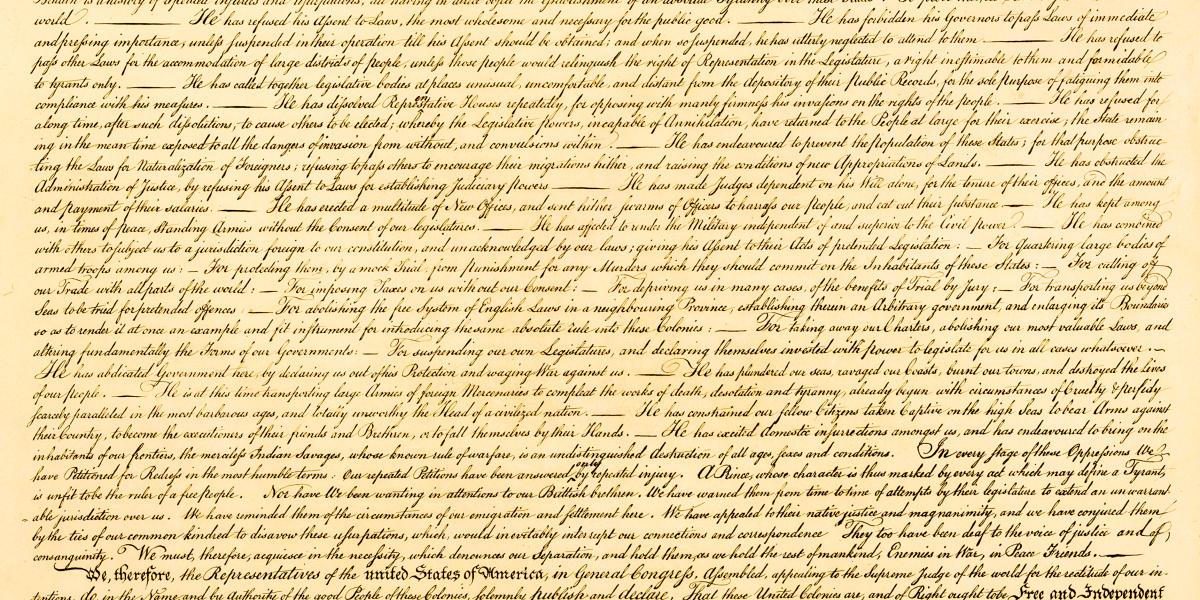
Justice Thomas cited with approval Abraham Lincoln’s view that the Declaration of Independence is an “immortal emblem of Humanity.” But the men who declared their independence from the British Crown were in no way attempting to establish an “immortal emblem of Humanity.” They regarded King George III as a tyrant. They wished to defend their right to liberty and to self-determination: “The history of the present King of Great Britain is a history of repeated injuries and usurpations, all having in direct object the establishment of an absolute Tyranny over these States.”
They declared that, “A Prince, whose character is thus marked by every act which may define a Tyrant, is unfit to be the ruler of a free people.”
The Revolutionary War soldiers fought for their liberty—to “secure the Blessings of Liberty to ourselves and our Posterity,” as they stated in the Constitution. They were not fighting for racial equality or any of the other political ideals that are now alleged to be hidden within the Declaration, such as being “colorblind” and not seeing race.
The language of the Founders certainly does not reflect “colorblindness.” One of their grievances against King George in the Declaration was that he “endeavoured to bring on the inhabitants of our frontiers, the merciless Indian Savages.” In their Naturalization Acts they specified citizenship rights for white people: “any Alien being a free white person.”
It is striking that Justice Thomas summarized the cause for which the Founders fought as “the principles they were asserting” rather than simply “liberty.” He frequently reminded us that the Founders fought for “their principles,” and called for devotion to “the principles of the Declaration of Independence.” His message was that one ought to be willing to die for one’s principles, if principles are not to be mere empty words.
This open-ended reference to “the principles of the Declaration” leaves the gate open for anyone to decide what principles they believe the Founders were probably fighting for—equality, abolitionism, civil rights, open immigration, nationalized healthcare, multiculturalism, or any other ideals they may see as the “idea” of America.
For Justice Thomas, it is clear that the key principle is equality. He describes his “first encounter with the principles of the Declaration of Independence” not by reference to liberty but to equality: “We hold these truths to be self-evident, that all men are created equal. . .”
But the Revolutionary War was not about the general importance of fighting for whatever you hold dear—salutary though that may be. It was specifically a war for independence. For liberty, and for freedom from tyranny.
The Founding Fathers were not civil rights activists, much as liberals today wish that had been the case. They seek to transform the Founders from heroes of a particular time and place into modern heroes whose values meet modern expectations. They seem to feel that the only way they can honor George Washington is by imagining him to have been a secret abolitionist. If Martin Luther King, Jr. is now the quintessential American hero, they would sure like to transform Washington into a man who shared the same beliefs as King. Washington would have gone marching from Selma to Montgomery to defend “the principles of the Declaration,” right?
They fall into this interpretative error by reading the Declaration as an abolitionist document, which leaves them facing the obvious question as to why slave-owning Founders would fight for it. As Justice Thomas sees it, “The ideas of the Declaration were so powerful that our nation could not coexist with the contradiction created by the great evil of slavery.” It does not occur to him that this apparent contradiction arises from his own ahistorical reading of the Declaration.
Historical documents must be understood in light of what people at the time thought, not what we now believe they should have thought with the benefit of hindsight. The question is not how to reconcile Washington’s views with Martin Luther King, Jr.’s views, but to ascertain what Washington’s views in fact were even though, 250 years later, we view the world much differently than he did. We appreciate and honor Washington’s achievements without wishing he had been more like us (having hubristically set ourselves up as the ideal moral standard).
As M.E. Bradford explained in “The Lincoln Legacy: A Long View,” Lincoln was “the first Northern politician of any rank” to attempt to reconcile the fact that slavery was protected by the United States Constitution with the political belief that America was founded on the ideals of racial equality.
By the end of his deadly war of aggression against the South, Lincoln stood at Gettysburg to shoehorn Radical Republican abolitionist ideals into the Declaration of Independence. It is no wonder that rebels in Georgia after the war sang that they hated the Declaration of Independence—so they certainly would, if the Declaration indeed justified Lincoln in burning their homes and barns to the ground in order to free the slaves, as Lincoln (wrongly) claimed in an attempt to justify his deadly war. Recall that the vast majority of Southerners did not own any slaves and that, as Tom DiLorenzo illustrates, the notion that the war was about abolition was a rather belated idea.
Bradford explains that Lincoln was the first “to make his moral position on slavery in the South into a part of his national politics.” He adds:
Lincoln, in insisting that the Negro was included in the promise of the Declaration of Independence and that the Declaration bound his countrymen to fulfill a pledge hidden in that document, seemed clearly to point toward a radical transformation of American society.
Lincoln’s radical transformation, which was much admired by Karl Marx, was said by Jaffa to be “conservative” because, as he saw it, abolitionism and civil rights had always been secretly embedded in the Declaration of Independence. David Gordon observes:
Jaffa shows himself well aware of a crucial objection to his reading of the Declaration. If the equality clause mandates the abolition of slavery, why did many signers of the Declaration, including of course Jefferson, hold slaves? No problem, Jaffa responds: the signers realized that it would be practically impossible to abolish slavery immediately. Instead, the equality clause states an ideal to be approached, as prudence best dictates, in the course of time.
The Revolutionary War soldiers certainly did not believe they were fighting for some future ideological ideal they could not yet achieve. As Bradford pointed out, Jaffa’s reading of the Declaration of Independence is entirely ahistorical. It reflects Jaffa’s philosophical opinions rather than what the Founders in fact believed.
There is no need to pretend that the Founders secretly wanted all races to experience an equal life. We do not need any pretense in order to understand the classical ideals of liberty and equality. Justice Thomas’s rather strained Jaffaesque attempt to embed his principles in the Declaration of Independence is wholly unnecessary. The real power and importance of his speech lies in the truth that he learned from his wise and devoted grandparents:
In God’s eyes we are equal. We are all equally created in the image and likeness of God. We are all endowed with natural rights to life, liberty, and property. Our rights and our dignity are inherent. They do not come from others and that they do not come from the Government. And, our Government derives its legitimacy and authority from our consent; we do not get ours from it.