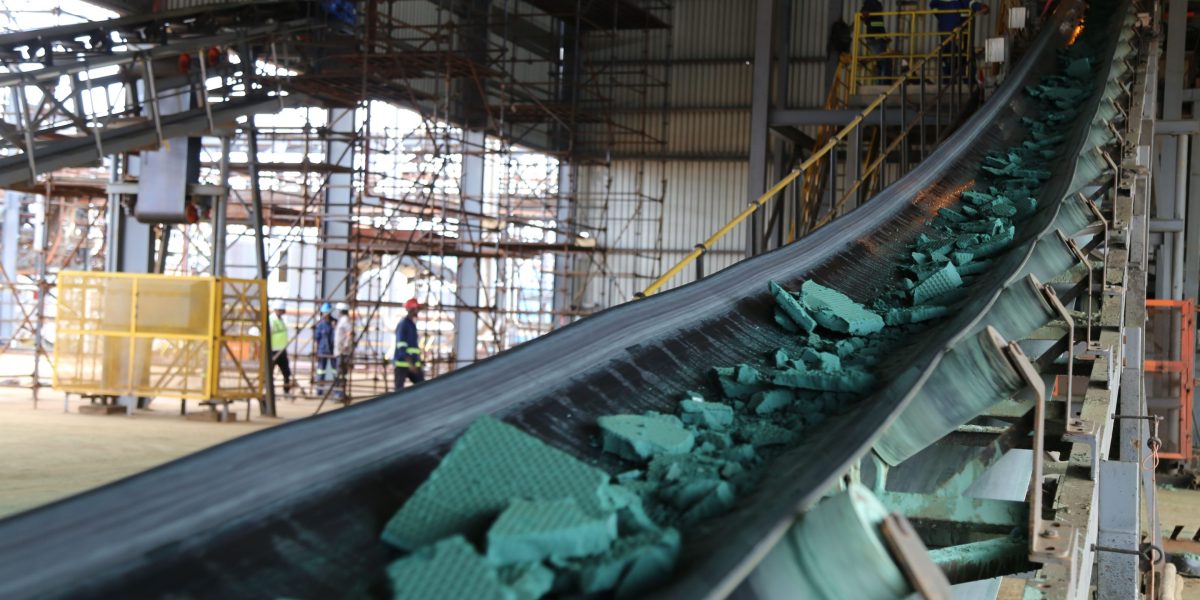
In Washington, bad ideas rarely die—they rebrand. Industrial policy—long discredited in theory and practice—has returned under the more palatable language of “resilience” and “strategic supply chains.” The Trump administration’s proposed minerals consortium is the latest iteration. Sold as a necessary response to dependence on China for the processing of rare earths and other critical minerals, it promises coordination, investment, and independence. What it will deliver instead is distortion, waste, and a fresh round of politically-driven malinvestment.
There is, to be sure, a kernel of truth animating the policy. The United States and its allies do rely heavily on China for refining capacity in rare earth elements and other inputs essential to modern industry. But this dependency did not arise by accident, nor is it evidence of “market failure.” It is the result of decades of global specialization—firms locating production where it is most efficient, given costs, regulations, and accumulated expertise. Washington’s answer is not to understand this process, but to override it.
A government-backed consortium—whether explicitly funded or quietly guaranteed—substitutes political priorities for market signals. And, as Ludwig von Mises demonstrated a century ago, without genuine price signals formed in voluntary exchange, rational economic calculation breaks down. Capital is no longer allocated according to profitability, but according to political favor. The predictable result is malinvestment: projects that exist not because they make economic sense, but because they satisfy a policy objective.
In the capital-intensive world of mining and mineral processing, this is a recipe for overreach. Subsidized or protected firms expand beyond what the market would sustain, creating overcapacity in some areas and shortages in others. Resources are pulled away from higher-valued uses and locked into ventures that require continuous political support to survive. What appears, in the short term, as a burst of “investment” is, in reality, a misallocation that will only be revealed when the subsidies falter or the political winds shift. And where politics directs capital, opportunists follow.
Recent reporting has pointed to a surge in dubious corporate filings, many routed through places like Delaware, from entities suddenly eager to position themselves in the “critical minerals” space. These are not, for the most part, seasoned operators responding to market demand. They are speculators, middlemen, and would-be contractors, drawn not by profit in the economic sense, but by the prospect of tapping into government-backed funding streams.
This is not corruption of an otherwise sound system; it is the system working as designed. As Friedrich Hayek observed, when economic power is concentrated, the incentives shift toward those most adept at influencing the decision-makers. The minerals consortium will not insulate the United States from dependency: it will create a new class of domestic dependents, firms whose business model is inseparable from state patronage. If this sounds familiar, it should.
The United States has experimented with industrial policy in the energy sector before, most notably in the synthetic fuels push of the 1970s and early 1980s. Backed by billions in federal support, these projects were heralded as essential to energy independence. They collapsed under their own inefficiency once market conditions changed, leaving taxpayers to absorb the losses. More recently, waves of subsidies and policy favoritism in shale and renewable energy have produced their own cycles of boom, overexpansion, retrenchment, and corruption—hardly the stable foundation that “strategic” planning promises. The minerals consortium risks replaying this pattern on a new stage.
None of this is to deny the geopolitical backdrop. Washington’s renewed interest in critical minerals is plainly tied to its broader posture toward China. Policymakers speak openly of great-power competition and the need to secure supply chains in anticipation of potential conflict. But here again, the logic is circular. The same political class that fostered deep economic interdependence now treats that interdependence as a liability—one to be corrected not through market adaptation, but through further intervention. Again we see a familiar pattern: intervention begets intervention.
From an Austrian perspective, the deeper problem is not merely incentive-based, but epistemic. No consortium—no matter how well staffed or well intentioned—can replicate the knowledge embedded in market processes. Decisions about where to invest, which technologies to pursue, and how to structure production depend on dispersed, often tacit information that cannot be centralized without loss. Committees do not discover prices; they guess at them. And when they guess wrong, as they inevitably do, the consequences are not borne by the decision-makers but socialized across the broader economy.
Historically, it has been shown that the invocation of “national security” only accelerates this process. Once a sector is designated as critical, normal economic constraints are suspended. Losses are rebranded as investments, inefficiencies as redundancies, and failure as the cost of preparedness. The discipline of profit and loss, the only reliable mechanism for distinguishing value from waste, is replaced by the logic of bureaucratic persistence.
What emerges is not resilience, but rigidity: an economy less responsive to real conditions, more prone to politicized allocation, and ultimately less capable of sustaining the very security it seeks to guarantee.
A genuinely market-oriented approach would look very different. It would begin by removing barriers to domestic production, streamlining permitting processes, reducing regulatory uncertainty, and allowing entrepreneurs to respond to price signals without political interference. It would recognize that diversification and resilience are byproducts of free exchange, not its substitutes.
Whether such an approach is politically viable is another matter. Industrial policy offers something markets do not: the appearance of control. It allows policymakers to point to specific projects, specific firms, specific “wins.” It generates headlines, ribbon-cuttings, and the illusion of strategic coherence. But illusions have a cost.
The minerals consortium may well mobilize capital and generate activity. It may even succeed in shifting some production. But if it does so by subordinating economic calculation to political priorities, it will deepen the very distortions it claims to solve. Like the industrial policies before it, it will leave behind a trail of misallocated resources, entrenched interests, and unmet promises.
And when it does, Washington will invariably move to do what it always does: rebrand, and try again.