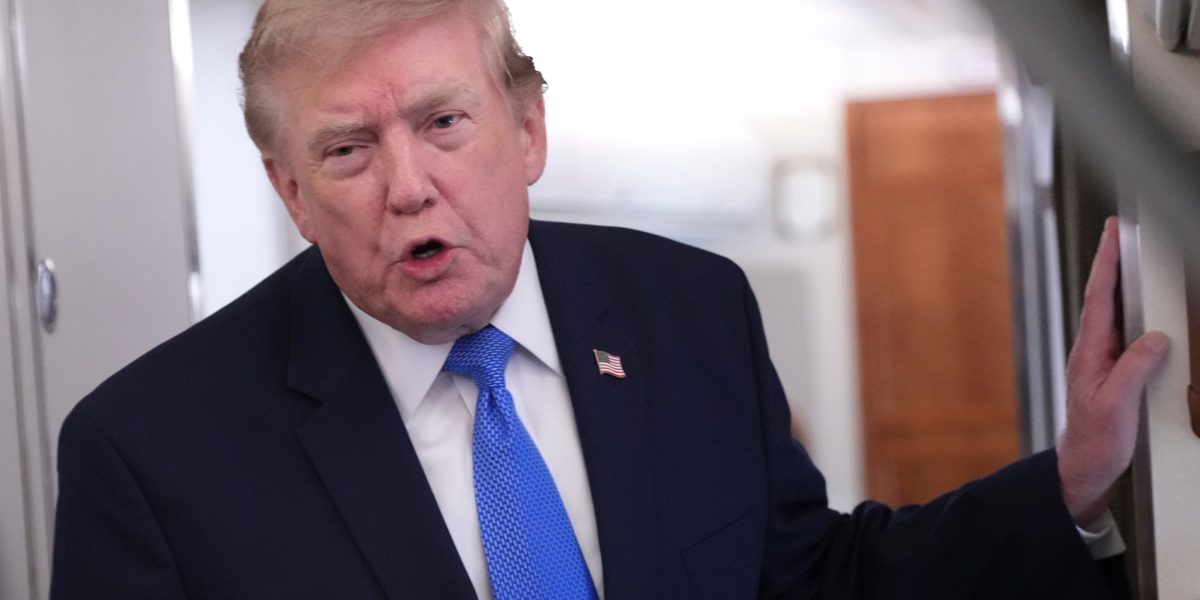
President Donald Trump last week stated that he would ask Congress for a $1.5 trillion defense budget in 2027, an enormous $500 billion increase over 2026’s military budget. The proposed spending increase reflects how much the Trump administration has become focused on pushing new wars, and how much the White House loves to spend taxpayer money.
Trump’s pledge to increase military budgets by 50 percent comes as we find that federal spending in the new fiscal year remains at some of the highest spending levels we’ve ever seen. Only three months into the fiscal year (which began on October 1), the federal government has spent more than $1.8 trillion, which is the second highest spending level for the period in history—even when adjusted for inflation. Not surprisingly, the federal government has run up a deficit of $602 billion. That’s the third highest deficit total for the period in history (inflation adjusted), topped only by spending of the Covid Panic and Biden’s final year in office.
In spite of Trump supporters claiming for months that we will “soon” see big cuts in federal spending, there is no sign of this at all. Indeed, the opposite is true since Trump now demands another half trillion for more spending on cronies in the defense industry and for more military hardware with which to threaten the US’s own longtime allies and trading partners, such as Denmark.
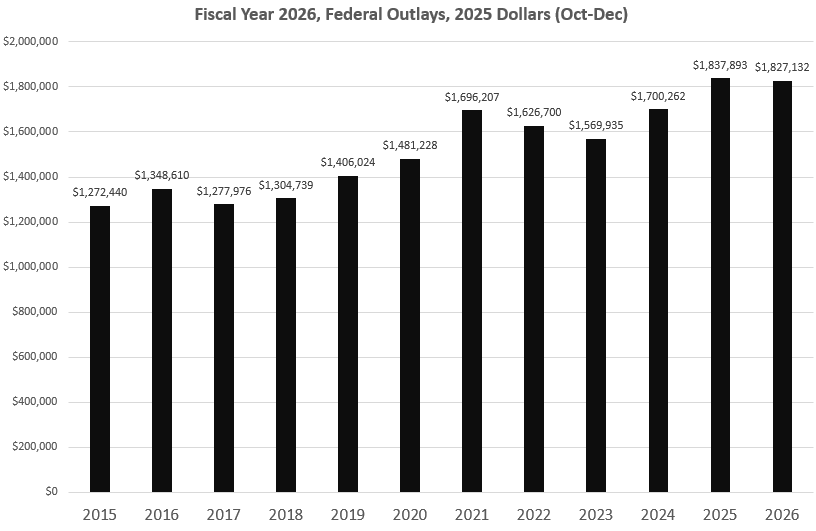
This will be the first fiscal year during which the Trump administration has been firmly in power for the duration, and if we’re going off the numbers, it’s hard to see any departure at all from the Biden years. If Trump gets his way on military spending, though, we will see a change from the Biden years: federal spending will be much higher.
A 50-percent Increase in Military Spending?
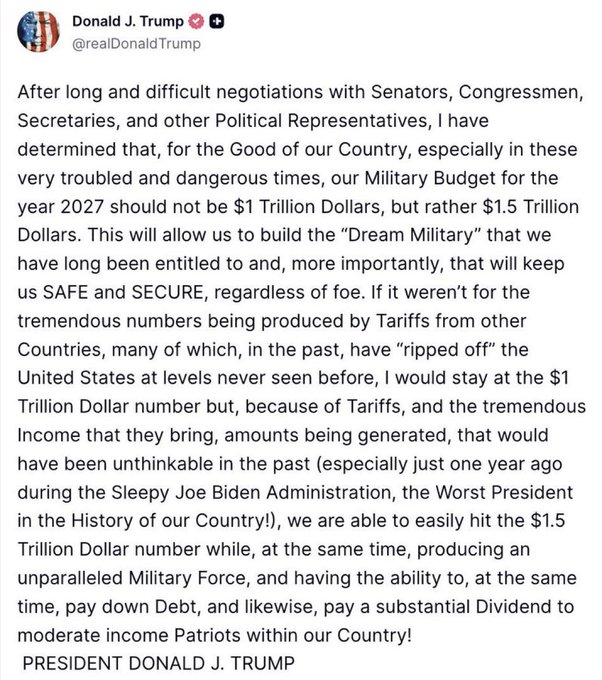
In a post to his social-media platform Truth Social last week, Trump stated that
After long and difficult negotiations with Senators, Congressmen, Secretaries, and other Political Representatives, I have determined that, for the Good of our Country, especially in these very troubled and dangerous times, our Military Budget for the year 2027 should not be $1 Trillion Dollars, but rather $1.5 Trillion Dollars … This will allow us to build the ‘Dream Military’ that we have long been entitled to and, more importantly, that will keep us SAFE and SECURE, regardless of foe.
Military spending in the US tends to increase nearly every year, although in recent years, price inflation has been so substantial that inflation-adjusted military spending has been largely flat around $915 trillion since 2024. At this level, military spending is already above what it was during the 1980s when the US and the Soviet Union were in an arms race. Although the Soviet Union —a superpower that was three times the physical size of the United States—has disappeared, the US has continued to increase military spending since it launched wars against the Iraqis and the Afghanis. After spending trillions of dollars to “democratize” the Middle East and defeat the “axis of evil,” those wars were lost, but the financial legacy of the spending remains.
An additional increase of $500 billion would nonetheless be huge in relation to typical spending increases, as can be seen if we actually graph the results. Such an increase would be “off the charts,” so to speak:
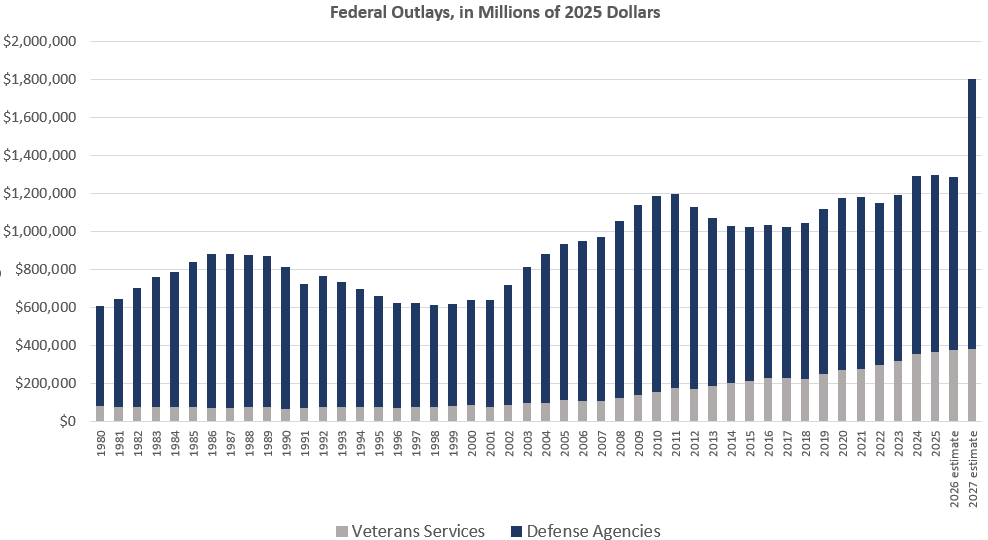
Combined with veterans spending—which is just deferred military spending that is placed in a separate category for political reasons—total military spending would reach to $1.8 trillion if Trump gets his way.
Growing Spending and Deficits
Where will the administration get this extra half-trillion dollars? It’s a very safe bet that much of it will come from more federal debt and larger deficits. Keep in mind, after all, that during this fiscal year the federal government has been racking up about $200 billion per month in deficits. Given recent trends, this will likely translate into a full-year deficit of more than $1.5-1.8 trillion. If Trump gets his increase to military spending, we’ll be looking at annual deficits of more than two trillion per year. Even if Trump settles for half his goal, and the federal government spends “only” $250 billion extra on the Pentagon, that will drive annual deficits to levels we haven’t ever seen, except during the Covid Panic.
Nor will tariff revenues significantly impact this. Even after months of growth in newly imposed tariffs (i.e., import taxes) the federal government continues to increase spending faster than tariff revenue comes in. Although the administration has wrongly claimed that tariff revenues have totaled $600 billion, the real total is less than half that, at around $280 billion for nearly a full year. Even with growing tax collections on imports, this still constitutes less than three percent of federal tax revenue.
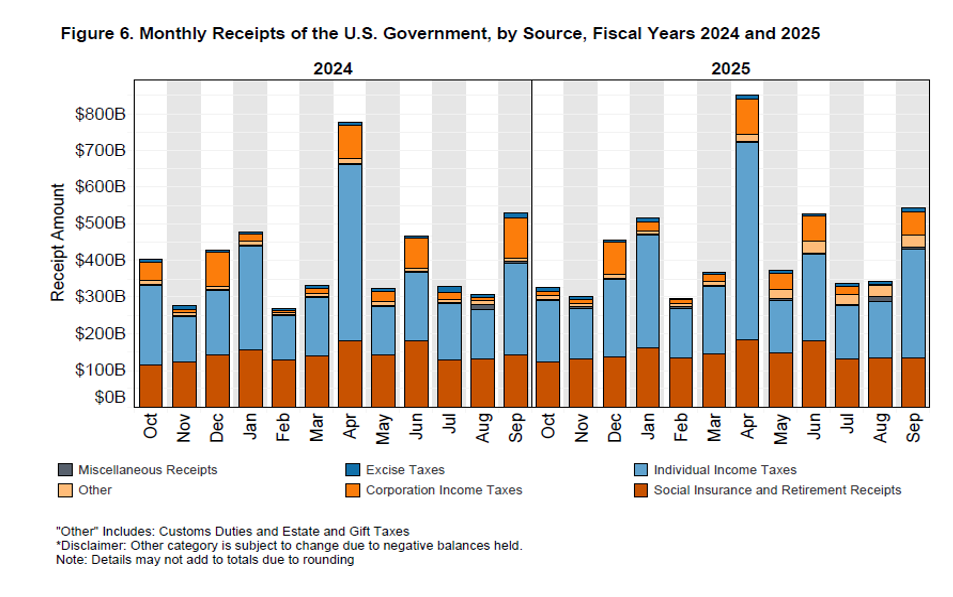
Source: Treasury Dept.
Moreover, any significant slowdown in employment or economic growth will greatly reduce tax revenue in general. When that happens—it’s a matter of when, not if—then the deficit will explode upward.
Nor is there any reason to believe that the administration or the ruling majority in Congress will make any significant cuts to other programs. We won’t be seeing any sizable cuts to Social Security, Medicare, Medicaid, or any of the other major programs that drive the overwhelming majority of federal spending.
In response to all, this some may channel their inner Dick Cheneys and declare that “deficits don’t matter.” Yet, Americans are paying a lot for these deficits. The new Treasury report shows, for instance, that the taxpayers paid more than $300 billion in interest on the national debt during the first three months of this fiscal year. In other words, the US is on track—yet again—to shell out more than a trillion dollars in interest this fiscal year. That’s a trillion dollars for no new services or resources of any kind. The interest expense is paid for by taxpayers who must now pay for lost wars and welfare boondoggles that were financed back when many of today’s taxpayers were children. Donald Trump wants to saddle the taxpayers will hundreds of billions more in spending and countless trillions of dollars in future obligations on federal debt.
Put another way, a recent analysis suggests that the cost to the US taxpayers to “buy” Greenland would be $700 billion. That is, the US taxpayer is now paying for the equivalent of more than one Greenland every year in terms of interest payments.
Indeed, broken down to the individual level, we find that $500 billion amounts to more than $1,400 for every man, woman, and child in the United States. For a household of two adults and child, that’s well over $3,000 per household, on average. Given that any additional military spending will be at least partly be financed with new federal debt, we must also factor in the future interest that taxpayers will be paying indefinitely.
At this point, most supporters of the administration will likely shrug and come up with excuses for more spending, such as claims that the Chinese will occupy Greenland if the American taxpayers don’t get in line and pay hundreds of billions more for “defense.” This phenomenon helps to illustrate how the radical laissez-faire liberals of old were right that war has always been one of the greatest boons to ruling regimes seeking more political power. In nearly all times and places, it has been relatively easy to scare the taxpayers—who are generally ignorant about anything outside their local communities—into surrendering ever more freedom and treasure to the government in the name of safety and “national defense.”