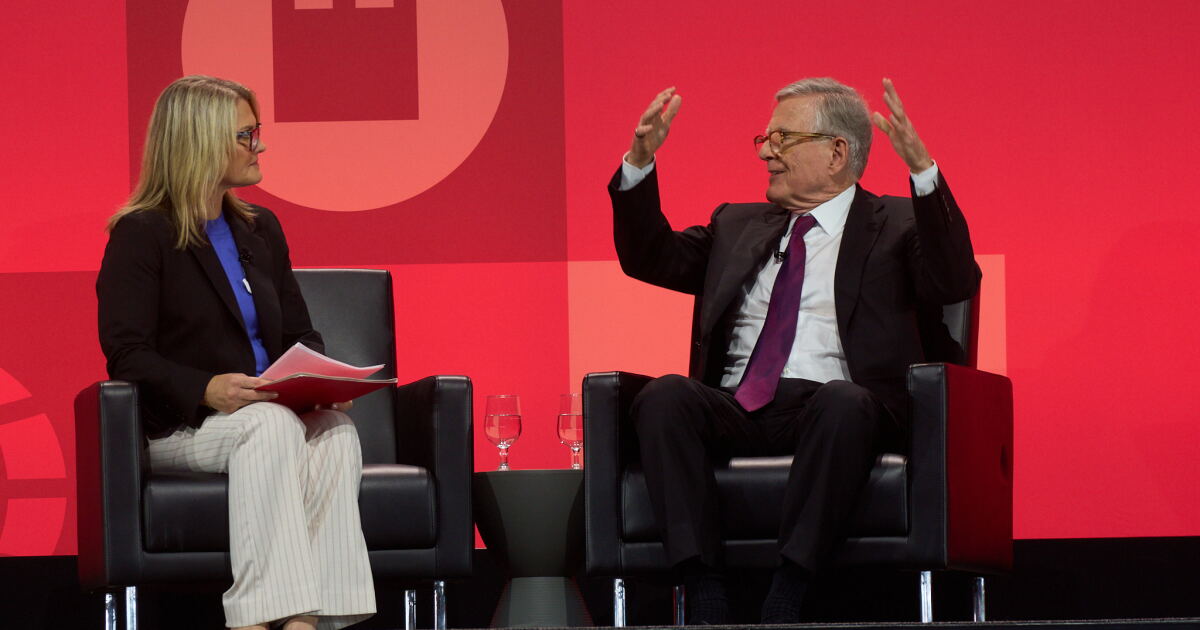
The close ties between the pioneering low-cost factor investing firm Dimensional Fund Advisors and thousands of planners date back 37 years, according to co-founder and chair David Booth. That history helps explain why reports that the $1.1 trillion asset manager may be exploring a sale have drawn so much attention from financial advisors.
Processing Content
When Dimensional began working with advisors in 1989, most of the investment business flowed through brokers and their firms, Booth recently recalled.
A financial advisor named Dan Wheeler was the first to access Dimensional’s funds outside the firm’s early institutional client base. That relationship led to what Booth called “a breakthrough for us” in working with fee-only planners.
“If you’re investing with a broker, you’re going to be trading a lot, which is one thing I think most of us are convinced of — doing a lot of trading is not a very good idea,” Booth said in a keynote interview at Morningstar’s conference last month. “The RIA market was a tiny part of the market, but it was a part that we believed in, so we kind of grew up together.”
Today, the firm that Booth and his University of Chicago Graduate School of Business classmate Rex Sinquefield famously launched from Booth’s Brooklyn brownstone in 1981 has surpassed $1 trillion in client assets and 1,600 employees across 15 global offices. Five Nobel laureate economists have worked for the company or consulted for it. That includes the co-founders’ onetime professor, current Dimensional director Eugene Fama. (After Booth contributed $300 million to his alma mater in 2008, the school was renamed the University of Chicago Booth School of Business.)
Across the decades, Dimensional has kept up with the times. It’s one of the largest active ETF issuers, the first company after Vanguard to gain approval to offer ETF share classes of mutual funds and the operator of many unified or separately managed accounts.
The firm’s scale, along with Booth’s upcoming 80th birthday, has fueled questions about its future. Citywire reported in May that Dimensional had tapped investment bank Moelis as an advisor in seeking a sale. A spokesperson for Dimensional told Financial Planning this month that the firm does not discuss “rumors or speculation,” while representatives for Moelis declined to comment.
For some advisors, the main question may not simply be who might own Dimensional down the road, but whether that owner would maintain the investment approach and advisor relationships that helped make the firm an influential industry player.
Another factor driving interest from industry observers is heavy deal flow among large fund firms — peers of Dimensional — for example, Wellington Management secured a deal worth $1.9 billion last month to buy the asset management unit of Hartford Insurance Group; Nuveen, a unit of TIAA, agreed in February to buy Schroders for $13.5 billion; and Janus Henderson completed a deal to go private at the end of June at a valuation of $7.4 billion.
READ MORE: LPL’s AI challenge: Moving fast without overwhelming advisors
Speculation is nothing new
The idea that Dimensional may be seeking some kind of a suitor just “pops up every few years,” according to Kelly Klingaman, the founder of Austin, Texas-based registered investment advisory firm Kelly Klingaman Financial Planning and a former Dimensional employee who worked with advisors there for a dozen years.
Some speculation comes from message boards, she said, but she believes Booth and other Dimensional executives “don’t want to upset” the firm’s employees and advisors who have favored its products for decades.
“I feel pretty confident that the integrity of what they stand for is going to be maintained, given that their entire history of working with financial advisors has been part of the huge success of the company,” Klingaman said. “Whatever decision they make will be very thoughtful in keeping that in mind.”
At the Morningstar conference, when Bridget Hughes, a senior principal for parent ratings who interviewed Booth onstage, asked him about the news reports, he said that he was “flattered” to a certain extent and noted that the firm passed the trillion-dollar milestone earlier this year.
“What happens when you get to be a bigger firm? All of a sudden you’re in the spotlight and people are calling you a lot and then rumors start flying,” Booth said. “In some ways, that’s kind of cool. All I can tell you is, I’m still going to work every day, and I love working with our clients and our employees.”
READ MORE: What clients miss about HSAs — and how advisors can help
What’s next?
Since Dimensional remains “a private company with a big shareholder” in Booth, it “stands to reason why there would be questions going around like, ‘What happens next?'” Hughes said in an interview.
Morningstar has assigned Dimensional its top parent rating of “high” in its five-point scale, with the latest note this month by Associate Director of Manager Research Daniel Sotiroff saying the firm had an “exemplary” response to mutual fund outflows beginning in 2019 in the form of fee cuts, ETFs and other shifts.
“Fully embracing exchange-traded funds has benefited its clients through lower fees and taxes, while it continues developing new services and capabilities,” Sotiroff wrote. “Its young ETF lineup, which largely mimics its existing mutual funds, recently started taking in enough money to offset the outflows from its mutual funds. Firmwide net flows turned positive in 2023 and grew modestly in 2024. Its mutual funds and ETFs in markets outside of the U.S. have remained stable and continue to take in new money. Co-CEOs Gerard O’Reilly and David Butler haven’t stood still. Dimensional has continued to prune fees, launch new ETFs and expand the ways it delivers investments.”
At its size, Dimensional isn’t struggling to reach scale, and firms of its kind could pursue several different strategies such as going public, seeking a private equity investor or even a buyout of Booth’s position, which could be “very, very expensive,” Hughes noted. The firm resembles a “well-oiled machine,” but Booth and his team still “do it their own way,” which leads to the complicating concern around ensuring that the company’s culture stays in place, she said.
“Most firms and, I think, investors appreciate a more synergistic, a more complementary acquisition, and with that comes the idea of cultural fit, and they talk about that all the time,” Hughes said. “Are you going to be able to continue to be independent? Are you going to be able to continue to do things your own way? Maybe, maybe not.”
Dimensional’s traditional strategies focus on smaller-capitalized, undervalued stocks with systematic, evidence-based vehicles that the company’s website describes as the “best of both passive and active investment approaches.”
But now Dimensional faces competition with giants like Vanguard and BlackRock and ETF upstarts such as Avantis Investors by American Century Investments, which has crossed $150 billion in client assets under CEO Eduardo Repetto, who was once the co-CEO and co-chief investment officer at Dimensional, noted Allan Roth, an investment columnist and the founder of Colorado Springs, Colorado-based Wealth Logic.
“It’s a trillion-dollar complex, so there’s a lot of money involved, and I don’t know how it’ll turn out,” Roth said. “There’s uncertainty to the planners.”
READ MORE: SEC pushes private market access, but retail is already in
Closely cultivated relationships
Regardless of any public commentary about a potential sale, Booth used the time onstage at the Morningstar conference to discuss his upcoming book, share the news of the combination of two similar ETFs in order “to make it easier and cheaper,” and reminisce about his decades in the field. For instance, he shared that his company’s name stemmed from the idea that small-cap stocks would bring a new “dimension” to portfolios for diversification.
Another memory revolved around how the company probably “violated every rule that you teach in business school,” by requiring any early adopting planners to attend a two-day seminar at their own expense before they could get approval to offer the funds.
“We do a lot of separately managed accounts now, which is kind of the future of the business,” Booth said. “But back in those days, it was all funds, and mutual funds are great as long as everybody behaves themselves. You just don’t want people coming in and coming out, so that’s why we screen.”
Wheeler, the advisor who kicked off the firm’s “breakthrough” with planners, led that process for more than 20 years. A Marine veteran, he had started his financial career at Merrill Lynch before becoming an independent advisor.
“He shifted from being an advisor to joining Dimensional in 1989 and starting the firm’s financial advisor business,” Butler, the firm’s co-CEO, wrote after Wheeler’s death in 2023. “It was in this role that Dan made his biggest impact: launching a movement that revolutionized financial advice. Dan was convinced that there were other financial advisors who would share his enthusiasm for marrying independent and conflict-free financial advice with cost-effective investment strategies grounded in a scientific approach. He just didn’t know who they were, and they didn’t know about Dimensional. With a larger-than-life personality and enough zeal to overcome the odds, he made this vision a reality.”
Those efforts explain why independent advisors remain “the biggest sales channel for Dimensional,” even though the training and outreach emphasizes study groups and learning sessions over pushing products, according to Klingaman.
“We had extremely close relationships with our clients,” she said. “It was much more of a consultative, close relationship. A lot of advisors use all Dimensional funds for their portfolios.”