
What Venezuelans Told Us in the First Hours After the Earthquake
On the evening of June 24, a magnitude 7.2 foreshock struck north-central Venezuela and, 39 seconds later, a magnitude 7.5 mainshock followed. Both were shallow. The destruction has been concentrated in the northern coastal state of La Guaira and in the capital, Caracas, where La Guaira has been declared a disaster zone. Official figures, which remain the authoritative source for loss of life, ranged, as of June 26, from roughly 188 to 235 dead and more than 4,300 injured, with those numbers expected to rise as search and assessment operations continue.
In the hours that followed, GeoPoll reached households directly through a WhatsApp rapid needs assessment. Between the morning of June 25 and midday June 26, 425 people across the country answered. They told us where the ground shook hardest, what their homes look like now, and what they need to get through the next night.
This is not a story about the whole country. The earthquake was not felt everywhere, and the data makes that clear. It is a story about a band of states along the central coast and capital region where lives were upended, and about the families there who took a moment, in the middle of fear and uncertainty, to tell us what is happening.
Our hearts are with them. The purpose of this assessment is to put an accurate, fast, household-level picture into the hands of the relief and aid organizations responding now, so help reaches the right places without delay.
Why this data matters in this disaster
Two features of this emergency make direct household data unusually valuable.
The first is the clock. Experts widely regard the first 72 hours after a major quake as the most critical window for saving lives, and access to water is often the deciding factor for those still trapped or displaced. In that window, the gap between what responders know and what is actually happening on the ground is where aid is delayed and lives are lost. Relief agencies on the ground, including PAHO and the Red Cross, are still rapidly assessing needs and mapping where to send resources.
Speed of information is itself a form of relief.
The second is the information environment. Disruptions to power and telecommunications, in an already limited information environment, have made it hard for residents and their families abroad to learn what has happened. The United Nations has stressed that timely access to reliable information will be vital to protecting lives in the days ahead. A survey that reaches people directly on the phones already in their hands, and lets them speak for themselves, helps close exactly that gap.
The impact was concentrated, and our data confirms where
The single most important finding is geographic, and it aligns closely with the official picture. When we map self-reported shaking intensity by state, a clear cluster emerges along the north-central coast and capital corridor, the same areas authorities and humanitarian agencies have identified as worst affected.
Felt intensity by state, on a 1 to 10 scale, and the share of respondents who reported violent shaking (8 to 10):
La Guaira: average 9.2, with all respondents reporting violent shaking
Capital District (Caracas): average 8.8, 88 percent violent
Carabobo: average 8.7, 80 percent violent
Miranda: average 8.4, 80 percent violent
Aragua: average 8.4, 74 percent violent
Guárico: average 7.5, 58 percent violent
These six states account for 201 of our 425 responses, roughly 47 percent. La Guaira, which residents rated as the most severe, is the same state where authorities have declared a disaster zone and officials report that more than 70,000 families are affected. Our independent, household-level data points to the same epicenter of suffering.
Outside this band, the picture changes sharply. States such as Zulia (average 2.4), Táchira (2.1), Nueva Esparta (2.4), and Mérida (3.3) reported little more than a tremor. This contrast is the actionable part: the need is not spread thinly across Venezuela, it is concentrated, and resources directed to the central coast and capital region will reach the people in crisis.
Inside the impact zone: what households are facing
Within those six states, the difference from the rest of the country is stark across every indicator we measured. This is the texture inside the aggregate official totals: not how many families were affected, but what those families are living through tonight.
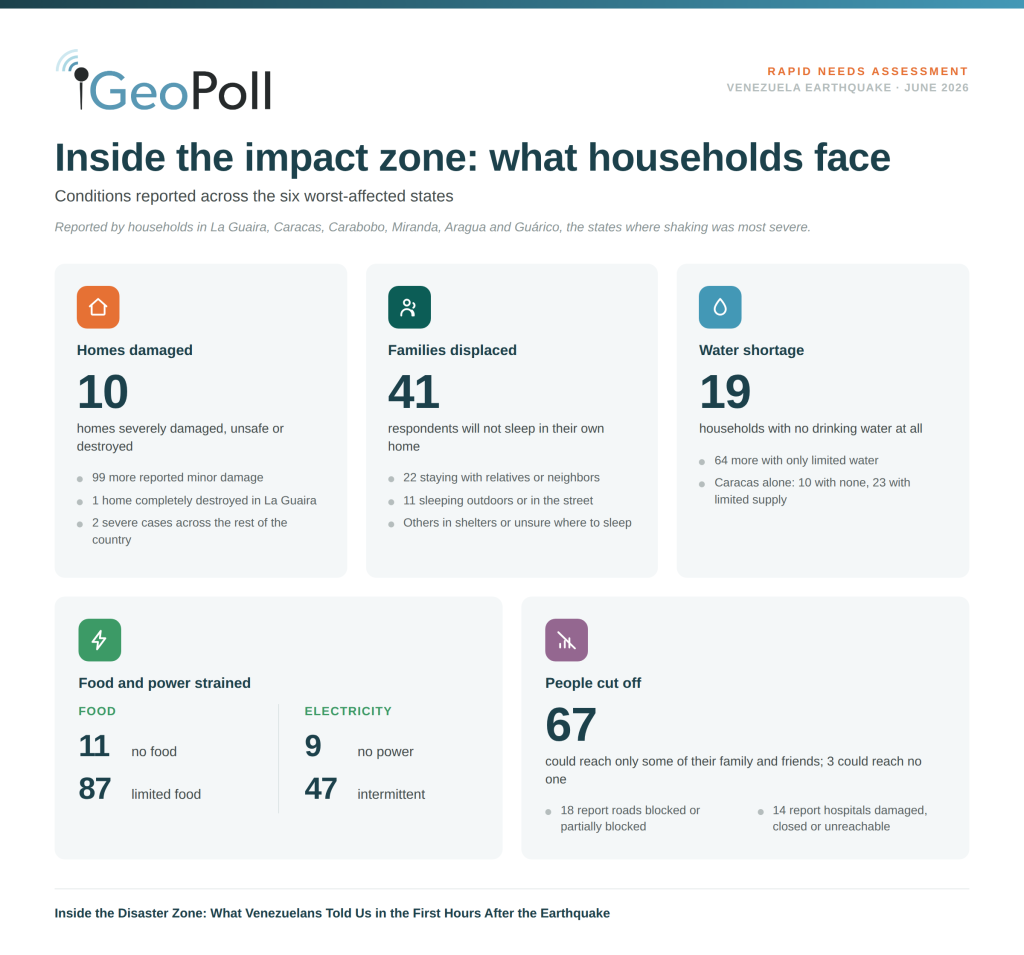
Homes are damaged. In the impact zone, 99 households reported minor damage and 10 reported severe, unsafe, or destroyed homes, including one home completely destroyed in La Guaira. Across the rest of the country combined, only 2 households reported severe damage.
Families are displaced. In the impact zone, 41 respondents said they will not sleep in their own home. Of those, 22 are staying with relatives or neighbors, 11 are sleeping outdoors or in the street, and others are in shelters or do not yet know where they will sleep. This mirrors what responders are seeing in Caracas and La Guaira, where many residents are spending nights outside, afraid that weakened buildings could collapse in an aftershock.
Water is the most acute shortage. In the impact zone, 19 households reported no drinking water at all and 64 more reported only limited water. Caracas alone accounts for 10 of the households with no water and 23 with limited supply. With water widely identified as the deciding factor for survival in this window, this is among the most urgent signals in the data.
Food and power are strained. 87 households in the impact zone reported limited food and 11 reported none. On electricity, 47 reported intermittent power and 9 reported none.
People are cut off. In the impact zone, 67 respondents could reach only some of their family and friends, and 3 could reach none. Roads are blocked or partially blocked for 18 respondents, slowing both escape and the arrival of help. Hospitals were reported damaged, closed, or unreachable by 14 respondents, at a time when health facilities are already operating under mass casualty protocols.
The human toll, in the words of those reporting it
We are intentionally not publishing our own casualty figures. Official numbers exist and should remain the reference for loss of life.
What we can responsibly share is how many people, in their own homes, reported these emergencies. Each number below is a household that reached out:
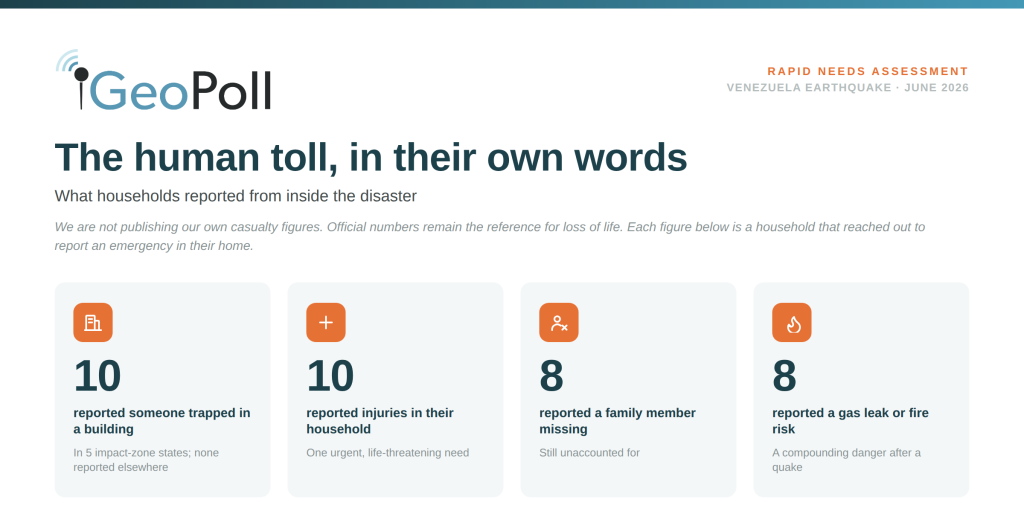
10 respondents in the impact zone reported someone trapped in a building, across La Guaira, Caracas, Carabobo, Aragua, and Miranda. No respondent outside the impact zone reported anyone trapped.
10 respondents reported injuries in their household, one of them flagging an urgent, life-threatening medical need.
8 respondents reported a family member missing.
8 respondents reported a gas leak or fire risk near their home, a danger that compounds in the hours after a quake.
Behind each of these is a voice. One respondent in Caracas, sleeping outdoors after their home was damaged, wrote only that they need “un hogar,” a home. A mother in Caracas wrote that her son is in La Guaira and she has not been able to reach him since 11 that morning. In La Guaira, where a home was completely destroyed, a respondent now in a public shelter asked for one thing: “hogar.” Others, even those displaced to relatives’ homes, asked first for water and food, and several asked for psychological support and simply for calm: “tranquilidad, estamos muy nerviosos.”
What people are asking for
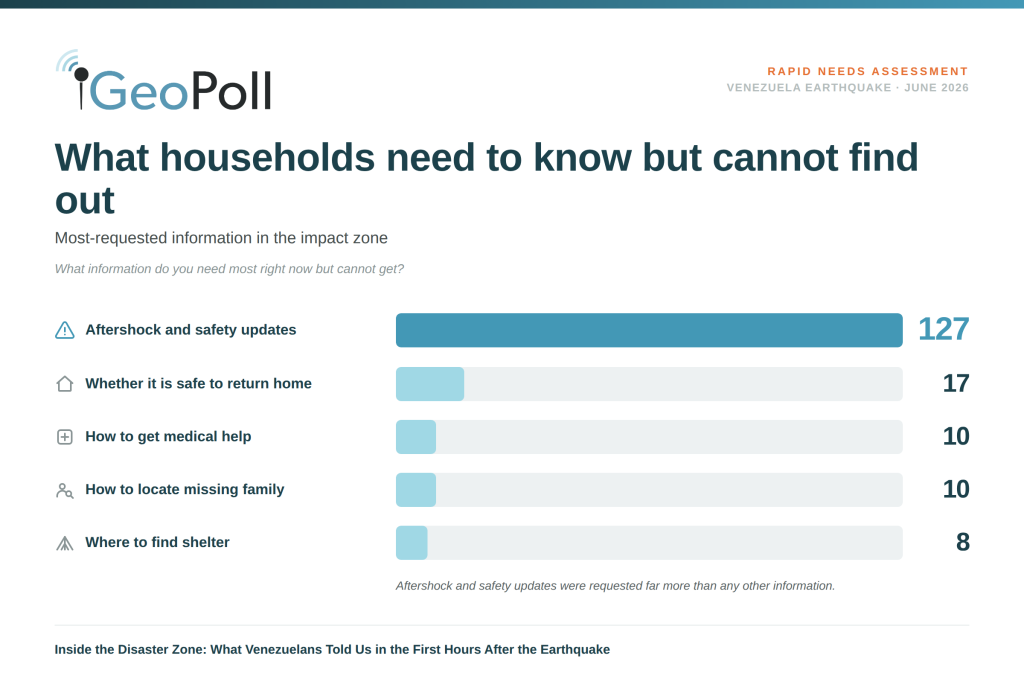
When we asked what information households need most but cannot get, the answer in the impact zone was overwhelming: 127 respondents want aftershock and safety updates. Another 17 want to know whether it is safe to return home, 10 need to know how to get medical help, 10 are trying to locate missing family, and 8 are looking for shelter.
This is the information gap made concrete. In an environment where reliable updates are hard to come by, people are not only short on water and shelter, they are short on the knowledge they need to stay safe and make decisions. The most requested immediate needs in open responses were consistent and basic: water, food, shelter, and reassurance. These match the priorities relief actors have named, from the Red Cross call for emergency shelter and trauma care to the government distribution of drinking water, food, mattresses, and blankets. They are needs a coordinated relief effort can meet quickly if directed to the right places.
Why speed and precision matter now
This assessment was completed in under 28 hours, with responses arriving from the morning of June 25 through midday June 26. That speed is the point. The data here narrows the gap between what responders know and what is happening on the ground, and it does so through the voices of the people living it.
It shows where the earthquake hit hardest, confirming the official focus on La Guaira and Caracas, and it adds resolution inside those areas: water and shelter for the central coast and capital region, medical outreach where hospitals are compromised, family-tracing support for those still searching, and trusted safety information for communities bracing for aftershocks.
We are sharing this assessment, and the live dashboard (with near-realtime numbers since the survey is still in the field) alongside it, openly with the relief and aid community. The dashboard lets responders filter by state and explore each indicator in detail, and it continues to update as more responses arrive.

To the families across La Guaira, Caracas, Carabobo, Aragua, Miranda, and Guárico who answered while living through this: thank you. Your voices are now part of the effort to bring help to your communities.
This rapid needs assessment was conducted by GeoPoll via WhatsApp survey. Figures reflect 425 completed responses collected June 25 to June 26, 2026, and represent an early-stage, unweighted sample of self-reported conditions. They are intended to guide and accelerate humanitarian response and to complement, not replace, official damage and casualty figures, which remain the authoritative source for loss of life. Responses were collected anonymously, and quotes are published without identifying information.
For more information:
GeoPoll specializes in reaching people that other data collection methods miss, gathering direct household input from hard-to-reach and crisis-affected populations across emerging markets, fast.
If your organization is responding to this earthquake, we want this data in your hands, and we are ready to help you use it. The full, updated dataset will remain ready and available, and our team can break it down by state, indicator, or population group to match what your response needs. We can also field follow-up questions to the same households or launch a new rapid assessment within hours, so your decisions stay grounded in what people on the ground are reporting.
Reach out to the GeoPoll team to access the data, request a custom cut, or set up a briefing.







-1024x797.jpg "Liberty Lifestyle: America Has a Trust Problem")

















