No Result
View All Result
  • Login
Tuesday, June 23, 2026
theadvisertimes.com
  • Home
  • Business
  • Financial Planning
  • Personal Finance
  • Investing
  • Money
  • Economy
  • Markets
  • Stocks
  • Trading
  • Home
  • Business
  • Financial Planning
  • Personal Finance
  • Investing
  • Money
  • Economy
  • Markets
  • Stocks
  • Trading
No Result
View All Result
theadvisertimes.com
No Result
View All Result
Home Market Analysis

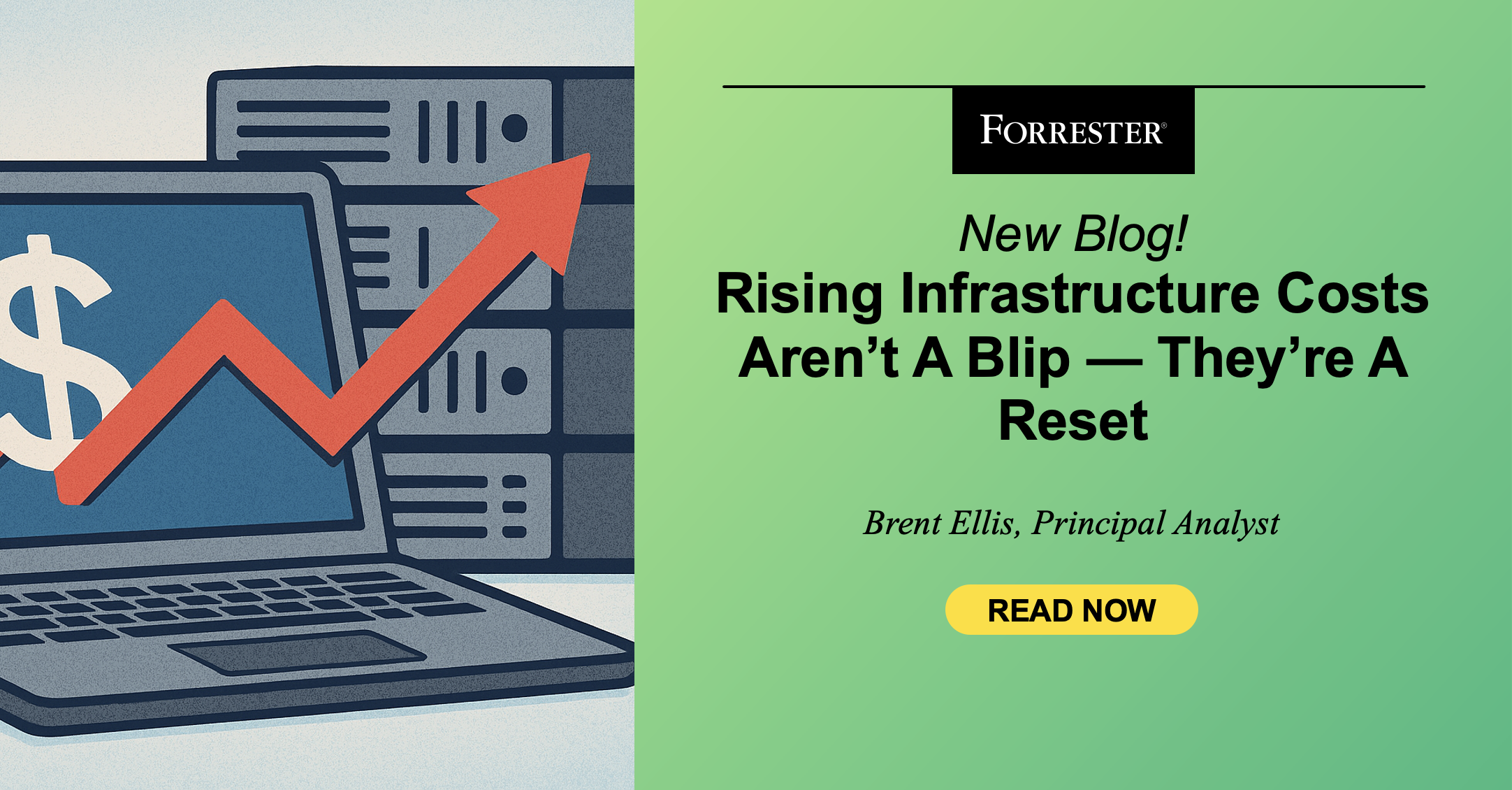
Rising Infrastructure Costs Aren’t A Blip — They’re A Reset

by theadvisertimes.com
3 months ago
in Market Analysis
Reading Time: 3 mins read
A A
0
Rising Infrastructure Costs Aren’t A Blip — They’re A Reset
Share on FacebookShare on TwitterShare on LInkedIn


Over the past several months, I’ve gotten a sharp uptick in questions from infrastructure leaders trying to make sense of rising infrastructure costs. The questions are all variations of the same theme: What’s actually driving this? Is it temporary? And what — realistically — can we do about it?

The short answer is that this isn’t a cyclical blip or a transient supply issue. It’s a structural shift in how compute, memory, and storage capacity are produced, allocated, and priced — and it has durable implications for enterprise infrastructure planning.

What’s changed is not just cost. It’s access.

What’s Happening — And Why This Isn’t A Temporary Reset

Enterprise infrastructure markets are being reshaped by an AI‑driven realignment in how capacity is built and allocated. Manufacturing resources, both for the production facilities and for the raw inputs for compute, memory, and storage, are being prioritized for higher-margin AI‑optimized components — GPUs, high‑bandwidth memory, high‑density dynamic random-access memory, and high-performance flash — reducing effective supply for traditional enterprise configurations.

Because these components share underlying fabrication capacity, the supply chain effects stack up. Lower-margin commodity memory and conventional flash storage have been casualties of this compounding, while the shrinking hard disk drive market no longer provides a reliable low-cost fallback for storage. Long-term contracts from hyperscalers and AI infrastructure vendors leave fewer production resources for the conventional compute market, whether it is enterprise servers or end-user laptops and desktops.

The most visible impact is cost. Many enterprise customers are seeing their infrastructure refresh quotes 10–20% above the prices they were getting at the end of last year. This is coupled with a very short-term quote validity window and longer delivery lead times, especially with custom configurations. But the more important story is how long this price hike may endure. Flash memory manufacturers, specifically, have shifted toward margin discipline, passing on higher prices to downstream suppliers. While some new fabs were already being built, new capacity takes years, and anything that breaks down today won’t contribute to supply for 18–24 months.

For the demand side, AI infrastructure order pipelines through 2026 remain high, and new use cases such as self-driving cars will require hundreds of gigabytes of RAM per vehicle, signaling a long-term increase in memory demand. When the supply and demand side stabilizes, expect manufacturers to control production to resist flooding the market and crushing profits. Rather than seeing prices fall to historical norms, the baseline will be higher.

The question that enterprises are grappling with, then, isn’t how long this will last — it’s how to plan and operate effectively when prices are rising and there is no end in sight.

Controlling IT Costs In A Structurally Constrained Market

Enterprises can’t control global supply dynamics, but they can reduce exposure to volatility by changing how they plan, buy, and govern infrastructure. In a supply-constrained market, cost control is less about squeezing unit prices and more about making deliberate choices earlier — around commitments, configurations, and expectations. The organizations adapting best are shifting away from just‑in‑time infrastructure decisions, narrowing the set of configurations they rely on, and placing more emphasis on supply reliability and predictability than on headline discounts alone. Negotiations increasingly focus on clarity, protection, and long-term parts availability, not just price.

Just as importantly, refresh planning is changing. Many enterprises are now assuming higher baseline costs and being more selective about where premium infrastructure is justified while looking harder at utilization and lifecycle discipline to avoid unnecessary growth. Some are even turning to the circular economy, with some infrastructure vendors recertifying used parts for use in production.

The net effect is a more intentional approach to where infrastructure spend increases show up — and where they don’t.

The Bottom Line

Rising infrastructure costs aren’t a temporary anomaly. They’re the byproduct of a structural realignment driven by AI, manufacturer and supplier behavior, and long‑term capacity planning. Enterprises that continue to rely on late‑stage negotiation and just‑in‑time purchasing will feel increasingly exposed. Those that shift earlier, simplify configurations, and treat allocation reliability as a first‑order concern will be far better positioned — not just to manage costs but to keep critical programs moving.

The question is no longer how to get infrastructure cheap — it’s how to get it predictably and plan for the best possible utilization.

If you have questions and you’re a Forrester client, reach out to schedule an inquiry or guidance session.




Source link

Tags: arentblipCostsinfrastructureResetRisingtheyre
ShareTweetShare
Previous Post

United-Guardian, Inc. (UG) Reports FY2025 Earnings

Next Post

Carnival Corporation & plc (CCL) Reports Q1 Earnings

Related Posts

Ship and Debit Explained: Protecting Your Channel Margins

Ship and Debit Explained: Protecting Your Channel Margins

by theadvisertimes.com
June 22, 2026
0

Manual ship and debit workflows often lead to financial leakage of up to 8% of the total program value because...

The Canary In The CDP Mine: Databricks CustomerLake Is The Litmus Test For Agentic Marketing

The Canary In The CDP Mine: Databricks CustomerLake Is The Litmus Test For Agentic Marketing

by theadvisertimes.com
June 22, 2026
0

Databricks announced CustomerLake, a new customer data platform (CDP) offering, at its Data + AI Summit last week. Though widely...

Death of Fundamental Analysis? How Option Market Makers Now Dictate Spot Prices

Death of Fundamental Analysis? How Option Market Makers Now Dictate Spot Prices

by theadvisertimes.com
June 22, 2026
0

For nearly a century, equity valuations rested on a universally accepted economic playbook: analyze corporate earnings, project free cash flows,...

Report: South Africa Social Tensions Survey 2026

Report: South Africa Social Tensions Survey 2026

by theadvisertimes.com
June 22, 2026
0

South Africa has long been a destination for migrants from across Africa and beyond, drawn by economic opportunities, education, and...

Nuvei Makes Its B2B Cross-border Payment Move: The Payoneer Acquisition

Nuvei Makes Its B2B Cross-border Payment Move: The Payoneer Acquisition

by theadvisertimes.com
June 22, 2026
0

Nuvei’s planned $2.75 billion acquisition of Payoneer signals a broader shift in B2B cross-border payments. The market is moving from...

Guide to Volume Incentive Rebates (VIR) Optimization

Guide to Volume Incentive Rebates (VIR) Optimization

by theadvisertimes.com
June 21, 2026
0

Did you know that for many industrial distributors, rebate income accounts for between 40% and 70% of total net profit?...

Next Post
Carnival Corporation & plc (CCL) Reports Q1 Earnings

Carnival Corporation & plc (CCL) Reports Q1 Earnings

15 Cities in America Where Homebuyers Compete for Aging Fixer-Uppers

15 Cities in America Where Homebuyers Compete for Aging Fixer-Uppers

  • Trending
  • Comments
  • Latest
Should You Offer a Concession to Get Your Apartment Leased Faster?

Should You Offer a Concession to Get Your Apartment Leased Faster?

June 15, 2026
6 Hotels Where Chase’s Points Boost Yields 2.5x

6 Hotels Where Chase’s Points Boost Yields 2.5x

May 22, 2026
Understanding risk remains a major investor blind spot: TIAA Institute

Understanding risk remains a major investor blind spot: TIAA Institute

June 5, 2026
Anthropic’s confidential S-1 signals summer AI IPO race could heat up fast

Anthropic’s confidential S-1 signals summer AI IPO race could heat up fast

June 2, 2026
Memorial Day 2026: Take Advantage of Food Freebies, Deals

Memorial Day 2026: Take Advantage of Food Freebies, Deals

May 23, 2026
9 Best Cheap Cell Phone Plans That Will Save You Money

9 Best Cheap Cell Phone Plans That Will Save You Money

June 3, 2026
As the shekel nears NIS 3/$, what’s next?

As the shekel nears NIS 3/$, what’s next?

0
The Fed Signals a Reversal in Rates

The Fed Signals a Reversal in Rates

0
Pzena Focused Value Strategy Increased Skyworks Solutions (SWKS) on a Dip

Pzena Focused Value Strategy Increased Skyworks Solutions (SWKS) on a Dip

0
Cutsinger’s Solution: Veggies and Noodles

Cutsinger’s Solution: Veggies and Noodles

0
8 Places to Sell Printables Online for Cash

8 Places to Sell Printables Online for Cash

0
Vedanta Power, Oil & Gas, and Iron shares rally up to 5%; Aluminium sheds 3%. Should you buy, sell or hold?

Vedanta Power, Oil & Gas, and Iron shares rally up to 5%; Aluminium sheds 3%. Should you buy, sell or hold?

0
Pzena Focused Value Strategy Increased Skyworks Solutions (SWKS) on a Dip

Pzena Focused Value Strategy Increased Skyworks Solutions (SWKS) on a Dip

June 23, 2026
EU Committee Advances Digital Euro CBDC Bill After Vote

EU Committee Advances Digital Euro CBDC Bill After Vote

June 23, 2026
Roku (ROKU) Has a CTV Operating-System and Ad Platform Bigger Than a Hardware Narrative

Roku (ROKU) Has a CTV Operating-System and Ad Platform Bigger Than a Hardware Narrative

June 23, 2026
Cisco Systems (CSCO): Neues Fundament nach Kurssprung!

Cisco Systems (CSCO): Neues Fundament nach Kurssprung!

June 23, 2026
The Fed Signals a Reversal in Rates

The Fed Signals a Reversal in Rates

June 23, 2026
Gen Z: if you want to succeed at work, you need to start friction-maxxing

Gen Z: if you want to succeed at work, you need to start friction-maxxing

June 23, 2026
theadvisertimes.com

Get the latest news and follow the coverage of Business & Financial News, Stock Market Updates, Analysis, and more from the trusted sources.

CATEGORIES

  • Business
  • Cryptocurrency
  • Economy
  • Financial Planning
  • Investing
  • Market Analysis
  • Markets
  • Money
  • Personal Finance
  • Startups
  • Stock Market
  • Trading

LATEST UPDATES

  • Pzena Focused Value Strategy Increased Skyworks Solutions (SWKS) on a Dip
  • EU Committee Advances Digital Euro CBDC Bill After Vote
  • Roku (ROKU) Has a CTV Operating-System and Ad Platform Bigger Than a Hardware Narrative
  • Our Great Privacy Policy
  • Terms of Use, Legal Notices & Disclosures
  • About Us
  • Contact Us

© Copyright 2024 All Rights Reserved
See articles for original source and related links to external sites.

Welcome Back!

Login to your account below

Forgotten Password?

Retrieve your password

Please enter your username or email address to reset your password.

Log In
No Result
View All Result
  • Home
  • Business
  • Financial Planning
  • Personal Finance
  • Investing
  • Money
  • Economy
  • Markets
  • Stocks
  • Trading

© Copyright 2024 All Rights Reserved
See articles for original source and related links to external sites.