No Result
View All Result
  • Login
Monday, July 13, 2026
theadvisertimes.com
  • Home
  • Business
  • Financial Planning
  • Personal Finance
  • Investing
  • Money
  • Economy
  • Markets
  • Stocks
  • Trading
  • Home
  • Business
  • Financial Planning
  • Personal Finance
  • Investing
  • Money
  • Economy
  • Markets
  • Stocks
  • Trading
No Result
View All Result
theadvisertimes.com
No Result
View All Result
Home Market Analysis

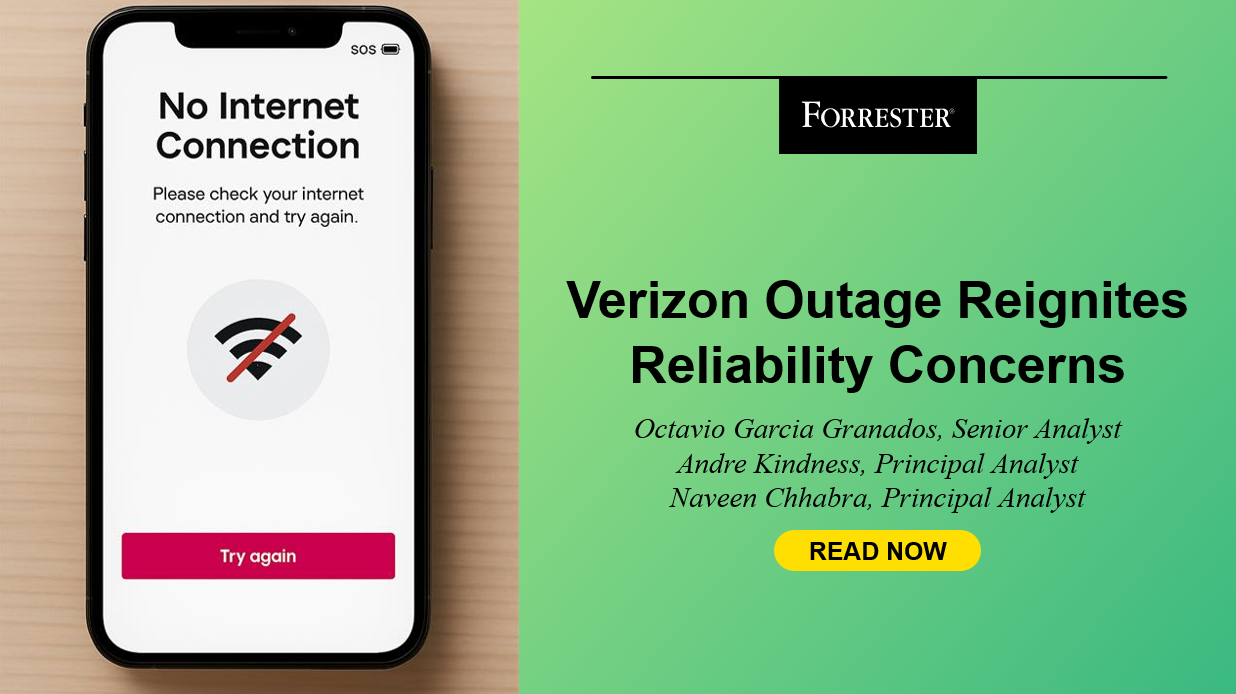
Verizon Outage Reignites Reliability Concerns

by theadvisertimes.com
6 months ago
in Market Analysis
Reading Time: 4 mins read
A A
0
Verizon Outage Reignites Reliability Concerns
Share on FacebookShare on TwitterShare on LInkedIn


On January 14, Verizon experienced a major nationwide cellular service disruption that left subscribers across the country facing significant connectivity issues. Although outage report numbers climbed into the hundreds of thousands, this visible count represents only a small portion of the true impact. As is typical in large‑scale outages, many customers who encountered problems never submitted or couldn’t submit reports, and the hidden effects were far broader — extending to countless IoT‑driven services that rely on cellular networks, including tracking platforms, point‑of‑sale systems, and other connected devices.

The outage persisted for approximately 11 hours, and drawing on the economic effects observed during similar past events — such as interruptions to financial transactions and delays across supply‑chain operations — we estimate the total impact on the US economy to be about $500 million.

Here’s an overview of the incident and what to expect next:

A software issue caused the massive outage. While awaiting Verizon’s official communication, a company spokesperson attributed the outage to a software issue. What’s the big deal? For most of us in IT, cellular technologies have been used as backup underlay technology for wide-area networks, making the impact minimal. But for some enterprises, cellular connectivity is the lifeline of their core business functions such as operations (e.g., field and fleet operations, asset tracking and management) or sales (e.g., payment terminals, kiosks, etc.). In these circumstances, an outage like this is devastating.
There will be investigations and significant cost to Verizon. A chain of events will unfold following the outage, starting with Verizon submitting the official outage root cause report to the FCC. In parallel, US government agencies will support efforts to rule out any possible cyberattacks. Customer rebates and credits will start to flow and, similarly, lawsuits from consumers and businesses alike. Verizon will implement processes and technology improvements addressing the root cause(s), and the FCC will be forced to review its rules. We estimate that Verizon will see as much as $1.5 billion in impact considering outage duration and subscriber volume proportions, which could be bundled into a three-year improvement plan in the vicinity of $20–30 billion.
Verizon’s brand reputation takes a hit. Similar to the experiences of other businesses following outages, Verizon’s brand reputation will take a hit and face potential customer churn in the months after this incident. These effects typically unfold over the first six to nine months following the event. We expect Verizon to introduce resiliency enhancements and roll out customer‑focused credit or guarantee programs, similar to AT&T’s “AT&T Guarantee.” In large‑scale outage situations, transparency and timely communication are critical to minimizing reputational damage. Unfortunately for Verizon, this level of communication did not occur during this latest event.

Network outages and performance slowdowns are inevitable — driven by physics, human intervention, and the growing complexity of modern infrastructure. What made this incident stand out, however, is that it involved a major national carrier that both businesses and consumers rely on daily. Because of this level of dependence, carriers are expected to meet exceptionally high standards, often committing to service‑level agreements of five-nines availability. That translates to no more than 5 minutes and 15 seconds of downtime annually. An 11‑hour disruption is far outside those expectations and ranks among the most significant outages we’ve seen in recent years. So what should carriers and IT leaders take away from this event?

Revisit your wireless connectivity strategy. For organizations that depend on a single cellular carrier for connectivity, this may be the right moment to reevaluate whether additional technologies could offer resilience business needs. Options such as multi‑SIM or eSIM‑based redundant carrier connectivity, or incorporating alternative wireless paths like satellite links or low‑power wide‑area technologies, can greatly reduce the risk of a complete service outage. But the takeaway extends beyond diversifying connectivity. While we rightly expect carriers to meet stringent reliability standards, we also have an opportunity to act proactively.
Accelerate advanced networking capability investments. Despite the inevitability of network outages and performance slowdowns, many networking teams still struggle with planning ahead and building resilience into their environments — often treating network monitoring and proactive safeguards as secondary priorities. But maximizing uptime and ensuring rapid remediation are critical to customer experience. This is why network automation, comprehensive performance management (including visibility, observability, and AIOps), fast analytics for root‑cause analysis/CAST, and systemwide optimization through AI have become essential capabilities. While automation and AI won’t prevent every outage, they can surface issues earlier, avoid many degradations, and even run simulations to anticipate the impact of changes before they are deployed. Automation can help resolve widespread issues faster.
Advanced companies — especially carriers — must pursue more sophisticated practices. Basic investments in automation, observability, and analytics are no longer enough. Leaders should adopt enterprisewide networking fabrics, digital twin simulations, and real‑time event communication. Traditional, segmented networks required slow, manual, component‑by‑component changes, while modern software‑defined fabrics push a single update to hundreds or thousands of devices at once, making pre‑change validation critical. Digital twins let teams safely simulate configuration updates, patches, and upgrades to understand their full impact before production. Carriers should accelerate adoption of these capabilities, similar to how aerospace and aviation professionals rely on simulation to manage complexity and ensure precision.

Engage with us via an inquiry call by emailing [email protected].



Source link

Tags: ConcernsoutagereignitesReliabilityVerizon
ShareTweetShare
Previous Post

10 Amazon Dupes That Are Just as Good as the Expensive Versions

Next Post

Market Talk – January 15, 2026

Related Posts

Oil Field Chemicals Market: Sustainable Solutions & Emerging Technologies

Oil Field Chemicals Market: Sustainable Solutions & Emerging Technologies

by theadvisertimes.com
July 13, 2026
0

The Oil Field Chemicals Market is witnessing steady expansion as oil and gas producers prioritize operational efficiency, asset integrity, and...

WTI Bulls Vs. Bears: The Next Big Oil Price Move!

WTI Bulls Vs. Bears: The Next Big Oil Price Move!

by theadvisertimes.com
July 13, 2026
0

is trading on the 4-hour timeframe in a recovery phase after rebounding from the $69 low. However, prices continue to...

The Agentic Age Needs A Cognitive Operating Model

The Agentic Age Needs A Cognitive Operating Model

by theadvisertimes.com
July 13, 2026
0

Last October, I published a blog proposing a different mental model for AI agents: Treat them as cognitive skills and products,...

Overcoming Fear of Channel Conflict to Drive Sales Growth

Overcoming Fear of Channel Conflict to Drive Sales Growth

by theadvisertimes.com
July 12, 2026
0

What if the friction currently stalling your partner relationships is actually the clearest indicator of untapped revenue potential? For many...

Building Trust with Channel Partners: The 2026 Operational Guide

Building Trust with Channel Partners: The 2026 Operational Guide

by theadvisertimes.com
July 11, 2026
0

Did you know that 97% of channel marketing leaders identify driving partner-led pipelines as their top strategic priority for 2026,...

How to Motivate Channel Partners: A Strategic Guide for 2026

How to Motivate Channel Partners: A Strategic Guide for 2026

by theadvisertimes.com
July 10, 2026
0

Partner-sourced deals close 46% faster and have a 53% higher win rate than direct sales, yet many organizations still struggle...

Next Post
Market Talk – January 15, 2026

Market Talk - January 15, 2026

How to Save Money FAST: Real, Doable Steps for Busy Families

How to Save Money FAST: Real, Doable Steps for Busy Families

  • Trending
  • Comments
  • Latest
Should You Offer a Concession to Get Your Apartment Leased Faster?

Should You Offer a Concession to Get Your Apartment Leased Faster?

June 15, 2026
How I Maximize My Sapphire Reserve Dining Credit

How I Maximize My Sapphire Reserve Dining Credit

July 10, 2026
Fourth of July 2026 Freebies and Deals

Fourth of July 2026 Freebies and Deals

July 3, 2026
5 things financial therapists want every advisor to know

5 things financial therapists want every advisor to know

June 26, 2026
The 10 Largest NYC Tech Startup Funding Rounds of June 2026 – AlleyWatch

The 10 Largest NYC Tech Startup Funding Rounds of June 2026 – AlleyWatch

July 6, 2026
Prime Day, June 2026: How Retailers Competed With Amazon

Prime Day, June 2026: How Retailers Competed With Amazon

June 29, 2026
The Fallacy of the Keynesian Theory of Insufficient Demand

The Fallacy of the Keynesian Theory of Insufficient Demand

0
Germany opposes EU trade embargo on settlements

Germany opposes EU trade embargo on settlements

0
Ford Recalls Nearly 1M Vehicles in 2 Weeks. Is Your Car on the List?

Ford Recalls Nearly 1M Vehicles in 2 Weeks. Is Your Car on the List?

0
Goldman Sachs quietly snags a corner of America’s retirement money

Goldman Sachs quietly snags a corner of America’s retirement money

0
US stocks today: US stocks end lower as Iran tensions dampen risk appetite; chipmakers drop

US stocks today: US stocks end lower as Iran tensions dampen risk appetite; chipmakers drop

0
Bolivia Considers Recognizing USDT for Payments Amid Dollar Shortage

Bolivia Considers Recognizing USDT for Payments Amid Dollar Shortage

0
Ford Recalls Nearly 1M Vehicles in 2 Weeks. Is Your Car on the List?

Ford Recalls Nearly 1M Vehicles in 2 Weeks. Is Your Car on the List?

July 13, 2026
How Outdated EBT Cards Are Fueling a Surge in SNAP Benefit Theft

How Outdated EBT Cards Are Fueling a Surge in SNAP Benefit Theft

July 13, 2026
US stocks today: US stocks end lower as Iran tensions dampen risk appetite; chipmakers drop

US stocks today: US stocks end lower as Iran tensions dampen risk appetite; chipmakers drop

July 13, 2026
Waller says Fed shouldn’t ‘fight the last war’ on inflation but warns hikes still possible

Waller says Fed shouldn’t ‘fight the last war’ on inflation but warns hikes still possible

July 13, 2026
Exclusive: Delaware Secretary of State partners with Norm Ai to propose the AIC, a legal entity for agents

Exclusive: Delaware Secretary of State partners with Norm Ai to propose the AIC, a legal entity for agents

July 13, 2026
Will the Trump Admin Buy Into OpenAI & Save Softbank?

Will the Trump Admin Buy Into OpenAI & Save Softbank?

July 13, 2026
theadvisertimes.com

Get the latest news and follow the coverage of Business & Financial News, Stock Market Updates, Analysis, and more from the trusted sources.

CATEGORIES

  • Business
  • Cryptocurrency
  • Economy
  • Financial Planning
  • Investing
  • Market Analysis
  • Markets
  • Money
  • Personal Finance
  • Startups
  • Stock Market
  • Trading

LATEST UPDATES

  • Ford Recalls Nearly 1M Vehicles in 2 Weeks. Is Your Car on the List?
  • How Outdated EBT Cards Are Fueling a Surge in SNAP Benefit Theft
  • US stocks today: US stocks end lower as Iran tensions dampen risk appetite; chipmakers drop
  • Our Great Privacy Policy
  • Terms of Use, Legal Notices & Disclosures
  • About Us
  • Contact Us

© Copyright 2024 All Rights Reserved
See articles for original source and related links to external sites.

Welcome Back!

Login to your account below

Forgotten Password?

Retrieve your password

Please enter your username or email address to reset your password.

Log In
No Result
View All Result
  • Home
  • Business
  • Financial Planning
  • Personal Finance
  • Investing
  • Money
  • Economy
  • Markets
  • Stocks
  • Trading

© Copyright 2024 All Rights Reserved
See articles for original source and related links to external sites.