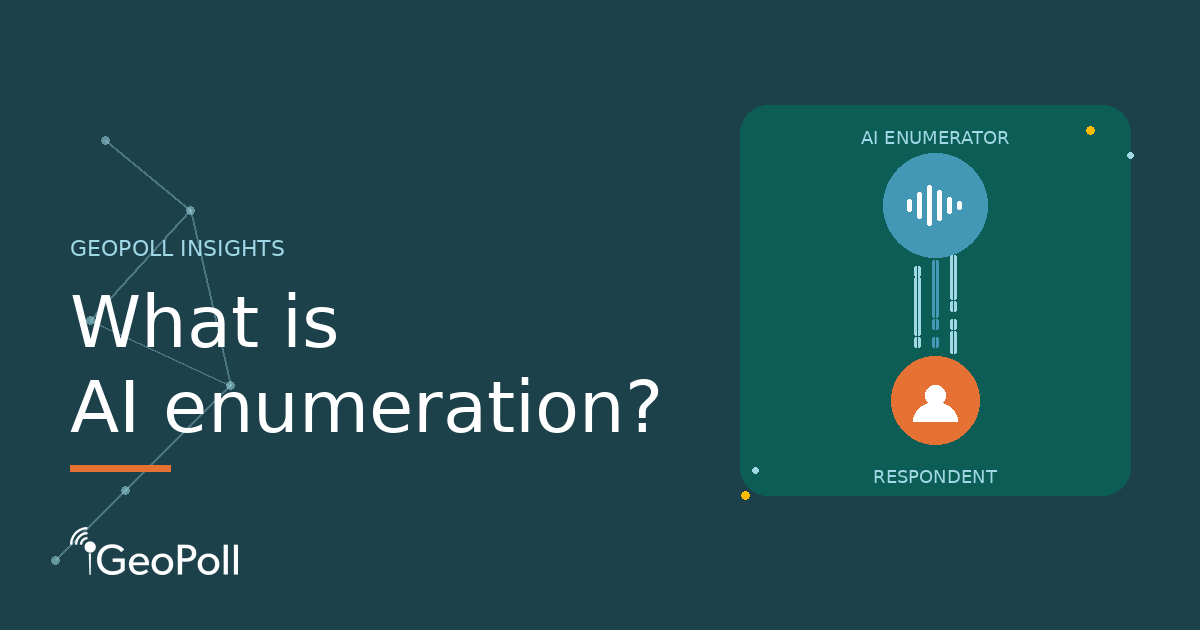
AI enumeration is the use of conversational AI systems to conduct survey interviews with respondents, replacing or augmenting the role of a human enumerator. Instead of a trained interviewer dialing a respondent and reading questions from a script, an AI voice agent does the work: asking questions, listening to responses, probing open-ends, and recording structured data in real time.
The term borrows from traditional survey research, where “enumeration” refers to the act of collecting data from respondents in the field, by phone, or through mobile channels. AI enumeration applies the same function to a new mode of delivery.
For research teams operating at scale across multiple languages and time zones, AI enumeration is one of the most significant methodological shifts since the move from face-to-face interviewing to computer-assisted telephone interviewing (CATI). But like any new method, it works well in some contexts and poorly in others, and understanding the difference is what separates useful adoption from expensive experimentation.
This guide covers what AI enumeration is, how it works, where it adds value, where it falls short, and why research expertise and verified respondent panels remain essential even as the interview itself becomes automated.
How AI enumeration works
At a mechanical level, AI enumeration systems combine three technologies: speech recognition to understand what the respondent says, a large language model to interpret meaning and generate follow-up questions, and text-to-speech to deliver questions in a natural voice.
The AI follows a structured questionnaire, just as a CATI interviewer would, but it can adapt within defined boundaries. If a respondent gives an unclear answer to an open-ended question, the AI can probe for clarification. If a respondent mentions something worth exploring, the AI can branch into a follow-up. And if the respondent speaks a different dialect or code-switches between languages, modern systems can often keep up.
The respondent experience varies. Some AI enumeration deployments use voice over the phone, mirroring traditional CATI. Others use voice through WhatsApp or messaging apps. A few use text-based chat interfaces. The common thread is that the interview feels like a conversation rather than a form.
AI enumeration versus traditional enumeration
Traditional enumeration relies on trained human interviewers. It is proven, flexible, and capable of handling almost any research context, but it is also expensive, slow to scale, and subject to variability between interviewers.
AI enumeration flips several of these tradeoffs. It scales almost instantly, runs consistently across thousands of interviews, and operates in any language the model supports, at any hour, without fatigue. What it gives up, at least for now, is the human judgment that skilled enumerators bring to difficult interviews: reading hesitation, building rapport with reluctant respondents, and knowing when to push and when to step back.
Neither method is universally better. The useful question is which method fits which study, and for many projects the answer is a thoughtful combination of both.
Advantages of AI enumeration
Cost efficiency at scale. Human enumeration costs scale roughly linearly with sample size. AI enumeration has a higher fixed setup cost but much lower marginal cost per interview, which makes it economical for large samples, tracking studies, and high-frequency research. A study that would require hundreds of call center hours can often be completed in a fraction of the time at a fraction of the cost.
Speed to field and speed to data. An AI enumerator can start interviews as soon as the questionnaire is approved and the sample is ready. There is no enumerator training, no briefing, no staffing up for peak periods. Fielding windows that used to take two to three weeks can close in days, and because the AI transcribes and codes as it goes, clean data is available almost immediately after the last interview completes.
Consistency across interviews. Every respondent hears the same question in the same tone with the same phrasing. Interviewer effects, which are a real and often underdiscussed source of measurement error, are largely eliminated. This matters especially for tracking studies, where even small shifts in enumerator behavior between waves can create noise and bias that look like signals.
Language and dialect coverage. Multilingual studies have traditionally required recruiting, training, and managing enumerators in each language. AI systems trained on sufficiently large speech datasets can handle dozens of languages, including low-resource languages that are difficult to staff for. This is a particularly meaningful advantage in regions like Sub-Saharan Africa, where a single national study might need to run in five or more languages.
Respondent candor on sensitive topics. There is a growing body of evidence that respondents disclose more openly to AI interviewers on sensitive subjects, including health behaviors, financial status, political attitudes, and experiences of discrimination or violence. The absence of social judgment seems to reduce the performative element of responses that skews sensitive-topic data.
24/7 availability. AI enumerators do not have shifts. Respondents in rural areas who are only reachable in the evening, or business owners who can only talk after closing, can be interviewed whenever they are available. This expands the reachable universe and reduces the bias introduced by sampling only people who answer during call center hours.
Scalability without quality degradation. In traditional enumeration, scaling a study often means hiring less experienced interviewers, which degrades quality at exactly the moment you need it most. AI enumeration holds quality constant regardless of sample size.
Drawbacks and considerations
Rapport limits. Human enumerators build trust through small cues: warmth, acknowledgment, cultural references, shared language. AI systems are getting better at this, but they still struggle with the kind of rapport that gets a reluctant respondent to open up or a busy executive to stay on the line. For studies where participation depends on rapport, human enumeration is still the better choice.
Complex probing and narrative elicitation. AI enumerators can probe effectively on structured open-ends, but they might fall short in deep narrative elicitation, especially when not well trained, where the interviewer needs to follow an unexpected thread, understand implicit meaning, or recognize when a respondent is circling back to something they have not yet said. Ethnographic and deeply qualitative work remains firmly in human territory.
Respondent trust and consent. Respondents have a right to know they are speaking with an AI. Disclosure is both an ethical and, increasingly, a regulatory requirement. Studies need to handle this transparently without suppressing participation.
Data security and model choice. AI enumeration involves sending the respondent’s speech to speech recognition and language models. The choice of models, where they are hosted, and how respondent data flows through the system are all material questions, particularly for studies involving vulnerable populations or regulated data.
Why research expertise still matters
AI enumeration automates the interview. It does not automate research.
Designing a study that yields valid, useful insights still requires methodological judgment: framing the research question, selecting the appropriate methodology, designing a questionnaire that avoids leading and double-barreled items, setting quotas that reflect population realities, defining weighting schemes that correct for known sample biases, and interpreting results in context. None of this is done by the AI.
If the questionnaire is poorly designed, an AI enumerator will execute it flawlessly and produce flawless garbage. If the sampling frame is biased, running the interviews through AI will produce precise estimates of the wrong quantity.
To get value from AI enumeration, researchers must pair it with genuine research expertise. If you treat AI enumeration as a replacement for research thinking, you will ship studies faster and be wrong faster.
Why a respondent database still matters
The second thing AI enumeration does not solve is the sample.
An AI enumerator needs someone to interview. That means a reachable, representative, profiled, and willing respondent base. Building such a base takes years and requires serious investment in recruitment, verification, profiling, re-engagement, and incentive management. It is not commodity infrastructure, and it cannot be conjured at the moment a study is commissioned.
In regions where traditional sampling frames are incomplete and where reaching specific demographic segments requires deliberate panel construction, the quality of the underlying respondent database largely determines the quality of any study run on top of it. An AI interviewer that calls the wrong people efficiently is not useful.
This is the pattern likely to play out across the industry: AI enumeration will become widely available, but the research buyers who get meaningful results will be the ones working with providers who own and actively maintain the respondent relationships the interviews depend on.
This is where organizations like GeoPoll, which has access to over 300 million mobile subscribers, come in. To provide a diverse enough sample to produce good research.
Best practices for AI-enumerated studies
Pilot before you scale. Always run a pilot of at least 50 to 100 interviews before a full rollout. Listen to the recordings. Check the transcriptions. Identify the questions where respondents are confused, the probes that are not firing, and the moments where the AI misinterprets an answer. Fix before scaling.
Design questionnaires for voice. Questionnaires that work on self-complete mobile surveys do not always work for voice. Long question stems, complex scales, and nested skip patterns that are fine for a human enumerator can confuse both the AI and the respondent. Shorter, cleaner, more conversational phrasing produces better results.
Plan QA before fielding, not after. Decide in advance what proportion of interviews will be reviewed, what flags will trigger review, and who owns the review process. Budget time and cost for it.
Use hybrid designs deliberately. AI for the scalable, structured portion of the study; human enumerators for the harder segments (rural, elderly, sensitive follow-ups, and qualitative deep dives). The best hybrid designs are intentional about which mode handles which respondent type.
Be transparent with respondents. Disclose at the start that the interview is being conducted by an AI. Give respondents the option to decline. Respondents who participate under clear consent give more reliable data than those who feel tricked.
Measure mode effects. If you are transitioning a tracking study from human CATI to AI enumeration, run a bridge study. Mode effects are real and measurable, and pretending they do not exist is how tracking data quietly loses its comparability.
Use cases for AI enumeration
Large-scale tracking studies. Brand health, political opinion, consumer confidence, and public health tracking studies all benefit from AI enumeration’s consistency and cost efficiency, particularly when they run monthly or quarterly across multiple markets.
Multilingual research in emerging markets. Studies that span multiple countries or multiple languages within a country, including African markets where staffing enumerators across five or more languages is a recurring operational challenge, can be run more cheaply and consistently with AI enumeration.
Rapid-turnaround studies. Crisis response research, reaction studies around news events, and tight-deadline commercial studies all benefit from the speed advantages of AI fielding.
Sensitive-topic research. Studies on health behaviors, financial vulnerability, gender-based violence, and political attitudes can produce more candid data through AI enumeration, though with strong ethical guardrails and clear pathways to human support where relevant.
Panel recontact and longitudinal work. Reaching existing panel members for follow-up waves is operationally expensive with human enumerators. AI enumeration lowers the cost enough to make more frequent, lighter-touch recontact viable.
Hard-to-reach schedules. Research with business owners, healthcare workers, farmers during harvest, or parents with young children requires flexibility that fixed call center hours cannot easily provide. AI enumeration’s always-on availability changes what is reachable.
Where AI enumeration is headed
AI enumeration will not replace human enumerators across the board. It will be for specific kinds of work, at specific scales, in specific contexts, while expanding the total volume of research that is economically viable. Integrating AI enumeration into a broader research offering rather than treating it as a standalone product is the current stance.
Powered by the ASR models we have been creating over the last few years using GeoPoll AI Data Streams, GeoPoll is currently running AI enumeration across our own survey platform. Our focus on multilingual performance in Africa, Asia, and Latin America, and on the quality controls that make AI-collected data fit for client use.
If you are thinking about AI enumeration for your research project, or if you would like to discuss a pilot, get in touch with the GeoPoll team.