We’ve reached the midway point of 2026, and with six months of housing market data to pull from, one thing is clear: the headlines don’t match reality.
The media is full of economic uncertainty, global conflict, and even housing crash predictions. But the actual data points to something else entirely.
The 2026 housing market? It’s surprisingly stable. No, there isn’t a ton of activity. Interest rates remain elevated. We’re still in the “Great Stall.” But things are more predictable. And that’s all investors need to make informed decisions.
Not to mention, there’s a third factor—a silver lining—that not nearly enough real estate investors are paying attention to. You won’t see it reflected in the data, but investors are scooping up real estate deals at massive discounts.
To be clear, this isn’t happening in every market. But if it’s happening in yours—or a market you’re targeting—the next six months could be your window to buy rental properties at prices we might not see again.
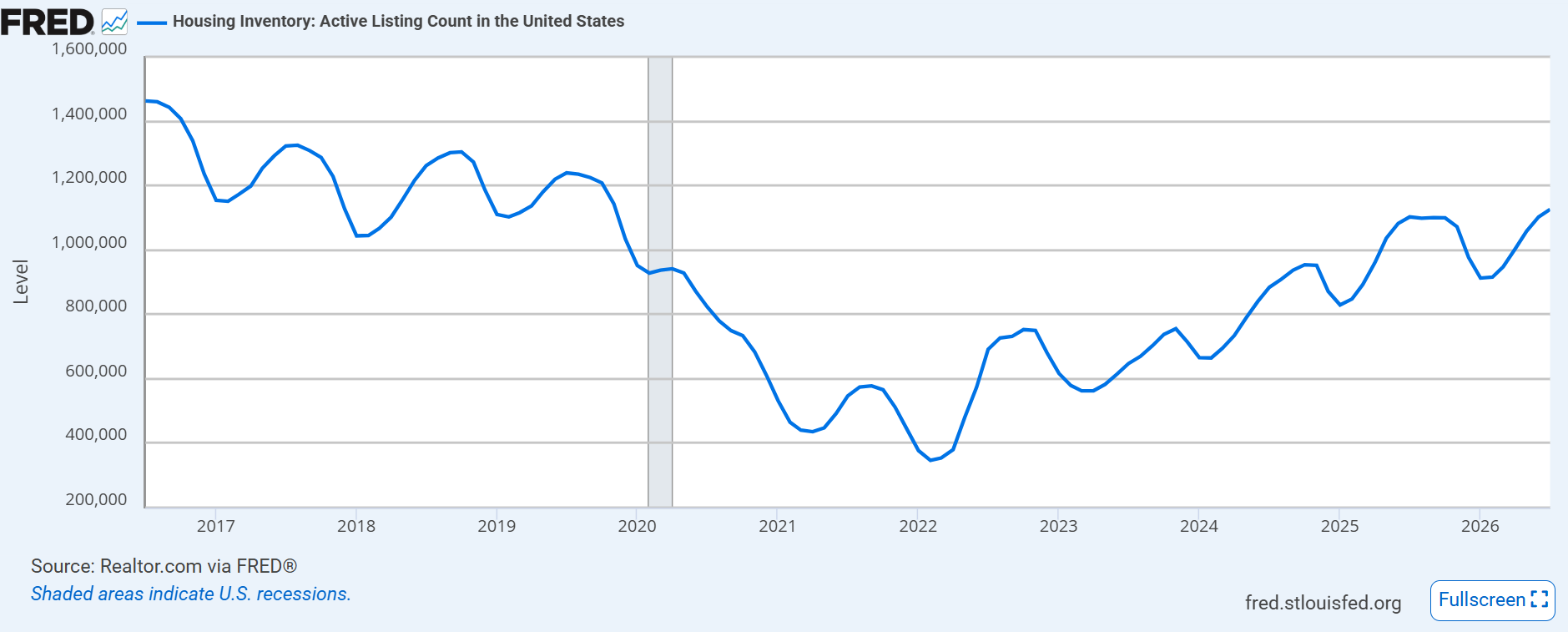
Dave Meyer:Are homes secretly cheaper than you think right now? All the data shows that the housing market is flat. Nationwide, the average home costs about the same today as it did a year ago, but those sale prices don’t tell the whole story because nearly half of all homes sold right now come with a seller concession. Sellers are willing to pay your closing costs, buy down your mortgage rate, or to make costly repairs just to get you to buy their properties. Seller concessions are more common now than in any other year we have data for. On homes that sell with a concession, they average close to 5% of the purchase price. That could easily be the difference between a deal penciling or not. And that’s our big story in this July’s housing market update.What’s up everyone? I’m Dave Meyer, chief investment officer at BiggerPockets. Today, I’m giving you my monthly update on all the data in the housing market. We’ll cover trends in home prices, the risks of a real estate crash, the rise in seller concessions, and more. Let’s dive in. First up, let’s just talk about where the housing market is at this year. I’ll just give you the big picture headline here. Really not that much has changed. And I know if you look at the news, if you look at social media every day, you say someone saying the market is going to crash or something’s going terrible or no one can afford to buy homes. But the reality is we’re pretty much where we were three months, six months, 12 months ago. This is why for years now, I have been calling this the great stall because the market is pretty boring and pretty flat.And I’ll just share with you the data and information that reflects that. So the first data that we’re going to look at is inventory. This is basically how many homes are for sale at any given time in the United States. And it’s a really, really important and helpful metric in the housing market because it helps us measure the balance between supply and demand. When inventory is up, that typically means that there are more sellers than buyers, and that creates a buyer’s market and prices tend to go down in those kinds of market. When inventory is going down, that points to a seller’s market. It means there’s more buyers than sellers, and that tends to lead to rising prices. What we have right now in terms of inventory is dead flat. It’s basically exactly the same, less than 1% difference year over year. And when I say year over year, just so you know, what I’m doing is comparing this week or this month in 2026 to the previous year.So I’m talking about June of 2026 versus June of 2025. And the reason I do this and talk about this year over year data is because housing is seasonal. You can’t really compare January inventory to July inventory because there are always these patterns where inventory and sales are lower over the winter, they go up over the summer. And so that’s why you compare year over year. And what we see is inventory is exactly the same. And so all these people saying housing prices are going to explode because we have inflation, inflation pushes up prices, that hasn’t happened. All the people saying that the market is going to crash because everything is unaffordable and no one could buy a home also hasn’t happened. What we are seeing instead is inventory is almost exactly the same as it was last year. It’s kind of boring. But beneath the surface there, there are some variances that are important here.So there’s sort of this subcategory of inventory called new listings, which is basically how many people are putting their homes up for sale in a given month. And this is different from inventory because inventory is how many homes are for sale. They could have been listed six months ago or three months ago or a month ago. New listings are just like, how many new ones hit the market, the MLS this month? Those are actually going up. Those are up about 8%. And that is notable because when you start to see new listings go up, oftentimes what can happen is inventory goes up too, that’s more supply, and then you start to see prices go down. But inventory hasn’t changed, right? So you’re seeing new listings go up and inventory in flat. How do you square that? Well, that means that buyers are scooping up those new listings.It means people are coming in beyond what we had last year and buying those new listings. Basically, new demand is offsetting it. If these new listings were sitting on the market and we were starting to see this snowball effect that often precedes a deep correction or even a crash, we would see inventory go up, but we aren’t. And this is reflected in other data. We can verify that this is what’s happening because we also see this in pending sales. Pending sales are up 6% year over year. So if you want a holistic picture, a clear picture of what’s going on, the market is still sluggish. It’s not very exciting. More people are listing their homes for sale by a little bit, nothing crazy, 8%. But there are also more people buying. So when you hear all those people saying no one’s buying, that’s actually not true.More people are buying this year, this summer than a year ago. And when that happens, when you have more new listings, but you also have a corresponding rise in the amount of people who are willing to buy those new listings, the equilibrium or the balance in the housing market stays exactly the same. When demand and supply move proportionally, prices stay the same. That’s exactly what we have. And that’s why prices are pretty much flat. They’re actually up a little bit depending on who you ask. If you look, Redfin has it up about 2% year over year. NAR is like one and a half percent. Different sources of different things, but they’re all usually, they’re about between one and 2%. So in nominal terms, we’re seeing modest gains, but in real terms, so inflation adjusted terms, prices are still going down. And that’s why I have said and continue to say that we are in a housing correction, because even though that price you see on Zillow or realtor.com or whatever is going up a little bit, 1%, 1.5%, it’s pretty much flat.The fact that they’re going up slower than the pace of inflation means that real returns, and when I say real, real just means inflation adjusted. Inflation adjusted returns are actually going down. And I think as investors, if that is going down, if we are losing money to inflation on the price of homes, that’s a correction, that we are losing spending power in that scenario. And so that is what we need to pay attention to. So that’s it. In the interest of making good content, maybe it would be cooler if we had some big story to tell you, but I’ve been trying to tell y’all for years that this is going to be boring, that we’re in the great stall. This is a boring period in the housing market, and that is exactly what we’re getting. And I think it’s important to call out that this is happening even though affordability has actually gotten worse in recent months.And to me, that’s a good sign. Not because I want affordability to get worse. I very strongly want the opposite to happen, but because I think it just shows the resilience of the market. I think that this last three, four months after the war in Iran started, interest rates went up, inflation has gotten worse. That was, in my mind, kind of a big test for the market to see, are we going to see demand really pull back? Are people super interest rate sensitive to the point where the rates going from six on average to six and a half percent is going to change demand? And we have an answer now, and the answer is no. And that’s good for the housing market. We’re seeing evidence of the great stall that even these minor changes in affordability and rates and blah, blah, blah, all that stuff, we’re kind of in this.This is where we’re at for right now, and I expect that’s what’s going to continue. I don’t really think that we are going to see any fundamental changes to the housing market over the next couple months. Now, one of the questions I get a lot is there’s a peace deal kind of in place over the last couple of days. Iran and the United States have been trading fire. So by the time this airs, the ceasefire might be gone. But I just want to call out, a lot of people have asked me since the ceasefire in place, will inflation go down? Will rates go down? I don’t think so. I think that we’re going to have inflationary pressure for the rest of the year and that mortgage rates are probably going to stay higher mid-sixes, not higher than they are right now. If the war starts up again and the Strait of Hermos closes, who knows?But if we sort of stay in the status quo that we have geopolitically right now, I think rates are going to stay in the mid-sixes. So if I were you, I wouldn’t be waiting around for some big change in mortgage rates. They’re always going to swing 0.1%, 0.2% in either direction, but I still think we’re going to be in the mid, hopefully maybe 6.2, 6.3 if the war ends by the end of the year, but I would be shocked if we were below six anytime in 2026. So that’s how I’m personally planning to make my own investing decisions. It’s what I recommend for all of you is just to count on the great stall continuing for affordability to hover around where it’s been and make decisions based on what is a pretty stable market. I know it’s not a good market and I know it’s not a healthy market, but it is stable.We kind of know what to expect now. And for me, as an investor, that’s really what you should care about. You know that if you lock in a rate tomorrow, it’s not going to be that different a week from now. You know that prices aren’t probably going to jump in the next three months. They’re probably not going to go through the floor in the next three months. This allows you to underwrite deals better. And again, we all hope it gets to be a healthier housing market, but being in a place where you can underwrite deals confidently, that is a good spot to be as a real estate investor. So take this information, understand that we’re in the great stall, underwrite your deals conservatively, but feel confident when you do that. Feel confident that the market is probably not going to do something crazy, at least in the next six months.Great stall is still what we got. So plan accordingly. Now on top of all this data, which we always talk about every month in the housing market update, there’s some new data that I’m stoked about and I think is a huge opportunity for investors who want to grow and pursue financial freedom in the great stall. And I’m going to share this new data with you right after this quick break. Stick with us.Welcome back to the BiggerPockets Podcast. I’m Dave Meyer. This is our July 2026 housing market update. Before the break, I talked about how we’re in the great stall. The first half of the year has been kind of boring. I’m kind of expecting boring for the second half of the year. But I think in the data that we often talk about, that’s often in the mainstream media, I think some great opportunities for investors may be hiding in that data is not fully represented in that data. And that opportunity, in my opinion, is through seller concessions. If you don’t know what this is, this is basically sometimes during the course of negotiating a real estate deal purchase, you ask the seller to give you some money, to give you good terms. These are things like asking them to buy down your interest rate or to cover their closing costs or fixing things or adding something to the house.These are all seller concessions that you as a buyer can ask for. And seller concessions kind of always exist, but there is data that shows right now that nearly half of US homes, when they’re sold, give concessions to buyers. Actually, in May, it’s the highest on record according to Redfin. Data does not go back that far. I think it goes back about 10 years. So it doesn’t go back to the great financial crisis. Keep that in mind. But still, nearly half of home sales have a concession. And really one in seven homes, one in seven, that’s 16% had a concession and a price drop. And so if you think about this and sort of extrapolate it, it kind of means in effect that prices are going down. Now the headline price, the thing that is recorded with the county and what the records say will say the same top line number, but the number that you as a buyer are effectually paying is actually going down.Because let’s just say you’re going out and buying a home for $300,000. Even if you pay 300, but then they give you $20,000 in seller concessions, at the end of the day, you’re kind of paying 280, right? It depends on the nature of the concessions and all of that, but you are getting a discount on that deal even if the sale price does not reflect that discount. And so when I say the top part of the show that the median home price is up one and a half percent year over year in a nominal basis, that is true, that is factually accurate. But is that data sort of hiding the fact that concessions are where buyers are really getting their discounts? It might not be in the home price where you as an investor and a buyer can get your best discount. It might be getting concessions instead.And this is kind of just a psychological thing. Sometimes people, sellers, they want their number. They just want to sell it for 300. They’ve decided because their neighbor sold it for 290, they want to sell it for 300. And they’re even willing to give you concessions just to hit that number. I don’t know why, that’s just sometimes how it works. And according to this data from Redfin, the typical concession size runs 1.5 to 2% of the sale price. But remember, that includes the 50% of homes that don’t get concessions. If you just zoom in on the properties that do get concessions, the average concession is closer to 5%. So on a $300,000 home like we were talking about, that’s 15 grand. That’s amazing. Now it might not come to you in the form of $15,000. It might be that you don’t pay closing costs. It might be five grand goes to closing costs and 10 grand goes to buying your interest rate down from 7% to five and a half or 5%.Still super valuable. That is real, real money. And so the reason I’m telling you this is you should be using this in your bid strategy when you’re going out and looking for deals. Work with your agent and figure out how to try and negotiate concessions. This should be a tool every investor is using right now. Now you got to figure out the right balance between asking for concessions and price reductions because different sellers have different motivations, different things that they care about. But try this. I don’t see why you wouldn’t try to build this into your strategy and your offers if you’re in a market that is corrected. If you’re in the Sunbelt, why wouldn’t you be doing this? Now, if you’re in Chicago or Milwaukee or Hertford, Connecticut, probably not going to get concessions. But most places in the country, especially if you’re targeting motivated sellers or things that have been sitting on the market for a while, this could really work.It could work better than low balling the sale price. It could work in conjunction with a lower sale price. That’s something you should talk to your agent about how to build the right combination here. But you should be trying this because clearly sellers are showing that they’re more willing to give money back in concessions than they are in lowering price. And you should be using that in your investing. Now you should also know though, you can’t count entirely on concessions. There are actually limits on how much concessions can be built into a contract. It depends on your loan type. If you’re buying for cash, you can do whatever you want. But for other loan types, if you get a conventional loan, it’s usually 3% is the limit. If you’re putting under 10% down, it can go up to 9% if you’re putting 25% plus down.For FHAs, the limit is 6%. For VA loans, it’s 4%. For investment properties, you should know it is 2%. That’s a conventional investment property. And with DSCR loans, you’ll have to ask because those are less regulated. It depends on the specific lender. All right, well, hopefully that helps you go out and bid on your next property. I think this is really cool. We do have one more topic to cover on this month’s housing market update, which is our risk report. We’ve talked about being in the great stall era, but with foreclosures on the rise, we do need to address the elephant in the room and ask ourselves, is a crash likely? Could it actually happen again? We’ll get into that right after this quick break. Stick with us.Welcome back to the BiggerPockets Podcast. I’m Dave Meyer. We’re doing our July 2026 housing market update. Before the break, we talked about how we’re in the great stall, but the opportunity that comes with negotiating concessions right now, because that is a tool you should be using as an investor. Our last story here today is our risk report, something we do every single month where we look at some of the fundamentals of the housing market and how some of the plumbing of the housing market and the financing and the credit world work to understand if there is a risk of the correction that we’re in turning into a full-blown crash. And the first thing we always look at when we do this is our delinquency rate. How many people in the United States are paying their mortgage on time versus how many aren’t? And the reason this is such a good indicator for the health and relative risk in the housing market goes down to supply and demand.The more people who are not paying their mortgages, the more people are at risk of being foreclosed on, and the more risk there is that there’s going to be something called forced selling where we get more and more new listings on the market. Like I talked about before, you have more and more people listing their homes on the market, not because they want to, but because they have to. And if that happens at such a big volume that demand can’t absorb it, that can sort of start a crash. That’s what happened in 2008. So we want to know, could that happen again? And as of right now, the national delinquency rate is at 3.35%. That’s the number of people who are in some form late on their mortgage. And that is exactly unchanged over the last month. So nothing has really changed. And it is below the long-term average of about 4%.It is also, importantly, below where it was in 2019. I like to compare data now to 2019 because it was the last normal year before COVID where a lot of the data you can’t really use because it was just so unusual. It was just an anomaly. You can’t say, oh, how does foreclosures this year compare to 2021? There were government forbearance programs, there was eviction moratoriums, all these things that make it very difficult to compare to that time. So I prefer when looking at this delinquency to look at the long-term average, which is 4%, and where it was in 2019, which was darn close to the long-term average of around 4% and compared to where we are today, which is 3.3%. So we’re still pretty far below. And I know the difference between 3.3 and 4% doesn’t sound like a lot. And it’s not crazy.They’re pretty close, but when we’re dealing with really small numbers, the difference between 3.3 and 4%, that means we’re almost 20% lower now in delinquencies than we were in 2019. So if you’re worried about a crash coming from a similar source that it came from in 2008 where there was for selling, not super concerning right now. Now, FHA loans are sort of one area that I have flagged in previous risk reports that we need to keep an eye on. Because FHA loans recently, that delinquency rate really did start to shoot up. Looking at it right now and what we see in just terms of serious delinquencies, so 90 days plus, they call that a serious delinquency. Serious delinquencies are up near 6% for FHA loans. That is pretty high and it is significantly higher than it was in 2019. So again, we’re doing that analysis against 2019.It was below four in 2019. Now it’s above six. So that is a concern. It’s an area that we’re going to watch on the risk report. But I will call out that in the last month, it actually started to go back down. That’s just one month. I am not going to say that there’s no more risk in FHA. I would like to see that come down for several months before we looked at that. But it is good to see that it’s not just going parabolic and we’re going to just see more and more delinquencies in FHA. Even a month of reprieve I think is a good sign. Now keep in mind, and I’m going to call this out every time we talk about FHA delinquencies, that FHA loans are about 11% of the total mortgage market. So it’s small compared to the other areas. So even if FHA loans get worse, the risk of it sort of spiraling the whole market is a lot lower.Back in 2007, it was conventional mortgages that took down the market. It was not FHA. And so yeah, it’s concerning. You don’t want to see this stuff. It’s something we’ll keep an eye on. But right now, the risk of this causing a crash remains pretty low. When you look at the other indicator that we need to know about, which is foreclosures, delinquencies and foreclosures are kind of tied together. But it’s important because literally I was looking at three different news sources today and two of them had stories about foreclosures going up. Everyone’s saying foreclosure’s going up. Well, yes, they are. Foreclosure starts are up about 25% year over year. But again, year-over-year data comparing to the last few years, it’s kind of pointless. What I see when I look at this data is that foreclosure starts were 29% below 2019 levels. So not really concerning in my opinion.And they were actually, foreclosure starts, by the way, fell five and a half percent from the previous month. So it’s not like they’re just going up and up and up and up and up. They actually went down last month. Now I do think foreclosures are going to go up. I think they’re going to continue to go up. But this is what we would call what is most likely what we would call a reversion to the mean, if you’ve heard that term before. But basically things have been artificially low because of these programs over the last couple of years. And so getting foreclosures back to the normal run rate is kind of what you would expect to happen. So that’s kind of why I’m saying that, not because I’m seeing any signs of particular distress in the market. Of course, there could be. The unemployment rate starts rising rapidly and all these AI fears come true.Sure. Yeah, definitely could happen. But as of today, is there risk that foreclosures or delinquencies are taken down the housing market? No, there just isn’t. I say that pretty confidently. We’ll see what happens for the next few years. But again, as an investor, when I look at the market and what’s likely to happen, this is why I feel so confident in the great stall because I don’t see a lot of downside risk right now. I’ve said before, I think prices might go down nationally this year, one or 2%. But do I see risk of a crash? No, I really don’t. The only thing I could see creating a crash is if all of a sudden we have massive layoffs and unemployment goes to eight or 9%. But that’s not even happening. Unemployment’s at 4.2 right now. It went down last month. It’s partially because labor force participation declined, but now I’m getting into a whole economics nerdy rant.But labor market data looks relatively solid right now. It’s not an inspiring labor market in my opinion, but it’s not as bad as people think. There’s all this data that shows the number of layoffs. It’s really not that bad. It’s high profile is the issue. It’s like big name companies are laying people off, but most people work for small businesses in the United States and they’re not laying people off. And so this is why I just don’t see the delinquency, foreclosure, forced selling, which you kind of need to see for the housing market to crash. I don’t see it. It’s just not there. There’s no evidence of it. The other thing we would see beyond just this data is what we talked about at the beginning of the show is inventory. Inventory would go up if the market was moving towards a crash. We would see it for a couple of months before a real crash materialized.It was up a couple points year over year, three months ago. Now it’s flat, meaning that the trend of rising inventory is slowing, or you can even argue that it has stopped. It might even turn negative. So if you want an informed take on the risk of a crash right now, it’s low. Rest assured. In your market, it might go down, but on a national level, market, it’s stable, it’s fine, it’s boring, it’s sluggish, it’s not exciting, but it’s not that risky. Any given house, any given property could come down two, three, 5%. Certain markets in Florida, in Texas, where I live in Washington could come down. Those markets could drop three, four, 5%. But on a national basis, a crash, 10%. No, it’s not going to happen anytime soon unless something really dramatic changes, some sort of black swan event. Otherwise, you’re good. And for me, again, that’s what you need.This assurance that the bottom is not going to fall out. You are not going to catch a falling knife. Those are the things you need to know to make an informed decision about investments. Should you still buy below current market comps? Of course. Yeah, definitely. In this kind of market, you should be buying five, eight, 10% below market comps just to be sure. If your market goes down 2%, you want to still be walking into equity. That’s the way to get a great deal here in 2026 or ask for a concession, right? Get that money back any way you can. Get them to buy down your interest rate so you’re saving two or $300 a month on your expenses. That’s cashflow in your pocket. That’s great. Use these things to your advantage. The market is boring and slow, but there are things that investors can and should do to take advantage of it.There are more motivated sellers. There are more opportunities for concessions. You have more time to be patient and to negotiate. And if you use those things to your advantage, you can absolutely find great deals in the second half of 2026. I know I’m still going to be looking for deals. All the experienced investors I know are still going to be looking for deals, and you should be too. That’s our show for today. Thank you so much for checking out this episode of the BiggerPockets Podcast. I’m Dave Meyer, and I’ll see you all next time.
Help us reach new listeners on iTunes by leaving us a rating and review! It takes just 30 seconds and instructions can be found here. Thanks! We really appreciate it!
Interested in learning more about today’s sponsors or becoming a BiggerPockets partner yourself? Email [email protected].