No Result
View All Result
  • Login
Tuesday, June 23, 2026
theadvisertimes.com
  • Home
  • Business
  • Financial Planning
  • Personal Finance
  • Investing
  • Money
  • Economy
  • Markets
  • Stocks
  • Trading
  • Home
  • Business
  • Financial Planning
  • Personal Finance
  • Investing
  • Money
  • Economy
  • Markets
  • Stocks
  • Trading
No Result
View All Result
theadvisertimes.com
No Result
View All Result
Home Markets

The Next Big Leap in AI Might Already Be In Our Heads

by theadvisertimes.com
1 month ago
in Markets
Reading Time: 5 mins read
A A
0
The Next Big Leap in AI Might Already Be In Our Heads
Share on FacebookShare on TwitterShare on LInkedIn


Artificial intelligence is rewriting the computing landscape.

It has to. Because the old model is running into bottlenecks everywhere.

Training frontier AI models now requires vast clusters of specialized chips, extraordinary amounts of electricity and entirely new data center architectures. 

And the scale of the AI buildout is staggering.

But it’s necessary because everyone understands that artificial superintelligence (ASI) could be the most important technological breakthrough of this century… and beyond.

The race for more powerful AI might also depend on entirely new forms of computing.

But what if the next leap doesn’t come from better silicon chips at all?

What if nature has already solved part of this problem?

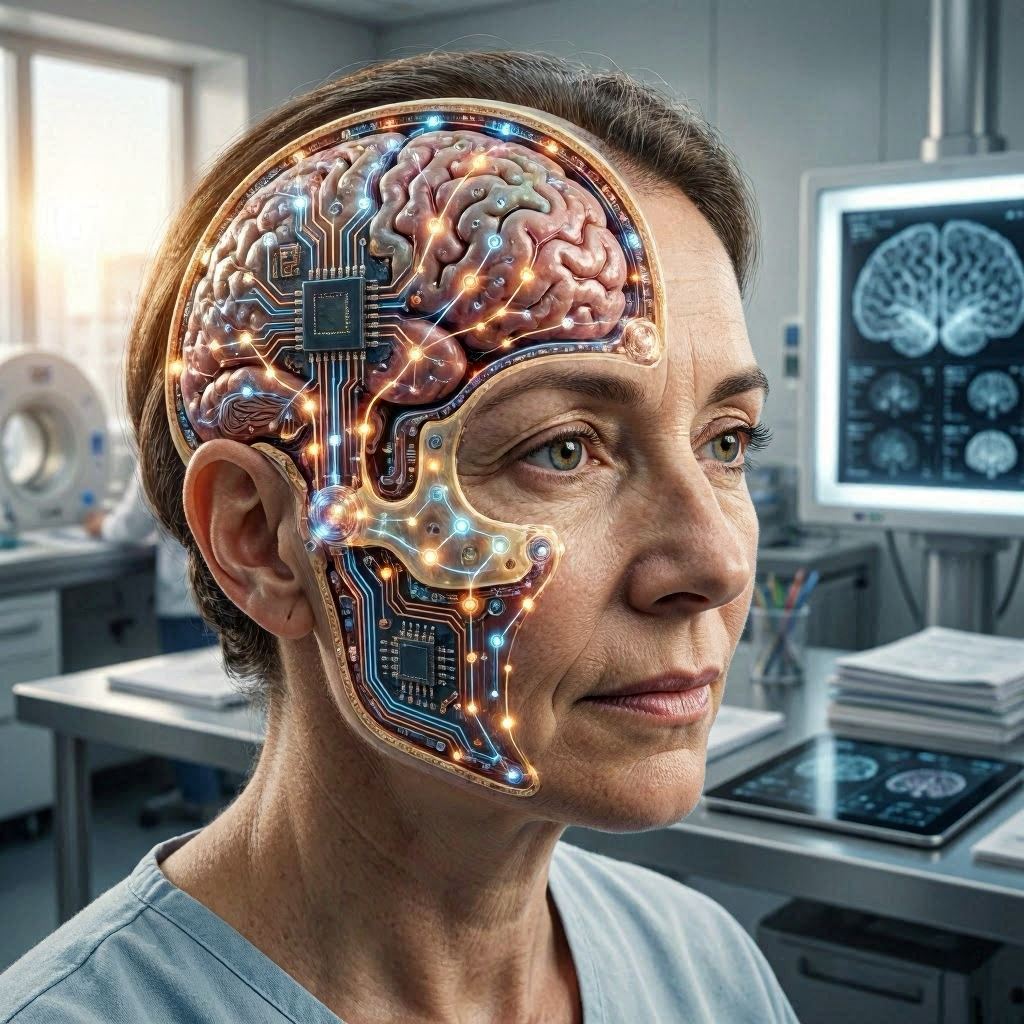
Because right now — as crazy as it sounds — researchers are renting computers built partly from living human brain cells.

And I believe this technology gives us an early glimpse into something truly profound.

Biological Computing

Moore’s Law tells us that if you want more computing power, you just need to make chips smaller, faster and more efficient.

Image: Wikipedia

That’s how we got from room-sized mainframes to smartphones. It also gave us the hardware driving the AI boom.

But now some researchers are exploring a radically different path.

Not better silicon, but living intelligence fused with silicon.

Two startups are already commercializing early versions of this idea. Australia’s Cortical Labs has built a system called CL1 that combines silicon hardware with about 800,000 living human brain cells grown in a lab.

Turn Your Images On

Image: Cortical Labs

Those neurons sit on a chip, allowing researchers to send electrical signals into the network and read responses back out.

In effect, biology has become part of the computational system.

And it isn’t confined to a lab experiment.

Cortical Labs says CL1 can be purchased for around $35,000 or accessed remotely through what it calls “wetware-as-a-service.”

If that’s not mind-blowing enough, Swiss startup FinalSpark offers remote access to brain organoid bioprocessors through its Neuroplatform.

Turn Your Images On

Image: FinalSpark

For about $500 per month, researchers can now rent biological computers over the internet to run experiments on living neural systems from anywhere.

Obviously, this is a niche market right now.

But it could become much bigger as AI pushes against the limits of conventional computing.

After all, compute is expensive and power is becoming increasingly scarce. A large AI model might need thousands of watts of energy to generate answers.

But the human brain runs on roughly 20 watts. That’s less than a dim light bulb.

And that contrast is why this field exists.

Researchers want to know whether living neurons can process certain signals more efficiently than traditional hardware, and whether entirely new forms of computing might emerge from that.

This isn’t purely theoretical either. Because we’ve already seen an early demonstration of what it could look like.

A few years ago, Cortical Labs’ DishBrain experiment made headlines when neurons connected to a chip learned to play Pong.

Turn Your Images On

At the time, many people dismissed it as a novelty.

But I didn’t.

Because I know that breakthrough technologies can sometimes look ridiculous before they become revolutionary.

What’s more, companies like IBM and Intel have pursued neuromorphic computing — chips inspired by brains — for years. So it’s not like the idea is new.

But what’s happening today is taking it a step further.

Instead of merely mimicking biology, these systems actually use biology.

The technology is still fragile, scaling is uncertain and no one should mistake this for a replacement for GPUs.

It could prove revolutionary, or it could prove impractical. It’s simply too early to know.

But whether these first-generation systems end up working matters less to me than what they tell me about where computing could be headed.

Because they suggest that computing could be evolving beyond silicon. And that could prove vital as AI pushes existing computing architectures to their limits.

We know what happens when conventional approaches start running into constraints.

New computing architectures tend to emerge.

And these “neurocomputers” could be another example of this cycle.

Of course, using human brain cells for computing comes with its own set of serious ethical questions.

Who owns biological computing? And could advanced systems someday force us to rethink what counts as consciousness?

Those are issues regulators will need to grapple with sooner rather than later, so we don’t repeat the pattern we’re seeing with AI today, where policymakers are scrambling to catch up with the technology.

Still, I find it incredibly exciting.

Because if biology becomes part of computing, it could lead to something beyond faster and more efficient computers.

It could lead to entirely new ways for AI systems to learn and think.

Here’s My Take

Traditional computing wasn’t built to handle the demands of AI.

As AI continues pushing against the limits of today’s hardware, it will become increasingly important to discover new ways to compute.

And we already know the human brain does something today’s machines still struggle with. It learns, adapts and processes enormous amounts of information while using remarkably little energy.

I’m not suggesting that biological computers will completely replace today’s silicon chips. But I do think they point toward a future where computing might no longer rely on silicon alone.

Living neural systems could eventually become tools for disease modeling, drug discovery, adaptive intelligence and even entirely new training paradigms for AI.

Which means these early “wetware” experiments could soon stop looking like science projects…

And more like the first signs of a computing revolution.

Regards,

Ian King's SignatureIan KingChief Strategist, Banyan Hill Publishing

Editor’s Note: We’d love to hear from you!

If you want to share your thoughts or suggestions about the Daily Disruptor, or if there are any specific topics you’d like us to cover, just send an email to [email protected].

Don’t worry, we won’t reveal your full name in the event we publish a response. So feel free to comment away!


Source link

Tags: bigHeadsleap
ShareTweetShare
Previous Post

Prediction markets: NFL letter wants certain betting contracts banned

Next Post

SEC’s Atkins criticizes off-channel comms enforcement

Related Posts

Roku (ROKU) Has a CTV Operating-System and Ad Platform Bigger Than a Hardware Narrative

Roku (ROKU) Has a CTV Operating-System and Ad Platform Bigger Than a Hardware Narrative

by theadvisertimes.com
June 23, 2026
0

Roku is often framed as a low-margin device company, but that lens misses where the economics really sit. The company...

China’s 618 shopping festival growth slows sharply as consumer spending malaise persists

China’s 618 shopping festival growth slows sharply as consumer spending malaise persists

by theadvisertimes.com
June 22, 2026
0

Citizens gather to purchase and scratch instant lottery tickets at a lottery ticket booth on June 21, 2026 in Guangzhou,...

Bed Bath & Beyond Combines Stores with Another Chain. See Locations

Bed Bath & Beyond Combines Stores with Another Chain. See Locations

by theadvisertimes.com
June 22, 2026
0

Bed Bath & Beyond’s saga continues with a new in-person concept opening nationwide. On June 18, Bed Bath & Beyond...

Fortive (FTV) Has a Recurring-Regulated-Tools and Software Story Bigger Than a Conglomerate Label

Fortive (FTV) Has a Recurring-Regulated-Tools and Software Story Bigger Than a Conglomerate Label

by theadvisertimes.com
June 22, 2026
0

Industrial conglomerates are often judged as if they are collections of unrelated assets that rise and fall with broad manufacturing...

Nvidia’s stock struggles as Kalshi traders bet chip prices are coming down

Nvidia’s stock struggles as Kalshi traders bet chip prices are coming down

by theadvisertimes.com
June 22, 2026
0

Jensen Huang, CEO of NVIDIA, speaks during a press conference after arriving at Gimpo International Airport in Seoul, South Korea,...

Judge Halts Trump Voter Database Over Privacy, Accuracy Fears

Judge Halts Trump Voter Database Over Privacy, Accuracy Fears

by theadvisertimes.com
June 22, 2026
0

A federal judge has blocked the Trump administration from creating a database of Americans’ Social Security numbers and citizenship status,...

Next Post
SEC’s Atkins criticizes off-channel comms enforcement

SEC's Atkins criticizes off-channel comms enforcement

AI data centers employ very few people: What the numbers how

AI data centers employ very few people: What the numbers how

  • Trending
  • Comments
  • Latest
Should You Offer a Concession to Get Your Apartment Leased Faster?

Should You Offer a Concession to Get Your Apartment Leased Faster?

June 15, 2026
6 Hotels Where Chase’s Points Boost Yields 2.5x

6 Hotels Where Chase’s Points Boost Yields 2.5x

May 22, 2026
Understanding risk remains a major investor blind spot: TIAA Institute

Understanding risk remains a major investor blind spot: TIAA Institute

June 5, 2026
Anthropic’s confidential S-1 signals summer AI IPO race could heat up fast

Anthropic’s confidential S-1 signals summer AI IPO race could heat up fast

June 2, 2026
Memorial Day 2026: Take Advantage of Food Freebies, Deals

Memorial Day 2026: Take Advantage of Food Freebies, Deals

May 23, 2026
9 Best Cheap Cell Phone Plans That Will Save You Money

9 Best Cheap Cell Phone Plans That Will Save You Money

June 3, 2026
8 Places to Sell Printables Online for Cash

8 Places to Sell Printables Online for Cash

0
Vedanta Power, Oil & Gas, and Iron shares rally up to 5%; Aluminium sheds 3%. Should you buy, sell or hold?

Vedanta Power, Oil & Gas, and Iron shares rally up to 5%; Aluminium sheds 3%. Should you buy, sell or hold?

0
The Board-Lot Reckoning: Access, Liquidity, and Governance

The Board-Lot Reckoning: Access, Liquidity, and Governance

0
EU Committee Advances Digital Euro CBDC Bill After Vote

EU Committee Advances Digital Euro CBDC Bill After Vote

0
Cisco Systems (CSCO): Neues Fundament nach Kurssprung!

Cisco Systems (CSCO): Neues Fundament nach Kurssprung!

0
Roku (ROKU) Has a CTV Operating-System and Ad Platform Bigger Than a Hardware Narrative

Roku (ROKU) Has a CTV Operating-System and Ad Platform Bigger Than a Hardware Narrative

0
EU Committee Advances Digital Euro CBDC Bill After Vote

EU Committee Advances Digital Euro CBDC Bill After Vote

June 23, 2026
Roku (ROKU) Has a CTV Operating-System and Ad Platform Bigger Than a Hardware Narrative

Roku (ROKU) Has a CTV Operating-System and Ad Platform Bigger Than a Hardware Narrative

June 23, 2026
Cisco Systems (CSCO): Neues Fundament nach Kurssprung!

Cisco Systems (CSCO): Neues Fundament nach Kurssprung!

June 23, 2026
Gen Z: if you want to succeed at work, you need to start friction-maxxing

Gen Z: if you want to succeed at work, you need to start friction-maxxing

June 23, 2026
266. “I carry the household, the bills, and the stress”

266. “I carry the household, the bills, and the stress”

June 23, 2026
Lies, Damn Lies, and the History of Capitalism

Lies, Damn Lies, and the History of Capitalism

June 23, 2026
theadvisertimes.com

Get the latest news and follow the coverage of Business & Financial News, Stock Market Updates, Analysis, and more from the trusted sources.

CATEGORIES

  • Business
  • Cryptocurrency
  • Economy
  • Financial Planning
  • Investing
  • Market Analysis
  • Markets
  • Money
  • Personal Finance
  • Startups
  • Stock Market
  • Trading

LATEST UPDATES

  • EU Committee Advances Digital Euro CBDC Bill After Vote
  • Roku (ROKU) Has a CTV Operating-System and Ad Platform Bigger Than a Hardware Narrative
  • Cisco Systems (CSCO): Neues Fundament nach Kurssprung!
  • Our Great Privacy Policy
  • Terms of Use, Legal Notices & Disclosures
  • About Us
  • Contact Us

© Copyright 2024 All Rights Reserved
See articles for original source and related links to external sites.

Welcome Back!

Login to your account below

Forgotten Password?

Retrieve your password

Please enter your username or email address to reset your password.

Log In
No Result
View All Result
  • Home
  • Business
  • Financial Planning
  • Personal Finance
  • Investing
  • Money
  • Economy
  • Markets
  • Stocks
  • Trading

© Copyright 2024 All Rights Reserved
See articles for original source and related links to external sites.











