SpaceX is the world’s largest space launch provider, accounting for roughly half of all orbital launches worldwide last year[0]. It also owns the Starlink satellite internet service, xAI (CEO Elon Musk’s AI company, which developed the Grok chatbot) and the social media site X (formerly Twitter). And it went public today in the largest initial public offering ever.
The company made its debut on the Nasdaq exchange under the ticker symbol “SPCX” at a price of $135 per share[0], raising $75 billion at an initial market cap of $1.75 trillion[0]. The stock finished its first trading day with a share price slightly above $160.
If you want to invest in SpaceX, read on to learn how to do so (and how you might end up with some SpaceX in your portfolio without having to do anything at all). Click here to jump to this section.
But Musk is a controversial figure, and some advisors are wary about the hype around SpaceX. If you don’t want to invest in SpaceX, avoiding it might require more effort than just not buying shares. You may need to avoid certain index funds that are set to include SpaceX due to rule changes from the underlying indexes. Click here to learn more about that.
We’re also discussing the pros and cons of investing in the company, and highlighting some other publicly-traded companies in the space industry. Click here to jump to that.
How to invest in SpaceX
Starting today, you can buy SpaceX shares in a brokerage account. Soon, you’ll also be able to invest in SpaceX through a variety of ETFs and mutual funds — including certain index funds.
Buying individual shares
SpaceX’s IPO has already happened, so it’s too late to snap up shares at the opening price of $135. Based on the stock’s post-IPO trajectory so far, you’re likely to pay significantly more than that now.
But if you did get IPO shares, there’s a quick reminder worth mentioning:
Most of these brokers have an “anti-flipping” policy under which IPO investors who resell their shares within 15 or 30 days can be suspended or banned from participating in future IPOs on the platform (which could shut you out of a potential OpenAI or Anthropic IPO later in the year).
And at least one of the SpaceX IPO brokers, SoFi, charges an additional fee on sales of IPO shares in the first few months of trading[0]. (SoFi charges $50 on an investor’s first sale of IPO shares within 120 days of an IPO, and then $5 on subsequent sales.)
We originally wrote about the brokers offering SpaceX IPO shares back in April in NerdWallet’s investing newsletter, the Nerdy Investor. You can subscribe for free here.
In spite of those IPO brokers’ anti-flipping policies, some IPO investors did resell their SpaceX shares right away, and thus shares are now available on all brokerage platforms that offer individual stocks (not just the five brokers that offered IPO shares).
Investing in SpaceX via index funds, ETFs or mutual funds
Certain index funds may invest in SpaceX automatically, as soon as a few days or a few weeks from now, as a result of index rule changes designed to fast-track the inclusion of mega-cap IPOs.
Back in May, Nasdaq announced that the Nasdaq 100 index was changing its rules for newly-public companies. Typically, companies must trade for a “seasoning period” of three months before they become eligible for index inclusion. But Nasdaq is shortening that waiting period to as little as 15 days for companies that rank within the top 40 largest on the Nasdaq exchange and have at least $5 million in average daily trading volume[0].
This means that ETFs and mutual funds that track the Nasdaq 100 index — as well as the larger Nasdaq Composite index, which includes the Nasdaq 100 — could have a SpaceX allocation within 15 days.
FTSE Russell, which maintains the Russell series of indexes, also announced last month that its Russell 500 large-cap index would start adding newly-public companies that met its minimum market cap within just five trading days of their IPOs[0]. (Companies previously had to wait three months before becoming eligible.)
As a result, mutual funds and ETFs that track the Russell 500 index — as well as the more popular Russell 1000 and Russell 3000 indexes, which include the Russell 500 — may have a SpaceX allocation as soon as the end of next week.
There are also ETFs that already had pre-IPO exposure to SpaceX, such as the Tema Space Innovators ETF (NASA), the Baron First Principles ETF (RONB) and the ERShares Private-Public Crossover ETF (XOVR).
In addition, a variety of single-stock ETFs launched today that use leverage to attempt to deliver some multiple of SpaceX’s daily returns, although advisors caution that these are risky instruments intended for short-term speculation.
SpaceX may also get added to thematic ETFs (like space ETFs or AI ETFs) and actively-managed funds in the weeks ahead, but it’s too early to say which ones will add it.
How not to invest in SpaceX
Given that some index funds are set to add SpaceX exposure soon, avoiding exposure to SpaceX may be more complicated than simply not buying shares. If you’re an index fund investor who wants to make sure you don’t invest in SpaceX, here are your options.
S&P 500 and DJIA: Not all index funds are adding SpaceX right away
S&P Dow Jones Indices, which maintains the S&P 500 and Dow Jones Industrial Average indices, among others, announced on June 4 that it will not change its rules to fast-track the inclusion of new mega-cap IPOs like SpaceX in the S&P 500[0].
This means that S&P 500 ETFs and mutual funds will not include SpaceX for at least one year, which is the customary waiting period for new companies to be added to that index.
The Dow Jones Industrial Average has a more holistic methodology for selecting stocks — there’s a committee that chooses them — so it’s uncertain if or when SpaceX might be added to DJIA ETFs and mutual funds. But S&P Dow Jones Indices has not announced any DJIA rule changes that would fast-track SpaceX’s inclusion in that index.
However, S&P Dow Jones Indices also offers total stock market indices, which the company defines as “broad market indices intended to represent the investment universe.” S&P Dow Jones Indices has slightly loosened the rules for inclusion in its total stock market indices, although these may have been set to add SpaceX quickly anyhow due to their broad nature.
Make sense of the markets with The Nerdy Investor
A weekly wrap on what’s moving markets, plus two monthly deep-dives on how to improve your investing, straight to your inbox.
Avoiding SpaceX in a Nasdaq or Russell allocation via direct indexing
Suppose you want a Nasdaq index or a broad-market Russell index in your portfolio, but you don’t want it to include exposure to SpaceX. There is a way to have your cake and eat it too in this situation, although it’s a bit complicated and may involve some minimum balance hurdles.
Direct indexing is an investment strategy that involves “reconstructing” an index fund by buying fractional shares of all of its constituent stocks in the same weighting as the index.
It was originally developed as a tax-optimization strategy. Direct indexing makes it possible to harvest tax-deductible losses from specific stocks within an index that have negative year-to-date returns, even when the index as a whole is up. But as NerdWallet strategist Bella Avila noted in a recent article, it also makes it possible to hold an index-like investment minus specific stocks that you want to avoid, such as SpaceX.
What’s the final verdict on SpaceX stock?
There’s no question that SpaceX is a leader in the emerging space industry. It’s the largest space launch provider in the world, and its subsidiary Starlink is the largest satellite internet provider in the world[0], both by comfortable margins. There’s also no question that investors were excited about its IPO — reports from earlier this week showed that there was about $250 billion worth of investor demand for only $75 billion worth of IPO shares[0], and the price of SpaceX shares surged more than 19% on its first trading day.
But there are a few statistics in its most recent prospectus that might give investors pause:
The company isn’t consistently profitable yet. SpaceX’s prospectus includes an earnings table showing that it lost $1.69 per share last year, broke even in 2024, and lost $1.68 per share in 2023. You can see that in the screenshot below:
Source: SpaceX prospectus
It expects to make most of its money in AI, not space. That might be a risky bet. The prospectus lists a total addressable market (the theoretical maximum amount of revenue SpaceX could take in from a 100% market share for its products) of $28.5 trillion, but only $2 trillion of that is space stuff like launch services and Starlink. The rest — $26.5 trillion — is AI stuff. Its AI subsidiary, xAI, has struggled to win market share from its competitors. Its chatbot Grok trails ChatGPT and Google Gemini in terms of popularity by a significant margin.
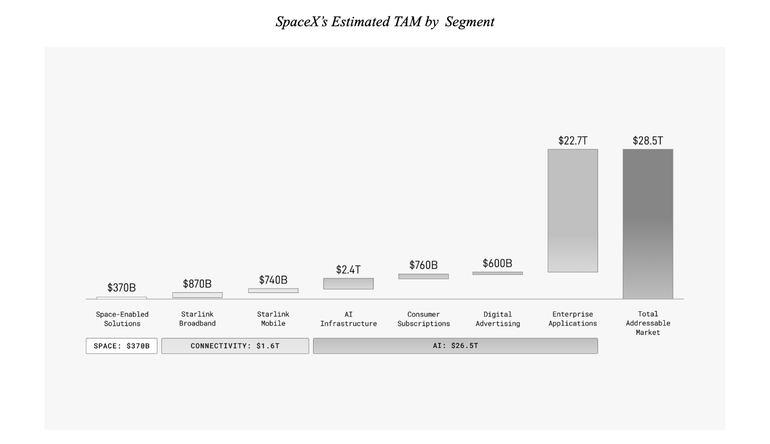
Source: SpaceX prospectus
What do financial advisors think?
Frank Paré, a California-based certified financial planner, noted that Tesla, Musk’s other publicly-traded company, took nearly 20 years to become profitable — but that wasn’t always an issue for investors.
“During that time, the stock was off the charts,” he said.
Douglas Boneparth, a New York-based certified financial planner, weighed the pros against the cons in an email interview.
The main pro: A solid space business. “This is a real business, not a story stock. Starlink generates most of the company’s revenue and the launch business has no serious competitor,” he said.
The cons: A shaky AI business, an unpredictable CEO and the risk of post-IPO doldrums. “You’re paying roughly $1.75 trillion for it, the largest IPO valuation ever, for a company that still loses money. Perfection is priced in. The xAI merger bolted a cash-burning AI bet onto the rocket business, so you’re not buying the simple version of this company. There’s enormous key-man risk concentrated in one famously distractible person. And history is brutal here. Most hot IPOs underperform the market in the years after their debut,” Boneparth said.
A Nasdaq analysis of IPOs between 2010 and 2020 showed that two-thirds were underperforming the market index by their third year of trading[0]. And John Owens, another New York-based certified financial planner, noted in an email interview that some do much worse.
“The IPO process is a very bumpy ride and [clients] need to be prepared to see the price drop below that level – perhaps permanently. We’ll give them examples of prior IPOs that longer-term didn’t do so great – like Figma last year that’s down over 80%,” Owens said.
All three advisors concurred that investors should keep their SpaceX allocation to 5% or less of their overall portfolio to manage risk.
That might be difficult if you’re heavily invested in Nasdaq index funds, and if the stock surges after its IPO. If it hits a market cap of $2.75 trillion, it will make up more than 5% of the Nasdaq 100 index. It already crossed the $2 trillion mark on its first trading day, up from its initial valuation of $1.75 trillion.
So investors with simple portfolios that have a heavy Nasdaq allotment may want to consider direct indexing (if that option is available) or holding a different index fund.
Other ways to invest in the space industry
SpaceX is now the largest publicly-traded space exploration company, but it’s not the only space stock. In fact, there are a variety of well-established companies in the space industry. Below is a list of the top-performing space stocks that have been trading for at least 1 year and have a market cap of at least $1 billion, ranked by 1-year returns.
Source: Finviz. Data is current as of 12:30 p.m. Eastern time on June 12, 2026, and is intended for informational purposes only.
Neither the author nor editor owned positions in the aforementioned investments at the time of publication.