No Result
View All Result
  • Login
Tuesday, June 23, 2026
theadvisertimes.com
  • Home
  • Business
  • Financial Planning
  • Personal Finance
  • Investing
  • Money
  • Economy
  • Markets
  • Stocks
  • Trading
  • Home
  • Business
  • Financial Planning
  • Personal Finance
  • Investing
  • Money
  • Economy
  • Markets
  • Stocks
  • Trading
No Result
View All Result
theadvisertimes.com
No Result
View All Result
Home Startups

AI Doesn’t Fail Because of Models. It Fails Because of Systems.

by theadvisertimes.com
2 months ago
in Startups
Reading Time: 4 mins read
A A
0
AI Doesn’t Fail Because of Models. It Fails Because of Systems.
Share on FacebookShare on TwitterShare on LInkedIn


There is a quiet frustration building inside a lot of companies right now.

They have experimented with AI, built prototypes, and in many cases shipped something that looks impressive in a demo. And yet, when it comes time to rely on it, to put it in front of customers, or to trust it inside real workflows, things start to break.

At the inaugural York IE AIConf in Ahmedabad, Ashish Patel, Senior Principal Architect for AI, ML & Data Science at Oracle, put words to what many teams are experiencing: “Demos are easy. Reliability is hard.”

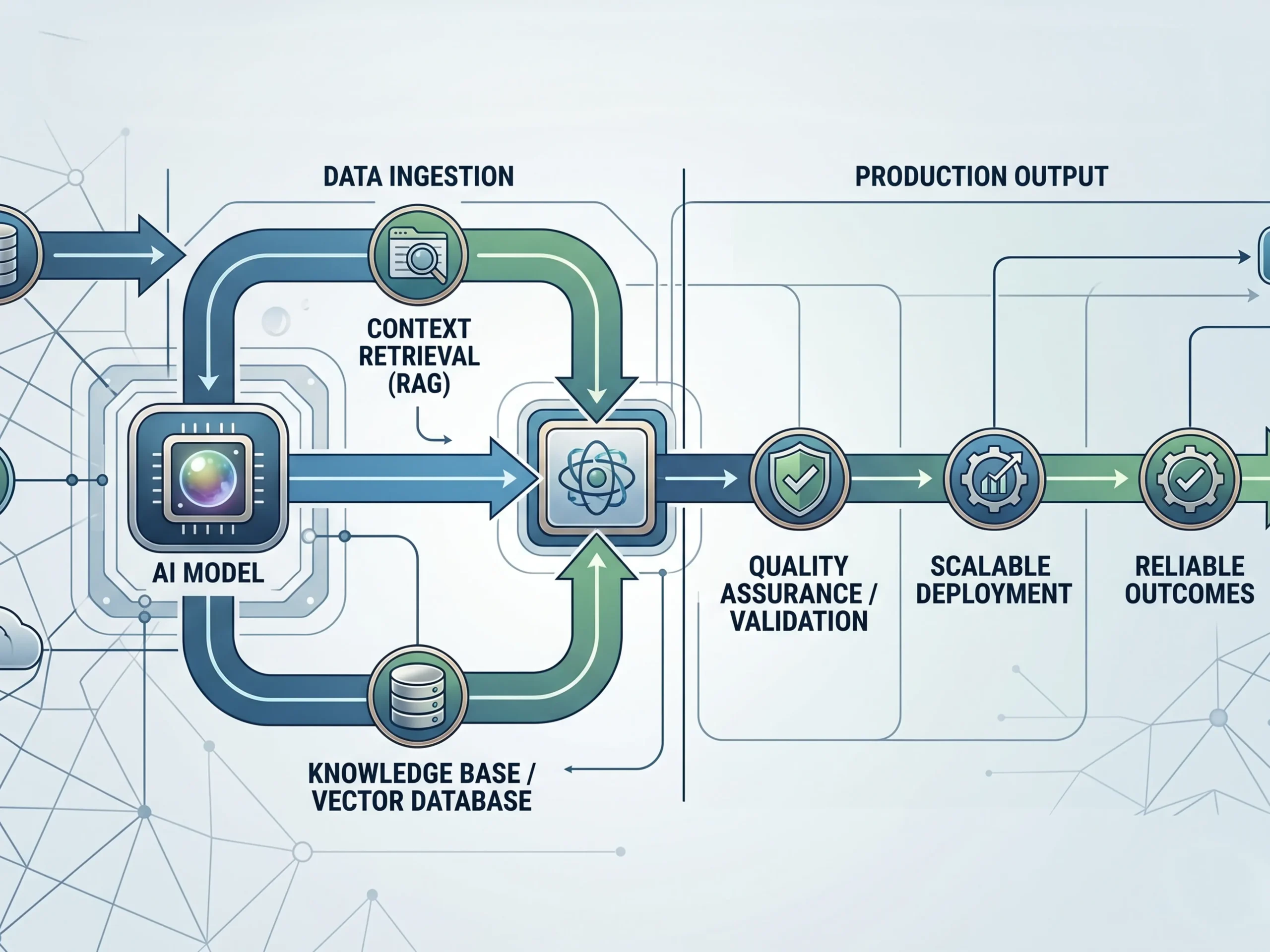
That line captures the gap between experimentation and execution, and it points to a deeper truth. AI does not fail because the models are not good enough. It fails because the systems around them are not.

The 90/10 Trap

Most teams fall into what Ashish described as the 90/10 trap. Ninety percent of the effort goes into building something that works in a controlled environment, while the final ten percent, the part that makes it reliable, scalable, and production ready, is where things begin to unravel.

The issue is not intelligence. It is structured. Static workflows break when they encounter edge cases, and systems often lack memory, error handling, and proper tool integration. What looks like a smart system in a demo quickly reveals itself to be fragile in the real world.

Even more importantly, teams tend to misdiagnose the problem. They assume the model is the bottleneck, when in reality, the bottleneck is the lack of system capabilities around it.

That insight shifts the conversation from model selection to system design. And that is where the real work begins.

Why Better Models Don’t Fix the Problem

If the model is not the bottleneck, then what is? The answer is context.

There is a common belief that better models produce better outcomes. It feels intuitive. Bigger models, more training data, and more intelligence should lead to better answers. But in practice, performance is not driven by intelligence alone. It is driven by how well the system informs that intelligence.

As Ashish explained, a model’s output is only as reliable as the specific, up to date data provided in the prompt. Without context, even the most advanced models fail in simple ways. They do not understand your business, your data, or your constraints, so they fill in the gaps. And they do it convincingly.

This is why so many teams struggle with accuracy. They invest in fine tuning, prompt engineering, and new tools, when the real issue is that the system is not providing grounded, relevant information. Ashish offered a practical rule that cuts through the noise: use RAG first. Ninety percent of agentic failures are context related, not behavior related.

That means your retrieval layer matters more than your model choice. Data quality and accessibility are not backend concerns. They are the foundation of performance.

Hallucination Is a Design Problem

This also reframes one of the most talked about challenges in AI: hallucination.

Most teams treat hallucination like a glitch, something that occasionally happens and needs to be caught after the fact. But that framing misses the point. Garbage in, garbage out. Wrong context leads to wrong output.

Models are designed to be helpful. When they lack information, they fill in the gaps with plausible answers. They are not malfunctioning. They are operating exactly as designed. The failure is in the system that surrounds them.

There are three patterns that show up consistently. First, poor context, where the system cannot retrieve the right information. Second, no validation layer, where outputs are never checked before being used. And third, weak architecture, where there is no redundancy or second opinion built in.

Fixing hallucination is not about writing better prompts. It is about building better systems through stronger retrieval, built in validation, and structures that allow outputs to be tested before they are trusted.

From One Agent to Many

As teams begin to address these challenges, the architecture naturally evolves. Most start with a simple idea: build one powerful AI agent that can handle everything. It is a logical starting point, but it quickly becomes limiting.

As tasks grow more complex, a single agent runs into cognitive overload. It is responsible for too much context, too many decisions, and too many responsibilities at once. As that load increases, accuracy drops and errors become more frequent.

The solution is not to build a smarter single agent. It is to build a system of agents.

In a multi agent architecture, each agent has a defined role. One researches, another analyzes, another executes, and another reviews. Instead of one generalist trying to do everything, you create a team of specialists. This structure introduces something most AI systems lack today: verification.

As Ashish noted, in a multi agent setup, one agent can double check the work of another. One agent produces an output, another critiques it, and a third synthesizes the result. The system becomes more reliable not because any single model is perfect, but because the system is designed to catch mistakes.

This is the shift from isolated intelligence to coordinated intelligence, and from outputs to outcomes.

What Actually Separates Systems That Work

By the end of the session, the distinction became clear. There are two types of AI systems being built today.

The first are experimental. They are impressive in demos but brittle in production, relying on prompts, linear workflows, and best case assumptions. The second are structured. They are designed for real world conditions, incorporating memory, retrieval, validation, orchestration, and resilience.

These systems are built to recover when something breaks, not just to work when everything goes right. That is the difference between building something that looks like AI and building something that actually works.

The Bottom Line

AI is not just a model problem. It is a systems problem.

The teams that win in this next phase will not be the ones chasing the latest model release. They will be the ones investing in architecture, context, retrieval, validation, and coordination. They will move beyond demos and build for reliability.

Because in the end, the goal is not to create something that looks intelligent. It is to create something that can be trusted. And that only happens when the system is designed to support it.

To stay up-to-date on all upcoming York IE events, follow us on LinkedIn.



Source link

Tags: DoesntFAILfailsModelssystems
ShareTweetShare
Previous Post

Can OnEMI Technology IPO offer value for long-term investors?

Next Post

Cloud revenue is now 18% of Alphabet’s business. Is Google’s identity as a search company changing?

Related Posts

We give people a few days and expect them back as themselves, when the science of loss says grief takes no days off at all, and the shame around admitting that is its own quiet cruelty

We give people a few days and expect them back as themselves, when the science of loss says grief takes no days off at all, and the shame around admitting that is its own quiet cruelty

by theadvisertimes.com
June 22, 2026
0

The average bereavement policy in Europe gives employees somewhere between three and five days for the death of an immediate...

Psychology suggests that people who fear AI are often not only afraid of the technology itself — they’re afraid of what it threatens to erase: the status, competence, identity, and sense of usefulness they spent years building.

Psychology suggests that people who fear AI are often not only afraid of the technology itself — they’re afraid of what it threatens to erase: the status, competence, identity, and sense of usefulness they spent years building.

by theadvisertimes.com
June 22, 2026
0

In late 2024, the Pew Research Center surveyed more than 5,000 employed Americans and found that 52 per cent were...

The Weekly Notable Startup Funding Report: 6/22/26 – AlleyWatch

The Weekly Notable Startup Funding Report: 6/22/26 – AlleyWatch

by theadvisertimes.com
June 21, 2026
0

The Weekly Notable Startup Funding Report takes us on a trip across various ecosystems in the US, highlighting some of...

McKinsey’s 2025 global AI survey: 88% of organizations now use AI in at least one function, up from 78% — but most are still stuck in pilot mode, and only a minority can point to any real impact on profit

McKinsey’s 2025 global AI survey: 88% of organizations now use AI in at least one function, up from 78% — but most are still stuck in pilot mode, and only a minority can point to any real impact on profit

by theadvisertimes.com
June 21, 2026
0

Two numbers from McKinsey’s 2025 survey sit awkwardly next to each other. The first is 88 percent, the share of...

The oldest known written customer complaint is a 3,750-year-old clay tablet from ancient Ur, where a furious customer named Nanni accused the merchant Ea-nasir of delivering sub-standard copper — proof that bad reviews are almost as old as writing itself

The oldest known written customer complaint is a 3,750-year-old clay tablet from ancient Ur, where a furious customer named Nanni accused the merchant Ea-nasir of delivering sub-standard copper — proof that bad reviews are almost as old as writing itself

by theadvisertimes.com
June 20, 2026
0

In the British Museum’s Mesopotamian collection sits a palm-sized rectangle of baked clay, catalogued as UET V 81. It is...

I asked ChatGPT why reaching every goal still leaves me flat. The answer wasn’t the one I was expecting.

I asked ChatGPT why reaching every goal still leaves me flat. The answer wasn’t the one I was expecting.

by theadvisertimes.com
June 20, 2026
0

I typed it out plainly: “Based on everything you know about me, why does reaching my goals still leave me...

Next Post
Cloud revenue is now 18% of Alphabet’s business. Is Google’s identity as a search company changing?

Cloud revenue is now 18% of Alphabet's business. Is Google's identity as a search company changing?

Spring Clean Your Customer Data For Consumer Personalization Programs 

Spring Clean Your Customer Data For Consumer Personalization Programs 

  • Trending
  • Comments
  • Latest
Should You Offer a Concession to Get Your Apartment Leased Faster?

Should You Offer a Concession to Get Your Apartment Leased Faster?

June 15, 2026
6 Hotels Where Chase’s Points Boost Yields 2.5x

6 Hotels Where Chase’s Points Boost Yields 2.5x

May 22, 2026
Understanding risk remains a major investor blind spot: TIAA Institute

Understanding risk remains a major investor blind spot: TIAA Institute

June 5, 2026
Anthropic’s confidential S-1 signals summer AI IPO race could heat up fast

Anthropic’s confidential S-1 signals summer AI IPO race could heat up fast

June 2, 2026
Memorial Day 2026: Take Advantage of Food Freebies, Deals

Memorial Day 2026: Take Advantage of Food Freebies, Deals

May 23, 2026
9 Best Cheap Cell Phone Plans That Will Save You Money

9 Best Cheap Cell Phone Plans That Will Save You Money

June 3, 2026
China’s 618 shopping festival growth slows sharply as consumer spending malaise persists

China’s 618 shopping festival growth slows sharply as consumer spending malaise persists

0
School Choice on the Brink: PA Democrats Put State Before Students

School Choice on the Brink: PA Democrats Put State Before Students

0
Mortgage Rates Today, Monday, June 22: A Little Higher

Mortgage Rates Today, Monday, June 22: A Little Higher

0
Ship and Debit Explained: Protecting Your Channel Margins

Ship and Debit Explained: Protecting Your Channel Margins

0
Boring is beautiful: Why advisors are avoiding the bull market’s hype

Boring is beautiful: Why advisors are avoiding the bull market’s hype

0
Despite war Nahariya penthouse fetches NIS 5m

Despite war Nahariya penthouse fetches NIS 5m

0
Canada’s Inflation Problem Is Far From Over

Canada’s Inflation Problem Is Far From Over

June 23, 2026
China’s 618 shopping festival growth slows sharply as consumer spending malaise persists

China’s 618 shopping festival growth slows sharply as consumer spending malaise persists

June 22, 2026
.5M DeFi vault pulled overnight: The wake-up call for traders chasing high yields

$8.5M DeFi vault pulled overnight: The wake-up call for traders chasing high yields

June 22, 2026
Gold steady as investors focus on US-Iran peace talks

Gold steady as investors focus on US-Iran peace talks

June 22, 2026
Ship and Debit Explained: Protecting Your Channel Margins

Ship and Debit Explained: Protecting Your Channel Margins

June 22, 2026
We give people a few days and expect them back as themselves, when the science of loss says grief takes no days off at all, and the shame around admitting that is its own quiet cruelty

We give people a few days and expect them back as themselves, when the science of loss says grief takes no days off at all, and the shame around admitting that is its own quiet cruelty

June 22, 2026
theadvisertimes.com

Get the latest news and follow the coverage of Business & Financial News, Stock Market Updates, Analysis, and more from the trusted sources.

CATEGORIES

  • Business
  • Cryptocurrency
  • Economy
  • Financial Planning
  • Investing
  • Market Analysis
  • Markets
  • Money
  • Personal Finance
  • Startups
  • Stock Market
  • Trading

LATEST UPDATES

  • Canada’s Inflation Problem Is Far From Over
  • China’s 618 shopping festival growth slows sharply as consumer spending malaise persists
  • $8.5M DeFi vault pulled overnight: The wake-up call for traders chasing high yields
  • Our Great Privacy Policy
  • Terms of Use, Legal Notices & Disclosures
  • About Us
  • Contact Us

© Copyright 2024 All Rights Reserved
See articles for original source and related links to external sites.

Welcome Back!

Login to your account below

Forgotten Password?

Retrieve your password

Please enter your username or email address to reset your password.

Log In
No Result
View All Result
  • Home
  • Business
  • Financial Planning
  • Personal Finance
  • Investing
  • Money
  • Economy
  • Markets
  • Stocks
  • Trading

© Copyright 2024 All Rights Reserved
See articles for original source and related links to external sites.