Ever found yourself standing at the kitchen counter, wrestling with an egg that seems determined to leave half its white stuck to the shell? You’re not alone. I’ve been there countless times, especially during those rushed mornings when I just wanted a quick protein-packed breakfast before work.
The frustration is real. You follow what seems like a straightforward process, yet somehow end up with eggs that look like they’ve been through a battle. The shells come off in tiny, stubborn pieces, taking chunks of egg white with them. What should be a simple task turns into a test of patience.
But here’s the thing: professional chefs rarely struggle with this problem. They’ve figured out the science and technique behind perfectly peelable eggs, and after diving deep into their methods (and yes, testing them repeatedly in my own kitchen), I’ve discovered their secrets aren’t as complicated as you might think.
Start with older eggs, not the freshest ones
This might sound counterintuitive, but chefs swear by using eggs that have been sitting in your fridge for at least a week. When I first learned this, it completely changed my approach to grocery shopping. I used to pride myself on buying the freshest eggs possible, thinking newer meant better for everything.
Fresh eggs have a lower pH level, which makes the whites bond more strongly to the inner membrane of the shell. As eggs age, the pH increases, weakening this bond. Professional chefs often let their eggs age for 7 to 10 days before hard-boiling them.
I’ve tested this myself over several weeks, and the difference is remarkable. Those week-old eggs practically slip out of their shells, while the ones I boiled the day after buying them required careful peeling and still came out looking rough around the edges.
The ice bath isn’t optional
For years, I thought plunging eggs into ice water was just about stopping the cooking process. Turns out, it’s the secret weapon for easy peeling that chefs never skip.
The rapid temperature change causes the egg to contract slightly, pulling away from the membrane. You need to be quick about this. The moment your timer goes off, transfer those eggs directly from boiling water into a bowl filled with ice and water. Let them sit for at least 5 minutes, though many chefs recommend 10 to 15 minutes for best results.
I learned this lesson the hard way during a dinner party prep. Running behind schedule, I skipped the ice bath for half my eggs, thinking I could save time. The difference was embarrassing. The ice-bathed eggs peeled beautifully, while the others looked like I’d let a toddler handle them.
Add something to your water
Professional kitchens often add a splash of vinegar or a teaspoon of salt to their boiling water. While this doesn’t directly make peeling easier, it serves an important purpose that chefs value: if an egg cracks during cooking, the vinegar or salt helps the whites coagulate faster, preventing them from leaking out into the water.
Some chefs also swear by adding a teaspoon of baking soda to raise the pH of the water, which can help with peeling. I’ve experimented with both methods, and while the difference is subtle, every little bit helps when you’re aiming for consistently perfect results.
The rolling technique changes everything
Here’s where technique really matters. Most chefs don’t just tap and peel their eggs. They use what’s called the rolling method, and once you master it, you’ll never go back to your old ways.
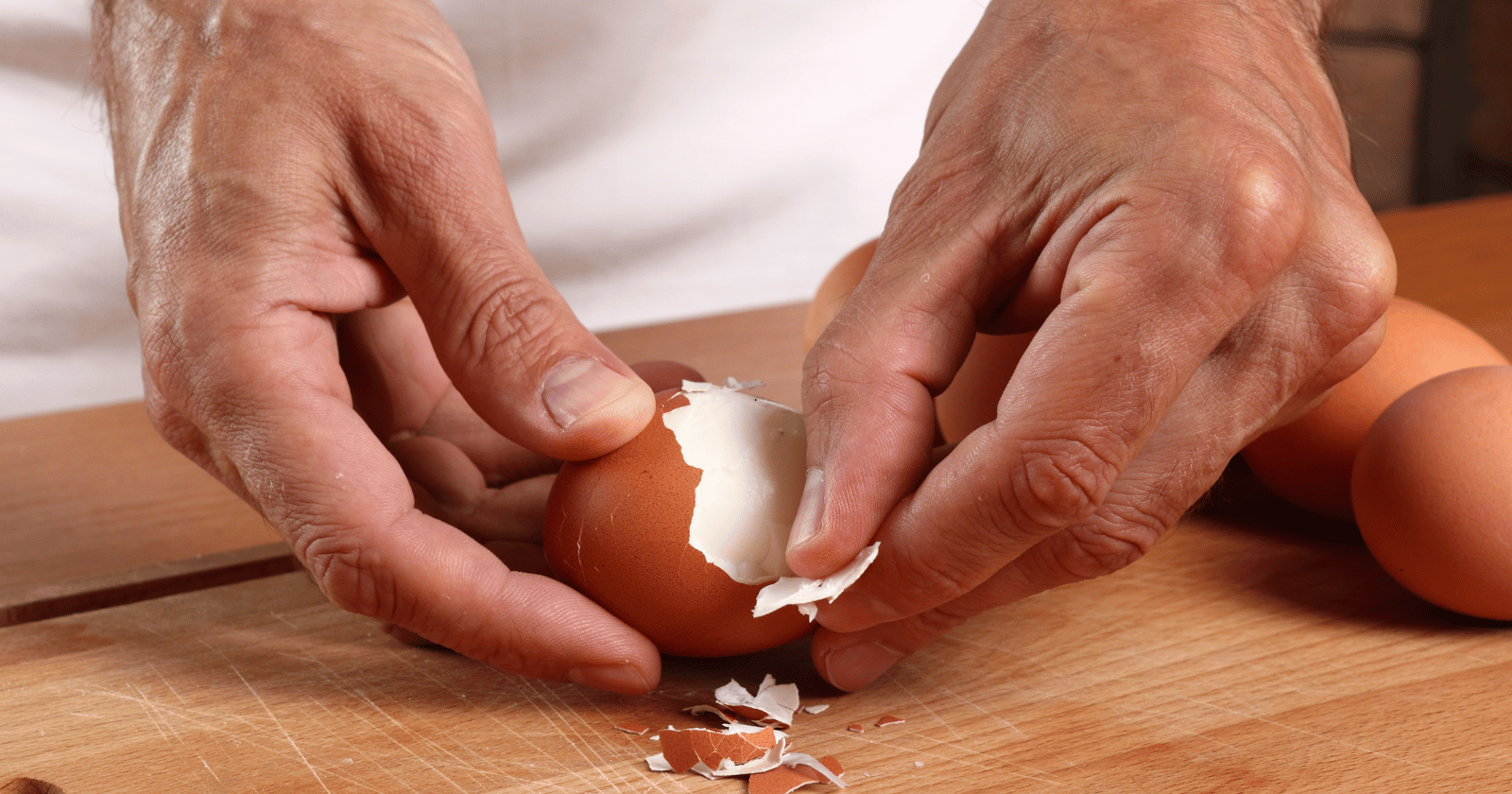
After your eggs have cooled, gently tap one end on a hard surface to create a small crack. Then, lay the egg on its side and apply light pressure while rolling it back and forth. You’ll hear and feel the shell cracking all around. The goal is to create a network of cracks that loosens the entire shell at once.
When done correctly, you can often remove the shell in just a few large pieces rather than picking at dozens of tiny fragments. It’s oddly satisfying, like peeling a sticker that comes off cleanly in one piece.
Start with boiling water, not cold
This was perhaps the most surprising revelation from my chef research. Many home cooks start with cold water and bring it to a boil with the eggs already in the pot. Chefs typically do the opposite: they bring water to a rolling boil first, then carefully lower the eggs in.
The reasoning is twofold. First, starting with boiling water gives you more precise control over cooking time, which is crucial in professional kitchens where consistency matters. Second, the sudden heat shock seems to help with the peeling process, similar to how the ice bath works in reverse.
I’ll admit, I was skeptical about this one. Starting with cold water felt safer, less likely to crack the eggs. But using a slotted spoon to lower room-temperature eggs into boiling water has become my standard method. The shells come off noticeably easier, and I get more consistent doneness every time.
Timing matters more than you think
Chefs are obsessive about timing for good reason. For hard-boiled eggs that peel easily, most professionals stick to 11 to 13 minutes in boiling water, depending on egg size and desired yolk texture.
Overcooking is a common mistake that makes peeling harder. When eggs cook too long, the whites become rubbery and seem to grip the shell more tightly. Plus, you get that unappetizing gray-green ring around the yolk.
I started using my phone timer religiously after ruining a batch of eggs while trying to multitask. Now, when those eggs go in, the timer gets set immediately. No more guessing or getting distracted by emails.
Final thoughts
After testing these chef-approved methods repeatedly, I can honestly say that perfectly peelable eggs are no longer a matter of luck in my kitchen. The combination of using slightly older eggs, starting with boiling water, timing precisely, and never skipping that ice bath has transformed what used to be a frustrating experience.
The rolling technique alone has saved me countless minutes and prevented plenty of morning frustration. It’s these small victories in the kitchen that remind me why understanding the science behind cooking makes such a difference. Like baking, which I picked up during a stressful period for its precision and meditative qualities, mastering eggs has become another small but satisfying part of my routine.