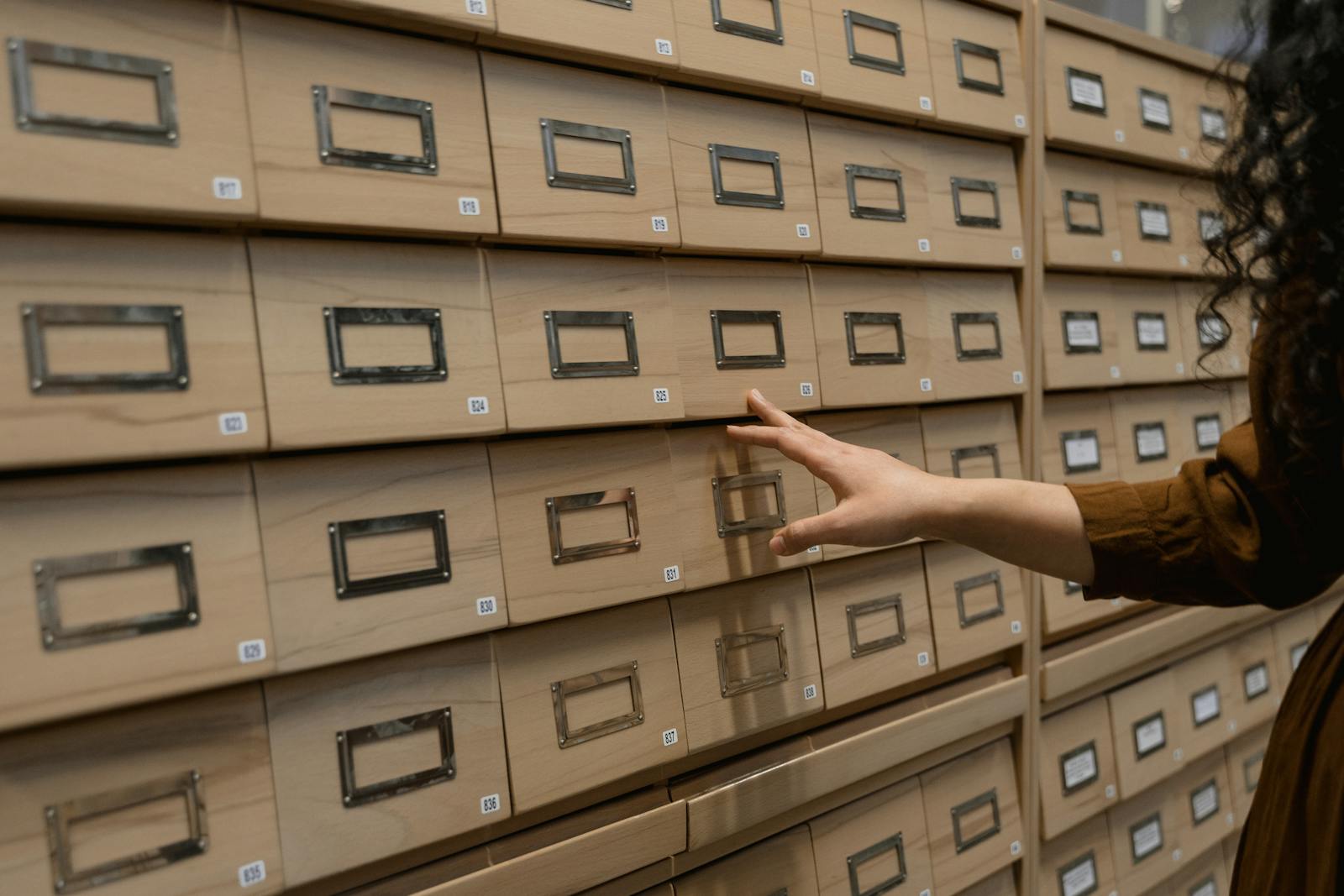
The folder lives in the second drawer of the filing cabinet, or in a plastic accordion file behind the couch, or in a shoebox at the top of the wardrobe. Inside: warranty cards, old leases, paid utility bills, dealership invoices with handwritten annotations only the owner understands. To a visitor, it looks like an unusual hobby. To the person who built it, it looks like the only thing standing between them and a kind of disaster they have already seen happen.
People love to call this behaviour uptight. It isn’t. It’s a memory.
Most adults who keep meticulous paper records didn’t decide one afternoon to become organised. They watched something. Usually they watched a parent get cornered by a piece of paperwork they couldn’t produce, in a moment when producing it would have changed the outcome. A landlord wanting proof of payment. A bank requesting the original loan agreement. An insurance company asking for the date of a repair. The adult in the room scrambling, rifling through a drawer, getting quieter and more humiliated by the second. The child watching, learning that being unable to find a piece of paper can make a grown person look small.
The folder is not anxiety, it is evidence
There’s a tendency in psychology writing to pathologise organisation. Hyper-organised people get labelled anxious, controlling, perfectionist. Sometimes that’s accurate. But honestly, more often than not, the folder isn’t a symptom of disordered thinking, it’s a rational response to a specific lesson learned early, and we keep mistaking the response for the disorder because the response is visible and the lesson isn’t.
If you grew up watching adults get embarrassed by paperwork they couldn’t produce, you didn’t conclude that the world is dangerous. You concluded something more specific: that there are systems that will ask you to prove things, and the people who can prove them stay safe while those who can’t get hurt.
That’s not a phobia. That’s a working model.
Research on how childhood adversity shapes brain and behavior suggests that the unpredictability of a child’s early environment may be just as important as more recognised forms of adversity. The folder, in that frame, is a direct response to early unpredictability. It’s the construction of predictability where none was given.
What the child actually saw
It’s worth being concrete about what these scenes looked like, because the texture of them is what gets stored.
A father standing at the kitchen table, on the phone, saying he knows the bill was paid, he can remember paying it, but he can’t find the cheque stub. A mother going through a kitchen drawer twice, three times, looking for a guarantee that would let her return a faulty heater. A grandparent being told by a clerk that without the original document, there is nothing to be done.
The child doesn’t understand the financial mechanics. What the child understands is the look on the parent’s face.
The drop in the voice. The shift from competent adult to person being talked down to. And the child decides, often without language for it: I will not let that happen to me.
Decades later, the folder exists. Every receipt, every warranty card, every utility bill from a property they no longer live in. Not because it’s likely to be needed. Because being unable to produce it, if it were ever needed, would re-open something the body has not finished processing.
Coping mechanism, or quiet competence
Look, Psychology Today’s discussion of coping mechanisms as habitual responses to stress is useful here, but it needs a small adjustment for this case. The folder isn’t a distraction from stress. It’s an attempt to pre-empt it. There’s a difference between a coping behaviour that lets you avoid a feeling, and one that lets you feel safe enough to function. Drinking a bottle of wine to numb out is the first kind. Filing a receipt is, more often than not, the second. And honestly, I’d argue the folder is the more competent move of the two, even when it tips into ritual, because the people watching Hoarders and clucking at the screen have rarely sat with the alternative, which is the version of yourself that opens an envelope and feels nothing because you’ve trained yourself not to. The folder at least keeps you in the game. It keeps you legible to the systems that will, eventually, ask you to prove something. The test isn’t whether the behaviour looks tidy or excessive from the outside. The test is whether you can still throw out a five-year-old gas bill when prompted, or whether the act of throwing it out feels like flinching.
Why some kids built folders and others didn’t
Not every child who watches a parent get embarrassed by paperwork becomes an obsessive filer. Some become the opposite, refusing to engage with admin at all, treating any envelope from a bank as an object to be ignored. Why the split?
Timing and context, mostly. A Yale study published in Communications Psychology in March 2025, led by Lucinda Sisk with co-senior author Dylan Gee, found that low-to-moderate adversity during middle childhood and adolescence can actually foster resilience to anxiety later in life, particularly when coupled with the brain’s ability to distinguish between threat and safety cues. The developmental stage at which a stressor occurs, Gee noted, significantly affects how it shapes the brain — and separate Yale work on parental stress confirms what most of us already suspect: kids absorb their parents’ overwhelm long before they have language for it.
Translated to our folder-keeper: a child who watched paperwork stress at eight or nine, in a household that was otherwise stable, often built a system. They could see the problem clearly enough to design a solution. A child who watched the same scene at four, in a household where the chaos was constant, more often opted out entirely. There was nothing to organise against. The system itself felt unsafe.
The intergenerational piece
The folder rarely arrives from nowhere. It usually has a lineage. Intergenerational trauma research describes how the effects of past traumatic events can ripple across multiple generations, sometimes through behaviour, sometimes through inherited stress responses, sometimes through the simple modelling of what a competent adult is supposed to look like.
If your grandmother kept every document in a tin under the bed because she had been a refugee, and your mother kept every document in a filing cabinet because her mother had taught her that paperwork was survival, then your accordion file isn’t a quirk. It’s the third generation of a single, transmitted lesson: the people who can produce the document stay safe.
What changes across generations is the threat. The grandmother was filing against displacement. The mother was filing against bureaucratic humiliation. The grandchild is filing against an insurance dispute they may never have. The behaviour persists even after the original danger has receded, which is one of the more honest definitions of trauma I know.
The cost, when there is one
I want to be careful here, because there’s a tendency in this kind of writing to push everyone toward letting go. And look, the Marie Kondo of it all has its appeal, but a binbag full of “doesn’t spark joy” doesn’t help you when the council asks for proof of residence from 2019.
The cost shows up in two places. First, in time. If you’re spending hours a week maintaining records you will never use, the maintenance itself becomes the problem. Second, in relational friction. Partners, children, and flatmates often find the system baffling, and the keeper of the system can become defensive about it in ways that hurt the relationship more than any lost receipt ever would.
The folder-keeper runs toward the source of potential anxiety in order to neutralise it before it arrives, a pattern that mirrors in reverse those who avoid anxiety-producing situations entirely. Both are responses to the same underlying signal. One is just more socially legible than the other.
What it shares with other quiet adaptations
The folder is one of a family of behaviours I’ve come to recognise as childhood-witness adaptations. They look unrelated on the surface but share the same root: a young person watching an adult get caught out, and resolving never to be caught out the same way.
Silicon Canals has covered several of these patterns, including people who can’t stop helping at someone else’s house because being useful was the price of being welcome, and people who say they prefer being alone after learning the version of company available to them cost more energy than solitude. These adaptations look like personality. They are usually evidence.
In my recent piece on people who thrive under pressure by building systems, I argued that what looks like resilience is often just better infrastructure. The folder is small-scale infrastructure. It’s the personal version of the spreadsheet a founder keeps to track every email she sent during a hard fundraise. Same instinct. Same source.
The thing the folder cannot do
What the folder cannot do is process the original scene. It can prevent a recurrence, but it can’t go back and explain to the eight-year-old that what they witnessed wasn’t their fault to fix. The folder is a forward-facing tool, and the wound is rear-facing.
This is why some folder-keepers, even when their system is working flawlessly, still feel a low hum of dread when an unexpected envelope arrives. The system is doing its job. The body hasn’t been told.
The folder is one of the more functional things a child can build out of absorbed adult overwhelm. It’s not the worst outcome. It’s a competent one.
If you are the folder-keeper
You are not being uptight. You built something. The fact that the something is made of paper and labels rather than savings or property doesn’t make it less real. It was the safety you could construct with the tools available to a child who was paying attention.
But here’s the question I’d actually sit with, and I say this as someone who has my own version of the folder: at what point does the eight-year-old get to stop running the household? Because the folder is brilliant, genuinely, and it has probably saved you in ways you’ve never bothered to count. It’s also, if you’re honest, a contract you signed with a kid who didn’t know any better, and you’ve been honouring it ever since.
The danger isn’t the paperwork. The danger is mistaking maintenance for safety, and forgetting that the child who built the system was trying to protect an adult who, decades on, doesn’t actually need the protection in the form it was first imagined. The folder works. That’s not in dispute. What’s in dispute is whether the part of you still filing is the same part of you still watching someone you love look small at a kitchen table, and whether you ever planned to let that part of you grow up, or just get better at organising.
I don’t have a clean answer. I’m not sure there is one. The cabinet’s still in my second drawer.
Feature image by Tima Miroshnichenko on Pexels
About this article
This article is for general information and reflection. It is not medical, mental-health, or professional advice. The patterns described draw on published research and editorial observation, not clinical assessment. If you’re dealing with a serious situation, speak with a qualified professional or local support service. Editorial policy →