
Most people assume the funniest person in the room is the most confident. They read social fluency as emotional fluency, extraversion as openness, and the ability to make a group laugh as proof that someone is doing fine. This is almost exactly backwards. The person who controls a room’s emotional temperature through humor is often the person with the least experience of being asked how they actually feel.
The conventional reading of the class clown, the quick-witted friend, the person who can defuse any tension with a well-timed line, is that they’re naturally gifted communicators. Some version of: they’re just wired that way. What this misses is that humor as a social default is almost always learned, and the classroom where it gets learned is rarely a happy one. The funniest person in the room didn’t start being funny because life was easy. They started because funny kept things from getting worse.
The Mechanics of Redirection
Deflection, in psychological terms, is the act of passing attention away from yourself and toward something else. According to psychological frameworks, deflection involves redirecting attention away from oneself to avoid uncomfortable topics or feelings. In Freudian framing, it’s been linked to regression: reverting to earlier developmental strategies when the present moment feels threatening.
Humor is the most socially rewarded form of deflection available. When someone cracks a joke in the middle of a heavy conversation, the room doesn’t just move on. It thanks them. The laugh itself is a kind of collective permission to avoid whatever was about to surface. And the person who provided that permission gets labeled as fun, easygoing, the one everyone wants around.
But think about what just happened mechanically. Someone sensed emotional pressure building. They intervened before it reached them. The room exhaled. And nobody noticed that the intervention was also an exit.
This is the part most people miss. The humor isn’t covering sadness like a blanket over a stain. It’s redirecting the room’s gaze with such precision that the question of how the comedian is doing never even forms in anyone’s mind. It’s not concealment. It’s prevention.
Why the Car Ride Home Is Different
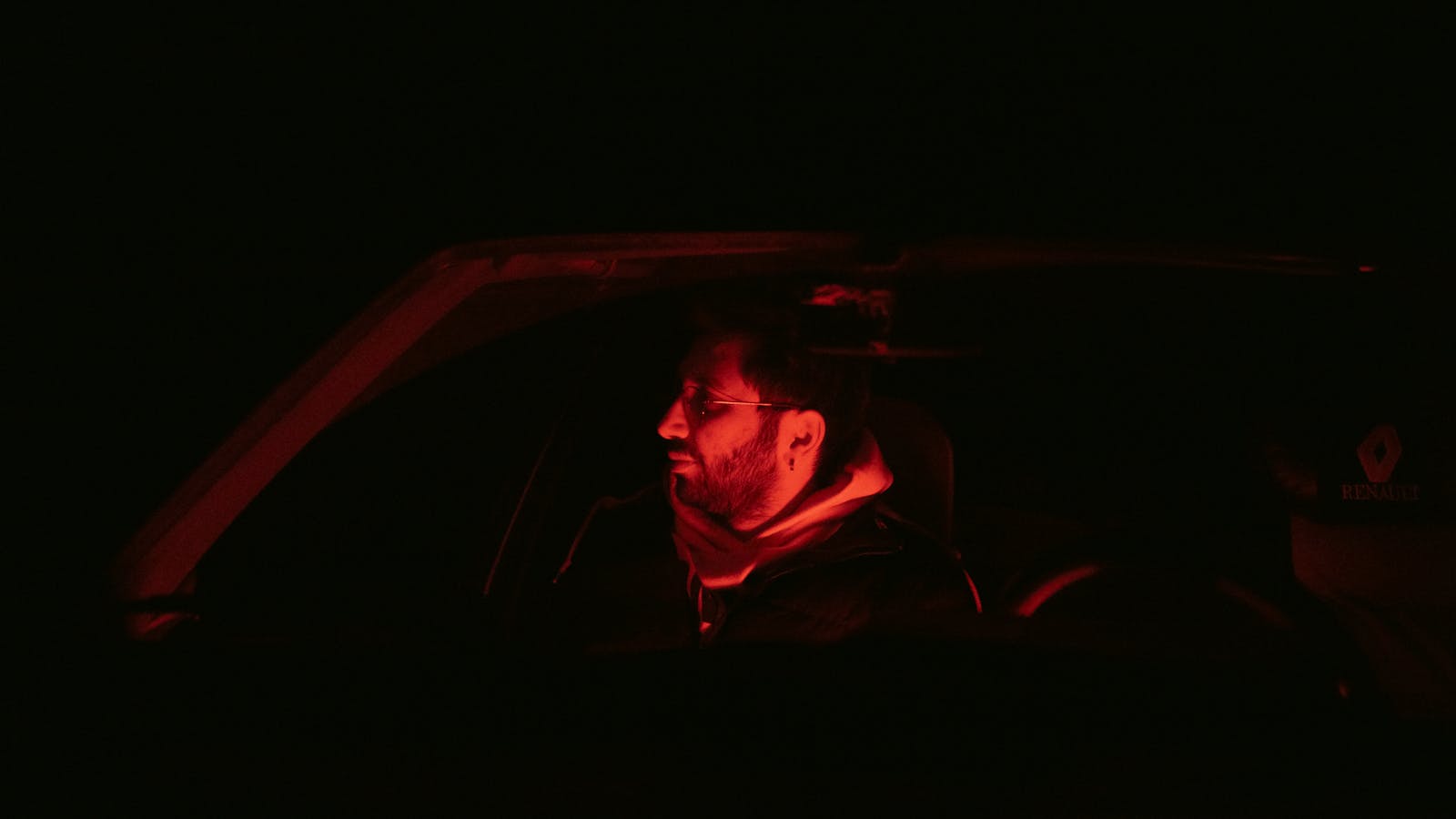
Performance requires an audience. The moment the audience disappears, the performance has no function. This is why the loneliest moment for people who use humor as a social tool isn’t the quiet Tuesday at home. It’s the fifteen-minute drive after the dinner party.
During the dinner, they were the center of the room. Everyone was laughing. Multiple people probably told them they were hilarious. The evening was, by any external measure, a success.
But nobody asked them anything real. Nobody asked them anything substantive about their actual well-being. Nobody inquired about their struggles or challenges. And the comedian didn’t notice during the evening, because during the evening the machinery was running. It’s only in the car, in the quiet, that the accounting happens.
I wrote recently about the kind of exhaustion that comes from performing versions of yourself rather than from any physical effort. The tiredness that settles after a night of being the funniest person in the room is precisely that kind. It’s the weight of translating your inner life into a format that entertains, rather than connects.
And here’s what makes it worse: the better you are at it, the lonelier the car ride gets. Because competence breeds repetition. The more laughs you get, the more locked in the role becomes, and the harder it gets for anyone, including you, to imagine the conversation going any other direction.
Loneliness Doesn’t Require Being Alone
One of the most persistent misunderstandings about loneliness is that it means not having people around. It doesn’t. The U.S. Surgeon General’s 2023 advisory on loneliness drew a sharp distinction between loneliness and isolation. Loneliness is the subjective, distressing feeling that your connections don’t meet your needs. Isolation is the objective lack of contact.
You can be isolated and not lonely. And you can be surrounded by people who love you and still feel profoundly alone.
Dr. Thomas Cudjoe, assistant professor of medicine at Johns Hopkins, emphasized this gap at the 2024 Hayes Symposium at the University of Delaware. At the 2024 Hayes Symposium, a Johns Hopkins researcher described how loneliness can exist even when surrounded by people, as those connections may not meet specific emotional needs.
This is the comedian’s exact position. They are surrounded. They are valued. They are sought after. And they are lonely, because the version of them that people seek out is the performance, not the person.
Lisa Jaremka, associate professor of psychological and brain sciences at the University of Delaware, has been researching loneliness and its health consequences for fifteen years. She defines loneliness as a subjective sense of disconnection that can persist even when surrounded by others. Her research has found that lonelier adults experience higher levels of inflammation when exposed to psychological stressors, suggesting a biological toll that compounds over time.
Jaremka emphasizes that the need for love, care, and connection is fundamental to human well-being. Jaremka compares the human need for connection to other essential needs like breathing and eating.
The problem isn’t that the funny person has no friends. The problem is that their friendships operate on a frequency that skips the channel where emotional needs actually get met.
The Feedback Loop Nobody Talks About
Researchers at Penn State recently found something striking about the relationship between loneliness and cognitive performance in older adults. Jee eun Kang and Martin Sliwinski studied 313 adults aged 70 to 90, tracking their momentary feelings of loneliness and cognitive performance five times per day for fourteen days. They found that loneliness one day predicted decreased cognitive performance the next, and that decreased cognitive performance then predicted increased loneliness hours later.
The research suggests a cyclical relationship between loneliness and cognitive decline, where each condition may reinforce the other.
The finding was about older adults and cognition specifically, but the feedback loop it describes maps onto the comedian’s predicament with uncomfortable accuracy. Loneliness breeds the need for social contact. Social contact performed through humor breeds the conditions for more loneliness. The cycle doesn’t correct itself, because the mechanism that creates the social contact (the humor) is the same mechanism that prevents the contact from being meaningful.
Every successful joke tightens the loop. Every room they light up reinforces the pattern. And research on loneliness as a complex interplay of social impairments and physiological responses suggests that the distress of unmet connection isn’t just psychological. The body registers the gap, too.
What This Pattern Looks Like from the Outside
If you know one of these people, you probably think of them as the low-maintenance friend. The easy one. The one you never worry about because they seem to be doing great.
They text you first, but the texts are funny, not vulnerable. They remember your stories. They know what you’re going through. They check in. They make sure you feel seen.
This pattern isn’t unique to the comedian. There’s a certain kind of friend who checks in on everyone but never tells anyone when they’re struggling, and the comedian is a close cousin. The checking-in friend learned that care flows in one direction. The comedian learned that the safest way to be in a room is to control its emotional weather.
Both learned the same underlying lesson: people don’t ask about you unless you give them a reason to. And both found strategies that, by succeeding, ensured nobody ever would.
The hyper-attentiveness that powers the best comedy, the room-reading, the timing, the knowing exactly what someone needs to hear to relax, often has its roots in scanning rooms for shifts in mood and tone. The skill set that everyone admires was originally built for something much less entertaining.
The Difficulty of Stopping
Jaremka’s research at the University of Delaware found something that challenges a common assumption about loneliness interventions. Social skills training doesn’t work. Research from the University of Delaware challenges the assumption that lonely people lack social skills. The research indicates that lonely individuals are fully capable of effective social interaction.
This is the comedian’s problem in miniature. They don’t lack the ability to connect. They lack the experience of connecting without performing. The skill set is there. The permission isn’t.
I used to think I was someone who loved big conversations about ideas, and I am. But I also had to reckon with the fact that those big conversations were sometimes a way to avoid the smaller ones about how I was actually feeling. Being articulate about abstract concepts is its own form of deflection when it consistently steers the conversation away from anything personal. Being right about something doesn’t matter if you can’t say it in a way people can hear, and being funny about something doesn’t matter if the humor prevents anyone from hearing you.
The difficulty of stopping isn’t about courage. It’s about infrastructure. When you’ve spent twenty or thirty years building a social identity on a particular frequency, changing the frequency feels like risking the entire structure. What if the people who loved the comedian don’t like the person underneath? What if underneath the performance, you’re not that interesting?
These fears aren’t irrational. They’re the reasonable conclusions of someone who has received consistent evidence that they are most valued when they are performing. The room lights up when they’re funny. The room gets awkward when they’re sincere. They’ve run the experiment thousands of times, and the data always points the same direction.
What Actually Helps
If you’re the person reading this and recognizing yourself, the research isn’t especially encouraging about easy fixes. Jaremka noted that interventions for loneliness have not shown consistent effectiveness. Support groups sometimes help. Sometimes they don’t.
What seems to matter, based on both the research and what I’ve observed, is the quality of one or two relationships, not the quantity. The comedian doesn’t need more audiences. They need one person who will sit through the silence when the jokes stop and not fill it with reassurance or advice.
I lost a close friend suddenly a few years ago. The thing that hit me hardest wasn’t the grief itself. It was the realization that I had been treating the relationship as something that would maintain itself. That I could show up when it was convenient, be entertaining when we were together, and assume the connection was solid because it had always been there. I learned the hard way that male friendships take more effort than I gave them in my thirties, and that the effort I’d been avoiding was exactly the kind the comedian avoids: the unsexy, unperformative work of just being present without a bit.
Kang’s research suggests that older adults experiencing loneliness should take early action, such as reaching out to friends or neighbors or engaging in brief social interactions.
The advice is simple. The execution, for someone whose entire social architecture is built on redirection, is not.
But here’s what I think matters: the people around the comedian have agency too. You don’t have to wait for them to change their pattern. You can interrupt it. Not by refusing to laugh. Not by staging some intervention. Just by asking a question they can’t answer with a joke.
Asking something like ‘How are you, really?’ is often too easy to deflect. Better: Questions about specific recent difficulties are harder to deflect, or noting a specific observation and asking about it makes deflection more difficult. Specificity defeats deflection. It’s harder to redirect when someone names something concrete.
As Silicon Canals has explored before, people who always respond with “fine” aren’t lying. They learned that the real answer produced worse outcomes than the shorthand. The comedian learned the same thing, but their shorthand is funnier and more socially rewarded, which makes it even harder to put down.
The funniest person in the room is often doing extraordinary emotional labor that looks, from the outside, like effortless fun. The loneliness isn’t a secret they’re keeping. It’s a question nobody thinks to ask, because the performance is that good. And the better the performance gets, the less anyone suspects there’s something behind it worth asking about.
The car ride home is where the math gets done. The room loved you. The room didn’t know you. Both things are true, and they don’t cancel each other out.
Feature image by Ekaterina Belinskaya on Pexels