
Financial institutions face a structural mismatch that has become impossible to ignore: regulators now expect banks to show their work on every consequential decision, yet the AI tools flooding the market were built for environments where a wrong answer carries no legal consequence. General-purpose large language models lack the domain training, regulatory context, and governance architecture that banking requires, leaving thousands of community, regional, and super-regional banks caught between board-level pressure to adopt AI and examiner-level expectations they cannot meet with off-the-shelf tools. Titan addresses this gap with a banking-native AI platform built from the ground up on the language, workflows, and regulatory logic of financial institutions – not adapted from general-purpose models after the fact. The platform combines Titan Foundry, a secure governed interface that displaces unmanaged shadow AI, with proprietary banking small language models trained in collaboration with former regulators, senior bank operators, and financial lawyers, plus configurable banking agents that automate high-volume compliance, credit, and operations workflows. In independent benchmarking across more than 7,400 banking scenarios, compliance officers preferred Titan’s responses over those of ChatGPT, Gemini, and Claude more than 70 percent of the time – a performance gap the company attributes to its banking context layer, which produces structured, traceable reasoning chains that satisfy examiner standards rather than approximating them.
AlleyWatch sat down with Titan Founder and CEO Arjun Sirrah to learn more about the business, the platform, and the recent $3M seed round that backs the company’s next phase of growth.
Who were your investors and how much did you raise?We raised $3 million in seed financing, led by Entropy Ventures.What makes this particularly meaningful is that it’s Entropy Fund I’s inaugural investment. Jeff Reitman, Entropy’s Founder and GP, is a deep fintech operator and investor, and he chose Titan for his fund’s first investment. Jeff was previously a GP at Canapi Ventures and a founding team member at Nyca Partners.
Tell us about the product or service that Titan offers.Titan is the AI platform for banking, purpose-built for regulated financial institutions – not a general-purpose AI model.The hardest problem in deploying AI at a bank isn’t the model. It’s context: how banking works, how this specific bank’s policies and people relate, delivered in a way that’s governed and explainable to examiners. That’s a big part of what we solve.The platform has three integrated layers: a secure governed interface that replaces unmanaged shadow AI; banking-native models trained from the ground up on the language, workflows, and regulatory logic of financial institutions; and configurable banking agents that automate workflows across many lines of business including compliance, credit, and operations.The banking context layer ties it together. Our ontology produces structured, traceable chains that make every model more effective and more explainable in a regulated environment. In blind benchmarking against ChatGPT, Claude, and Gemini, compliance officers preferred Titan’s responses more than 70 percent of the time. That’s validated performance.
What inspired the start of Titan?Titan came from lived experience inside banking. I was Founding CTO at Laurel Road, a digital bank we built inside a community bank. After selling to KeyBank, I became EVP of Fintech and Digital at Key, operating fintech and banking products within the full weight of a regulated banking environment. Earlier in my career, I had started a machine learning company. Those experiences gave me something most AI founders don’t have: I understood both sides of the problem. I knew what modern technology could do, and I knew exactly where it broke down when it met bank compliance, credit policy, and examiner expectations.What I kept seeing were the same three problems: security, because banks can’t send sensitive data outside their perimeter; explainability, because regulators expect you to show your work and black-box AI fails that test; and domain specificity, because general-purpose models don’t understand how banking actually works.Titan was built to solve all three simultaneously, not as add-ons but as foundational design principles. Banking-native models that are purpose-built from the ground up: secure by design, explainable by construction, and trained on the language, workflows, and regulatory logic of banking specifically. It’s the infrastructure I wish had existed at Laurel Road and at Key.
How is Titan different?We own both ways knowledge enters a model: in the weights through our banking-native models, and at runtime through the banking context layer. Most competitors pick one. We built both.The part I find most durable is the compounding story. Titan’s value strengthens as frontier models improve rather than competing with them. Feed our context layer into Claude or GPT and it gets better at banking. Our position gets stronger as those models advance, not weaker.The whole platform is also fully governable. It runs on bank infrastructure, training data is documented, and updates happen on the bank’s schedule after MRM review, not on a vendor’s release cycle the bank can’t inspect or control.
What market does Titan target and how big is it?American banks, with a focus on community, regional, and super-regional banks, credit unions, and fintechs in regulated environments. Thousands of institutions, hundreds of thousands of knowledge workers across compliance, risk, underwriting, and relationship management.The opportunity has two layers. First, the cost layer: the labor cost of judgment-intensive workflows run manually today, including compliance research, loan docs, exam prep, and BSA investigation. Second, the revenue layer: AI that accelerates loan origination and deepens customer relationships translates directly to net interest margin (NIM).Banking is one of the last major industries where AI hasn’t found footing at scale. The regulatory barrier that slowed everyone else is our moat.
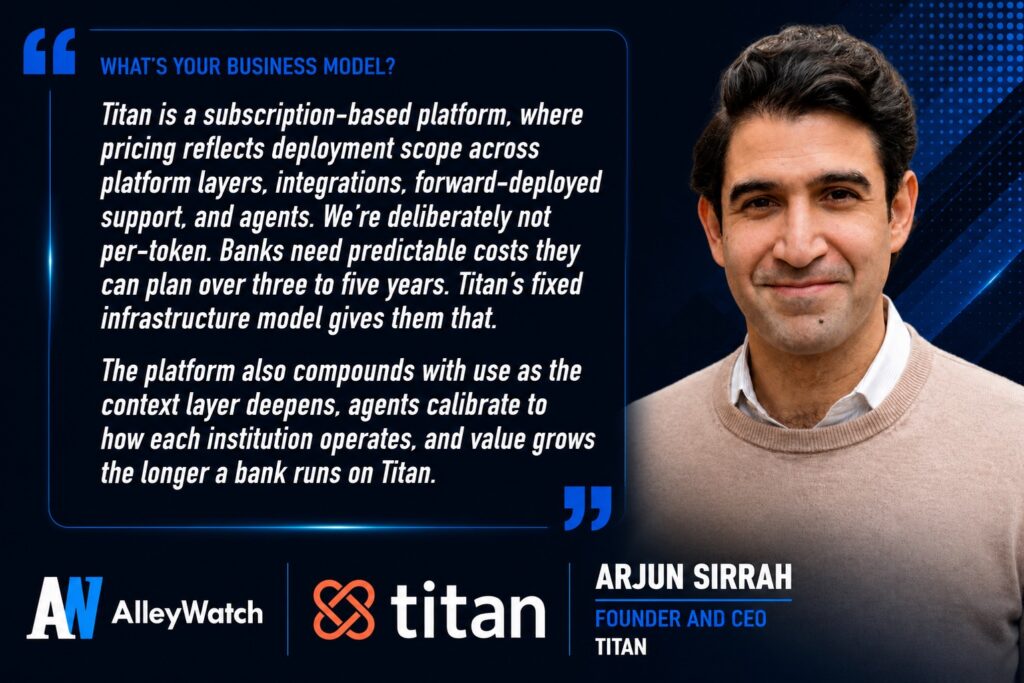
What’s your business model?Titan is a subscription-based platform, where pricing reflects deployment scope across platform layers, integrations, forward-deployed support, and agents.We’re deliberately not per-token. Banks need predictable costs they can plan over three to five years. Titan’s fixed infrastructure model gives them that. The platform also compounds with use as the context layer deepens, agents calibrate to how each institution operates, and value grows the longer a bank runs on Titan.
How are you preparing for a potential economic slowdown?A tighter environment tends to strengthen our position. When margins compress, banks prioritize operational efficiency, which is core to our value prop. Regulatory scrutiny also intensifies in downturns, which makes the governance and auditability case for purpose-built AI stronger, not weaker.
We’ve built capital-efficiently from the start, tripling live ARR without burning recklessly. We focus on ROI-linked use cases, including compliance hours recovered, loan cycle time reduced, and exam prep accelerated, that banks can defend internally regardless of the macro backdrop.
What was the funding process like?Investors with genuine operator experience, or who are close to Vertical AI already understood the problem, so we could get straight to the thesis.With Jeff, it moved quickly for two reasons: we’ve known each other for five years, and the conversation felt like a shared diagnosis rather than a pitch. The qualifier we learned to apply early was straightforward: investors who engage at the level of why banking-native matters, not just what AI is.
What are the biggest challenges that you faced while raising capital?We were not actively raising capital. That said, we do see category definition as a part of the education process. Banking-native AI is a specific thesis, not ‘AI for enterprise,’ not ‘fintech,’ not ‘regtech.’ Moreover, bank technology is an industry built on “point solutions” that solve very specific problems, so to be building a horizontal platform within the vertical of banking represents a real mindset shift for the investor community.
What factors about your business led your investors to write the check?Three things. First, ARR trajectory: seven-figure ARR at stealth exit, tripled shortly after. Banks are conservative buyers. When they deploy and pay, it means something.Second, team depth. Titan was built by bank operators and technologists who have spent over a decade inside large financial institutions. Domain expertise plus AI expertise is rare, and that combination is foundational to what we’re building.Third, strategic durability. Titan’s value compounds with frontier model improvements rather than competing against them. The banking context layer makes any model better at banking, so our position strengthens as frontier models get more capable.
Titan’s value compounds with frontier model improvements rather than competing against them. The banking context layer makes any model better at banking, so our position strengthens as frontier models get more capable.
What are the milestones you plan to achieve in the next six months?Our key milestones for the next six months fall into the following buckets:
Product: expand banking model coverage across regulatory domains; deepen agent library for compliance and credit workflows; continue to build on our platform’s model & context capabilities by deploying the control plane for banking agents.
Team: hire engineers, banking operators, and forward-deployed practitioners who can own client outcomes end-to-end.
Customers: continue to convert institutional interest into live deployments at community, regional, and super-regional banks.
What advice can you offer companies in New York that do not have a fresh injection of capital in the bank?Know what you want from your investors before you start talking to them. Pre-qualify ruthlessly. The clearer you are on the type of partner you need, the faster you can get back to the real work which is operating.Have a genuinely defensible point of view on why your problem is real, your approach is right, and why now is the moment. Not a polished pitch but an actual conviction.
Where do you see the company going now over the near term?Depth before breadth. We want to be genuinely indispensable to the institutions already using Titan before we expand the footprint.The category we’re building toward is the banking context layer, which means owning the hardest problem in banking AI. The problem isn’t the model. It’s context: how banking works, how this specific bank works, delivered in a way that’s governed and explainable.
What’s your favorite summer destination in and around the city?The east end of Long Island.

You are seconds away from signing up for the hottest list in NYC Tech!
Sign up today
























