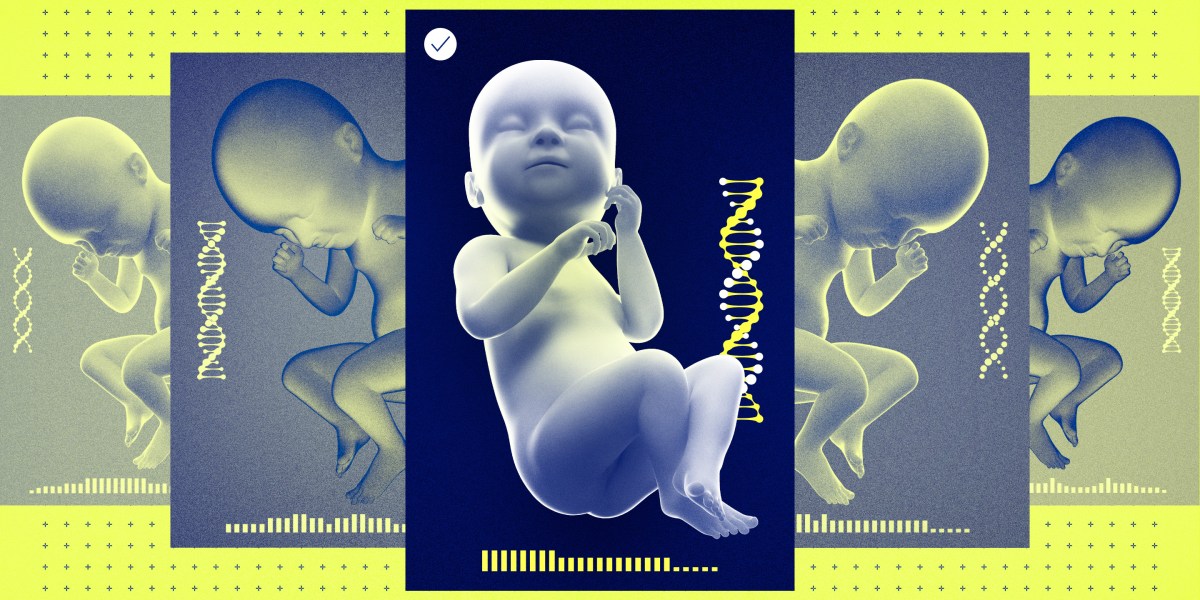
If you could design your ideal baby, what would you choose? A lover of naps who sleeps through the night? A mind for math and an affinity for the viola? For the founders of fertility tech startup Herasight, this is not a hypothetical.
Herasight founder Michael Christensen is 6-foot-6, and even in a world where taller men are perceived as stronger and more competent, it’s a bit much. He wants his future children to be shorter and more comfortable on commercial planes.
“It’s annoying to be super tall,” he said. “Nothing is made for you.”
Chief science officer Tobias Wolfram has already banked frozen embryos with his partner in preparation for their future family. His great-grandparents lived past 100 with no cancer or serious health problems, suggesting a family tendency toward healthy aging. But there’s depression on his side of the family.
“I’d really like to make sure that’s not passed down,” he said. Wolfram has waited five years for Herasight’s technology to reach its current state, so that he can screen embryos for mental health indicators.
Jonathan Anomaly, a communications executive with Herasight, is approaching 50 and planning a family with his partner, 37. His grandmother was a genius, said Anomaly, but she suffered from five different autoimmune disorders that kept her homebound. He plans to screen embryos for autoimmune diseases, and like Christensen, Anomaly said he’ll screen for height. But he wants potential sons to be slightly taller than his 5 feet 9 inches.
This is the new era of family planning emerging across the Bay Area, a place known for its concentration of extreme wealth, high risk tolerance, affinity for new technology, and early-adopter mentality. Rather than having babies the Where Did I Come From? way, prospective parents are blazing an unprecedented approach to family planning. Gone are the wealthy parents who pay women for their eggs because they have desirable traits or who seek out sperm donors based on Ivy League degrees and athletic prowess. This is reproduction reimagined through the lens of algorithms and data science down to the genetic blueprint that makes up a human being.
This new method means opting for IVF from the start even if infertility isn’t an issue to create embryos. From there, prospective parents are investing thousands in different types of next-level embryo screening that can essentially spin up versions of your future children’s health prospects by showing their risk of inherited diseases, childhood cancers, schizophrenia, autism, and Types 1 and 2 diabetes. Other traits like height, body mass index, musical ability, and higher IQ points are also among the offerings at certain firms. And with billionaires backing fertility tech startups and funding new research related to conception and embryo selection, the boundaries between proven science, emerging possibilities, and aspirational hype become increasingly complex to parse.
On the outer edges, scientists and researchers are studying the efficacy of penis transplants, and five have been performed worldwide so far, including one in the U.S. Uterus transplants have led to 29 live births, nearly all by C-section. A team of Chinese scientists successfully conceived mice with two male mice fathers—without DNA from a mother mouse. And more is on the horizon, including AI-enabled and automated IVF processes that could lower costs substantially and artificial womb development. A height and intelligence screening startup backed by Reddit and Seven Seven Six fund founder Alexis Ohanian plastered New York City subway stations with ads this month for Nucleus Genomics, imploring riders to “Have Your Best Baby.”
The global IVF industry remains a nascent $28 billion enterprise, and investment in women’s health and IVF-related tech startups began picking up last year, with 2024 standing out as the largest year for investment at $2 billion, a 55% increase over 2023.
Some of these new add-ons to IVF are driven by people who just “want to know” about their embryos in the way people want to find out the sex of their baby before birth, said Barry Behr, director of Stanford’s IVF lab and a professor of obstetrics and gynecology who is known for his groundbreaking work in improving IVF and advancing the field of embryo selection. Other times, it’s about how to make more money from the IVF process or lower the cost for patients. Regardless of the motivation, for anyone who has had a child or relative who has been sick with a debilitating disease or condition, “you know how that makes you feel,” said Behr, who is an advisor to Orchid Health, which offers embryo screening.
“A parent would do anything—give a kidney, give a limb, or whatever you could give to a child to avert suffering,” said Behr. “So don’t tell me how anyone could even question doing something to your embryo that we do for other reasons routinely.”
Yet the rapid pace of innovation and investment has created a regulatory and ethical vacuum, experts have observed. “Technology will always outpace the law,” said Rich Vaughn, a prominent fertility lawyer who has seen the field evolve during the past two decades. “Technologies develop first; law and regulations make things legally safer for everyone, but they trail behind.”
Moreover, the controversial process of embryo editing—which refers to changing the DNA of an embryo before it is implanted and is illegal in 70 countries or banned through funding restrictions—is being studied and backed financially despite the considerable risk involved. Coinbase cofounder and billionaire Brian Armstrong said he invested in embryo-editing startup Preventive, which has raised $30 million. Armstrong is joined by OpenAI CEO and cofounder Sam Altman’s husband, Oliver Mulherin.
Another startup focused on embryo editing is led by former Thiel Fellow Cathy Tie, who wants to genetically correct mutations in embryos before they are implanted to dramatically minimize the risks of inherited disease. (Investor Peter Thiel offers a two-year, $200,000 fellowship program to entrepreneurs who want to drop out of or take time off from college to focus on developing an idea.)
“I believe that gene correction technology is much more effective in achieving those goals than embryo screening,” said Tie, cofounder of Manhattan Genomics. She plans to begin testing on nonhuman primates early next year before moving to human embryos, pending regulatory approval.
Tie believes many couples, especially those with relatively older women, wind up with too few embryos to choose from after they go through the process of stimulating their follicles and retrieving eggs. “Let’s say I’m a woman in my mid-thirties,” said Tie. “I’m lucky if I’ll get 10 eggs, and from that I’ll maybe get two embryos. Then a company will tell me one embryo is better than the other.” Despite public controversy over embryo editing, which alters genes that would be passed down to new generations and involves irreversible decision-making, Tie said she has received a lot of support from researchers, scientists, and IVF doctors.
Hank Greely, a Stanford law professor who specializes in issues surrounding biomedical technologies and authored The End of Sex, a 2016 book that predicted humans will eventually reproduce mainly through IVF, told Fortune screening for cosmetic traits like hair, eye, and skin color or nose shape isn’t far off.
People in Silicon Valley, where Greely lives,are most interested in influencing their offspring’s intelligence, personality, musical and sports ability, and proficiency in math. Right now those are areas scientists “know almost nothing about,” he said.
But the technology is moving at a swift pace, and some experts think the line between acceptable and not will evolve as well.
“There was a time when it wasn’t appropriate to show your knees, and now you can wear a thong at the beach,” said Behr. “The line moves with time.”
The new line in tech-assisted IVF
Reproductive tech startup CEO Noor Siddiqui has a personal inspiration behind founding polygenic screening firm Orchid Health. Her mother suffers from a rare genetic eye condition called retinitis pigmentosa, which led to progressive vision loss and her mother’s eventual blindness. Siddiqui, also a Thiel Fellow, said she was motivated to pursue embryo screening after watching her mother’s condition progress. Siddiqui also plans to have four children, and has screened her own embryos using Orchid’s technology.
The firm occupies the middle ground of the IVF tech market—pushing the boundaries of science, but mainly to prevent disease.
For years now, prospective parents who use IVF to have babies have been able to opt for preimplantation genetic testing to make sure the embryo has the correct number of chromosomes. In addition to chromosomal abnormalities like trisomy 21—an extra copy of chromosome 21 that causes Down syndrome—tests also scan for life-altering diseases stemming from single-gene mutations like sickle cell anemia or cystic fibrosis.
Orchid offers “polygenic risk” scoring for their embryos. The startup counts Day One Ventures and Prometheus Fund among its backers, as well as angel investors including Figma CEO Dylan Field and 23andMe cofounder Anne Wojcicki. Eventbrite cofounders Julia and Kevin Hartz have also invested in Orchid, and the couple screened their embryos for inherited diseases including Alzheimer’s before having twins they dubbed “Cohort 2” after their first two daughters were in their teens. Published reports have anonymously quoted sources claiming that Shivon Zilis, who has children with the world’s wealthiest man, Elon Musk, has used Orchid’s services.
Orchid’s approach involves whole genome sequencing, and expands on traditional screening by sequencing nearly all of an embryo’s genome. Siddiqui said Orchid scans for more than 1,000 genetic diseases as one option for clients, while another option scans for 3,000 single-gene diseases, covering inherited and spontaneous changes in the embryo. Traditional tests scan for chromosome numbers and single-gene disease. She often compares it to publishing a book that a writer would want to be fully accurate.
“If your proofreader didn’t actually read your book to check for spelling errors, missing words, missing punctuation, would you be satisfied if they just told you all the chapters were present?” she said. Siddiqui said parents are also interested in the genetics of autism, and Orchid screens can detect genetic mutations in specific genes known to cause autism spectrum disorder, although it cannot predict all autism risk. Experts have warned that there is no reliable test for autism, although recentstudies have found a genetic cause in 25% to 50% of cases.
“We want the maximum amount of information to be provided to parents to mitigate the maximum amount of risk when it comes to genetics,” said Siddiqui.
Herasight, the startup with the three founders who each are hoping to screen for traits in their next generation, recently emerged from stealth mode after several years and conducts polygenic screening with a different technical approach that allows it to work with any IVF clinic. It screens the data for potential childhood and adult diseases and health problems, and in some cases height, IQ, longevity, and mental health conditions like depression.
The firm offers a free IVF calculator so prospective parents can get an idea of their chances at conception, from retrieving eggs through birth, based on more than 100,000 IVF treatment cycles recorded in the U.K. national registry. Herasight’s published studies show it can reduce disease risks by 20% to 44% when selecting among five embryos. The validation results come from the firm’s own research rather than independent studies, but Herasight has published its methods and data for others to review. The company’s research has shown what they call “positive pleiotropy,” which means when selecting against one disease, parents often reduce risks for related conditions, too.
“Everyone has a unique family history, so we don’t have one type of customer,” Christensen told Fortune. Sometimes a prospective parent will come to the firm, excited about screening embryos for IQ, and then they’ll discover a BRCA gene mutation, which can increase the risk of breast and ovarian cancers. Then that becomes the top priority in screening embryos, said Christensen. Anomaly said every embryo-screening choice represents a tradeoff. “Creating the perfect baby—that doesn’t exist,” he added.
Kyle Farh, a scientist with DNA sequencing and genetic analysis company Illumina’s artificial intelligence lab, said a huge gap in data interpretation remains at the moment because AI models simply need more information. About 1 million people globally have sequenced their genomes, and realistically about 1 billion people need to sequence their genomes for models to function more meaningfully.
“It’s a chicken and egg problem,” said Farh. “We can predict [traits], and we can show that there’s some significant correlation between our predictions and what happens in real life, but the correlation is still very poor.”
But for parents looking to prevent a major life-altering disease, the technology has been transformative. Software engineer and consultant Roshan George and art director Julie Kang, who live in San Francisco, hired Orchid to screen their embryos after the couple discovered they shared a genetic mutation that could cause profound deafness in their children. One day after having their newborn daughter, Astra, it took about two minutes to find out if the thousands they invested in embryo screening had helped them toward the outcome they wanted for their child. A tech gave Astra a hearing test in their sunny Sutter Health hospital room, the culmination of months of genetic analysis and embryo risk scores.
“I mean, we spent all this money, we did this whole thing and got through all this,” said George. The test showed Astra’s hearing was normal, and the new parents were relieved and are planning for another child soon; they still have screened embryos, George said.
Cases of preventing disease are growing, which is giving these startups a boost. And in addition to screening for certain health risks, founders are hopeful that the impact on pregnancy loss for couples and families who go through IVF will be substantial. Certainresearch shows chromosomal abnormalities are responsible for about 50% of first-trimester miscarriages, and the hope is that screening allows people to prioritize embryos most likely to result in successful pregnancies.
But the use cases that scientists and ethicists fret about aren’t quite here—yet. “Even the most optimistic folks—and I think scientists and most geneticists are way too optimistic—think they can account for, oh, three or four IQ points,” said End of Sex author Greely. “Plus, we know plenty of ways to improve IQ test results with things like good childhood nutrition, childhood vaccinations so kids don’t get sick, and parents who read to their kids.” Brains are incredibly complicated, he said, and may ultimately prove too complicated to screen for intelligence and qualities like extroversion.
“It makes great headlines, it makes great clickbait, it makes great dystopian science fiction,” said Greely. “But the designer baby idea? At least when you’re talking about behavioral traits, it’s not very plausible—at least for decades.”
But given the intensity and expectations of the tech-oriented set interested in this brave new world, NYU bioethicist Arthur Caplan notes there’s a danger that some parents might view their children as products and potentially even “commercial failures.” He questions how positive this will be for kids. “When you start saying, ‘I tested you, and I have a certain outcome that I expect,’ you’re taking away the kids’ future,” said Caplan. “You’re making them less free because you have expectations, and they better turn out that way.”
Victoria Fritz and her husband, who used Herasight to screen embryos to try to prevent passing along her Type 1 diabetes, hope to do an embryo transfer in January, and are realistic about the prospect.
“I feel like, regardless of what embryo we choose, we will hopefully have a happy, healthy child and be a happy family regardless,” said Fritz. The screening provides peace of mind, she noted, but “it doesn’t guarantee that your child is going to have a perfect, healthy life.”


-1024x683.jpg "The Human Trafficking Crisis Continues in America")