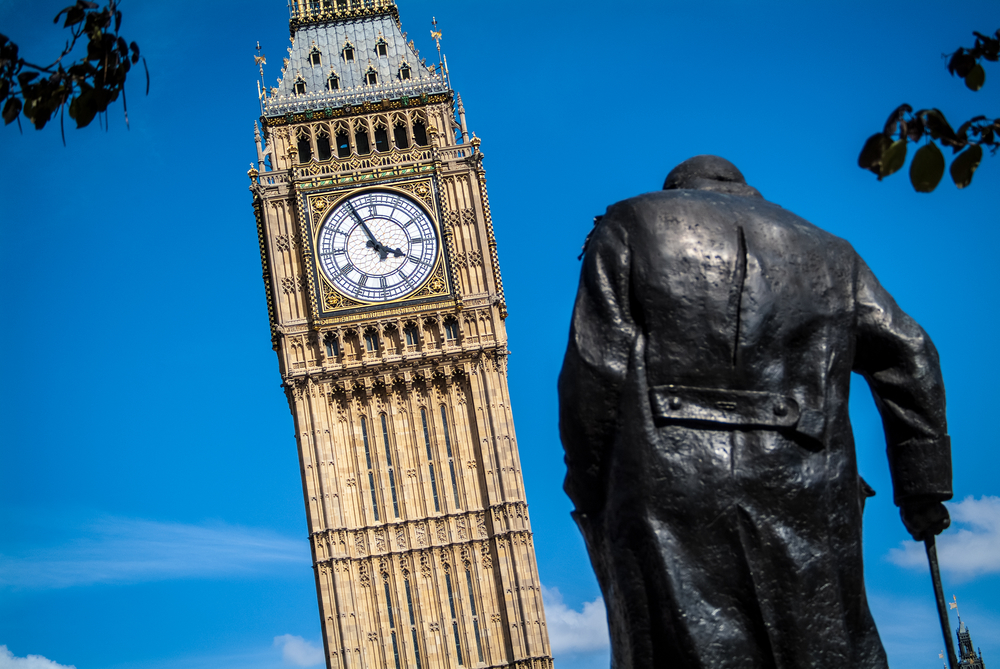
When Winston Churchill was named Chancellor in November 1924, he is said to have assumed it was the largely ceremonial post of Chancellor of the Duchy of Lancaster and was as surprised as anyone, given his lack of interest in economics, to find that it was Chancellor of the Exchequer, constitutionally the second most powerful office in the British government. “I was surprised”, he wrote, “and the Conservative Party dumbfounded”.
The controversy that would follow Churchill’s tenure has implications for policy debates today. It all has to do with macroeconomics and exchange rates: how they affect trade and development, whether they should be fixed or floating, and the problems these questions create for policymakers. In the short term, the decisions Churchill made led to the General Strike of 1926, and these debates continue to echo in the longer term.
Churchill inherited a difficult problem: returning Britain to the gold standard at the pre-World War I parity. In 1914, sterling was exchangeable into gold at the rate of £4.25 per ounce, which implied an exchange rate with the dollar of £1 for $4.87. On the outbreak of war, convertibility was suspended to prevent losses of gold and Britain, like other combatants—indeed, to a much lesser extent—issued currency to finance the war. Between 1914 and 1918, total metallic reserves as a share of bank notes plus deposits (currency) fell from 40% to 33%.
In 1918, the Cunliffe Committee recommended a return to convertibility, but the mismatch of currency and reserves threatened a run as holders of sterling swapped them for gold, draining reserves. Britain’s postwar governments sought to build up reserves by running balance of payments surpluses and keeping monetary policy tight with high interest rates, which would also reduce circulating currency. This raised sterling from a low of £1 for $3.38 in February 1920 to £1 for $4.78 in March 1925.
Churchill had doubts about returning to gold at the pre-War parity, but he also doubted his ability to match economic wits with Montagu Norman, Governor of the Bank of England, and a forceful advocate of the policy to protect London’s position as the center of the financial world. “If [economists] were soldiers or generals I would understand what they were talking about,” Churchill grumbled. “As it is, they all talk Persian”.
He hoped that John Maynard Keynes—a public intellectual since publishing The Economic Consequences of the Peace in 1919—would do it for him. In 1925, Keynes published a pamphlet titled The Economic Consequences of Mr. Churchill, which argued that Britain’s relatively high unemployment rate “is a question of relative price here and abroad. The prices of our exports in the international market are too high.” The problem, Keynes wrote, was that “the value of sterling money abroad has been raised by 10 per cent, whilst its purchasing power over British labour is unchanged.” An American purchasing a product priced at £1 would have had to hand over $4.33 for it previously, but $4.78 now. More likely, he argued, was that “we have to accept 10 per cent less in our money” ($4.33 or 90 pence), which squeezed profits into losses and accounted for the economic depression.
“About this there is no difference of opinion,” Keynes wrote, and he was right. All believed that the problem was excessive wages in exporting industries such as coal. The difference was that Norman and others proposed nominal wage cuts and a lower domestic price level—an internal devaluation—to restore profitability.
Keynes believed an internal devaluation was impossible. It would require “a struggle with each separate group in turn,” he wrote. “Those who are attacked first,” he continued, “are faced with a depression of their standard of life, because the cost of living will not fall until all the others have been successfully attacked too; and, therefore, they are justified in defending themselves…it must be war, until those who are economically weakest are beaten to the ground.” Keynes’ remedy was external devaluation, lowering one price, that of sterling, or the exchange rate, “to raise prices in the outside world,” so it would fall back to £1 for $4.33.
Norman, who described Keynes as “always absolutely charming, always absolutely wrong,” got his way. In April 1925, in a defensive speech, Churchill announced Britain’s return to the gold standard at the pre-war parity.
But in this case, Keynes was right. As their prices rose in foreign currency terms, Britain’s coal exports plunged, profits turned to losses, mine owners demanded wage cuts, and unions resisted. The miners, Keynes wrote, “are to make this sacrifice to meet circumstances for which they are in no way responsible and over which they have no control.” The government punted the question into the following year by establishing a commission and enacting a temporary subsidy, but when a government-appointed court of inquiry into coal disputes reported in July 1925, one member, Sir Josiah Stamp, explicitly blamed “the return to gold” for the unrest. When the commission reported in March 1926 and recommended wage cuts, the General Strike followed in May, the greatest industrial unrest in British history.
The arguments from the debate around the return to the gold standard under Churchill would resurface. Milton Friedman advocated for floating exchange rates for reasons similar to Keynes’s, reasons that were also at the core of Margaret Thatcher’s opposition to Britain’s membership of the European single currency. As the eurozone’s peripheral members struggled through the debt crisis of 2010 to 2013, the arguments of the unlikely pairing of Keynes and Friedman echoed again. When faced with imbalances, it was better, where possible, to adjust the external price (the exchange rate) rather than all internal prices (the price level).
The exchange rate is just the price of one currency stated in terms of another, and fixing this price works no better than fixing any other.
Churchill’s private secretary, Sir James Grigg, wrote in his memoirs that “Winston has almost come to believe it, that the decision to go back to gold was the greatest mistake of his life.” As great a man as he was, there was stiff competition for that title, but he may have been right all the same.