Today’s Iran war post is a bit thin because news flow is down. I will make an update when I return, probably by 8:30 AM EDT. More intense kinetic action and the rising risk of shortages is now the new normal. I doubt this will last long, since Netanyahu is traveling to Washington DC and staying through Tuesday.
We cited one of Robert McNamara’s lessons of war, which translates roughly as “Rationality goes out the window.” Nevertheless, one assumes that even the more and more unhinged Trump had something dimly resembling thinking behind his decision to escalate. It’s likely a combination of bad information and wishful thinking.
As we pointed out, ex nukes, the US cannot keep up a high level of air strikes for more than a few weeks. The US in theory could hold off the oil cliff for quite a while if Trump and Hegseth green lit emergency use, where the US could go down to 150 million barrels, versus its July 10 level of 316.5 million barrels. So Trump may not feel much constrained. He can punish Iran until he runs out of ammo, telling himself he is not at risk of an oil-cliff-induced market rebellion, and decide what to do next if that fails. After all, Trump is all tactics, no strategy.
Admittedly, Trump keeps threatening to blow up Iranian energy faciities and bridges.1 I may seem Pollyanish, but the Gulf State before have forced a TACO. The Saudis and Kuwaitis quickly put the kibosh on Trump’s barmy Strait of Hormuz escort plan, Project Freedumb. Trump’s super fast reversal of his 20% Strait of Hormuz toll plan was probably due to their and big shipping company protests. So I think they will quickly force a climbdown if the US hits what Iran regards as important infrastructure and Iran starts striking petrostate energy assets.
Nevertheless, Trump’s power is falling, at least if he is paying attention. The fact that both houses took the very unusual step of not advancing the Pentagon-funding NDAA is significant, as we described long form in a new post. Trump may eventually turn this around but one assumes at some cost.
Note that the latest SPR draw was modest by recent standards, only 3 million barrels, and diesel inventories actually rose, so that crunch had been pushed back a bit:
EIA weekly petroleum status: US crude inventories fell by 1.7 million barrels, while a further 3 million barrels were released from the Strategic Petroleum Reserve (SPR), taking the cumulative post-war drawdown to almost 100 million barrels. Gasoline stocks declined by 1.5… https://t.co/TLRZLnzlOy pic.twitter.com/PgxecFYQw9
— Ole S Hansen (@Ole_S_Hansen) July 15, 2026
The full body:
EIA weekly petroleum status: US crude inventories fell by 1.7 million barrels, while a further 3 million barrels were released from the Strategic Petroleum Reserve (SPR), taking the cumulative post-war drawdown to almost 100 million barrels. Gasoline stocks declined by 1.5 million barrels, with Gulf Coast inventories falling to their lowest level since 2017, highlighting continued regional tightness during the peak summer driving season. Distillate inventories, however, rose by 4.6 million barrels, providing some welcome relief to the segment of the refined products market that has experienced the greatest supply stress in recent months.Elsewhere, inventories at the Cushing delivery hub climbed back above 20 million barrels. US crude exports increased to 3.7 million bpd but remained below the one-year average of 4.2 million bpd and well below the record 6.4 million bpd reached in May.Domestic crude production was unchanged, while four-week average implied demand for both gasoline and distillates eased, broadly in line with normal seasonal trends.
Not a good look:
Over the last 3 weeks, EIA overestimated US commercial crude inventories by 13.461 million bbls. You can see this in the spike in modified adjustment, which usually reverses lower later on. pic.twitter.com/HFdTonCGao
— HFI Research (@HFI_Research) July 15, 2026
Not only is the bull case still strong, but Rory Johnson remarked in passing in a long new interview with Jeff Currie that all the oil traders’s models were extremely bullish, as in they called for high prices, but they had been burned too much of late to place that bet now. More along those lines:
Oil is going to $200+ in the coming months if Hormuz stays shut:
Including record crack spreads, end users are already paying $140+ per barrel. Crack spreads are only at record highs because:
1) Global crude SPRs are still offsetting lost crude supply while product inventories… https://t.co/iJ9VdrjXNB
— AllThingsVentured (@AllVentured) July 15, 2026
The money paragraph from the body:
This paints a very convex picture for crude prices: Ongoing crude deficits will push up crude prices. Higher crude prices will reflexively capture a larger share of the final product price (currently ~$140 per barrel). Very little final demand destruction is happening at $140. If $250+ is needed to balance a market that is still missing close to 10mmb/d from the gulf, crude is likely to capture at least ~$220 of that. That is a big jump from $80.
And the diesel day of reckoning is still set to arrive even sooner, even with some apparent relief now. The US does not produce enough heavy sour crude. Even if it stop exporting oil, it can’t readily solve that problem. And with Russia, the world’s second largest diesel exporter, having just halted exports, buying from the global market is a less viable alternative. We earlier cited Steven Newbury, The Naphtha Heart Attack: Why $120 WTI is a Ghost Signal Preceding a Negative-Price Inversion, in full. It seemed apocalyptic but that does not make it wrong if we continue on current trajectories.2
Lloyd’s List saw fit to make the state of diesel its lead story, in Russian ban and Hormuz setback deliver one-two punch to seaborne diesel:
Russian diesel exports are already down over by 683,000 bpd vs last year’s levels and are expected to fall further over the next two weeks
Middle East Gulf diesel exports are down by more than 520,000 bpd versus last year’s levels; that deficit should increase due to renewed Hormuz hostilities
US Gulf is the main producer to fill the gap, but refineries there are already running at full bore, at 96% utilisation
More detail:
A 25 percent decline sounds about right. https://t.co/V29bvVoYtK
— Policy Tensor (@policytensor) July 15, 2026
Alexander Mercouris contends that Russia is still producing more than enough diesel for domestic needs, so the Ukraine attacks won’t hurt the domestic economy. But bystanders, beware.
Now Iran fully intends to bring the pressure point forward if the US provides justification with hitting more civilian infrastructure, particularly energy production and distribution. It has threatened both export from the UAE via Fujairah and the Saudis by having the Houthis again target traffic in the Bab el-Mandeb strait. The Saudis seem to have woken up to the idea that that is an outcome to be avoided. They bizarrely got very aggressive with Ansar Allah after it tested an air blockade by sending a plane in and out of Saana. When Iran tried a re-run, the Saudis blew up the runway and took other measures to try to prevent a landing. Larry Johnson described their retreat today:
The proximate cause is aviation, not ground war. About ten days ago a Mahan Air flight landed in Sanaa — the first Iran–Sanaa flights in over a decade — and picked up a Houthi delegation traveling to the funeral of former Supreme Leader Ali Khamenei. Saudi Arabia blocked subsequent flights, fearing they’d be used to move weapons or Iranian military advisers to the Houthis. (Note the airport itself has been largely destroyed and out of action since Israeli strikes in May.)
Following the Saudi Attack on Sanaa, the Houthis retaliated by firing ballistic missiles and drones at Abha International Airport in Saudi Arabia’s southwestern Asir region — a mountainous area near the Yemeni border and a domestic summer destination. Saree claimed the strike. The Saudi-led coalition spokesman said air defenses “dealt with a threat from ballistic missiles” launched toward the southern region. No casualties reported.
This exchange marked the first Saudi Arabian attacks on the Houthis since the informal truce took effect in March 2022. I thought that the Saudis would retaliate on Tuesday or Wednesday for the Houthi strike on Monday … Thankfully, I was wrong
Johnson does understate the importance of the Yanbu port as an export route for the Saudis now. It handled roughly 1 million barrels a day before the war, and that has increased to over 4 million barrels a day (the pipeline can handle 7 million barrels a day but the terminal limits are about 4.5 million barrels a day). That is a significant proportion of Saudi pre-war exports of approximately 7 million barrels a day.
We’ll start with some high-level updates. The normally investor-cheering Bloomberg is again in a sober mood:

From the featured story, Iran-US Skirmishes Worsen as Hormuz Shipping Traffic Dwindles:
The US struck Iran for a fifth straight day overnight and hit a sanctioned oil tanker near the country’s main export terminal, as tensions between the warring sides show little sign of abating.
Iran responded to the US’s barrage on military targets such as command centers and missile sites by firing upon American bases in Kuwait and Jordan. The Jordanian government said it intercepted eight missiles…
The US is increasingly frustrated with Iran’s willingness and ability to attack vessels in the Strait of Hormuz..
Early Thursday, the US said it had struck a supertanker near Iran’s Kharg Island export terminal, its first attack on a vessel since the blockade restarted. The strike, was deep within the Persian Gulf and far from the Hormuz strait, suggesting the US is widening the scope of the naval operation.
The US military said the Curacao-flagged “unladen” tanker ignored multiple warnings as it moved to an Iranian port.
The blockade, which threaten to further weaken Iran’s strained economy, was first imposed in April and then lifted with the signing of the MOU.
The American military added it had assisted more than 10 ships going through the strait overnight. Still, the number of transits has fallen sharply in the past week. The seven-day average of oil flows has dropped to 3.9 million barrels from 4.6 million, according to RBC Capital Markets LLC.
And from IEA Boss Warns Global Economy in Peril If Hormuz Crisis Persists:
The global economy faces a renewed challenge if the conflict that’s choked the Strait of Hormuz isn’t resolved in a matter of weeks, said International Energy Agency Executive Director Fatih Birol…
Visible traffic through the strait has thinned markedly over the last week as vessels were attacked and the US reimposed its blockade of Iranian shipping. Saudi Arabian oil loadings from inside the Persian Gulf have slumped in the wake of strikes on supertankers, while the International Maritime Organization has said the waterway remains too dangerous for commercial vessels to transit.
HFI Research is on the same page:
Strait of Hormuz over the last 24 hours: Escalation continues.
The US and Iran continue to bomb each other, but no tankers have been attacked, at least not any that have been publicly reported.
Mainstream media in the past 48 hours really started to pick up on the notion that… pic.twitter.com/eOYIvNphO4
— HFI Research (@HFI_Research) July 16, 2026
And in the “quelle surprise” category:
Some shipping companies are avoiding a US military program designed to protect commercial vessels transiting the Strait of Hormuz because of security concerns following continued Iranian attacks, Reuters reported Wednesday, citing seven maritime security and shipping industry…
— Iran International English (@IranIntl_En) July 15, 2026
From the body of the tweet:
Mainstream media in the past 48 hours really started to pick up on the notion that the oil shuttling service through the Oman lane is slowing down. Based on satellite data, it is not completely dead yet, but how much are the shipowners willing to risk it?
Well, they are having a hard time getting crew members to agree, and a few have already reported that the captains have refused transit.
In the meantime, the Iran lane is getting all the traffic with AIS turned on. No visible tanker transits through the Oman lane, as expected.
Janta Ka features JD Vance walking back the Trump speculation that the US might deploy ground troops. It also shows that Trump’s bullshitting has hit the point that even Fox News is having trouble standing behind it:
From Middle East Eye’s live feed:
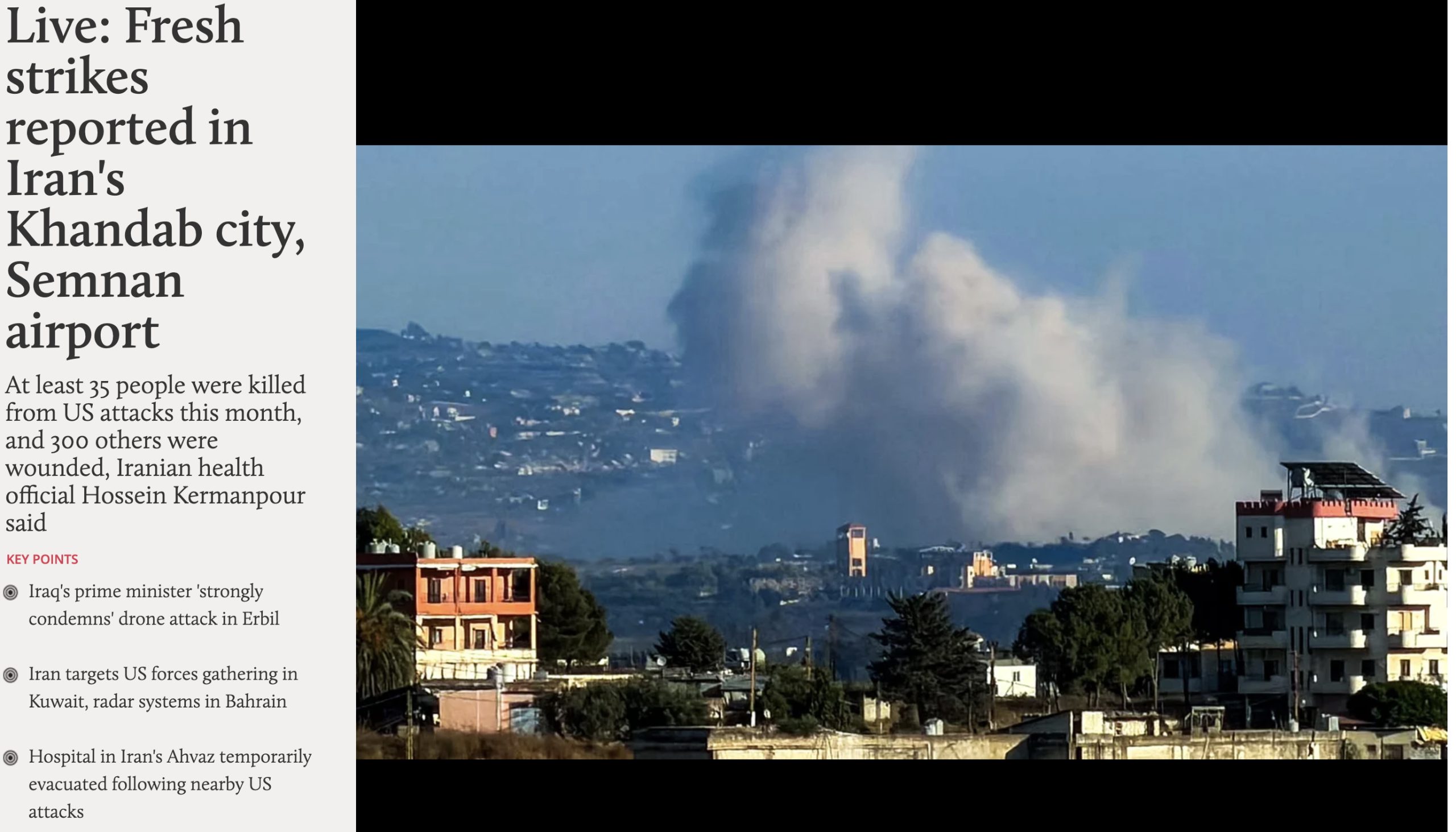
Relevant entries:
Iran warns all infrastructure in the region would be ‘crushed’ if US continues attacks
Tehran warned that it would target regional infrastructure if the US carried out threats to strike Iranian sites.
The spokesman for Iran’s top joint military command, Ebrahim Zolfaghari, said that if the US followed through on its threats, “all infrastructure in the region” would be “crushed under the steel blows” of Iran’s armed forces.
Iran targets US forces gathering in Kuwait, radar systems in Bahrain3
The Islamic Revolutionary Guard Corps announced targeting a C-RAM early warning radar system at the Ali al-Salem base in Kuwait as well as a gathering of “criminal soldiers of the US terrorist army”.
Another attack targeted communication and radar systems in Bahrain’s Sheikh Isa Air base.
The latest salvo is part of Iran’s tenth phase of Operation Lightning, the statement indicated, adding that Tehran “stands firm and steadfast against the enemy, merciful to one another”.
A slightly older update:
Centcom says it ended latest strikes against Iran, as Tehran targets US facilities
The US Central Command (Centcom) said that it completed its latest wave of strikes against Iran, saying it struck command centres, air defence sites, missile and drone capabilities as well as coastal surveillance facilities.
Meanwhile, Iran’s military said its newest attacks targeted the US al-Azraq Air Base in Jordan and US military assets at the Ali al-Salem Air Base in Kuwait.
From Aljazeera’s live feed:

Iran’s military warns “all infrastructure in the region will be crushed under steel blows” if the United States carries out its threat to attack Iran’s civilian sites.
The US military says it launched another wave of strikes on Iran with Iranian media reporting explosions on Qeshm Island, Bandar Abbas and Chabahar.
On the US war crime of the day:
U.S. had 4 Waves of Strikes Near the Hospital in Ahvaz
“There are patients here, sick patients, cancer patients, and special patients who are all in a very distressing situation, meaning they’re bedridden.”
Heartbreaking to see. pic.twitter.com/rTowwiyoZh
— Ryan Rozbiani (@RyanRozbiani) July 15, 2026
Iran’s Minister of Health CONFIRMS the Baqai Cancer Hospital in Ahvaz was ATTACKED by Missiles pic.twitter.com/YVqUCmOK7I
— Ryan Rozbiani (@RyanRozbiani) July 15, 2026
And fresh kinetic updates
IRGC: The F-18 fighter jet maintenance ramp and the new US command and control center in West Asia, located at Al-Azraq, Jordan, were targeted by Kheibar Shekan ballistic missiles.
— IRNA News Agency ☫ (@IrnaEnglish) July 16, 2026
💢 Iran launched fresh missile and drone attacks on U.S. military sites in Kuwait, Bahrain and Jordan early Thursday, hours after another round of American strikes on Iran, escalating a cycle of retaliation that is straining efforts to end the war, Al Jazeera reported.
Here is… https://t.co/qmCcgeAoHs pic.twitter.com/l2jeJNq6IR
— Drop Site (@DropSiteNews) July 16, 2026
As we said, two can play at the “sabotage negotiations” game. An entirely credible, albeit single-sourced report at DropSite, Iran claim that Witkoff and Kushner were more interested in grifting than negotiating. As much as this revelation is intended to embarrass this shameless Administration, it can also set up a new escalation in demands that would impede any resumption in talks: that the loathed and incompetent Zionist duo be excluded.
Keep in mind that the more reality-based faction in Iran, sometimes called hardliners, are well aware that the US is fundamentally untrustworthy. An old saying in commercial negotiations is that an agreement is only as good as the parties that sign it. Intractable US dishonesty means that any “deal” is meaningless. So the hardliners regard even talking to the US as not just pointless but an insult to the great Iranian nation: it exposes negotiators to assassination risk, forces them to listen to US blather and posturing, and is generally a waste of good brain cells.
Nevertheless, Iran is under pressure to try to settle the conflict, despite the obvious, Marianas-trench level gap between the position of the two parties. In a video of a new talk between Daniel Davis and Douglas Macgregor, Davis mentions in passing that the negotiators (here one assumes Pakistan and perhaps Qatar) are calling Trump, and one assumes also the Iranians, every other day to try to reboot the discussions. China also ritually hand-wrings every time the conflict heats up, piously calling for a peaceful resolution.
Now to the juicy DropSite find:
Iran told mediators that they estimated Kushner and Witkoff had made some $9B in market-manipulation profits and that Iran should get half https://t.co/fcDeybSVPN
— Ryan Grim (@ryangrim) July 15, 2026
So making the “you need to get rid of Witkoff and Kushner or else cut us in” would put the US on tilt. Who is Iran to tell the almighty US is a fit negotiator? But if this story goes viral in Iran (likely), it would become politically even more untenable for Iran to resume negotiations unless there was serious change on the US end (what that would need to amount to is over my pay grade).
Some may wonder whether this leak was completely unauthorized, approved on a wink-and-nod basis by some negotiation hostile insiders, or could even be an official ploy. On Twitter, we’ve seen some criticism of chief Iran negotiator Ghalibaf for now seeming less….fierce…than he did before he became the head interlocutor. It’s human nature to try to succeed if you are assigned an important role, even when it is Mission Impossible. Some have pointed to a fresh tweet by Ghalibaf as an intent to nudge the Iran side back to the table.
But this looks like cherry-picking Ghalibaf. This fresh remark is hardly pacific:
Iranian Parliament Speaker Ghalibaf says a memorandum of understanding is only meaningful if its clauses are valid and implemented, warning Iran has no reason to adhere to such understanding if it does not benefit. He added Iran’s armed forces retain full freedom of action to…
— Middle East Observer (@ME_Observer_) July 15, 2026
And a longer-form recap from Ryan Rozbiani on Twitter:
SUMMARY of Ghalibaf’s SEVEN Statements to The Iranian People
Dr. Ghalibaf: America Has NEVER Accepted a Strong Iran
• The Supreme Leader ALONE decides whether Iran fights, negotiates, or does both, based on national interest
• The U.S. still seeks to weaken and fragment Iran, and that goal has NOT changed
• Iran’s resistance in the 40-day war forced the U.S. to seek a ceasefire after failing
• The people of southern Iran are on the FRONT LINES, and Ghalibaf pledged Iran will give a “DEFINITIVE response” to U.S. attacks.
• The moment the memorandum of understanding stops serving Iran, there is NO reason to keep it
• The Strait of Hormuz stays under Iranian control, and the U.S. will not dismantle what Iran built there
• Separating military power from diplomacy is a STRATEGIC mistake, both defend Iran’s interests
• Iran’s armed forces have FULL freedom of action and will avenge fallen commanders
• Iran stays READY for war at all times, even while pursuing talks
• No U.S. president has EVER tolerated a powerful Iran
He closed by warning Iranians not to fall for information campaigns built to spread fear and division.
On the oil front, we cited HFI Research before on the fact that Iran strikes in the Fujairah port environs had shut down shipping. Fujairah represents roughly 1.7 million barrels of supply a day, as in a meaningful amount. It was soon reported as open again. Iran has apparently cleared its throat that that condition may not continue:
BREAKING: A source close to Iran’s Ghalibaf says the IRGC attacked and hit the UAE Fujairah Port with a missile, leading to a halt in all operations.
This comes after Iran warned this morning that the UAE Fujairah pipeline and Saudi East-West pipeline would be closed in…
— The Hormuz Letter (@HormuzLetter) July 15, 2026
Some closing tidbits:
🏥 MEDEVAC — Three evacs, five days, zero official casualties.
📌 LOOK CLOSER: Three C-17 medevac flights in five days, Saudi pickups routing to Ramstein — the standard combat-wounded pipeline. CENTCOM says zero casualties. Statistically, three unrelated non-combat incidents… pic.twitter.com/4AJphN0Z77
— perceptiondaily (@perceptiondaily) July 15, 2026
BREAKING:
Large-scale Iranian strikes target Kurdish separatist positions in Iraq and the U.S. base at Erbil International Airport.
— Iran News 24 (@IRanMediaco) July 15, 2026
Iranian TV reports severe damage to American equipment and personnel from recent operations, with explosions heard near a US military base in Kuwait; full details to be announced despite media blackout, the network says. (Al Mayadeen Breaking, citing Iranian TV)
— Middle East Observer (@ME_Observer_) July 15, 2026
___
1 Keep in mind that bridges are very hard to destroy. The one that the US did successfully damage was vulnerable by virtue of not having been completed.
2 Critics on the original post questioned Newberry’s posture of inevitability. As one wrote:
We do not need to wait for WTI to go negative. If we start seeing vessel queues, berthing delays,and VLCC reverse-lightering bottlenecks at Corpus Christi or Sabine Pass, that is the physical precursor to a Cushing inversion. It will show up on satellite AIS data two to three weeks before the price signal.
Nevertheless, the mechanics of how a diesel shortage progresses seem germane. From Newberry:
The strategic planning emerging from the US Treasury and Energy departments relies on the assumption that North America can isolate itself from this global seizure. This calculus rests on two perceived safety valves.
The first is the pivot towards Venezuelan Merey 16. By capturing this heavy sour crude through overseen accounts (GL 46A/48), US planners believe they can maintain Gulf Coast middle-distillate yields while the rest of the world burns. This is a profound geopolitical miscalculation. It ignores the ‘Social Entropy’ of the Venezuelan state; the Venezuelan people and militias, who have endured a decade of sanctions, are unlikely to passively allow their national exergy to be siphoned off to subsidise an American lifestyle while their own region fractures.
The second is a reliance on Canadian Synthetic Crude (SCO). However, this ‘upgraded’ product is extremely natural gas intensive, requiring hydrogen derived from the domestic market. While the US imports relatively little Middle Eastern crude, it remains critically dependent on ~300,000 barrels per day of finished diesel imports—concentrated in the Northeast where refining capacity no longer exists. When global refining seizes, those imports stop. Regions that voted to ‘drill baby drill’ will soon discover that producing light oil in Texas does nothing to heat a home in New England.
Readers are encouraged to opine if this scenario might still come into play.
3 One wonders what these forces were up to. Perhaps little green men to help our clever plot to have the Kurds mix things up?
From Davis in a lightly cleaned-up machine transcript:
From all accounts from some folks that we’ve talked to in the Administration, that issue at Isfahan (the “rescue” where the US lost more air assets in an operation since the Vietnam War_ just spooked Trump and and confirmed to him that it’s a bad idea to do anything on the ground. So, probably even Kargh Island is not going to happen.