
When I was a junior at a high school in the suburbs of Los Angeles in late 1978, rather uncharacteristically, I took a big risk. The teacher of my American Government class, Mr. Knapp, gave us an assignment to write a serious paper about government economic policy. Instead of doing that, I decided to submit a paper with a satirical theme, estimating what it would cost to become Santa Claus. Not only was I not following instructions, I had no idea how Mr. Knapp would react to my brand of humor.
As you read the transcription of my paper below, bear in mind that I wrote it a few years before I learned anything about libertarianism or about Austrian economics. Still, I was under the influence of the libertarian zeitgeist prevailing in California at the time. With inflation raging out of control while traditional statist authority figures in both major parties were lamely touting yet more business-as-usual interventions and tax increases, Californians had had enough by then. In November of 1978, they revolted against property taxes (led by the legendary anti-tax gadfly Howard Jarvis, passing the Proposition 13 voter initiative to amend the state constitution) and even gave a libertarian candidate for governor 5.5 percent of the vote. Reading this work of mine, I’m sure you’ll agree that there was a definite proto-Austro-libertarian influence at work.
Keep in mind too that the purchasing power of the dollar in 1978 was at least a factor of ten times greater than it is today, and, of course, the American population has increased a great deal too, so you might find my cost estimates absurdly low. They weren’t low at the time, however. Also be mindful that there was neither an internet nor privacy-unfriendly smart phone service, and personal computers had only just been introduced into the marketplace (in fact, my part-time retail job responsibilities at Radio Shack the previous summer included sales of the primitive TRS-80 computer), so you’ll have to pardon the technological backwardness of my cost analysis in the information category—that part of Santa’s job could probably be done much more cheaply these days.
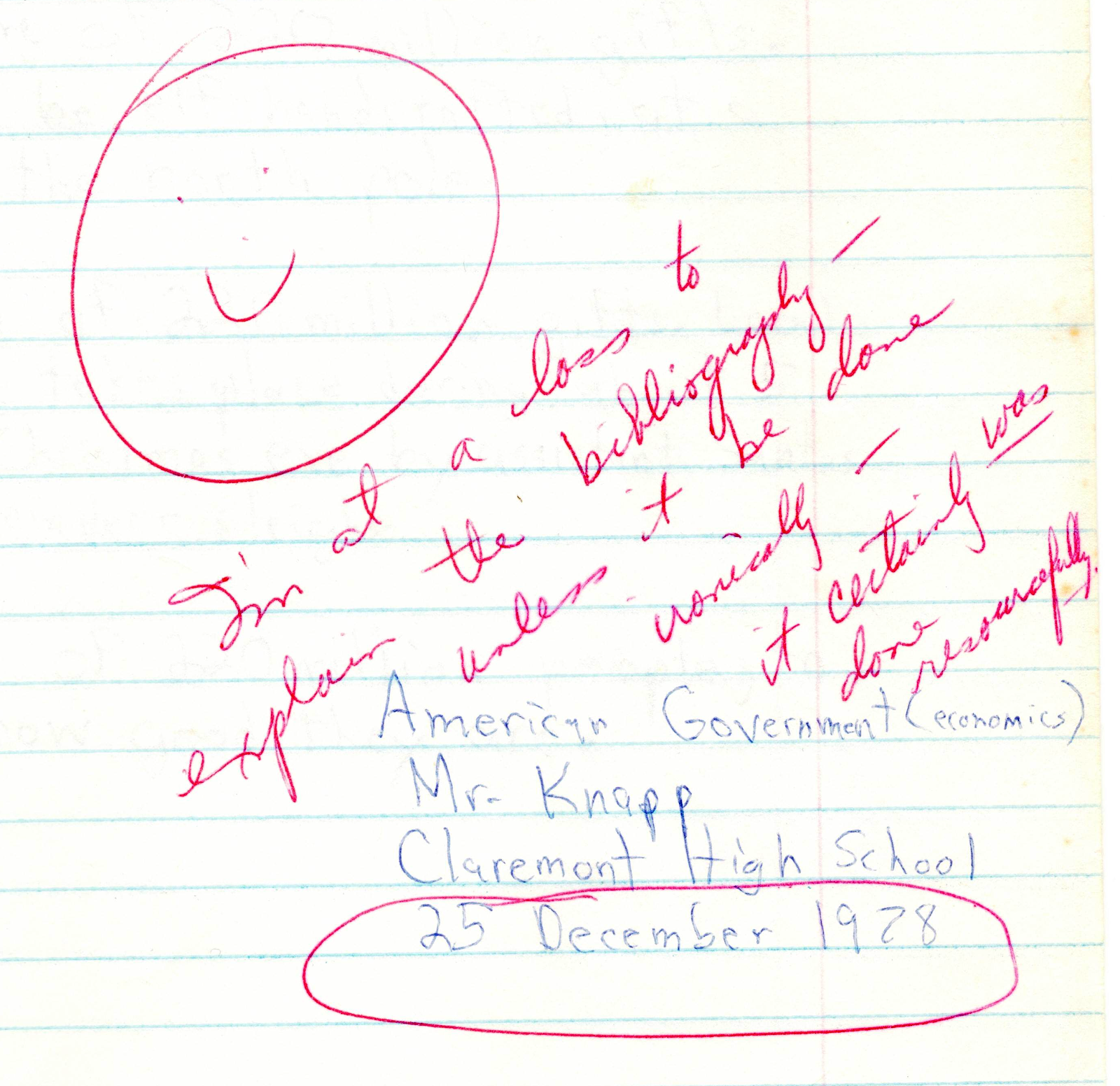
I have added screenshots of my paper showing a couple of Mr. Knapp’s comments. I’m taking another big risk to spring my youthful joke on you nearly five decades later, hoping that you’ll enjoy it as much as Mr. Knapp did back then—Merry Christmas!
Economics of Santa Claus
How often have you heard that there is no Santa Claus? If you check your history books, there was a real St. Nicholas who gave gifts to children, and he was given the Santa Claus title. Suppose someone wanted to claim this title now. How much would it cost? (I will restrict this Santa to the United States.)
To examine this profound question, I will break down the cost analysis into the three major categories which Santa is expected to fulfill.
1) Manufacture of 220 million gifts. These must be elf-handcrafted, at a factory at the North Pole.
2) Distribution of 220 million gifts. Local distribution takes place during about 5 hours on Christmas Eve by assistant Santa’s with 12 reindeer sleighs.
3) Monitoring of 220 million people, to determine how good they are.
For the first category, I will assume that an elf is a special sub-culture of human beings. An elf should be able to turn out one hand-crafted gift a day. Since working conditions at the pole are very difficult, Santa will be expected to provide room and board, plus a salary of $200 per day. 220 million gifts then would require 220 million elf-days of labor at $200 per elf-day, at a total cost of $44 billion. Assuming continuous use of facilities, a city would be needed to house 600,000 elves. At the North Pole, this would be very expensive, say $1,000 per elf per day. This would bring the cost of facilities to $219 billion per year. Assuming the materials for each gift cost an average of $30, including transport to the pole, then the materials cost would be roughly $7 billion. Finally, we have the cost of the factories themselves; which, given the transient nature of the arctic ice cap, might cost $60 billion per year.
We see that arctic manufacturing is very expensive, I estimate the sub-total for this category to be $330 billion each year.
The second category is distribution. This can be further divided into primary distribution (from North Pole to local distribution centers) and Christmas Eve local distribution (from local centers by sleigh to living rooms of families).
For the primary distribution, airlifting goods from the North Pole to the Canadian railroad network would be needed. This would probably cost about $10 billion. Further distribution and storage would also cost about $10 billion.
For Christmas Eve, assuming a sleigh crew of 3 men could handle 20 households, a fleet of 3 million sleighs, 36 million reindeer, and 90 million man-hours of labor would be needed. Assuming $500 a year for maintenance, the sleigh fleet would need $1.5 billion, plus another $0.5 billion for storage. Each reindeer would probably cost $1000 a year, for a total of $36 billion. 90 million man-hours, at $10 per man-hour, would cost about $1 billion. An additional $1 billion would be needed to cover the cost of legal expenses involved for employees caught trespassing while delivering gifts.
The sub-total for this category is about $60 billion.
The third category of Santa’s activities is in checking up on people to see who is good and who isn’t, to determine who deserves the best gifts. The best method would be to hire a detective to monitor listening equipment at homes, workplaces, and schools. A single Santa detective could probably monitor 20 people, and write in-depth evaluations of them. For the United States, this would require 11 million detectives, plus a communications network, information storage and processing at the north pole, and equipment for the detectives. Since a full-time detective probably would cost $20,000 per year, total labor cost would be about $220 billion per year. Information evaluation, storage, and communications might cost $30 billion for 220 million reports. New equipment costs (such as “bugs,” mini microphones, transmitters, tape recorders, etc.) might run about $2 billion a year.
Sub-total for this category might be about $252 billion per year.
Adding up the three subtotals, we get a grand total for being a Santa Claus as $642 billion per year. This is even more than the federal government spends, which shows how impractical it is to become a Santa Claus.
Still, there might be some potential income for Santa. Huge sums of money could be extorted from people by the bad information that Santa’s detectives get. Santa might also get to claim his 600,000 elves as dependents on his tax forms. His detectives could claim to be unemployed, and thus collect welfare and unemployment checks from the government. Santa could incorporate and collect royalties on the use of his image from corporations. Best of all, Santa’s free gifts might drive corporations into bankruptcy, and he could take over all economic activity in the United States, with all of its potential for profit. Santa could then proceed to take over the economies of many extremely rich nations, like Saudi Arabia and Iran, and thus assure himself of enough money to run his operations.
Figure 1: Important Question Posed by Mr. Knapp
Source: Vincent Cook
Figure 2: Mr. Knapp’s Overall Comment
Source: Vincent Cook















-1024x683.jpg "Ending the Iran War to Stop an ‘Economic Catastrophe’")