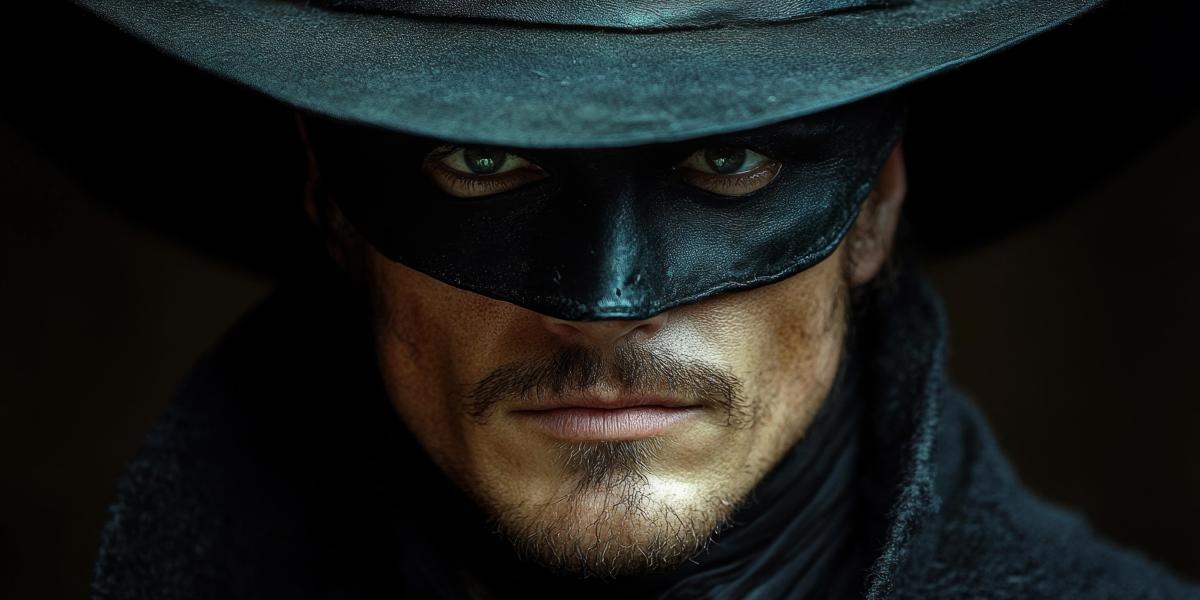
The Mark of Zorro (1940)—directed by Rouben Mamoulian and starring Tyrone Power, Basil Rathbone, and Linda Darnell—stands as one of Hollywood’s most enduring classics. The film truly shines, with its charismatic cast, sharp dialogue, beautiful cinematography, blending romance and witty one-liners with cinema’s best sword fight.
Set in colonial Spanish Los Angeles around 1820, the movie takes viewers back to a conservative and traditional society, very different from LA today. Yet, like the original novel from 1919, it explores timeless themes: identity and deception, the inspiring force of heroism, the tension between individual will and societal expectations, and—to top it off—justice and political struggle. One reviewer put it well: “The Mark of Zorro emphasizes the significance of fighting against injustice and standing up for what is right, even if it means taking risks and going against societal norms.”
These social and political messages make the film highly relevant today. Strong critiques of fiscal pressure, ruling minority corruption, and government overreach, all echo the situation in current so-called “democracies.” These messages are vividly delivered in dialogue, especially between Zorro (aka Don Diego Vega), his friend, friar Felipe, and his father.
Unbearable Fiscal Pressure and Revolt Against the State
Friar Felipe provides—in his characteristically colorful way—the social and economic context into which Don Diego Vega arrives back to California from Spain: “I tell you, these conditions are beyond bearing. This whole district, from the hills of Verdugo to the shores of Del Rey, is a stench in the nostrils of heaven.”
Several scenes show raw depictions of taxation as examples of economic coercion by the state. In one exchange with a tax collector, Don Diego exposes the implicit violence always lurking behind mandatory tribute, and the punishment that awaits all those who try to resist:
“We are collecting taxes from the peons today.”
“And you use that little ‘switch’ on the taxpayer?”
“Only when they’re stubborn!”
“When you come to collect my taxes, Sergeant, I won’t be stubborn, I promise you.”
The state is here exposed in its most primitive and useless form, as “nothing more nor less than a bandit gang writ large,” as Rothbard wrote in The Ethics of Liberty (1982). Not surprisingly, public opinion turns against the oppressive and unjust rulers. In fact, the very first person whom Don Diego encounters upon arrival tells him:
“People cannot sing with hatred in their hearts, Señor.”
“Hatred for whom?”
“The Alcalde [mayor], may his soul burn in hell.”
Zorro’s revolt is thus clearly a revolt against state oppression, in defense of popular sovereignty. He directly challenges centralized political power, expressing a republican ethos that is far more threatened in the United States today than in either 1820 or 1940. His action should not be seen as simply a regressive transfer of funds back to the people, but a necessary and desperate attempt to correct systemic abuse by the state. Don Diego tells friar Felipe, after having raided some of the rulers’ ill-gotten tax revenues: “This gold was wrung from the peons. It’s up to us to restore it to them.” Zorro thus becomes a symbol of both political and economic justice in the face of predation by the ruling class.
Coercion, Corruption, and the Ruling Class
The movie also portrays how this economic coercion of the people is intimately linked to state corruption, in the secret understanding that exists between the two corrupt officials, Mayor Luis Quintero and Captain Esteban Pasquale, his depraved military aide:
“I can’t afford to lose you, my dear Luis.”
“No, you can’t. Your pickings end if anything happens to me.”
The captain tries to frame their immoral actions as a positive social nudge:
Conditions have changed since you left, Don Diego. Your father… resigned. Age, you know. Since then, the peons have become more, uh…more industrious. As to the caballeros, they’re encouraged to think of their own affairs. We take care of the government.
But Don Diego immediately detects this outrageous lie that heavy taxation supposedly increases production; as Rothbard wrote in the Anatomy of the State (1974):
The “political means” siphons production off to a parasitic and destructive individual or group; and this siphoning not only subtracts from the number producing, but also lowers the producer’s incentive to produce beyond his own subsistence. In the long run, the robber destroys his own subsistence by dwindling or eliminating the source of his own supply.
This scene also chillingly illustrates how those who could represent a challenge to state power are subtly warned not to get involved. This is an important reminder that revolutions never happen without the leadership of a disgruntled segment of the ruling minority. Significant political change requires Pareto’s Circulation of Elites. No successful change of political system can take place by the ruled majority alone; it must be organized and led by dissatisfied or power-hungry challengers belonging to the ruling minority.
The Law and the Limits of Obedience
Another of the movie’s key political conversations is when father and son discuss the moral dilemma of rebelling against a corrupt government. Don Diego’s father begins:
The friar urges me to lead the caballeros in a revolt which would surely fail against a garrison of trained soldiers. Even if I thought it would succeed, I’d refuse.
But why, Father?
Because the law is the law, my son. I won’t rebel against a government I served for 30 years.
But that government is now vile and corrupt.
I know, but two wrongs don’t make a right, and never will.
This dialogue captures the enduring tension between loyalty to an existing order and the moral necessity of disobedience when the law becomes an instrument of oppression. The disagreement between father and son stems from the fact that they implicitly have two radically different views of the Law: “ius quia iussum” (law as imposed) for the father and “ius quia iustum” (law as just) for Don Diego. The latter is rooted in natural law theory (i.e., law as legal defense of the right to property), while the former is legal positivism (i.e., law as generally accepted at a given time and place).
A Film for Today’s Youth
In its political wisdom and social wit, in a setting of action and romance, The Mark of Zorro gives essential political advice: that corruption, injustice, and tyranny from the state are perpetual dangers, and that the struggle for freedom is never fully resolved. The film’s political commentary remains strikingly pertinent today, reminding viewers that civil courage, moral integrity, and political resistance are important virtues in any society. Indeed, Ludwig von Mises fully adopted this attitude and encouraged as many as possible to be Zorros each in his own way, fighting state coercion in all its forms:
Everyone carries a part of society on his shoulders; no one is relieved of his share of responsibility by others. And no one can find a safe way out for himself if society is sweeping toward destruction. Therefore, everyone, in his own interests, must thrust himself vigorously into the intellectual battle. None can stand aside with unconcern; the interest of everyone hangs on the result. Whether he chooses or not, every man is drawn into the great historical struggle, the decisive battle into which our epoch has plunged us.
The Mark of Zorro is therefore a highly entertaining movie, but also an excellent introduction to such an attitude of “political concern for society.” The ideas of freedom and libertarianism would clearly have been congenial to the masked vigilante.